
Sally Magnusson is the daughter of celebrated journalist, Mamie Baird, and broadcaster Magnus Magnusson. Her account of her mother's dementia, Where Memories Go: Why Dementia Changes Everything by Scottish Broadcaster Sally Magnuson, is this week's Book of the Week
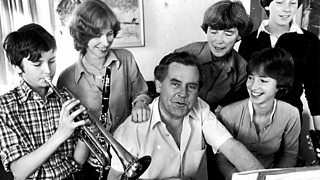
Sally Magnusson, mother Mamie, father Magnus and her sisters and brothers
In the prologue to your book you quote Irina in Chekhov’s The Three Sisters: ‘All this must be written down’. What prompted you to write down the story of your mother’s dementia?
I did agonise over publishing such a personal story. But through speaking to other people struggling to balance a great love with the overwhelming demands of looking after a person with dementia I thought then that our story matters. Not because it is ours, but because it could be anybody’s.
Writing and talking about our experiences is the best way to undermine the stigma surrounding this condition and to enable it to be seen as the greatest social, medical and ethical challenge of our times.
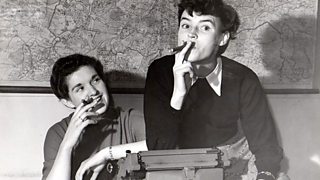
Mamie Baird and a friend fool around in the newsroom
What did you know about dementia before your mother’s illness?
I thought that people with dementia were largely “out of it” - happy, perhaps, with not knowing what was going on. My mother changed all that. She knew her mind was going and it was an agony for her. She was so hugely frustrated by losing her independence and ability to make decisions for herself.
You mention the tell-tale signs that you failed to notice, or perhaps to acknowledge. Why do you think it took your family so long to accept that something was wrong with your mother?
Everyone slows down, don’t they? Even a seventy-something as blithe of heart as my mother. In older age the world contracts, doesn’t it? That’s what we initially thought.
While never referring directly to what were clearly the symptoms of early dementia, my father did find a word for how my mother seemed at these times. ‘Distraite,’ he called it. It is from the Latin distrahere, to pull apart.
We didn’t talk about it very much at first, mainly, I think, because we wanted to keep everything normal for as long as possible. It felt to us at the time like a slippage of moorings. If we didn’t acknowledge it, even to ourselves, maybe we could pretend it wasn’t happening. Experts now urge early diagnosis.
Your mother’s dementia was advancing when your father died of cancer. How did this affect her ability to grieve?
Grief owes so much of its traumatic force to memory. As the American physicist Austin O’Malley has said, ‘It is yesterday that makes tomorrow sad.’
My mother mourned my father’s loss with a sadness which was at times acute but more often – so it appeared from outside – muffled and distant. Her yesterdays were going, and with them a clear sense of the husband who was no longer there.
I often wondered how much she was aware herself of this blunting of the sharper edges of bereavement. She gave me the answer one day after she became upset over misplacing her hat, the pink woollen one he had bought for her. With an insight that rocked me on my heels she said, ‘I made more of losing your father’s hat there than I did of losing him, didn’t I?’
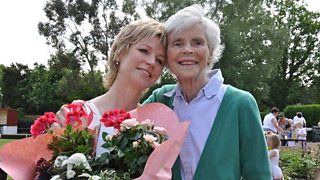
Sally and Mamie
What has caring for your mother during her illness taught you?
People with dementia do not turn into “unrecognisable shells” unless we do that to them. The problem with dementia is not that these people forget – but that we forget them. As a society we too often give up on them. They become invisible. We are in danger sometimes of thinking about them as somehow less than alive. That’s one of the reasons behind the many well documented scandals in the institutional care of people with dementia.
I learned that there are things we can do to help people with dementia retain hold of their identity – not through pills but by continuing human contact and interaction. My mother was brought back to herself again and again when we sang with her. It’s why I’ve now started a charity, Playlist for Life, to encourage everyone with dementia to be given access to the musical playlist of their lives on a digital device. The effect really is like a miracle.
You and your sisters managed, with paid help, to care for your mother at home until the end. Why was this so important to you?
We simply wanted to keep our mother with us, in the surroundings that were most familiar, as long as we could. It’s not always possible for people to do this, much though they might want to. We managed it mainly because there were three of us to share the care.
Your experience of dementia care in hospital wasn’t positive, but you are careful not to blame the hospital staff. How could this be improved?
It’s widely recognised now that all hospital staff need to be trained in dementia care; they need to understand what dementia is like, what the signs mean, and how to find out what a person might really be trying to express by looking agitated or banging on a table. When this kind of care is done well, patients are happier and they are likely to have fewer falls and fewer episodes of delirium.

Mamie and her daughters
You end the book by saying ‘I am beginning to conclude that dementia holds a dagger to the heart of Western morality’. What do you mean by this?
Dementia confronts us with profound philosophical questions about what it means to be human. The ultimate guarantee of civilisation for any society in any century is that every mind, every person, is regarded as equally precious. In our century this involves not just eloquent declarations of principle but a communal recognition that whatever is done for the weakest today is also done for the strong and whole of mind whose decline into invisibility lies in the future.
A nation discovers its truest dignity when it cherishes the dignity of those from whom it has not heard for a very long time.
- Look at more photos from Mamie Baird Magnussun's Photograph Album
- More from Book of the Week
The BBC is not responsible for the content of external websites
