
'I always imagined that to bring an orchestra to play together is not enough for a conductor.' Kurt Masur
At the start of this week Rob started a little debate on Essential Classics about conductors and how integral, or not, they were to great performances. We’ve been enjoying reading many of your thoughts this week, and whilst some have made it onto the airwaves, we’ve received many more fascinating emails, texts and tweets that we thought would be interesting to share here. And if you'd like to add some further comments about your own experiences with conductors, either as performers or listeners, please do. We'd really enjoy reading them.
If you’d like to join in the debate, feel free to post a comment, or you can get in touch via email or Twitter:
Email: essentialclassics@bbc.co.uk
Twitter: #essentialclassics
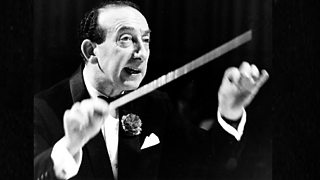
Stanley Black
Roger Pritchard, Reading
Rob,
I remember seeing Andre Previn on a TV documentary about music with the LSO many years ago. He was asked the question, why is a conductor necessary? Previn struck up the orchestra and started playing something and then stopped conducting.
He then started talking to the presenter and said, there, see what happens when I stop conducting, it all goes wrong. However, the joke was that the orchestra continued to play seemingly without fault.
Richard Linsell
Dear Rob
I am certain they make a difference! At times it can be great. We were lucky to be at the Royal Ballet on the night of the late Queen Mother's 100th birthday.The Kirov ballet were performing. It was announced in the press that Valery Gergiev was flying in from Salzburg to conduct the scenic half ballet, Scheherazade.The orchestra was completely transformed from that we heard play Stravinsky in the first half.The intensity and virtuosity were realised by Gergiev's musicianship and leadership.
Philip Blow, Barnes, Southwest London
Dear Rob
I agree with you that a conductor is probably necessary in larger works, if only to hold the thing together, although there have been attempts to do without them - the Symphony of the Air, formed from the NBC Symphony after Toscanini's death, for example - but they are the exception rather than the rule, I feel. But smaller ensembles, such as the Orpheus Chamber Orchestra, seem to manage quite well without them. Reminds me of the scene in a film whose name escapes me, where one musician asks another who was conducting the concert in which he had played the previous evening. 'Don't know', he replied, 'I didn't look!'
Mary Wortley, Andover
Hi Rob, I think conductors are necessary, having in the past listened and watched great conductors talk about how they work and seen how they get results from their orchestras. It is easy to say why bother with them but when you realise how a performance is coaxed and moulded then you know why they matter. Sir Mark Elder made this evident to me in “Symphony”.
Doug Anderson, Esher, Surrey
Hi Rob,
I once had the opportunity to be in the company of the leader of a well known UK symphony orchestra and asked him if a lot of music was playable without a conductor. He replied with an emphatic "yes", but also implied that large orchestral music might not be quite so easy.
Brooke Harvey
Conductors; necessary? Clearly not; several successful ensembles, up to full orchestral size, have managed without them. Desirable? Often, yes; they can transform the performance of a group. Unnecessary, and undesirable; a gesticulating, windmilling buffoon making gargoyle faces in front of musicians while they are performing. Sir Adrian Boult, writing on conducting, remarked that the time to tell a group what is needed, is in rehearsal; influence cannot be exerted during performance, as the musicians are too busy. The best the conductor can do is to beat time, preferably with a white stick in front of a black jacket. Someone pointed out that the gargoyle faces are never seen amongst the players, who are making the sounds.
I have seen a conductor of amateur and professional groups, said to be good by those who should know, who jumps about like a demented monkey when "conducting", complete with the most disconcerting (!) set of gargoyle faces. In the audience, below his rostrum, we can see only eyelids; most performers cannot bear to look at him. But he is the best player of the recorder I have ever heard, back to the Dolmetsches, without a trace of gargoylism; just an expert player, doing what he's good at.
Douglas Bateman
I attended the prom when Daniel Barenboim conducted the West-Eastern Divan Orchestra in two the Eroica. Actually, he hardly conducted at all, and had it not been for the intimate relationship between orchestra, conductor and presumably the work, a credible performance would have been impossible. What for example, would happen at the end of the first movement exposition? And, if the ensemble had come apart, maestro Barenboim would have had to become proactive.
Christopher Swann
Dear Rob
I don’t think you can get a real idea of what a conductor contributes to music making without spending some time watching them work. And I’ve been lucky enough to do so - filming many of the leading Maestros of their age:
Directing cameras on Bernstein in New York as he turned a rag tag orchestra of the best musicians in the city into a band that rocked for his recording of 'West Side Story’. Without him that recording would have been nothing.
Filming Harnoncourt for two whole weeks as he guided the Chamber Orchestra of Europe through his seminal recording of the complete Beethoven Symphonies.
Listening as Sawallisch talked to the LPO and literally changed the orchestra’s sound into that of 19th century Vienna for his Brahms Symphonies recording.
My favourite moment though was actually watching television when Carlos Kleiber was conducting the New Year Concert from Vienna. At one point he simply lent back dropped his shoulders and arms and let the Vienna Phil get on with it, smiling all the time. He had done the work in rehearsal and well such a good band weren’t going to let him down….now were they?
Evelyn Gottlieb
Hi Rob
I’ve played in early music consorts, in both large and smaller orchestras and believe it’s very helpful to have the guidance of a conductor to e.g. set the tempi of pieces, to bring in players who may have lost their places and to sort out dynamics… timpanists and piccolo players often have little to do so it must be reassuring to have an indication from the conductor in agreement as to when to come in. In early music e.g. that of Byrd, there can be frequent changes of tempo in a piece and it’s good to have the guidance of a conductor to establish the tempi thus avoiding disagreement amongst otherwise harmonious players.
Pat Wellock, Snowdonia - North Wales
Current discussion about Conductors. Question for Rob and to explain on the programme: What is the role of the Conductor? Please go into more detail. Not quick comments from listeners. You tell us, please. A brief rundown of what is involved particularly for many listeners who understand the theory of music, eg. What training is involved? Are intervals taken into account? Or you and the BBC may consider a programme on this particular subject?
Roy Hiscock, London
Dear Rob Cowan
Following one of your earlier replies on this point, if the conductor is like a football manager, does that mean that the leader (or concertmaster) is like a team captain? Yes, yes I know that historically orchestras were usually led (or conducted) from the first violin, but what - if there is a conductor - is the precise point of the leader? And historically - what about Lully? I write as somebody who does not play any instrument and so (obviously) has never played in an orchestra - I consider myself a lifelong amateur listener.
Angus McPherson
Dear Rob,
I think it is a human trait to identify an activity involving a number of people with someone designated as "leader." In music, therefore, the conductor is seen as this leader-someone, rightly or wrongly, who has brought together all the efforts of the individuals making the music. Many conductors clearly deserve this approbation, but as a variety of extraordinarily brilliant ensembles and pianists conducting from the keyboard have shown, they may not be essential for a superb performance.
Rob Dennis
Pity George Szell can’t enter the debate! He would have something to say
@robccowan Re Conductors are needed or not, an attempt to execute Beethoven Symph No5 without conductor lasted for 2 bars and a half.
@robccowan@BBCRadio3 a conductor is like a football manager - makes them play together as a team. Don't know many great sides without one.
Lawrence Thirlaway, Lichfield
Hi Rob
I don't think there can be a theoretical answer: it's a matter of experience. Some time ago, the OAE did a series of concerts showing all nine Beethoven symphonies - four with two in each and one with the ninth at Symphony Hall - each concert had a different conductor. The ninth was conducted by Simon Rattle and I couldn't get tickets. The fifth was conducted by Ivan Fischer and it was like hearing for the first time: I was overwhelmed, excited, joyful. At the end, there was no applause for seconds: the whole audience was too emotional and, when applause broke out, it went on forever. Perhaps as much to the point, the members of the orchestra looked excited - and surprised. I don't know if we need conductors, but I know we need conductors like Ivan Fischer.
Simon Anthony
Hi Rob
As a Prommer - standing behind many conductors over many years has left me in no doubt - conductors are essential. If you can though, avoid the glance of Bernard Haitink if you are not enjoying the performance - or if you have just coughed! It was 30 years ago and still burns within me. His glance when you love the music is just as tremendous!
Ian Anderson
Hi Rob
On the subject of conductors - Elizabeth and I were fortunate to hear Daniel Harding in his 1st year at Cambridge Uni. conducting at West Road (he left C.U. at the end of that year). I have only a moderate ear for music, E. has a better one, but we both said to each other at the end 'he's got a future'. It was a unique experience for me to think 'what superb conducting' - I cannot really explain our reaction except to say that there was, to use a somewhat hackneyed word, a 'synergy' between Daniel & the orchestra. There was somehow not just music in the air, but electricity too - one could feel the orchestra was 'playing its heart out'.
Peter Toye of Reading
A bit late maybe, but any scepticism I had on this subject was completely blown away by an experience at Dartington Summer School a few years ago. Four student conductors were each given an act from La Boheme. The first three all sounded exactly the same, and rather boring. The fourth, as soon as the music started, made the orchestra sound completely different - as thought they were really playing the music instead of going through the notes. Unfortunately I can't remember his name...
@BBCRadio3 Q: Are conductors necessary? Only Answer can be: Some more than others
