Sakari Oramo on the last instalment of his BBC Symphony Orchestra Nielsen cycle

Sakari Oramo
Chief Conductor, BBC Symphony Orchestra
Tagged with:
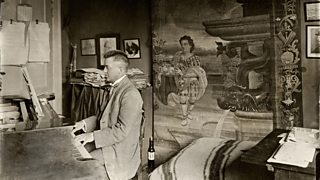
Carl Nielsen at his piano. Photo: The Royal Library, Copenhagen
Most of the BBC Symphony Orchestra’s cycle of Carl Nielsen symphonies is now complete, and I am hugely looking forward to completing this fascinating survey of the great Danish composer’s music mirrored by that of his contemporaries.
This year's other great birthday hero, Jean Sibelius, is an obvious companion, despite the almost diametrically opposed nature of the two composers' musical styles and philosophies. Tapiola (1926) is the Finnish composer's last significant symphonic statement, and here serves the purpose of showing how distant he had become to his Danish counterpart. Tapiola is an incredibly powerful, hypnotic piece of music which, when performed properly, makes a human feel very small indeed at the feet of the great God of the forests of Finnish mythology.
Sergey Rachmaninov is yet another composer who poses interesting possibilities for comparison with Nielsen. The 4th Piano Concerto (1926) is his most intimate, honest and self-revealing piece of music. Composed in a very long timespan of about ten years, it contains both destabilising uncertainty and a similar kind of simplification of musical means that Nielsen and Sibelius also went through in their later composing years.
John Foulds brings a welcome English sidestep to this programme. Categorised as 'a composer of light music’, the English musical establishment almost completely ignored the great skill and power of invention shown in his preserved larger-scale works, although in 2007 the BBC revived his heartfelt memorial to the dead of all nations ‒ A World Requiem ‒ once the centrepiece of the Royal British Legion's original Festivals of Remembrance. Most of Foulds’ scores were destroyed in India where the composer emigrated and later died of cholera. April-England (1926/32) is a reworking of a piano piece for orchestra, quintessentially English and very spring-like indeed, showing the composer's enormous skill in orchestration and harmony.
Finally, Carl Nielsen's Symphony No. 6 (named by the composer as 'semplice' ['simple'] but in fact anything but) is his brilliant final milestone in symphonic art. Consisting of four movements, it looks and feels like a classical work, yet the contents all seem to be upside down. To me this music is incredibly emotional in its stylistic restraint and anti-Romantic feeling. The toy-music in the 'Humoresque', the almost impenetrable seriousness of the 'Proposta Seria' and the unbuttoned anarchy of the final Variations provide a musical merry-go-round without any boundaries. What exactly does Nielsen mean by finishing his towering symphonic output with two bassoons playing alone in their lowest register? 'It all wasn't so serious after all', perhaps?
Sakari Oramo conducts the BBC Symphony Orchestra in Sibelius’s Tapiola, Rachmaninov’s Piano Concerto No.4 in G minor, (soloist: Denis Kozhukin), Foulds’s April-England, and Nielsen’s Symphony No.6 (‘Sinfonia semplice’) at the Barbican Hall on Saturday 23 May at 7.30pm. The concert will be broadcast live on BBC Radio 3.
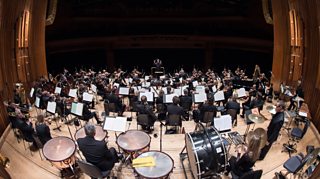
Sakari Oramo conducts the BBC Symphony Orchestra in the Barbican Concert Hall.
