
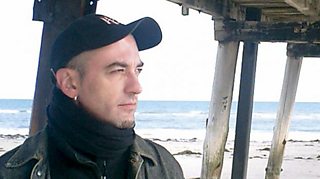
Francisco Lopez
On Saturday 14 March at 10.30pm I shall be presenting Hear and Now, live from Café Oto in Hackney, London. The programme comprises two 4 channel, surround-sound pieces by the Spanish sound artist Francisco Lopez. Radio 3 shall be broadcasting these new works in 4.0 surround-sound, as well as in stereo, and the programme shall be available, in 4 channels, on our website for one month after the transmission.
To hear the broadcast in 4 channels you will need a surround-sound system at home. Plug your laptop into the system and you will be able to hear the performance exactly as the audience are hearing it at Café Oto. For details about how to do this, go to this link. To help you set up your system before the broadcast you can go to this link.
We first broadcast the work of Francisco Lopez in 2003 as part of the initial series of Hear and Now’s Cut & Splice events. His pieces are completely immersive, multi-channel events. The audience are invited to wear blindfolds and listen in complete darkness. At Café Oto on Saturday, special Radio 3 blindfolds will be available.
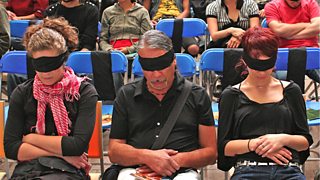
The source sounds of the compositions are recorded in large-scale, complex, sonic environments – rainforests, savannas, cities, etc – and then mixed and crafted into extended duration works. With the sense of sight being severely reduced, or restricted completely, the ears capture more detail. As listeners become more immersed and more focused they might enter what Lopez calls ‘a multiplicity of immersive/dedicated personal listening modes’. Hopefully, those listening with 4 channels will be able to attain this depth of involvement.
Multi-channel listening has been available in the home for some time and Radio 3 is working towards making hi-definition, surround-sound broadcasting a regular occurrence. This is especially important for music composed in the last 50 or 60 years.
In 1954 Karlheinz Stockhausen composed Gruppen for 3 orchestras. In performance the orchestras are located left, centre and right, on stage in the concert hall. The work has a precisely composed spatial structure which includes instrumental sounds moving from orchestra to orchestra. In 1961, the BBC broadcast the UK premiere of the piece in mono! We could not broadcast stereo in the early 1960s so the spatial aspects of the work could not be appreciated by radio listeners. Now, of course, we are able to enjoy Stockhausen’s masterpiece, at home, in all its glory.
At around the time that he was composing Gruppen, Stockhausen was also working on an early electronic work, Gesang der Junglinge. This involves 4 channels of sound projected from speakers located in the corners of the performance space. Stockhausen went on to compose many other works that involved upwards of 4 channels. In an interview I did with him in 1997 he said, ‘The sound in space has become, for me, as important as all the traditional characteristics of the sound.’ Spatial structures became as important as those of pitch, rhythm, harmony, dynamics, etc. Since the 1950s many composers have made works that involve elaborate, multichannel spatial structures but up until recently we have not been able to broadcast them. All that is now changing.
Plug your laptop into your surround-sound system on Saturday night and join me for a total listening experience.
