BBC Symphony Orchestra sub-principal viola Phil Hall reports from Spain
The tour did not begin well ‒ I left home with my wife's car keys in my pocket and no passport. Fortunately I realised these blunders just before boarding the train to Heathrow. The orchestra has been split into two groups for travelling to Alicante and my second group arrives at the hotel at midnight after 2 flights and a G&T stop in Madrid airport in between.
After the cool of London, Alicante is deliciously warm in the balmy night air and we check-in to the luminously-named Eurostars Lucentum hotel, opposite the wonderful central food market. There is time in the morning to climb the ancient Citadel and a quick dip in the crowded Mediterranean after lunch before the general rehearsal.
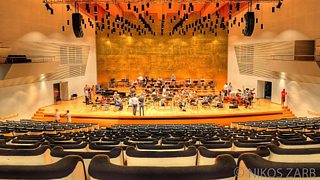
The Auditorio de la Disputacion
This is the first time the BBCSO has played in the new 1200-seater
Auditorio de la Disputación de Alicante. The Hall is only three years old and privately built by a petrol tycoon. The acoustics are bright with a strange echo which makes the noisy
Infernal Dance bounce back at us a quaver later! The concert is sold out and I feel sorry for a disconsolate man outside, queuing for a return ticket ‒ ‘The problem is you are the best...’ ‒ he complains to me in bittersweet tones.
Our soloist for the tour is the Spanish pianist Javier Perianes who plays the Ravel G major concerto quite wonderfully. Unfortunately a mobile phone joins in with the close of his encore, Debussy's Girl with the flaxen hair. This is to become an unwelcome feature of all the concerts unfortunately, despite the public address announcements.
Stravinsky's 1945 suite for The Firebird takes wing and brings the house down and after encores of Khatchaturian's Maskerade Waltz and Grieg's Morning we decamp to the hotel where our wonderful friend and tour promoter Gonzalo Augosto lays on a post-concert reception for the whole orchestra.
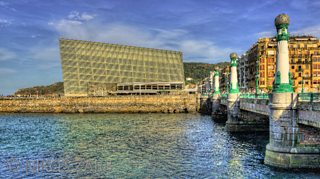
The Kursaal, San Sebastian
Early the next morning we climb aboard a charter flight to Biarritz and then it's a bus back across the border to nearby San Sebastián (or Donostia as it is called in Basque). Happily the good weather has followed us northwards, although my broken air-conditioning means I have the hottest hotel room in Christendom. After lunch by the cathedral we rehearse at the
Kursaal, a fantastic setting, located hard by the Bay of Biscay.
It is quite a loud hall and takes a little bit of getting used to. Our conductor Sakari Oramo runs to the back of the hall to listen while we carry on playing, in order to hear the balance. He comments that the acoustics cause the trumpets to sound as if they are coming from the other side of the stage from where they are sitting! We start the concert with Sibelius's dramatic tone poem En Saga, which gets whipped into a Finnish frenzy. It is always revealing performing any Sibelius with a Finnish conductor and Sakari brings many insights to the score, notably that nobody really knows how fast Sibelius wanted the opening string arpeggios, other than we know he admired Thomas Beecham's 1930s recording of the work. Javier plays an exquisite Grieg piano concerto and we finish with the Stravinsky which
sounds amazing in the hall but is marred only by some expert coughing and another mobile phone ring.
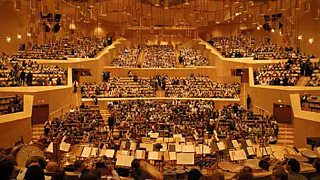
The Auditorio di Zaragoza
Afterwards we do our bit for international relations and try and learn some Basque from the waiter. An ancient Pre-Indo-European language, the best we can do is: ‘Eskerrik asko’, the Basque for 'thank you'. I go for a run to the sea at sunrise before three buses transport us to Zaragoza. Half way there we stop for coffee at an unlikely Wild West saloon cafe by the roadside. Unfortunately one of the drivers manages to reverse into an air-conditioning unit, shattering the rear windscreen. Amazingly a replacement bus arrives in only 20 minutes and we reach Zaragoza just a few minutes behind schedule. The glorious weather continues and it's a joy to return here as the
Auditorio di Zaragoza is arguably the best hall in Spain. All the more remarkable since, as with Alicante, there is no resident orchestra here. Now 20 years old, it is modelled on the Philharmonie in Berlin and has exemplary acoustics. Sakari drives the orchestra hard in rehearsals for Shostakovich 5 and gets great results in the concert with a scarily quiet 3rd movement and a terrific finale.
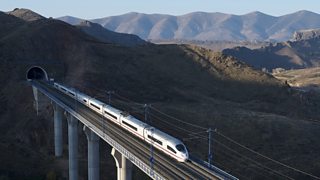
AVE high-speed train near Zaragoza
It's a leisurely 11 o'clock departure to Zaragoza's deliciously named Delicias station for an AVE high speed train to Madrid. It is a VERY fast train indeed as the indicator screen tells me the speed which is 253kph – or 157mph. We arrive at Madrid's Atocha station after one-and-a-half hours, having covered a distance of 195 miles. We have played in the
Auditorio Nacional many times before and it has good acoustics with the added bonus of the audience sitting all around us. Speeches of thanks are given from Sakari and management and everyone agrees it has been a highly successful tour. But Sakari urges us on to greater heights of spontaneity and excitement in the Stravinsky. Strauss's
Don Juan erupts on stage and there is an end-of-tour feel, a spring in our collective step. Javier shows no sign of wear-and-tear either as he launches into the Grieg with gusto. It has been a joy to work with him and observe the good nature between him and Sakari. But it was his warm, poetic playing that will linger in the memory banks. Happily we will perform the Grieg Concerto at the Barbican with him upon our return ‒ Live in Concert on BBC Radio 3, and recorded for CD... mobile phones permitting...