
In September of this year it will be 70 years since the beginning of the Third Programme, the early incarnation of what is now Radio 3. We think this landmark is an occasion to address the future, drawing on some principles of the past, ditching others, and just use it as an excuse for a party for all our listeners.
In Penelope Fitzgerald’s book about the BBC in wartime, Human Voices, a character describes BBC staff as ranging from ‘the intensely respectable to the barely sane’. It fits, too, as a description of the idea of setting up a high culture radio station, remorselessly intellectual, in the rubble of WW2 and in the beginning of a long period of post war austerity ‒ it wasn’t until 1953 that freedom from hunger was declared.
Yet 1946 was a time of optimism and possibility. The welfare state and the NHS were about to replace fear, and to conquer Beveridge’s ‘five giants’: squalor, ignorance, want, idleness, disease. But as well as this, it was a boom time for optimism about, and interest in, the arts. J M Keynes had set up the Arts Council that year to spread interest in culture across the nation. His battle cry, ‘Death to Hollywood’ (i.e. to the Americanisation of culture), found echoes in the BBC. The 1944 Education Act had raised the school leaving age and encouraged adult education: postwar working-class people began to get scholarships to universities. Theatres, concert halls and opera houses had reopened, many were to be built and there was a feeling that culture could become for everyone.
The BBC had taken over the Proms in 1927 after its sponsors pulled out, and it seemed to many that now was the time for a dramatic increase in arts programming. Planning for the Third took place during the war at the same time as the Government was planning an Arts Council.
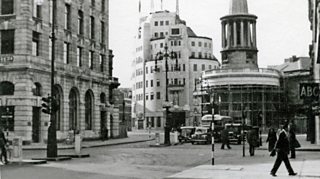
Broadcasting House in 1949
So, despite battles with unhappy unions, a weak signal from Droitwich, a stronger blocking signal from the Soviet Union who claimed the wavelength, resultant reception problems, uncertain budgets and print media sneering, ‘The Third Programme’ came to life at 6pm on 29 September 1946.
The name was chosen purely because it was the only one everyone could agree on. For a short, alarming time, it was destined to be named ‘The Droitwich Programme’ after the transmitter. 'Controller, Droitwich' could have been misinterpreted...
That first night, the network opened with a new comedy – How To Listen – which got in the self-deprecation before the press did. It gently made fun of high-minded, obscure concerts and imagined listeners turning off the wireless to read the racing news or play cards. It was followed by, amongst other things, Bachharpsichord music, a BBC Symphony Orchestra concert of a new work by Benjamin Britten and 25 minutes of Monteverdi madrigals. The Third may have been aware of its image problem but it had no intention of being swayed from its purpose.
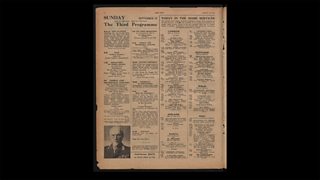
Radio Times for the Third Programme's first day
In September we are going use the excuse of our birthday to draw on the strength of our past and forge a new way forward: one that is confident that its mix of great music and culture is serving the audience that is curious and adventurous, well.
Radio 3 staff have come up with some great ideas for new commissions, mad concepts, all night musical raves, all centred round another pop-up residency at Southbank Centre. We are all driven by one concern – to draw from the spirit of the Third Programme in a contemporary way, better to get audiences engaged and connected with remarkable music and culture.
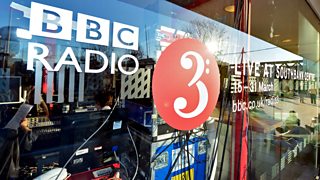
Radio 3's pop-up studio at Southbank Centre
