Radio Blog

Archives for February 2011

Series catch-up for speech-based radio programmes is here

Blog comments are currently unavailable. Find out more.

Post categories:

Andrew CaspariAndrew Caspari|18:13 UK time, Thursday, 24 February 2011

An illustration for Raymond Chandler's Farewell My Lovely on BBC Radio 4.

Ever since 2002, when we started offering listeners the chance to hear radio programmes on demand via the original Radio Player, listeners have consistently asked to be able to catch up on all the episodes of series whilst that series is on air. There is nothing more frustrating, they told us, than getting interested in a serial in the third week and not being able to catch up on the first two parts which disappear after 7 days. In fact we became quite concerned that people might not even start listening to a serial if they felt they would not be able to keep up.

Well, today we have had good news. The BBC Trust has approved plans to introduce 'series catch-up' for radio and we will introduce it over the coming weeks. This means all episodes of a selected range of series will be available on our websites and via the BBC iPlayer until 7 days after the final instalment has gone out. The first series to offer this is the magnificent Classic Chandler on Radio 4.

Series catch-up covers speech-based programmes where we have the rights in place and where there is a clear narrative that progresses from one episode to the next. On Radio 4 look out in particular for future Classic Serial dramas such as Patrick O'Brien's The Mauritius Command and The History of Titus Groan as well as Agatha Christie dramatisations. Some of our big factual series such as The Reith Lectures or The Story of Economics or other long-running history series will benefit too as will comedy serials such as Ed Reardon and Clare in the Community. Series catch-up will be possible for landmark series on all of the BBC's radio networks.

We conducted a trial of this offer last year. One of the projects featured was the Complete Smiley. The results from the audience were very encouraging. 7000 people responded to our survey and the headlines were:

  • 90% of users surveyed claimed they listened to more radio online as a consequence of series catch-up being available.
  • More than half listened to programmes they otherwise wouldn't have listened to.
  • More than half listened to more BBC radio online due to series catch-up.
  • 37% said they had listened to episodes of series they would otherwise have missed without series catch-up.

We are working hard to make it easier for our audiences to hear more of our programmes online and this has been a good couple of weeks. The Series Catch up approval comes hot on the heels of the Radio 3 and Radio 4 service licence reviews in which the BBC Trust encouraged us to increase the amount of archive content we make available on our sites. As an example of this we have just launched a collection of interviews with the authors whose books are being featured on World Book Night on March 5th. There will be much more of this kind of activity and I will update you on our progress in the coming months.

Andrew Caspari is Head of Speech Radio and Classical Music, Interactive at the BBC

The enduring value of live radio

Blog comments are currently unavailable. Find out more.

Post categories:

Tim DavieTim Davie|16:04 UK time, Tuesday, 22 February 2011

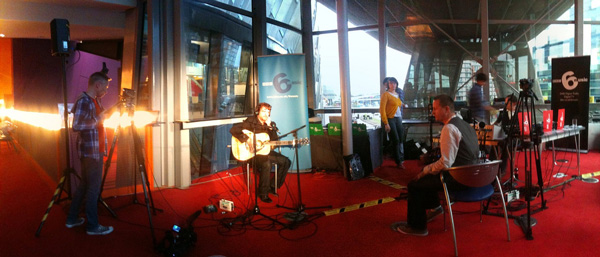
I Am Kloot live on Steve Lamacq on 6 Music

It is rare that passionate radio listeners overwhelmingly and immediately support the scheduling changes that we make to a well-loved BBC radio station. However, having just announced that Radio 3 will broadcast live concerts every weekday at 7.30 p.m. for 46 weeks of the year, the reaction has been almost universally positive. It is welcome news for UK performing groups and listeners who will enjoy an invitation to so many outstanding classical performances. What is perhaps less apparent is that it represents a deliberate move across BBC radio to keep building the percentage of live output that we air on our stations. For some, this approach may well seem counter-cultural as it comes at a time when digital evangelists continue to predict the media will move inexorably to time-shifted, on-demand content. This is true but, paradoxically, this very trend is driving the value of live experience.

Of course, on-demand does offer benefits, such as making available valuable archives like the In Our Time back catalogue, or a chance to catch-up on recent programmes, but surely it is time to declare that the appeal of live radio is not only here to stay but is going to grow. Even beyond radio, live seems to be where the action is. Whether we are watching an X-Factor final, the One Show or attending a concert, live seems to be a common factor in so many recent triumphs in areas that have been consigned by many to a future of inevitable decline. Radio is particularly advantaged by this trend as so much of what makes it successful is the drama and immediacy of live broadcast.

In what some see as a gravity-defying performance, radio listening remains buoyant and in the latest listening figures, it was 5 live that hit new record numbers. The thrill of England keeping the Ashes combined with a busy news agenda provided a steady flow of compelling live stories. Also, over Christmas we deliberately focused on ensuring many of our broadcasts remained live rather than playing pre-recorded programming while the nation indulged itself.

Behind these successes, there may lie a deeper and more enduring need for wider communal experiences. The explosive growth of computers, tablets and smartphones has lead to a huge amount of solo activity with either no interaction, or communication being restricted to a small group of friends. Live broadcast experiences, although not offering the visceral experience of a live event, still offer a chance to be connected to something much bigger than a social network.

You may be listening alone but you know that thousands of people are connected together in one story. This is nothing new. I remember hearing my neighbours screaming with joy when Dennis Taylor sank that black in 1985, or looking into another car as I saw someone as emotionally moved as I was by the story of the collapse of the Berlin Wall on the radio news. For programme makers and presenters, live tends to bring out the very best.

It is interesting that while BBC executives like myself are often thought to be intent on limiting risk and prefer the control of pre-recorded output, the truth tends to be the opposite. This is not to say that the art of pre-built radio in genres such as current affairs and drama is not to be nurtured as a precious skill, but even in these areas, live output can play an exciting and growing part. So while you will see the radio industry ensuring that it is part of the on-demand revolution, we remain champions of the wonders of live. On May 3rd, we begin our Radio 3 broadcasts. As the musicians begin to play, I hope that you will be there, at home, next to them.

Tim Davie is Director of Audio & Music at the BBC

A day in the life of 5 live

Post categories:

Steve BowbrickSteve Bowbrick|14:26 UK time, Monday, 21 February 2011

For the next couple of weeks, over on the 5 live blog, they're going to be taking listeners behind the scenes at the 24-hour station - with blog posts from people in every area of 5 live. Each blogger will write about a day in their life at the station, starting tomorrow morning with Chris Hunter, assistant editor on Breakfast. Imogen Crump, a producer at 5 live Interactive, has kicked the whole thing off with this fascinating time-lapse video of 24 hours in the newsroom. Read the rest of her blog post and leave a comment on the 5 live blog...

Steve Bowbrick, blogs editor

Daily live concerts on BBC Radio 3

Post categories:

Edward BlakemanEdward Blakeman|11:10 UK time, Friday, 18 February 2011

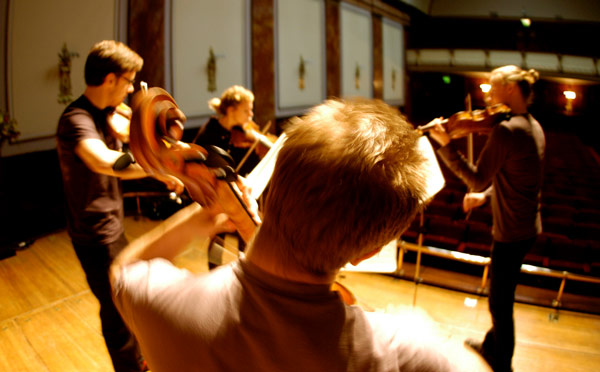
Meta4 Quartet from Finland rehearsing for a live Radio 3 performance on stage at The Wigmore Hall in September 2009.

BBC Radio 3 has just announced that its rich schedule of concerts, operas and recitals will be further enhanced from May 3, 2011 when listeners will be able to hear LIVE broadcasts direct from venues across the UK every weekday evening in Performance on 3. Here, Radio 3 Editor Edward Blakeman offers a look behind the scenes. 

I just love the prospect of live evening concerts on Radio 3! My colleagues and I have thought about it and planned it for months - since the end of last season's Proms in fact, and that was what gave us the idea. There is such a buzz during the Proms - 8 weeks of concerts all broadcast live on Radio 3 - so wouldn't it be great if you could carry that sense of really 'being there' on into the rest of the year? if you could offer Radio 3 listeners a live concert each weekday night - something that had never been done before.

Continue reading this blog post and leave a comment on the BBC Radio 3 blog...

  • The picture shows Finnish quartet Meta4 rehearshing for a live Radio 3 performance at the Wigmore Hall in 2009.

Using Twitter to control a slot-car race - MistaJam vs Scott Mills

Blog comments are currently unavailable. Find out more.

Post categories:

Patrick SinclairPatrick Sinclair|15:02 UK time, Tuesday, 15 February 2011

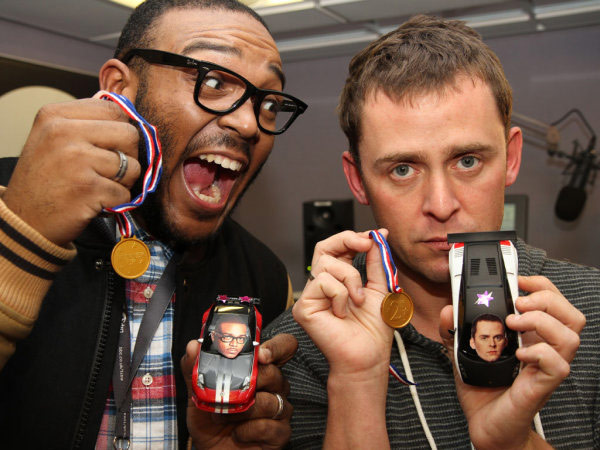
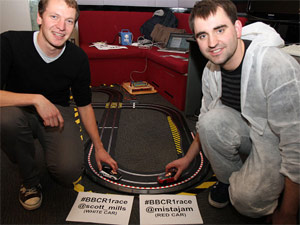
Scott Mills and Mista Jam

Editor's note: engineers in radio used to concern themselves with balancing audio and locating transmission towers but they now have a whole set of rather more pressing concerns - like how to stop slot cars spinning off the track when too many people tweet Scott Mills. Patrick Sinclair - a software engineer in the Radio 1 Interactive team - explains how connecting social networks with physical things (Using the volume of tweets from listeners to control a slot car race, to be specific) makes for good drivetime entertainment - SB.

Behind the scenes, we used:

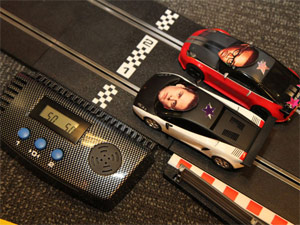
The Scott Mills and Mista Jam slot cars

We built a computer-controlled 'fake controller' that plugged into the track, just like a normal manual controller. Slot car controllers are basically just variable resistors. We varied the resistance by connecting relays across resistive load. As we turned the relays on and off, it enabled and disabled the resistors, varying the speed of the cars. Each of the resistors were potentiometers, which allowed us to calibrate the speed of the cars ahead of the race.

The relay board was connected to a USB interface board, which was then plugged into a laptop. We wrote a custom HTTP-to-USB server to make it easy for the Ruby script to turn the relays on and off.

The hardware allowed for a range of seven speeds: from 'slowest' through to 'fastest' and then 'eleven' where the car would spin off the track and finally 'out of this world' where the car would literally spin off into orbit!

Nick Humfrey and Patrick Sinclair.

We timed how long the car would take to track for each of the speeds so in theory each tweet would make the car go around the track once. Each car would have a queue of outstanding laps based on the number of tweets received, and the size of this queue would affect the speed the car ran at.

Compared to our previous efforts, using SMS messages, Twitter's API was amazing because we could get real-time feedback - within seconds of users tweeting, the car would respond. With the SMS feed, there was a delay of a couple of minutes between a message being sent and us receiving it.

The lessons were:

  • It was incredibly difficult to calibrate the system. There were too many variables - from variations between the cars, how the brushes on the cars were set up and how the resistors performed. It also performed very differently once the cars and resistors had warmed up.
  • It's hard to anticipate the volume of tweets. We received 82 tweets in one second at the start of the race while we were anticipating a few hundred during the course of the race. So we had to tweak how the system was set up a couple of times during the race, causing the cars to stop whilst the system rebooted.

For next time:

  • We'll allow the configuration to be changed without having to restart the system.
  • Be more accurate by measuring when the cars actually cross the finish line as opposed to guessing how long it took the cars to go around the track.

Patrick Sinclair is a software engineer at BBC Radio1

Peter Horrocks' somewhat smaller world

Blog comments are currently unavailable. Find out more.

Post categories:

Roger BoltonRoger Bolton|14:00 UK time, Friday, 4 February 2011

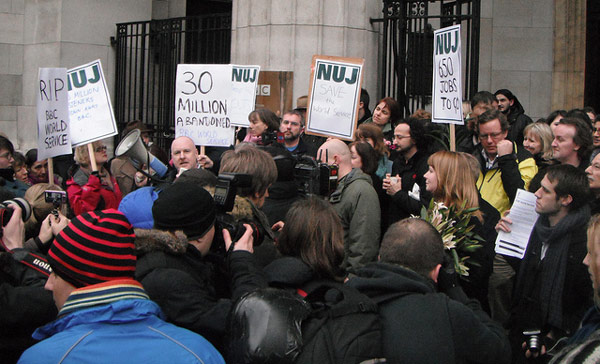
BBC World Service staff outside Bush House.

Spare a thought for the BBC's newish Director of the World Service Peter Horrocks.

No sooner has he sat down in his seat in Bush House than his paymaster, the Foreign Office, announces an unprecedented cut of 20 per cent in its funding.

No sooner has Mr Horrocks announced the inevitable closures and loss of jobs that have resulted, after tortuous negotiations with the Board of Management, the BBC Trust and the Foreign Office, than his chief lieutenant Craig Oliver announces that he is going to work for the Prime Minister whose Government has just inflicted such pain.

Mr Oliver is the new Andy Coulson or Alastair Campbell, running the media operation at No 10 and perhaps even now preparing to complain about the way his former employers have reported the latest Downing St initiative.

He certainly knows who to ring.

Craig Oliver ran the BBC's election coverage and edited its main TV news programmes, so jaws didn't just drop in the newsroom when news of his political appointment flashed up on screen, they crashed to the floor.

Of course I knew none of this when I interviewed Peter Horrocks in Bush House on Tuesday evening. I thought he looked a little distracted, but put that down to boredom with my questions, which were hardly original, as opposed of course to those which you, dear listener, had sent me.

When I talked to Mr Horrocks I asked him about the statement which William Hague, the Foreign Secretary, had made in the House of Commons, that the BBC had originally proposed that up to 13 languages should go but that the Government had refused permission for such a large cull. Was that true?

In order to see this content you need to have both Javascript enabled and Flash installed. Visit BBC Webwise for full instructions

Here at Feedback we are eagerly awaiting the appointment of a new Chair for the BBC Trust, the person who is supposed, above all, to protect your interests. As soon as we know who he is (and it most likely will be a he) - we'll try to get them on the programme. Let me know what you'd like to me to ask him.

Roger Bolton is presenter of Feedback

The Q4 Rajars in the press and on the social networks

Blog comments are currently unavailable. Find out more.

Post categories:

Steve BowbrickSteve Bowbrick|12:52 UK time, Thursday, 3 February 2011

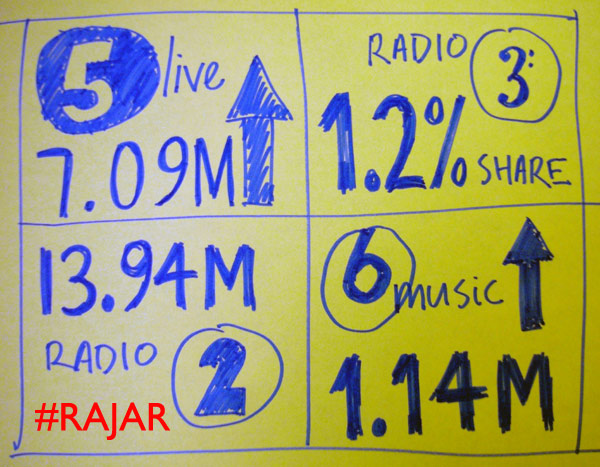
RAJAR Q42010

Using a beta (test) version of a service called Storify we've rounded up the reaction in the press, on the blogs and on the social networks to this morning's RAJAR numbers. What's your opinion of the numbers? Log in to leave a comment.

Steve Bowbrick, blogs editor

  • RAJAR (Radio Joint Audience Research) is jointly owned by the BBC and commercial radio trade body the Radio Centre. Participating listeners are asked to record their radio listening in quarter-hour time blocks for one week.
  • The RAJAR figures for 'linear listening', not including on-demand listening or podcasts, in a table and the official quarterly press release (PDF).
  • BBC Audio & Music's RAJAR press release.
  • Thanks to Jem Stone for curating the links.

Adrian Van Klaveren on 5 live's Rajars

Blog comments are currently unavailable. Find out more.

Post categories:

Steve BowbrickSteve Bowbrick|12:50 UK time, Thursday, 3 February 2011

I asked the BBC's media correspondent, Torin Douglas, to drop into 5 live's offices in Television Centre this morning to interview Controller Adrian Van Klaveren about the station's performance in the final quarter of 2010.

In order to see this content you need to have both Javascript enabled and Flash installed. Visit BBC Webwise for full instructions. If you're reading via RSS, you'll need to visit the blog to access this content.

Steve Bowbrick, blogs editor

  • RAJAR (Radio Joint Audience Research) is jointly owned by the BBC and commercial radio trade body the Radio Centre. Participating listeners are asked to record their radio listening in quarter-hour time blocks for one week.
  • The RAJAR figures for 'linear listening', not including on-demand listening or podcasts, in a table and the official quarterly press release (PDF).
  • BBC Audio & Music's RAJAR press release.

A RAJAR primer

Blog comments are currently unavailable. Find out more.

Post categories:

Paul KennedyPaul Kennedy|10:41 UK time, Tuesday, 1 February 2011

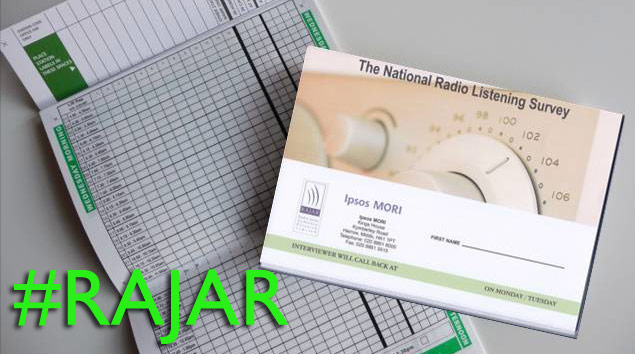
A RAJAR radio listening diary

Editor's note: on the eve of the publication of the latest radio listening figures, Paul Kennedy, Research Director at RAJAR, explains how they're gathered - SB.

RAJAR, or 'Radio Joint Audience Research', is the official body in charge of radio audience measurement for the UK. RAJAR was established in 1992 to replace two other measurement systems operated separately by the BBC and Commercial Radio. Today RAJAR collects information on behalf of over 300 stations, ranging from very small local services to the national networks.

Each week interviewers from Ipsos-MORI (an audience research organisation) recruit over 2,000 people to complete a RAJAR diary. These people are chosen at random within carefully selected areas to ensure the survey is completely representative in terms of the type of people who participate and the areas where they live. The random selection process also ensures inclusivity as much as possible - non-listeners are recruited, while people with disabilities are encouraged to take part with the help of a family member or carer if necessary. Ethnicity is also carefully monitored, with specific quotas set in areas of disproportionate ethnic balance to maintain the correct representation. Recruitment usually takes place over the weekend, and on the following Monday the selected respondents begin keeping a diary of their week's listening.

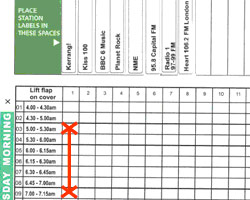
RAJAR uses a paper diary because it is the system that works best for most people. However, RAJAR is testing an online version, and this could be introduced later in 2011. But it is seen as a complement to the paper diary and not a replacement for it because there are many people who still do not have online access. The diary has separate pages for each day, with the day divided into quarter-hour periods down the side of the page, and the respondent's selected stations across the top to form a matrix. The respondent simply has to draw a line from the quarter-hour when they start listening to a station until the time when they stop. In addition to the station and date/time, the diary also collects information on where the listening takes place (e.g. at home, or in the car) and the platform (e.g. AM/FM, DAB, Internet).

Close-up of a RAJAR radio listening diary.

At the end of the week, the interviewers collect the diaries and return them to Ipsos-MORI for processing. This is repeated weekly and, at the end of every 3-month period, the numbers are aggregated to produce results for each station. All stations use the information to plan programme schedules, while the commercial stations also use the statistics to sell advertising airtime, without which they would cease to exist.

More than 100,000 people participate in the RAJAR survey every year, making it one of the largest media studies in the world. The paper diary is the most common method of measuring radio audiences worldwide, although some countries use electronic devices called audiometers. RAJAR has tested several audiometers and continues to work with developers to find one at an affordable price that measures all stations equally, regardless of size, format or means of broadcasting.

Paul Kennedy is Research Director at RAJAR

  • The Rajars for Q4 of 2010 are published on Thursday morning. We'll publish details here on the blog.

More from this blog...

Categories

These are some of the popular topics this blog covers.