
Could the sun cast a shadow on global temperature predictions?
There's something very unusual going on in the sky at the moment, which is causing great excitement amongst astronomers and solar scientists alike. The sun, which contributes 98% of all the planet's warmth, is very inactive; in fact such a solar cycle has not been observed for over 200 years. Where does this fit in the ongoing debate about global warming? On the face of it, it sounds significant, but is it?
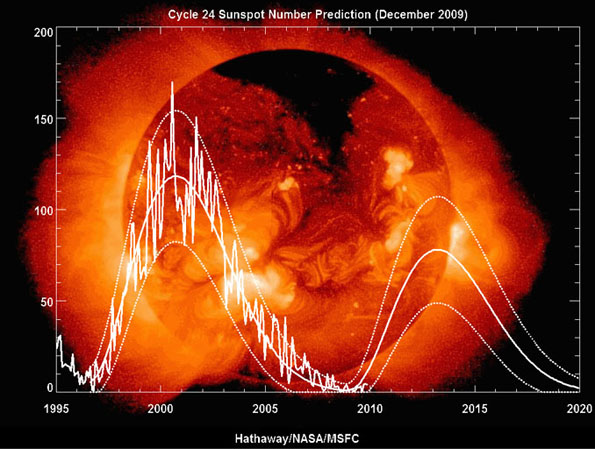
The sun's influence on global temperatures has long been contested by scientists on both sides of the global warming debate. Climate computer models do incorporate variations in the sun's 11 year solar cycle. But, according to satellite data first gathered at the end of the 1970s, the sun's overall contribution on this measure has been mostly static, and because of this most climate scientists have argued that the warming that has occurred since then could not have been down to changes in the sun's output. In fact according to the latest IPCC report, the role of the sun in explaining variation in global temperatures in recent decades has been insignificant.
But many scientists, on both sides of the argument, agree that going back further in time, the sun has played a bigger role in determining global temperatures.
One particular theory which seems to show this is the solar cycle length theory, first postulated by two Danish scientists, Friis-Christensen and Lassen. Their work has proved controversial. But although recent analysis cast considerable doubt on their findings regarding the sun's role in warming observed in the last few decades, their theory does seem to be valid during earlier periods.
According to their theory, temperatures respond to the LENGTH of the particular solar cycle, with changes in temperatures only becoming apparent during the following
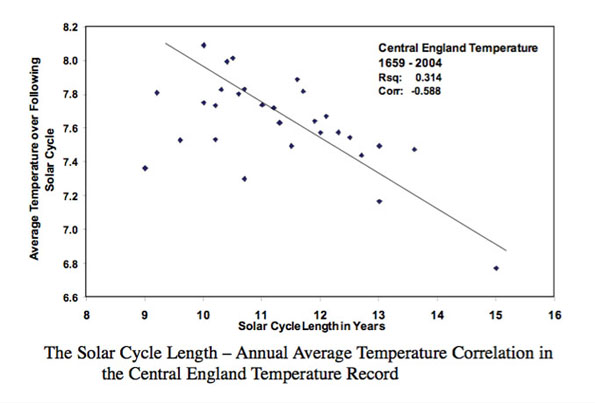
cycle, because of lag effects, such as, for example, the time it takes for oceans to absorb the suns energy. On average the length of the solar cycle is 11 years. If the solar cycle is shorter, then temperatures on average tended to be higher during the following cycle; and if the cycle was longer, temperatures in the following cycle tend to be lower.
Australian scientist David Archibald, who believes that the solar cycle can be used to predict global temperatures, has looked at Central England temperatures and the solar cycle length. Although the mechanism for a link between the two is poorly understood, his work shows there does seem to be a correlation.
Archibald then looked at the current unusual weakness in solar activity. Although it is difficult to be precise, it seems that Solar Cycle 23 (1996-2009) ended a few months ago and was two years longer than normal. It also looks like Solar Cycle 24, expected to run between 2009 and 2021 has started, but very weakly. Archibald says solar cycles 22(1986 to 1996) and 23 (1996-2009) were very similar to cycles of 3 (1775 to 1784) and 4 (1784 to 1798), which preceded the so called 'Dalton Minimum', a period of very quiet solar conditions between from 1798-1823, and named after meteorologist John Dalton.
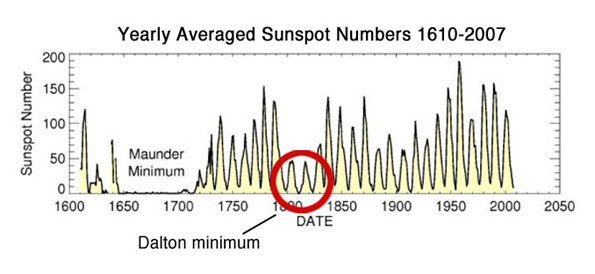
So if history is about to repeat itself, and we are headed into this so called lull in solar activity, similar to a Dalton Minimum, Archibald tried to work out what the implications would be for global temperatures. He looked back at what happened to temperatures during the Dalton minimum in the early 1800's across several mid latitude sites such as Armagh in Northern Ireland, De Bilt in the Netherlands, and also used the Central England temperature series. Archibald concluded that if solar patterns continue, global temperatures through the next decade are likely to fall. He says 'The difference will be seen most clearly with winters starting earlier, and lasting longer. And in that regard, the northern states of the US/Canada will be the bellwether, along with areas such as the UK and central Europe'.
The weather during the Dalton minimum coincided historically with the writings of Charles Dickens, with winters in England filled with extreme cold and snow. Six of Dickens's first nine Christmases were white. One of these fell in the winter of 1813-14, when Britain's last Frost Fair was held on a frozen River Thames. The ice around Blackfriars Bridge was
thick enough to bear the weight of an elephant.
Seem a bit far fetched to you? Well even NASA seems to think a Dalton minimum is possible. Back in July NASA's David Hathaway said 'Something like the Dalton Minimum -two solar cycles in the early 1800s that peaked at about an average of 50 sunspots - lies in the realm of the possible." And we are now 5 months on from when he made that statement, and the sun is still asleep on the job.
Whether global temperatures will respond as Archibald thinks in the coming years, as they did during the early 1800's, only time will tell. Professor Stephen Mobbs, Director, National Centre for Atmospheric Science at the University of Leeds, thinks it's unlikely, and points out that the analysis could be too simplistic.
'The planet is a very different place now compared with the early 1800s, with much higher concentrations of greenhouse gases' he said. 'So even though a degree of cooling, or more likely reduced warming, is possible should we enter something similar to a Dalton minimum in the coming decade', he added, 'then this is likely to be modified in large part by further man-made global warming, and any such cooling is likely to be difficult to detect against the background warming trend'.
(Note - click on text highlighted in blue for further reading)
 Hello, I’m Paul Hudson, weather presenter and climate correspondent for BBC Look North in Yorkshire and Lincolnshire. I've been interested in the weather and climate for as long as I can remember, and worked as a forecaster with the Met Office for more than ten years locally and at the international unit before joining the BBC in October 2007. Here I divide my time between forecasting and reporting on stories about climate change and its implications for people's everyday lives.
Comments
Sign in or register to comment.