Turing’s Sunflower Diaries

Erinma and Natalie
Turing's Sunflowers Team
Back in March 2012, we approached BBC Outreach to work with MOSI (Museum of Science and Industry, Manchester) on Turing’s Sunflowers, a citizen science experiment.
Turing’s Sunflowers celebrated the centenary of mathematician and code-breaker, Alan Turing’s birth, by testing his little known theories about mathematical patterns in sunflowers. Turing noticed that the number of spirals in sunflower seed heads often corresponds to a number in the Fibonacci Sequence (0, 1, 1, 2, 3, 5, 8, 13, 21, 34, 55, etc) but he died before this work was complete.
We worked with Professor Jonathan Swinton, a computational biologist, who came up with the idea for a public experiment after finding Turing’s unpublished research.
Our community and cultural partners helped us deliver a project involving over 3000 people from Greater Manchester and a global media reach of 62.8M people.
BBC Outreach was crucial in encouraging sunflower growers to share their stories by making short videos of their experiences. Caroline Ward from BBC Outreach worked with us and staff volunteers to shape a filmmaking campaign, The Sunflower Diaries. Growers submitted short videos fortnightly in response to a question e.g ‘Can you tell us about your biggest challenge and how you overcame it?’
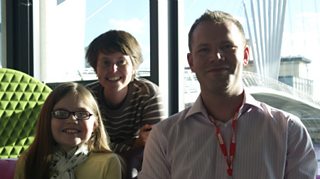
Staff volunteers Karen Millington and Duncan Bloor from BBC Learning with Isobel
Staff volunteers Duncan Bloor and Karen Millington from BBC Learning helped devise campaign questions and filmed interviews with key participants. This was the basis of a short documentary screened alongside the results presentation at the Manchester Science Festival.
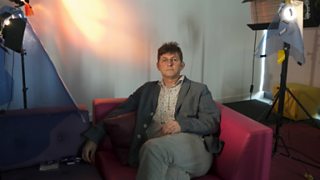
Jonathan (Professor Swinton) in studio at MediaCityUK
Karen and Duncan filmed on location at MOSI, Jonathan’s home, and at MediaCityUK in a studio setting. The studio shoot was fun and helped us to reflect at a crucial stage, just as the data was being analysed.
The growers enjoyed making videos and we loved watching them; one Jamaican family sang songs and another grower, Isabel, made videos about her sunflowers, Sunny, Rainbow and Raindrop.
See the experiences of citizen sunflower growers around the world.
Many other growers shared how they fended off squirrels, slugs and rain to keep their sunflowers alive.
BBC Outreach’s expertise was invaluable, especially in terms of getting clearance to use growers’ footage and providing the right formats for web and other screenings. Making the film with BBC Outreach was a lovely way to celebrate the public’s involvement and provide a legacy. The growers’ contributions show how creative the public can be when given the chance.
Find out how the Turing's Sunflowers science project came about.
BBC Outreach shared the video files with BBC radio, TV and internet news to use in their news coverage about the project. Overall, the project has been incredibly successful and many more people are now aware of Alan Turing’s legacy.
*Erinma Ochu and Natalie Ireland at MOSI (Museum of Science & Industry) worked with BBC staff volunteers in the North West to capture the story of the sunflower growers in Turing's Sunflowers citizen science project and to celebrate the life of mathematician and code-breaker Alan Turing.
