The crisis in Zimbabwe is causing real tension in Whitehall. This week the home secretary warned the cabinet of a possible mass influx of refugees, many travelling on false papers. And she warned of a growing risk of the spread of cholera from the region.
Some in the Foreign Office regard such talk as an attempt to justify tougher border controls to make it even harder for refugees to make it to the UK from Zimbabwe.
Currently any Zimbabwean needs a visa to travel to the UK. Those however who come from South Africa do not. The result is that many refugees flee over the border and buy false papers before making their way to Britain.
The Home Office wants to see the introduction of visa restrictions for all countries in the region, the Foreign Office does not.
There's also a debate going on about what to do about thousands of Zimbabweans who are in limbo here. They have not been granted asylum and therefore cannot legally work or claim benefits but the government is unwilling to send them home.
The debate in each case is about the moral imperative to help those fleeing the Mugabe regime, poverty and disease and the danger of encouraging more from Zimbabwe to stay here and make their way here at an unacceptably high cost to the tax payer.
One minute, Gordon Brown says he's saved the world. The next, the German finance minister tells us that Mr Brown is, in fact, saddling "a whole generation" with debt by "tossing around billions" in a "yearning for the Great Rescue Plan" even though "[i]t doesn't exist. It doesn't exist!"
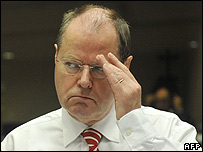 Speaking to Newsweek, Peer Steinbruck goes on to say: "I say we should be honest to our citizens. Policies can take some of the sharpness out of it, but no matter how much any government does, the recession we are in now is unavoidable", before adding that: "[w]hen I ask about the origins of the crisis, economists I respect tell me it is the credit-financed growth of recent years and decades. Isn't this the same mistake everyone is suddenly making again, under all the public pressure?"
Only a few weeks ago, Team Brown was telling us that Germany had proved the case for a fiscal stimulus by unveiling one of its own.
Now, however, we're told that the Germans are resisting calls for an EU-wide stimulus thanks to tensions in the Grand Coalition of parties of the left (the finance ministers from the SPD) and the right (the chancellor leads the CDU) that governs the country. It would be surprising if there were not tensions, not least with elections in Germany next year. However, there is one problem with this theory. Chancellor Merkl told her party congress this month that: "[w]e will not take part in a competition to outdo one another with an endless list of new proposals, in a senseless contest over billions".
Now, there are other theories being offered, too:
• having just suffered politically by raising VAT, the German government doesn't welcome comparisons with Britain where it's just been cut;
• the Germans fear that they will, as ever, be expected to foot the bill for any EU-wide stimulus;
• they have bad memories of the G5's Bonn summit in 1978 when they felt bullied by America to adopt an expansionary growth package which later fuelled German inflation;
• they have even worse memories of the rampant inflation which helped to create the conditions which led to the rise of Hitler.
There is, dare I suggest, another perfectly plausible theory. Mr Steinbruck believes what he says and does agree rather more with Mr Cameron than with Mr Brown, even though they come from the opposite ends of the political spectrum.