

Making history at the BBC
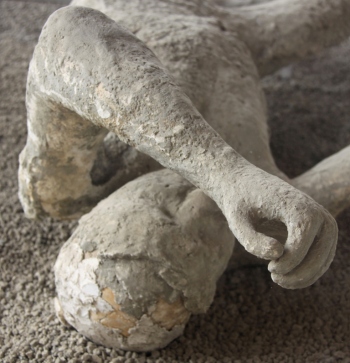
An excavation at Pompeii
I'll be hosting the event, which begins next Tuesday, 21 February. Our guests will include Mary Beard, Adam Nicolson, David Reynolds, Jenny Abramsky, Carlo Gebler, Alvin Jackson, John Bowman, Francesca Stavrakopoulou and many others. This will be very special, I can promise you; and to avoid disappointment you need to book a place. Admission is free.
Here's how you reserve your place at the BBC Festival of History and Broadcasting. You can book in for a whole day, or all three days, or book for an individual session.


Comment number 1.
At 10:51 17th Feb 2012, logica_sine_vanitate wrote:More often than not the word "history" is really code for "my interpretation of history".
An atheist "Bible scholar" - such as Stavrakopoulou - will inevitably "read" her atheism back into the biblical accounts, and concoct theories to make the biblical accounts fit what she wants to see - while at the same time accusing the biblical writers of "redaction" (a.k.a. wilful fraud). The absurd JEDP documentary hypothesis (based on the most arbitrary and convoluted subjective linguistic analysis) is another attempt to "demythologise" the Bible - i.e. engage in historical revisionism.
I hope, William, that your event will include discussion that frankly faces up to this problem of ideologically driven revisionism.
If the BBC cares about objectivity, then perhaps programmes by more conservative Bible scholars and historians would be useful to counterbalance the indoctrination that we are normally subjected to.
Complain about this comment (Comment number 1)
Comment number 2.
At 12:55 17th Feb 2012, Dave wrote:LSV,
More often than not the statement -
is usually code for "an interpretation of history which does not agree with mine".
Lets see if we can move from logic to recursion for a while.
Will,
Looks like an excellent series of events - hope to get along to some of it. I will keep any assessment of the merits and motivations of the speakers until I actually hear what they say or see it reported. LSV obviously has judged it as a whole based on I know not what - maybe predestination.
Maybe you should get LSV to speak at it on the subject of revisionism (or not agreeing with him as it is more commonly known) - I won't commit to going to that as I think I'll get my hair permed.
Complain about this comment (Comment number 2)
Comment number 3.
At 15:13 17th Feb 2012, logica_sine_vanitate wrote:Dave (@ 2) -
I assume you saw the word "counterbalance" in my comment?
In other words, Dave, I was not recommending that the offerings of atheists should be banned, but that the other side should be allowed to have their say.
Or is such tolerance not part of your view of broadcasting?
(Funny, but I thought "secularism" was supposed to be about tolerance and diversity, not about atheist indoctrination. Oh well...)
Enjoy the event, BTW...
Complain about this comment (Comment number 3)
Comment number 4.
At 15:26 17th Feb 2012, AboutFarce wrote:Why don't you do a fringe event.
Complain about this comment (Comment number 4)
Comment number 5.
At 17:13 17th Feb 2012, Dave wrote:LSV,
In order to provide counterbalance there would need to be something of equal standing to provide the counterbalance. The very term 'conservative' biblical scholars (ie those who wish to preserve the biblical account no matter what else appears to challenge it) really is not a counterbalance more of a head in the sand. It's a bit like trying to portray creationism as a counterbalance to evolution - apples and oranges I am afraid unless of course you think that belief is a counterbalance to evidence - or maybe you do?
Complain about this comment (Comment number 5)
Comment number 6.
At 17:31 17th Feb 2012, Will_Crawley wrote:Interesting points from LSV. I'm sure we will discuss that subject, and many others, during the event. In face, LSV, why don't you come along an put those points in person?
Complain about this comment (Comment number 6)
Comment number 7.
At 18:07 17th Feb 2012, logica_sine_vanitate wrote:Dave (@ 5) -
Well your response, Dave, tells me all I need to know about your level of commitment to truth. You are, by your own admission, not in the slightest bit interested in healthy debate or considering evidence objectively. Your definition of "conservative" is completely biased and prejudiced, and, in fact, one could just as easily claim that liberal or atheist "Bible scholars" have an agenda to rubbish the integrity of the biblical text come what may. I do actually know what I am talking about, as I graduated from a liberal University Theology faculty (Kings College, University of London). I am well aware of how the biblical text is treated by those committed to the imposition of a particular worldview.
As for your "creationism" comment (I'm tempted to say "gaffe"), you seem unaware of the fact that the term "creationism" covers a range of views, and the idea that the evidence supports the atheistic position is only true if the concept of "evidence" is defined in terms of a philosophy held on the basis of what you (fallaciously) term "faith" (namely the philosophy of naturalism).
So I guess that the idea of "intelligence" perhaps isn't a very effective counterbalance to question begging dogmatism (if you understand what that is).
William (@ 6) -
Thanks, Will, for the invite. Unfortunately I have work commitments where I live in Hastings, E. Sussex, but I am sure you will have a lively discussion about the importance of the BBC seeking to reflect a wide range of views in its broadcasting.
Complain about this comment (Comment number 7)
Comment number 8.
At 18:28 17th Feb 2012, AboutFarce wrote:Grrrrrrrrrrrooooooooaaaaaaaaannnnnnnnnnnnn.....
Complain about this comment (Comment number 8)
Comment number 9.
At 20:23 17th Feb 2012, newlach wrote:David Reynolds' series on the United States was excellent and Mary Beard never fails to enlighten. Unfortunately I shall not be at the event, so I shall miss any comparisons that professors Beard and Reynolds might draw with the Northern Ireland Assembly and government in ancient Rome and the United States. Professor Reynolds would have something very interesting to say on the way religion was viewed by the Founding Fathers and Professor Beard would know a thing or two about the historical evidence for the existence of the militant figure Jesus.
Complain about this comment (Comment number 9)
Comment number 10.
At 12:08 18th Feb 2012, Dave wrote:LSV,
I always think it is wise to read more widely than a single source before coming to a conclusion - but if it's how you roll....
Complain about this comment (Comment number 10)
Comment number 11.
At 13:09 18th Feb 2012, logica_sine_vanitate wrote:Dave (@ 10) -
Exactly.
Just what I was saying!
Message to Will: please could the BBC make sure that viewers and listeners have the opportunity to assess information from more than one source before coming to their conclusions.
Dave said so. And I agree.
Complain about this comment (Comment number 11)
Comment number 12.
At 13:23 18th Feb 2012, newdwr54 wrote:1. logica_sine_vanitate wrote:
"An atheist "Bible scholar" - such as Stavrakopoulou - will inevitably "read" her atheism back into the biblical accounts..."
Then you must believe that the corollary is also true: that theist "Bible scholars" - such as Dan Wallace - will inevitably "read" his theism back into the biblical accounts?
What you're saying is that people aren't capable of separating their religious convictions, or lack of them, from their academic integrity. I don't see how you can show that that's true, either in the case of Stavrakopoulou, or even Ehrman for that matter (who is not an atheist and is strictly speaking a theologian).
It's certainly not true in the case of Raymond Brown, who produced excellent higher criticism of, particularly, the 'Johannine community', whilst remaining ordained in the RC clergy. The same is true of the earlier German theologian Ferdinand Baur, who was a staunch supporter of Protestantism but a radical Biblical critic. And it was a Christian minister, Emil Schurer, who demonstrated that the checkable historical claims made in Luke's Nativity were irreconcilable with the historical evidence.
All these men retained their faith because they were able to separate the 'Jesus of history from the Christ of faith' - something I, and apparently you, are unable to do.
Complain about this comment (Comment number 12)
Comment number 13.
At 13:45 18th Feb 2012, logica_sine_vanitate wrote:newdwr54 (@ 12)
OK, so an atheist would be prepared to accept accounts of miraculous events in the Bible at face value, instead of trying to explain them away?
An atheist would not be prepared to date a prophetic book after the event successfully prophesied on the basis of any personally held philosophical view about prophecy?
An atheist would not be prepared to force biblical history into an evolutionary paradigm (such as monotheism developing out of polytheism), but would accept the integrity of the biblical record?
An atheist would accept the resurrection of Jesus Christ as a perfectly valid explanation for the empty tomb?
If you think an atheist would pursue biblical study in this way, then I'm afraid you're living in a dream world.
Complain about this comment (Comment number 13)
Comment number 14.
At 14:26 18th Feb 2012, PeterM wrote:I have a question, and not one about the bible!
What, I’m wondering, will the study of our contemporary world look like for future generations, who will, then, think of our today as history. I ask, because it seems to me that one of the complications will be the problem of too many sources rather than too few. Put it another way, who do we think are the ‘keepers’ (and formulators) of ‘today’s’ story?
Complain about this comment (Comment number 14)
Comment number 15.
At 14:38 18th Feb 2012, Will_Crawley wrote:I heard Fr Raymond Brown lecture a few times when I was a student in the US, and he was quite brilliant.
Complain about this comment (Comment number 15)
Comment number 16.
At 16:32 18th Feb 2012, newdwr54 wrote:13. logica_sine_vanitate:
Each of the questions you ask about atheist, or more properly 'non-theist', scholars has its corollary among 'theist' scholars.
Might theist scholars be more inclined to accept reported miracles at face value? Might they be more inclined to believe that a reported 'prophecy' actually pre-dated the event? Might a theist scholar be more predisposed to dismiss the possibility that the transition from widespread polytheism to monotheism reflected a gradual transition in social and cultural tradition as much as anything else? Might they be more likely to view the resurrection of Jesus as an actual historical event, rather than as allegory?
The answer is probably yes. Both non-theist and theist Biblical scholars (and scholars of any other 'sacred text') will probably carry some 'baggage' into their studies. However, historical analysis, like the scientific method, respects the primacy of evidence. It is 'evidence-led'. And as I have mentioned above, some of the most widely respected higher criticism of the Biblical texts has come from theistic scholars.
Just on the point of miracles: the Sun is said to have stood still then fallen and raised vertically in the sky above Fatima, Portugal on October 13th 1917. There were said to be 70,000 eye witnesses to this event. It is regarded by many Roman Catholics to have been a miracle. Do you accept these accounts at face value, or would you prefer to try to 'explain them away'?
Complain about this comment (Comment number 16)
Comment number 17.
At 16:36 18th Feb 2012, newdwr54 wrote:15. Will_Crawley
I'm very jealous! I have a prized copy (somewhere) of Brown's 'The Community of the Beloved Disciple...' (1979), which is a superb read, as well as a masterly historical work.
Complain about this comment (Comment number 17)
Comment number 18.
At 20:01 18th Feb 2012, newlach wrote:I note that under the heading of "Supervision and Teaching" Ms Stavrakopoulou includes the intriguing "God's penis". I have never before seen these two words side by side and would be grateful if William could ask the necessary questions.
Complain about this comment (Comment number 18)
Comment number 19.
At 21:22 18th Feb 2012, newdwr54 wrote:18. newlach:
Clearly I obtained tickets to the wrong show!
I hope to be at the 'God's Secretaries' event; 3:30 - 4:30 pm, Tuesday.
Complain about this comment (Comment number 19)
Comment number 20.
At 22:48 18th Feb 2012, logica_sine_vanitate wrote:This is getting good, this thread.
Two atheists agree with me...
newdwr54 (@ 16) -
...hence we need to hear different sides of the argument, to ensure that the influence of philosophical baggage is minimised.
Exactly! Hence my comment about the need for "(counter)balance". Remember I wasn't censoring atheists, just arguing that more (theologically) conservative scholars should have their say on the BBC. Which is only fair, if you think about it.
And then (as already mentioned)...
Dave (@ 10) -
Tremendous.
Will, I hope that you are taking account of this surprising consensus.
Oh, and I nearly forgot...
newdwr:
I couldn't agree more!
Just one little quibble...
Care to define what you mean by the word "evidence"? (I hope the word is not being defined under the influence of any particular philosophical "baggage"!)
Complain about this comment (Comment number 20)
Comment number 21.
At 10:58 19th Feb 2012, newdwr54 wrote:20. logica_sine_vanitate wrote:
"Care to define what you mean by the word "evidence"? (I hope the word is not being defined under the influence of any particular philosophical "baggage"!)"
_____________________________
In the case of Biblical criticism, evidence is anything that sheds light on when and where the texts were written, who wrote them, and what conclusions might be drawn from these observations. Such evidence can never prove anything, it can only support or reject an argument.
By a more general definition, evidence is anything that demonstrates the truth of an assertion. You never got round to giving us your views on the 'miracle of the Sun' at Fatima in 1917. Evidence supporting this miracle is a report of 70,000 eye witnesses (note: not '70,000 eye witness reports').
Complain about this comment (Comment number 21)
Comment number 22.
At 16:27 19th Feb 2012, paul james wrote:Interestingly the work of Israel Finkelstein and other Israeli archaeologists (interviewed during Professor Stavrakopoulou's Bibles Buried Secrets series) could find no evidence of an exodus from Egypt or much of the historical claims of the Bible despite the obvious pressures to confirm the basis of a modern state of Israel.
Complain about this comment (Comment number 22)
Comment number 23.
At 12:58 20th Feb 2012, Alex wrote:The event is tomorrow. Too bad that I can't be there. I love history and everything related to it. [Unsuitable/Broken URL removed by Moderator]
Complain about this comment (Comment number 23)
Comment number 24.
At 14:46 20th Feb 2012, logica_sine_vanitate wrote:newdwr54 (@ 21) -
Fair enough. Clearly such a definition can work within different worldviews.
Let's go back to your original comment about this (@ 16) ...
I neither accept this account at face value nor do I seek to explain it away with a naturalistic theory. If I were interested in pursuing this particular question (which, as it happens, I am not) I would need to assess the evidence from different angles - such as witness testimony, the reliability of the witnesses, possible other explanations and so on. But what I would not do is say: "If there is a claim that a miracle has occurred and we can find a possible naturalistic explanation for it - no matter how insanely improbable - then it follows logically that the naturalistic explanation must always be accepted as true." That is a non sequitur.
Complain about this comment (Comment number 24)
Comment number 25.
At 17:03 20th Feb 2012, newdwr54 wrote:Drat. They've moved the only event I got tickets for a day in advance and now I can't go because I have to go to work.
It's a conspiracy.
Complain about this comment (Comment number 25)
Comment number 26.
At 17:58 20th Feb 2012, newdwr54 wrote:24. logica_sine_vanitate:
"But what I would not do is say: "If there is a claim that a miracle has occurred and we can find a possible naturalistic explanation for it - no matter how insanely improbable - then it follows logically that the naturalistic explanation must always be accepted as true."
__________________________
Good, because I wouldn't do that either. what I'd do is say to myself:
'A miracle, by definition, is a violation of probability. Something highly improbable is reported to have occurred, otherwise it wouldn't be miraculous. So what I would need to do, in order to satisfy myself that the report is true, is investigate all and any contradictory evidence, to see if there is indeed a naturalistic explanation that would make the reported event less improbable.'
In the case of the report of the 'Miracle of the Sun' at Fatima, I personally would not be satisfied with eye witness reports - even 70,000 of them, I must admit. This is because we know that eye witness testimony is often wrong, and that people can be swept up with emotion into believing they saw something that they didn't actually see. Go to any football match if you don't believe me.
I would dig further. I know that even back then astronomers and cosmologists kept close observations on the sun. Do they have any records that indicate anything unusual on that date? Did meteorological observations over Portugal report any unusual weather conditions that day (it had been raining just before the event)? Did instruments indicate any fluctuation in the earth's orbit?
I'd want to know why a major event like the earth veering off its normal orbit even briefly (for surely the sun didn't move) didn't cause a catastrophic surge in ocean tides, wildly fluctuating weather patterns or even tectonic plate movements resulting in widespread earthquakes. Surely that's the very least we would expect?
If I could find no quantitative corroborating evidence for the claimed miracle, and I was offered no explanation for why the earth didn't suffer massive natural disruption because of the sudden and bizarre movement, then I would deploy Occam's Razor. I would ask 'which of these two explanations requires the lesser investment of assumptions -
i) that a group of people were swept up in a wave of emotional fervour and convinced themselves that they had seen something that they didn't actually see, or
ii) that the earth veered rapidly and violently off its normal orbital cycle without suffering any adverse consequences and without anyone outside Fatima so much as noticing it?'
Complain about this comment (Comment number 26)
Comment number 27.
At 18:05 20th Feb 2012, PeterM wrote:Ah well, if no one's interested in discussing the formation of tomorrow's history...
Nice post, newdwr; I take it you're aware of your biggest assumption?
Complain about this comment (Comment number 27)
Comment number 28.
At 19:31 20th Feb 2012, Andrew wrote:Craig Keener's new book on miracles;
https://www.amazon.co.uk/Miracles-Credibility-New-Testament-Accounts/dp/0801039525/ref=sr_1_7?s=books&ie=UTF8&qid=1329765993&sr=1-7
Anyone going to any of the lectures over the next few days?
Complain about this comment (Comment number 28)
Comment number 29.
At 21:01 20th Feb 2012, newdwr54 wrote:14. peterm2 wrote:
"I have a question, and not one about the bible!"
Sorry Peter. I'm in Bible mode on this blog. That one slipped under the radar.
"I’m wondering, will the study of our contemporary world look like for future generations, who will, then, think of our today as history."
Do you mean as far as Biblical literary criticism is concerned, or generally?
"I ask, because it seems to me that one of the complications will be the problem of too many sources rather than too few. Put it another way, who do we think are the ‘keepers’ (and formulators) of ‘today’s’ story?"
Assuming you're referring to Biblical criticism, then I suppose we should expect technological advances to be made in the dating of various texts/fragments. We can't rule out the possibility that events will overtake us; i.e. that Jesus will return on the clouds, rendering all speculation moot - or that there will be some sort of catastrophic breakdown in society caused by some other influence.
Speaking in general, and assuming that the apocalypse is forestalled for a further few hundred years more, then I think that the questioning nature of this modern society will be cast in a generally favourable light by future generations. But there are an awful lot of assumptions in these things.
Complain about this comment (Comment number 29)
Comment number 30.
At 21:31 20th Feb 2012, PeterM wrote:newdwr
"Do you mean as far as Biblical literary criticism is concerned, or generally?"
Surely my preface that my question was not about the bible was a bit of a give away?
I'll put it another way:
Given the enormity of informational available to us - some of it formally researched and presented (e.g. BBC news); some of it quite opinionated (e.g. the plethora of personal websites and blogs); some of it limited and clipped (e.g. from mobile phone text, photo and video footage); and all available to us at a click, and to the degree that we have difficulty in processing it even though we live in the circumstances; how, I'm wondering, will some future historian tell our story, the story of the world today. What will be the process of sifting the evidence, which evidence will be valued and which will be discarded, which stories will be told, and which current view will prevail?
Not that I'd want to put you off your 'quiet time'!
Andrew
Unfortunately I won't be able to attend the lectures - work commitments.
Complain about this comment (Comment number 30)
Comment number 31.
At 11:33 21st Feb 2012, Theophane wrote:Right then. Let's put ourselves in the shoes of a very large, world-renowned broadcasting organisation - the BBC, say. A famous politician in a foreign country is standing for re-election to the presidency of that country, so it is decided to make a big-budget, 4 part mini-series called 'Putin, Russia & the West'. I grant you, this is comparatively recent history, but it is history nonetheless. Why would there be no mention of the brutal school siege of Beslan, arguably the single most bloodthirsty atrocity committed anywhere in this century? When can we expect the sequel, 'Bush, the US & the East', with no mention of the September 11th attacks? Putin looks set to be serving for a very long time at or near the summit of Russian politics - so what? So did Winston Churchill. Russia doesn't really have a recognisable opposition - nor does South Africa. They are both *young* democracies. People only vote for him because he provides "stability". Stability is a 'God-send' to the vast majority of people in Russia, who saw their country reach the brink of social and economic collapse, not to mention all-out civil war, in the 1990s. This is about history, because history teaches the disciplines of honesty, balance and objectivity, disciplines which are sadly lacking in the BBC's coverage of Russia.
Complain about this comment (Comment number 31)
Comment number 32.
At 18:29 21st Feb 2012, Theophane wrote:History sometimes makes forays into the realm of speculation, which is what i intend to do here. One of those programmes referred to in #31 dealt with the Ukraine, where politics can be a pretty murky activity. I was struck by the fact that in 2004, according to the programme, Victor Yushchenko's opposition would go through the correct procedures to stage a large-scale political rally in a given city, only to find that a circus had arrived in town on the day of the event, occupying the site where the rally was to be held. Infamously, Yushchenko was subjected to some kind of poisoning in the run-up to that year's election, leaving his face horribly disfigured. But it does not automatically follow that Russia must be incriminated in such skullduggery. A minor point perhaps, but there was a bit of sloppy translation of the words of Leonid Kuchma, at that time the incumbent president, in his interview for the programme. The sub-title had him saying
"...the Russians had no desire to see Yushchenko elected president";
in fact he said
"...the Russians had no *great* desire to see Yushchenko elected president"
Anyway, here's the speculative bit. Putin has received bad press for, apparently, undergoing plastic sugery on his face. It does look as if the 'bags' under his eyes have been removed. Well, a year or so ago it was at a public appearance in the Ukraine that Putin had bandages on his eyes - almost certainly the operation was carried out there. My suggestion is that Ukrainian politicians with pro-Moscow leanings persuaded him to have the op, thinking it would only enhance his image - the same rationale, but inverted, which led to the poisoning of Victor Yushchenko.
Complain about this comment (Comment number 32)
Comment number 33.
At 19:09 21st Feb 2012, Andrew wrote:Managed to get to the Dan Cruickshank conversation today. Dan's a joy to listen to; time went by too quickly. Valiant effort, Will, trying to get him to spill the beans about his 5 months on the road.
Will the series be broadcast?
Complain about this comment (Comment number 33)
Comment number 34.
At 22:23 21st Feb 2012, Theophane wrote:To everyone for whom Lent is significant - may it be a fruitful time for you. To everyone else - so long! However difficult, i'm hoping to go without the BBC website for Lent, which starts tomorrow.
Complain about this comment (Comment number 34)
Comment number 35.
At 14:37 22nd Feb 2012, mscracker wrote:34.At 22:23 21st Feb 2012, Theophane wrote:
To everyone for whom Lent is significant - may it be a fruitful time for you. To everyone else - so long! However difficult, i'm hoping to go without the BBC website for Lent, which starts tomorrow."
**
Then you may not see this until Easter, but I hope your Lenten season is a fruitful one, too.God bless!
Complain about this comment (Comment number 35)
Comment number 36.
At 17:14 22nd Feb 2012, mscracker wrote:A quote reflecting on current events in history I saw online:
"A government that determines what is a religious ministry and what is not, what is the nature of an institution such as marriage, which predates both Church and state and is the creature of neither, when human life begins and when it can be taken without penal trial has exceeded the boundaries of limited government and is already on the road to totalitarianism."
- Francis Cardinal George
Complain about this comment (Comment number 36)
Comment number 37.
At 20:06 22nd Feb 2012, grokesx wrote:@mscracker
If a democratically elected Government shouldn't determine these things, then who should? The Pope?
Complain about this comment (Comment number 37)
Comment number 38.
At 20:57 22nd Feb 2012, mscracker wrote:In human/civil rights issues the elected govt surely has a duty to protect its citizens & their freedoms, one of which being freedom of religion. There will always be instances of friction, even with limited govt.
Complain about this comment (Comment number 38)
Comment number 39.
At 21:33 22nd Feb 2012, mscracker wrote:@37-PS, I like this quote from James Madison,too:
"(I)t may not be easy, in every possible case, to trace the line of separation between the rights of religion and the Civil authority with such distinctness as to avoid collisions and doubts on unessential points. The tendency to usurpation on one side or the other, or to a corrupting coalition or alliance between them, will be best guarded agst. by an entire abstinence of the Gov't from interfering in any way whatsoever, beyond the necessity of preserving public order, and protecting each sect agst. trespasses on its legal rights by others." James Madison -1832
Complain about this comment (Comment number 39)
Comment number 40.
At 23:57 22nd Feb 2012, grokesx wrote:@mscraker 39
Yeah, well, there was a lot of abstinence of Government interfering in the way the Catholic Church conducted itself over the years. That worked out really well.
Complain about this comment (Comment number 40)
Comment number 41.
At 11:55 23rd Feb 2012, grokesx wrote:@mscracker
The American Right and small Government:
The gubmint should stay the hell out of people’s bidness!
It finishes:
Complain about this comment (Comment number 41)
Comment number 42.
At 14:47 23rd Feb 2012, mscracker wrote:@41. grokesx,
Thanks, but I think I prefer the way James Madison expressed it.
Complain about this comment (Comment number 42)
Comment number 43.
At 14:57 23rd Feb 2012, logica_sine_vanitate wrote:grokesx (@ 41) -
?
Complain about this comment (Comment number 43)
Comment number 44.
At 15:24 23rd Feb 2012, AboutFarce wrote:@43.
Phew. That was a question mark. For a second there I thought it was a lightbulb.
Complain about this comment (Comment number 44)
Comment number 45.
At 23:04 23rd Feb 2012, grokesx wrote:@LSV
Hokay, to be scrupulously fair, it should read "Vetoing 150 years of scientific evidence supporting the best explanation we have for the diversity of life on this planet in favour of any old guff that is consistent with a bunch of scripture dating back 4,000 years or so."
And much as I would love to get involved in a long, meandering argument with you about science, naturalism and the like, I'm afraid I have to pass. You see, I did an ad hoc opinion poll on some of our previous encounters and found out that 90% of respondents were totally uninterested in the subject. Of the remaining 10%, 90% either thought your arguments were just plain weird or that I was weirder still for responding. Of the remaining 10%, 90% were Tea Party style fundie nutjobs and the remaining 10% was my mum.
kthxbai.
Complain about this comment (Comment number 45)
Comment number 46.
At 00:58 24th Feb 2012, logica_sine_vanitate wrote:grokesx (@ 45) -
Ooops. I didn't realise I'd stumbled on the blog for X Factor ... or perhaps it was for Miss Great Yarmouth.
Silly me. (Note to myself: avoid popularity contests. Galileo wouldn't have approved.)
Complain about this comment (Comment number 46)
Comment number 47.
At 12:06 24th Feb 2012, grokesx wrote:@LSV
Sometimes we just have to bow to the wisdom of fictional crowds.
Complain about this comment (Comment number 47)
Comment number 48.
At 15:34 24th Feb 2012, mariein wrote:Earlier, I was going to comment on how Marie Colvin (RIP) said “we send home the first rough draft of history.” But I’m still considering the verity. In most cases, what the war journalist initially writes is probably not what determines the memories of a war, or history. Although, what the journalist writes may oft be highly significant to war direction, so...?
Complain about this comment (Comment number 48)
Comment number 49.
At 18:55 24th Feb 2012, PeterM wrote:As it will only become lost on the Open Thread... and perhaps it is loosely connected to this one.
Richard Dawkins and Rowan Williams at Oxford:
https://fsmevents.com/sophiaeuropa/
Complain about this comment (Comment number 49)
Comment number 50.
At 22:51 24th Feb 2012, AboutFarce wrote:Dawkins and Williams do gospel... https://www.youtube.com/watch?v=ryWVRS4aehM
Complain about this comment (Comment number 50)
Comment number 51.
At 17:29 25th Feb 2012, newlach wrote:49 Peterm2
Thanks for the link. I thought Williams was put under a lot of pressure when questioned on why sophisticated theologians persist in telling the story of Adam and Eve when they accept that there wasn't a first human. Had Anthony Kenny not intervened I feared this might happen to Williams:
https://www.bbc.co.uk/news/science-environment-17013285
I forget the name of the professor who spoke at the end and who referred to the "angry and opinionated" blogosphere. I don't think anything would be achieved by naming names, but I know what he means.
Complain about this comment (Comment number 51)
Comment number 52.
At 17:42 25th Feb 2012, newlach wrote:re link in 51
Scroll down to 10,000 feet and click the pressure gauge.
Complain about this comment (Comment number 52)
Comment number 53.
At 07:53 26th Feb 2012, newdwr54 wrote:For anyone still interested in the purported 1st century fragment of Mark's Gospel referred to by prof. Dan Wallace earlier this month - scepticism about its provenance among Biblical scholars is growing fast.
A photo of a document that may be the fragment in question was leaked recently and has been described as 'unical script... used commonly from the 3rd-8th centuries CE'. It's origin has even been suggested to have been Egyptian, i.e. a Coptic Christian manuscript.
The paleographer who Wallace alleges gave a 'positive' dating to the first century has still not been named, and Wallace himself has fallen silent on the matter. His book is still planned within the next year though.
See: https://freethoughtnation.com/contributing-writers/63-acharya-s/654-1st-century-gospel-of-mark-fragment-discovered.html
Complain about this comment (Comment number 53)
Comment number 54.
At 21:16 26th Feb 2012, newdwr54 wrote:51. newlach wrote:
I gather that Dawkins accepted in this debate that he is ultimately an agnostic?
Good. I think that we are all agnostic about God; as we are all agnostic about nearly everything. It's impossible to 'know' whether a certain claim is true or not. Only the rash claim otherwise.
There might be 'many Gods'. There might be 'a God'. There might be 'no God'. As to what nature 'many Gods' or 'God' might have... that is greatly disputed. Fewer disputes arise over what nature 'no God' might have. There's just less to consider.
Complain about this comment (Comment number 54)
Comment number 55.
At 00:21 27th Feb 2012, grokesx wrote:@newdwr #51
Well, reiterated , although you wouldn't have thought it from the the shock and awe from some quarters.Complain about this comment (Comment number 55)
Comment number 56.
At 20:17 27th Feb 2012, newlach wrote:Newdwr54
Aye, he referred to the continuum that he uses in The God Delusion to explain where he stands. If complete disbelief in a god was a 7 on a scale of 1 to 7 (where 1 was complete belief) he said he would be a 6.9! It is strange that this comment generated the stories that grokesx refers to.
Did you manage to listen to Start the Week with Richard Holloway? He referred to himself as an "expectant agnostic" and "Christian agnostic" and talked of how the fixed rules of the Church are damaging humanity. He further said that we need to live with "unknowability" and was supported in this by Karen Armstrong who suggested that bishops today need to say: "We don't know." He paraphrased Wittgenstein's: "Not how the world is, is the mystical, but that it is."
https://www.bbc.co.uk/programmes/b01cjm4c
Complain about this comment (Comment number 56)
Comment number 57.
At 16:47 28th Feb 2012, mscracker wrote:I thought this was a good article re. the history of religious liberty:
Subject to the Governor of the Universe: The American Experience and Global Religious Liberty
ARCHBISHOP CHARLES J. CHAPUT, O.F.M. CAP.
"A friend once said – I think shrewdly – that if people want to understand the United States, they need to read two documents. Neither one is the Declaration of Independence. Neither one is the Constitution.
In fact, neither one has anything obviously to do with politics. The first document is John Bunyan's The Pilgrim's Progress. The second is Nathaniel Hawthorne's The Celestial Railroad..."
Full Text in link below:
https://www.catholiceducation.org/articles/politics/pg0265.htm
Complain about this comment (Comment number 57)
Comment number 58.
At 02:38 29th Feb 2012, AboutFarce wrote:I found the Archibishop's essay a good exercise in "doublethink", and I was disappointed by his recommendation of my least favourite book, ever, The Pilgrim's Progress for an insight into America. (I'd recommend Alexis de Tocqueville's Democracy in America.) He does a good bit of Bunyany hand-wringing. His rueful account of the passing of religious freedom is pretty laughable when the race for the Republican candidacy is saturated by religion to the exclusion even of "real" politics.
His apparent championing of secular ideals while at the same time decrying secularism is baffling, until it becomes clear what he really means is that secularism is the child of Christianity (course it is), and so is democracy while he's at it (course it is), and while of course we should pay lip service to secular ideals, we should ditch that term in favour of "religious liberty" (employing the same lexical jiggery-pokery, perhaps, as when the Departments of War became the Departments of Defence), and while we're at that, we would do well to remember that ultimately we have the Catholic Church to thank for the lot. (Course we do.)
That being the case, Muslims aren't likely to get it, although in time they might, just like Hindus and atheists. But like Bunyan's Pilgrim, we must be ever on our guard, and realise that even when religious voices drown out practically all others, this is likely the time of our greatest peril, and we must redouble our efforts to remind ourselves always - even when we seem to be on top - that we only have God to thank for our being able to manipulate law to enforce our doctrine on people of all faiths and none, in a country which is supposed to have a wall of separation between church and state, and since we've been able to do that, it's likely that God willed it (like everything else He in His wisdom wills, when we agree with it).
Above all in this time of bounty for public religion, we must regard a solution to a problem (secularism) as a problem in itself, and go on problematising it most vociferously because as a problem it has vigour, rather like our well-worn victim narrative. That way, should the evil of good sense prevail, as it all too soon might, we can howl that things are getting even worse for us, we can wail that we Christians ought to know what religious freedom is since we invented the thing, so it would be best left to us. We can then hope to have washed away enough sand from the shore of the state that our tide settles higher than before, for only when we get our next tsunami of public piety will we again have the opportunity to bemoan the awfulness of everything for public piety.
The Pilgrim's Progress. Such a short book and such an arduous chore. I longed for the God of Job to appear and give Pilgrim a taste of the Old-style treatment. I can honestly say I had more sympathy for Humbert Humbert, the second most pathetic character I've ever come across in a book and even he comes out looking a hero next to Bunyan's craven wretch. I'll keep an eye out for Hawthorne's story.
Complain about this comment (Comment number 58)
Comment number 59.
At 14:56 29th Feb 2012, mscracker wrote:@58. AboutFarce ,
Thanks for your thoughts & taking the time to read the article.
I haven't read Pilgrim's Progress for many years but I remember enjoying it.It reminded me a little of Tolkien.
Nathaniel Hawthorne's one of my favorite American authors.His daughter, Rose, was a convert to Catholicism & founded the Hawthorne Dominicans who care for cancer patients.
Speaking of Job, have you been able to see the film "Tree of Life?" One of my sons talked me into renting the DVD.It's an odd movie, but I thought very moving.Beautiful soundtrack, too.
Complain about this comment (Comment number 59)
Comment number 60.
At 15:53 29th Feb 2012, mariein wrote:Mscracker, AboutFarce,
“The big political idea of the Enlightenment is that earthly happiness, not divine authority, is the only credible moral foundation of political authority.” -- From something else to read:
The freedom to do God’s will, economically…
https://www.economist.com/blogs/democracyinamerica/2012/02/rick-santorum
----------------------------------------------------------------------
In the Open Thread, re transvaginal sonogram: I didn’t realize that the procedure is not needed for an abortion. I didn’t understand the process before. So not only is the state forcing women to listen to the heartbeat or a description (Dr: “Um, don’t know what you were expecting, but it looks like a piece of rice…”), the state - my state - really is forcing an internal procedure on women.
Complain about this comment (Comment number 60)
Comment number 61.
At 16:40 29th Feb 2012, AboutFarce wrote:Hi MsCracker,
I read an article on Hawthorne and Bunyan in Harpers magazine after posting here last night. I think his story is online so I might have a look for it later since it's short. I can't read anything of any real length on a screen... But it seems he was right to have been sceptical about the widely held belief towards the end of the 19th Century that science would make rationalists of us all and religion would fade.
As you can probably tell, the bishop's essay annoyed me. I don't understand how they can so brazenly cry fire in a flood. I was somewhat pleased Santorum took a knock in two states. I find myself praying for another Obama term and that the Tea Party continues to eat itself.
Anyone who's interested should have a look at Lord Carey (former Archbishop of Canterbury) on Hard Talk with Stephen Sackur. See here: https://news.bbc.co.uk/1/hi/programmes/hardtalk/default.stm
I thought, oh here we go, but Sackur was admirably tight on him -- by which I mean he asked the questions that needed to be asked. Judge for yourself how Carey did, but I thought he was pretty darn poor. Tied in knots actually, but I suppose you can't make a silk purse out of a sow's ear of a case. Count how many times he plugs his book. "My book, my book, my book..."
I haven't seen Tree of Life yet. It was well reviewed. I'd forgotten about it actually. Must look it up too.
Complain about this comment (Comment number 61)
Comment number 62.
At 17:45 29th Feb 2012, mscracker wrote:@60. marieinaustin,
As I understand the procedure is used in early pregnancies to determine the age of the unborn child & is already utilised in many facilities.Apparrently an internal ultrasound is more accurate at that stage. For the mother's safety & to determine which type of abortion is indicated, it's crucial to know the age of the fetus. Virginia has changed their legislation & retained only the abdominal ultrasound option, but the transvaginal ultrasound will continue to be a part of the abortion process because of its accuracy.
Complain about this comment (Comment number 62)
Comment number 63.
At 17:51 29th Feb 2012, mscracker wrote:@61.AboutFarce,
I'm requesting the Tree of Life" soundtrack from the library.
Hope you have a chance to see the film. It's kind of weird, but once I got past that part I found it very moving.
Weren't you searching for wild nettles this time last year or was it later in the spring? I think I asked you about poke sallet & learned it wasn't a part of Irish menus. Do you look for mushrooms, too? Some Americans do(I do occasionally), but probably not as many as in Europe.
Complain about this comment (Comment number 63)
Comment number 64.
At 19:26 29th Feb 2012, PeterM wrote:About Farce (I've only watched the 'highlight' clip)
"Judge for yourself how Carey did, but I thought he was pretty darn poor."
He was, he lacked clarity; but I'm wondering if part of the reason for this is that he is assuming that the civil law of the UK is 'Christian', or should be 'Christian'? Maybe not; however if what he means is that a secular civil law should be waived in some way to accommodate Christians but that it cannot be waived in some way to accommodate other faith groups, he's lost before he's started.
Complain about this comment (Comment number 64)
Comment number 65.
At 20:08 29th Feb 2012, mariein wrote:Hi mscracker,
I feel my property taxes rising again.
I think they should do the transvaginal sonogram (again) a few days after the abortion, to make sure the woman is in safe condition. Maybe that should be legislated. But that would be solely for the woman’s health, so I guess I can dream on.
Complain about this comment (Comment number 65)
Comment number 66.
At 20:22 29th Feb 2012, mscracker wrote:@65. marieinaustin:
I think we might disagree on some issues but would agree on other medical issues affecting women.I find most of what goes on in women's health to be invasive,patronizing & disrespectful.It's won me no brownie points with doctors to say so.
Complain about this comment (Comment number 66)
Comment number 67.
At 21:21 29th Feb 2012, AboutFarce wrote:Marie, 60.
Thanks for the link you provided too. That seems a bit more like it. Is your "property tax" a euphemism?
MsCracker, 63.
I was picking young nettles last year. There's no searching in it - they're everywhere here. I'd never used them in cooking before but I was really surprised at how distinctive a flavour they have. I was expecting to be underwhelmed by the taste of, well, leaf, but they've actually got a lot going for them.
Mushrooms are high on my list this year, but they'll be much later on. I was very lucky to find quite a lot of king boletes (I think that's what they're known as in the US -- ceps or porcini to us). I still have some dried. Last year seemed to be a good year for them, and I now know to be looking up at the trees as much as down as a guide to where they might be. Started digging out a vegetable patch today too as it happens. I'm only working three days a week maximum at the minute so looking at sorting out my parents' sadly neglected garden. I was very surprised that the wild garlic I planted last year has just come up so I'm going to get it into a trough quick so we don't stink out the entire street...
Peterm2, 64.
Carey should have had a full arsenal of facts going into that interview, having just published "his book". I'd have thought he would be quite clear in his mind what it was he meant to say. But he's allied himself with Christian Concern, Warsi and various other wobbly minded types and I think what it comes down to is that these people's agenda is unwise, unfair and unworkable. I thought that was demonstrated in the interview and while I'm sure Christian Concern are rubbing their hands that they can claim to have backing from a "big gun" like Carey, who gives them a veneer of respectability, Carey himself risks looking a basket case if he carries on pushing this, much like his Cabinet colleague Warsi. Watch the interview -- note how he is forcibly withered in stature from identifying first as a former Archbishop of Canterbury, and as a sitting Lord, to insisting he is a mere citizen, an individual, "a man of the church". The reason was because Sackur ran rings around him and I suspect he may have been expecting (as I did) to get an easy ride. I think it should be as easy to expose any of the people trotting out the "Christianity under attack in Britain" line, but at 6pm and 10pm we're fed sycophancy. It seems you have to be up at 4am to be considered able to see these people's arguments tested.
Complain about this comment (Comment number 67)
Comment number 68.
At 23:00 29th Feb 2012, PeterM wrote:About Farce
Oh flip! I watched the whole thing. And he was making assumptions about the civil law of the UK being 'Christian'.
Among other things, I’d like to know what the ex-Archbishop thinks it means for Christians to “show their backbone and stand up for what they believe in”. In my experience that usually means that Christians want to have their ‘rights’, their religious practice, recognised in law. Or have a 'Christian' civil law.
And this - How does ‘equality’ trump everything else, if it’s ‘equality? That doesn’t even make sense. Yikes! Sackur took him apart.
Can I make an appeal to Christians to stop acting as if ‘sauce for the goose is, em, sauce for the, er, em... goose.” Christianity doesn’t have to be recognised in law, we have a different message, and, here’s the pity, Sackur knows what it is.
Complain about this comment (Comment number 68)
Comment number 69.
At 23:24 29th Feb 2012, newlach wrote:AboutFarce
The link you gave took me to a 3 minute highlight of the programme. He was inconsistent and he wants Christianity privileged in the courts. Not long ago he was calling for judges with a particular understanding of Christianity solely to decide on matters related to Christianity. Lord Justice Laws in diplomatic language told him he was talking nonsense and that all judges would be capable of deciding on cases concerning Christianity.
"The precepts of any one religion, and belief system, cannot, by force of their religion origins, sound any louder in the general law than the precepts of another. If they did, those out in the cold would be less than citizens and our constitution would be on the way to a theocracy, which is of necessity autocratic."
Lord Justice Laws
Peterm2
How do you watch the whole thing, where is it?
Complain about this comment (Comment number 69)
Comment number 70.
At 23:42 29th Feb 2012, PeterM wrote:newlach
Click the link AboutFarce gave. Then, on the 'Hard Talk' web page, look to the top of the right hand column, to 'iPlayer, Watch Recent Episodes'. Clicky-click and a new page will open with a bright Pink Unicorn on it, click the unico... sorry 'Wed 29'.
Golly, there is a bright Pink Unicorn - it's the BBC 'watch now' icon, it's a subliminal message... quick, where's the incense...
Complain about this comment (Comment number 70)
Comment number 71.
At 00:59 1st Mar 2012, AboutFarce wrote:Oops. Sorry, I didn't check the link. This should get you closer...
Hard Talk with mere individual churchgoer Lord Carey: https://www.bbc.co.uk/programmes/b006mg2m/broadcasts/2012/02
Complain about this comment (Comment number 71)
Comment number 72.
At 04:46 1st Mar 2012, mariein wrote:This comment was removed because the moderators found it broke the house rules. Explain.
Complain about this comment (Comment number 72)
Comment number 73.
At 05:08 1st Mar 2012, mariein wrote:Moderators,
Please consider posting my #72 on this thread. It’s my review of a film that was introduced on the Open Thread (now closed) by one of these posters.
Complain about this comment (Comment number 73)
Comment number 74.
At 07:17 1st Mar 2012, AboutFarce wrote:@ Marie, Mscracker and Funnuala.
From Huffington Post:
I'm No Longer a Catholic. Why Are You?
By Soraya Chemaly
There are so many perspectives on the Obama/Catholic Church contraception debate that it is hard to keep track. But, after you've stripped it all of its partisanship, wonky indignation and misleading religious angst, what you are left with is whether or not you really think women are equal and how much that equality means to you personally.
At its core, this debate is about control. And not just birth control. Either you are willing to support and participate in a culture in which men, refusing to accept women as fully human, use a perverted claim of divine right to control women and their bodies, or you don't. For me, equality -- for everyone -- and the way I want my children to understand their place in the world outweighed my commitment to a faith, which, no matter how much real good it does in the world, does more harm by its failure to recognize the fundamental humanity of its female adherents. This isn't about freedom of religion; it's about freedom from religion.
Read on: https://www.huffingtonpost.com/soraya-chemaly/catholic-leadership-does-not-represent-women_b_1276929.html
Complain about this comment (Comment number 74)
Comment number 75.
At 08:40 1st Mar 2012, AboutFarce wrote:@ Mscracker.
Rowan Williams gives a very sensitive treatment of the relation of religious faith to human rights, which touches on the same notions of religious liberty as the archbishop you linked to, but with more honesty and intelligence by far. Hope you find time to read it. Compare and contrast...
Rowan Williams is the Archbishop of Canterbury. This lecture was delivered at the World Council of Churches Ecumenical Centre in Geneva on 28 February 2012.
https://www.abc.net.au/religion/articles/2012/02/29/3442363.htm
Complain about this comment (Comment number 75)
Comment number 76.
At 13:45 1st Mar 2012, mariein wrote:74. AboutFarce,
We all of us are participating in “a culture in which men, refusing to accept women as fully human.” It’s not just the Catholic Church, not just Christianity, not just religion. When I realized it in my mid-twenties, I got close to hitting real depression. I don’t have time to write any more on that at this moment.
------------------
Moderators,
All four or five times you’ve moderated me, I’ve been thankful. My earlier post was not a review at all. It was a psychological judgment on each person in the movie Jesus Camp. My contempt was not hidden.
------------------
Back to religion and the way of the world. The answers are in a John Bradshaw book or some such. Imo, it’s all child psychology.
Complain about this comment (Comment number 76)
Comment number 77.
At 16:16 1st Mar 2012, mscracker wrote:@67. AboutFarce,
I really enjoy wild greens but am not sure our nettles are the same plant you have in Ireland. I saw these names for our local variety: Stinging Nettle, Bull Nettle, Tread Softly, Finger Rot
(Cnidoscolus stimulosus)
"Finger rot" makes me wonder.... :(
The bolete mushrooms are great. One of my children lives in the mts. where they can hunt for morel mushrooms.An old name for those is "dryland fish."
Thanks for the info & good luck with your garden. Mine's still a work in progress but is on my future projects list.
Complain about this comment (Comment number 77)
Comment number 78.
At 16:24 1st Mar 2012, mscracker wrote:@75. AboutFarce,
Thank you for the link & yes, I think Rowan Williams writes very well.I appreciate that & wish most Americans could use language as he does.And I wish our liturgical music would take a cue from the Anglican Church, too.
I read somewhere that sensitivity & flexibility are positive things in religion but care has to be taken that flexibility does not become infidelity.Sometimes one can tread to softly.
Complain about this comment (Comment number 78)
Comment number 79.
At 16:35 1st Mar 2012, mscracker wrote:@74. AboutFarce,
Thanks for sharing that article.
One thought I had was that society/men when accepting women as "fully human" might also accept our fertility as something instrinsic,organic, & positive rather than a disease or pathology to be controlled by the pharmeceutical companies or surgery.I rather see that as another way of controlling women & their bodies.
The whole Ob/Gyn treatment of women is something which has run decades behind the progress women have made in other areas.And women can share the blame in not questioning it or looking outside the box.
Complain about this comment (Comment number 79)
Comment number 80.
At 19:09 1st Mar 2012, AboutFarce wrote:MsCracker,
77. It's stinging nettles - young, or else tops only of older ones. Obviously they lose their sting when cooked (brief blanch and some cream for me, but apparently nettle soup is very good for you, especially for arthritis).
78. I was more impressed by the superior quality of Williams' thought, never mind the writing. He differed fundamentally from the archbishop. I would contend that he made a far stronger case for a Christian perspective in lawmaking, whether you agree with him or not that the notion of the "intrinsic value" of individuals in rights law has exclusively Christian heritage. The archbishop's essay was twaddle. It was Catholic propagandising, pure and simple.
79. I'd hesitate to comment on your claim that women's fertility is a "disease or pathology to be controlled by the pharmaceutical companies or surgery". I'm not so familiar with the situation in the US, or yours personally. But if you say that's the case, then perhaps male-dominance at events like this should be brought into question:
"The House Committee on Oversight and Government Reform hearing on the contraceptive coverage rule called an all-male panel with no women representatives, prompting some women members of Congress to walk out of the hearing in protest. Issa, a Republican from California, is the committee chairman.
"Democratic women senators today came to back them up in protest of the hearing.
"I’m disappointed. I know it’s a disappointment that’s shared by millions of women across this country,” Sen. Jeanne Shaheen, D-N.H., said. “I’m saddened that here we are in 2012 and a House committee would hold a hearing on women’s health and deny women the ability to share their perspective."
https://abcnews.go.com/blogs/politics/2012/02/birth-control-hearing-was-like-stepping-into-a-time-machine/
Complain about this comment (Comment number 80)
Comment number 81.
At 20:21 1st Mar 2012, mariein wrote:Mscracker,
I must say I did like how you had a midwife. :)
Re the topic: At this time, I can’t rehash the whole - oh how surprising and appalling women are treated as less than zero in this or that religion, doctor’s office, omg name a place, blog or country. (I say, yeah that’s interesting. Wake up and smell the 100,000-year-old coffee.) To survive, I learned to take individual people as they come, and have my own money.
Complain about this comment (Comment number 81)
Comment number 82.
At 20:53 1st Mar 2012, AboutFarce wrote:We can probably thank an "education" system that puts a lot of kids off learning for life.
Complain about this comment (Comment number 82)
Comment number 83.
At 22:17 1st Mar 2012, newlach wrote:About Farce 61
Solid questioning by Stephen Sackur. Carey failed in his attempt to come over as a reasonable figure who simply wants the law to accommodate individual beliefs. Where he used the word "accommodation" the phrase "special treatment" should be substituted. He did get tied in knots, as you have said. Wrong for Sharia Law to work "alongside" civil law but fine for a special system be established as a part of the civil law to deal with religious matters and where, presumably, the Christian heritage would be respected and where judges would have an obligation to the Christian faith!
I liked it when Sackur raised the matter of Bideford Town Council and the saying of prayers during formal proceedings. Carey said he had a great compromise solution - have the prayers said before formal proceedings begin. Sackur pointed out that this is exactly what the National Secular Society had suggested prior to the judgement.
When a town council decides to use its new powers under the Localism Act to have readings from the Koran at the start of business there will be fireworks!
Peterm2
“show their backbone and stand up for what they believe in”
A new garment with a split down the back and a new practice opposite of kneeling!
Complain about this comment (Comment number 83)
Comment number 84.
At 22:47 1st Mar 2012, mariein wrote:82. “We can probably thank an "education" system that puts a lot of kids off learning for life.”
I took some feminist courses in college. Some days you’d feel hopeless. Often, the discussions were cathartic. Now I hear there are law schools with courses focusing on gay rights. I think, in general, rights for any group of men advance faster than rights for any group of women.
Complain about this comment (Comment number 84)
Comment number 85.
At 23:55 1st Mar 2012, AboutFarce wrote:84.
Funny, I was thinking of gay lib and women's lib as having hit the same rock when I posted that. What was imagined as a process in both movements has ground to a halt. Young people - teenagers - have no conception of what was won for them by those movements, though they enjoy their fruits. That's part of the reason this whole hankering after marriage and "integration" by gay people - an impulse to make themselves invisible by cringe-making aspirations to some imagined straight, picket-fence ideal which is wholly synthetic even among straights - annoys me. Maybe you're right, feminism has a far longer history than the gay lib movement, but both have lost impetus and that is largely because education offers the people most likely to be fired up by those stories precisely nothing of them. It teaches conformity first and foremost, and gives the impression it is there to instil in people "what" to think, rather than "how" to think, and it just must be that in doing so some of the best young minds simply turn away from it and never make it to higher education were they have a slightly better chance of actually being exposed to these ideas. I have to say I find the prevalence of drugging school children into conformity in the US thoroughly horrifying. And sick.
Years ago I worked for a tour company taking American groups made up of teenagers and teachers around Europe and part of the tour drill was to make sure everyone had their meds before long coach trips or a ferry or flight. These weren't antibiotics but Ritalin and barbiturates and antidepressants and all sorts. Every single tour I ran had at least one kid who was on "meds".
Interesting take on that here:
Would We Have Drugged Up Einstein? How Anti-Authoritarianism Is Deemed a Mental Health Problem
We are increasingly marketing drugs that essentially "cure" anti-authoritarians.
February 20, 2012
In my career as a psychologist, I have talked with hundreds of people previously diagnosed by other professionals with oppositional defiant disorder, attention deficit hyperactive disorder, anxiety disorder and other psychiatric illnesses, and I am struck by 1) how many of those diagnosed are essentially anti-authoritarians; and 2) how those professionals who have diagnosed them are not.
https://www.alternet.org/health/154225/would_we_have_drugged_up_einstein_how_anti-authoritarianism_is_deemed_a_mental_health_problem/?page=entire
So what ever happened to burning your bra and "gay" as pioneering cultural revolt? "Gay" is a marketing concept that's thoroughly stultifying. Not for nothing the jokes about clones. The best gay "scenes" I've been in are in countries where it's still illegal or else never was much of a problem to begin with. Here? Pffft! I think there's quite a lot to be said for the idea that "counter-culture" tends to be neutered by consumerism. As soon as something "new" or "different" emerges, it's spotted, it's immediately commodified and it's marketed back to the would-be rebels before it becomes remotely interesting. Which is why art, fashion, music and politics is so damn dull these days. Nothing gets off the ground before it's suddenly in all the shops and all over the TV and being peddled back to you, the consumer. I'd say despite my decidedly UN-scientific mind I've found infinite appeal in science since I recognised it as one creative medium that is really, truly subversive. And there's another example of the failing on the part of schools. It is as dry as dust in schools. I lost interest when I was told I couldn't take a piece of potassium home to throw in the sink. I don't recall Darwin ever being mentioned, never mind the implications of Darwinism, and I took biology until the age of 16...
Complain about this comment (Comment number 85)
Comment number 86.
At 00:07 2nd Mar 2012, PeterM wrote:AboutFarce #75
I'm going to have to stop commenting on bits of articles and bit of videos, but do I detect a certain warmth for Archbishop Rowan? I did read the Appleyard article though, thanks; I'll get back to you about it.
Complain about this comment (Comment number 86)
Comment number 87.
At 00:24 2nd Mar 2012, AboutFarce wrote:Warmth for Rowan? Respect, certainly. His honesty is refreshing for someone in his position. His account of the spirit of human rights law was one I could accept, even if at the end of his speech he sort of hung "Christian" on it like a Do Not Disturb sign. He made no grab for ownership of more than Christianity is arguably due in his account, unlike MsCracker's US bishop, and he made his argument thoroughly and well. But he's the exception, not the rule.
Complain about this comment (Comment number 87)
Comment number 88.
At 01:48 2nd Mar 2012, mariein wrote:I just finished chatting about the state of things with a friend. So many of us want to move to Canada. Truly, I hear it more and more. ...but for the cold! I think it would be cool if we could all move together. Blasted families, jobs, lives....
Complain about this comment (Comment number 88)
Comment number 89.
At 14:42 2nd Mar 2012, mscracker wrote:@81.marieinaustin,
Yes, having your own money makes a huge difference!
Complain about this comment (Comment number 89)
Comment number 90.
At 14:50 2nd Mar 2012, mscracker wrote:"I have to say I find the prevalence of drugging school children into conformity in the US thoroughly horrifying. And sick.
Years ago I worked for a tour company taking American groups made up of teenagers and teachers around Europe and part of the tour drill was to make sure everyone had their meds before long coach trips or a ferry or flight. These weren't antibiotics but Ritalin and barbiturates and antidepressants and all sorts. Every single tour I ran had at least one kid who was on "meds".
**
Thank you for your comments. I completely agree with you.
Instead of valueing intellectual diversity in children we drug them to comply with a factory-style educational environment & increasingly fail to expose them to nature or physical exercise either during the schoolday or at home.
Complain about this comment (Comment number 90)
Comment number 91.
At 16:12 2nd Mar 2012, mscracker wrote:Re#90.
So sorry, I was quoting & responding to #85.AboutFarce, I forgot to copy & paste that correctly. Anyway, great points about overmedicated US kids.
Complain about this comment (Comment number 91)
Comment number 92.
At 00:55 4th Mar 2012, mariein wrote:Hi AboutFarce,
I didn’t mean to avoid your post about Catholic women. It’s just a trying subject. Women are quite second when it comes to God. It seems man really was made in God’s image...or in some cases better than, when you think about it too long.... Anyhoo, about the drugged up US – Oh I knowww. It has changed so much since I was a kid. I wonder how today’s kids feel when they watch TV and see all the commercials about how their bodies are going to fall apart soon, in all these disgusting ways, and if they aren’t on drugs already, they’ll have to get on drugs, including drugs for side effects of drugs. My tin foil hat has signalled to me: ‘don’t get into the system, don’t get started. do yoga.’ (Oh wait, maybe that’s God.) Re: I can’t move to Canada – too much of my beloved non-biological family is here, besides SXSW is soon-lol, plus I don’t think I could get used to layers, plus my friend in Vancouver had to wait two years for surgery on his appendix...well, that type of thing will be here soon probably (chuckle). And for your Saturday late-night-early-morning viewing pleasure:
https://www.youtube.com/watch?v=NPtIHwbguO4
P.S. I think I’ll try the William James (yay!). But what do you guys do – sit around and read all the time?? Wish I could. When I was a kid, one of my brothers would say he wanted to go to prison so he could read all day. Poor guy, didn’t happen. But he and his wife are living in a beautiful house in the Rockies, so I guess things work themselves out.
Complain about this comment (Comment number 92)
Comment number 93.
At 12:39 4th Mar 2012, mariein wrote:92. Sorry. I don’t know what was in the glass. Hernia. He had to wait two years for his hernia operation. I wonder how the litigioUs Society will like that.
Complain about this comment (Comment number 93)
Comment number 94.
At 14:23 4th Mar 2012, AboutFarce wrote:I've heard of worms in Tequila but hernia is new on me. Is it any good?
Complain about this comment (Comment number 94)
Comment number 95.
At 14:34 4th Mar 2012, mariein wrote:Bitter. I should’ve noticed it.
Complain about this comment (Comment number 95)