

Galileo: what really happened?
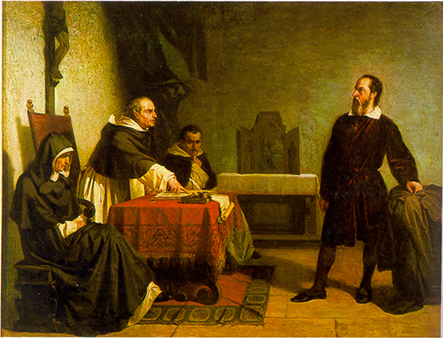 It's one of the most disputed chapters in the history of science, and critics of religion say it's an historical smoking gun which indicts the church as an organisation that assualts those who dare to think new ideas. Galileo proposed an idea that we now take for granted: that the earth rotates around the sun.
This idea (sometimes called "heliocentricity") had already been suggested as a hypothesis by Copernicus, and it was a perception that even the ancient Greeks considered. What Galileo brought that was innovative to this old idea was new observational technology, with the development of the telescope. Heliocentricity was not just an operating hypothesis for Galileo; it was a factual claim, evidenced by observation, that overturned the conventional wisdom of "geocentricity" (the idea that the sun rotates around the earth). But the church authorities of his day, Galileo's claim, and (perhaps more to the point) the way that he advertised his claim, was beyond the pale. The great scientist, often described as the father of modern science, was charged with heresy, tried in a church court, and eventually silenced and detained under house arrest.
On today's Sunday Sequence, Fr Ernan McMullin, a professor of history and philosophy of science at the University of Notre Dame, argued that the Galileo Affair is widely misunderstood. This was not a clash between science and religion. Everyone involved in the case was a Christian. Galileo wrote many thousands of words on the theology of biblical interpretation as he sought to make sense of the telescopic observations he was making.
You can read a summary of Ernan McMullin's argument here, in a paper published by the Faraday Institute for Science and Religion.
Fr McMullin's paper is part of a Faraday Institute series exploring some of the key questions emerging in the debate about science and religion. These include: "Creation and Evolution, not Creation or Evolution", "Interpreting Genesis in the 21st Century", "Ethical Issues in Genetic Modification", and "The Anthropic Principle and the Science and Religion Debate". Read them all here.


Comment number 1.
At 11:53 27th Jun 2010, newlach wrote:When Ernan McMullin made light of Galileo's house arrest I was immediately reminded of The Burmese government's house arrest of Aung San Sue Kyi. People under such luxurious house arrest really should show some appreciation for those who keep them captive!
Apologists for the Catholic Church might like us to think the Galileo affair was merely a minor disagreement between Christians, but it was such a blatant attempt by the Church to suppress the truth. I read on Wiki that Galileo 'was found "vehemently suspect of heresy"' - had he been found guilty of heresy would he have been burned at the stake like Giordano Bruno was in 1600?
Complain about this comment (Comment number 1)
Comment number 2.
At 12:59 27th Jun 2010, brianmcclinton wrote:This conference had me spewing out my pomegranate juice and choking into my Sainsbury’s balance with red berries. I felt my intelligence was being insulted and assaulted early on a Sunday morning. Speaker after speaker seemed to want to downgrade their IQs. Do they think SS listeners are idiots, or what?
As for Fr Ernan McMullin and Galileo, he spent so much time on Copernicus that the punchline about Galileo’s trial went awol altogether. Yes, and of course the house arrest, well, that was a mere bagatelle.
Like the other bagatelles. Bernardino Telesio (1509-1588) was a fervent critic of metaphysics and insisted on a purely empiricist approach in natural philosophy, becoming a forerunner of early modern empiricism. His book De Rerum Natura (On the Nature of Things) argued that all knowledge is sensation and that intelligence is therefore a collection of isolated data provided by the senses. This aroused the anger of the Church on behalf of its cherished Aristotelianism, and a short time after his death his books were placed on the Index. What about that notorious Index, father. Was it a figment of the historical imagination?
Others suffered worse fates than Telesio. Tommaso Campanella (1568-1639), a Dominican from Stilo in Calabria, became a disciple of the Greek sceptics and a follower of Telesio. In 1591 he published Philosophia Sensibus Demonstrata, or 'Philosophy Demonstrated by the Senses', in defense of Telesio. Nature should be observed 'directly' rather than relying on the written texts and shibboleths of the past. The book was condemned by the Holy Office and Campanella was imprisoned for heresy.
He got into more trouble for another work in which he argued that all nature was alive and that the world possessed a soul "created and infused by God". This time the Inquisition locked him up for 27 years. He eventually fled to France, where he lived his life out peacefully under the protection of Cardinal Richelieu. In 1622 he published his Apologia pro Galileo ('Defence of Galileo') in which he defended the Copernican system and the separate paths of Scripture and nature to knowledge of the Creator. He argued that truth about nature is not revealed in Scripture and claimed freedom of thought in philosophical speculation.
Newlach mentions Bruno (1548-1600), a lapsed Dominican friar from the same region, who was not so lucky. In De l'Infinito, Universo e Mondi (On the infinite Universe and Worlds, 1584) he argued that the universe is infinite and is full of a plurality of heliocentric systems, which are composed of matter and soul. Both matter and soul are two aspects of a single substance in which all opposites and all differences are reconciled. The soul of the universe is intelligent; it is-here Bruno takes a pantheistic view - in fact God. Birth is the individualization of the infinite (God) in the finite; death is the return of the finite to the infinite. Religion has a practical but not a theoretical value. Morality is the participation of the individual in the life of the universe. Bruno was charged with atheism because he identified God (the universe or external cause) and Nature (a different form of the universe although a totality of phenomena). To identify God and Nature was not a negation but an explanation, which construction led to Bruno's condemnation. This Humanist martyr, who championed the Copernican system and opposed the stultifying authority of the Church, refused to recant his philosophical beliefs throughout his eight years of imprisonment by the Venetian and Roman Inquisitions. In the early hours of the morning of 17th February 1600 he was taken to the Piazza dei Fiori in Rome and burnt alive at the stake.
His life stands as a testimony to the drive for knowledge and truth that marked the entire Renaissance epoch. In a sense, just as the period began about 1330, so it can be said to have reached its end, at least in its Italian manifestation, with Bruno's death in the year 1600. He challenged all dogmatism, including that of the Copernican cosmology, the main tenets of which, however, he upheld. He believed that our perception of the world is relative to the position in space and time from which we view it and that there are as many possible modes of viewing the world as there are possible positions. Therefore we cannot postulate absolute truth or any limit to the progress of knowledge. Bruno wrote in one of his final works, De triplici minimo (1591): "He who desires to philosophise must first of all doubt all things. He must not assume a position in a debate before he has listened to the various opinions, and considered and compared the reasons for and against. He must never judge or take up a position on the evidence of what he has heard, on the opinion of the majority, the age, merits, or prestige of the speaker concerned, but he must proceed according to the persuasion of an organic doctrine which adheres to real things, and to a truth that can be understood by the light of reason".
Let’s turn to Galileo from 1632 on. Galileo received a summons to appear before the Inquisition. Being by then an old man, he asked that his trial be moved to Florence, a request which was refused. Three physicians then declared that Galileo was too ill to travel to Rome. The Inquistion rejected their statement and declared that if Galileo did not travel to Rome voluntarily he would be arrested and taken in chains. In February 1633 Galileo arrived in Rome. He was allowed to stay at the home of the Tuscan ambassador, but was forbidden to have social contacts.
In April 1633 Galileo was interrogated before the Inquisition. For over two weeks he was imprisoned in an apartment in the Inquisition building. After being shown the instruments of torture, he agreed to plead guilty to a lesser charge in exchange for a more lenient sentence. He declared that the Copernican case was made too strongly in his book Dialogue Concerning the Two Chief World Systems, and offered to refute it in another book.
In June 1633 Galileo was sentenced to prison for an indefinite term. Seven of ten cardinals presiding at his trial signed the sentencing order. Galileo signed a formal recantation. He was allowed to serve his term under house-arrest in the home of the archbishop of Siena. In December he was permitted to return to his villa in Florence, where he lived under house-arrest.
In January 1638 Galileo, now totally blind, petitioned the Inquisition to be freed, but his petition was denied. On 8th January 1641 he died. In 1835 his Dialogue Concerning the Two Chief World Systems was taken off the Vatican's list of banned books. In 1992 the Catholic Church formally admitted that Galileo’s views on the solar system were correct.
Now, to say that all of this was not a dispute between religion and science is to quibble with words. We can say that it was a dispute over theology, or we can say that it was a dispute over science. What labels we stick on the argument doesn’t change the facts. And, of course, most of these scientists and philosophers were formally Christian, as were most people who lived in Christian Europe at the time, but what does this prove? The fact is that they disputed the dominant Christian view of the time and were victimised for it: imprisoned like Campanella, burnt at the stake like Bruno, or placed under house arrest, shown the instruments of torture and placed on the Index like Galileo.
Complain about this comment (Comment number 2)
Comment number 3.
At 16:59 27th Jun 2010, Heliopolitan wrote:For goodness sake, Will, McMullin's paper makes the point! It doesn't really seem possible to spin it any other way. Theology is a waste of time; by all means make it the SLAVE of science, but it can never EVER be its master. The Galileo affair makes that very very clear. The fact that Galileo was a Christian is completely irrelevant - it was not *Christianity* he was up against, but the nonsensical notion that the truth or otherwise of a proposition owed the slightest thing to its theological ramifications.
Now I'll need to have a listen to SunSeq - a little birdie tells me that someone was trying to defend Jerry Fodor's scientifically illiterate and ignorant comments on evolution; I hesitate to comment further without hearing what was said.
Complain about this comment (Comment number 3)
Comment number 4.
At 22:04 27th Jun 2010, Heliopolitan wrote:Aaaargh! Just listened to the podcast. What a dose of soap. What a *terrible* panel! Brian, I am in complete agreement with your assessment; it totally confirms my earlier point that Ernan McMullin convincingly makes the case that theological aspirations to make pronouncements on scientific issues are utterly misplaced. And if the panel were bad, the audience were worse, although I would like to hear a bit more from that Rev Hay chap about how he finds life as an evolutionist member of the clergy.
More on the "Ceasefire" thread - suffice it to say that the prospects of a ceasefire with such prolific cabbage vendors do not strike me as very promising. Relinquish your truth claims, chaps - then we can discuss the terms of your surrender.
Complain about this comment (Comment number 4)
Comment number 5.
At 23:52 27th Jun 2010, Phil Lucifer wrote:McMullin says that Galileo was "only" under house arrest. For 20 years. Lucky old Galileo!
And the Inquisition have been grossly misrepresented too. Those so-called instruments of torture were really only manicure sets and curling tongs. The thumb screws were to straighten unsightly gnarling of the bones. The Inquisition were really chiropractors, you know.
And Giordano Bruno was not burnt. He just became a little overheated in the course of an argument with some chiropractors.
Complain about this comment (Comment number 5)
Comment number 6.
At 10:50 28th Jun 2010, Will_Crawley wrote:Helio -- a predictably subtle and thoughtful response. Our programme has given a great deal of coverage to the new atheist movement (I think I've interviewed just about all the major movers in that movement more than once), but this gathering was mostly of theists working in science or interested in the questions. You regard their comments as cabbage; I'm sure they'd regard yours as manure. But do the horticultural analogies really help any of us to discuss the questions?
Complain about this comment (Comment number 6)
Comment number 7.
At 10:55 28th Jun 2010, brianmcclinton wrote:Come off it, William. It was apparent that you too were frustrated by many of the simplistic and inaccurate comments.
Complain about this comment (Comment number 7)
Comment number 8.
At 11:50 28th Jun 2010, Will_Crawley wrote:Now Brian, you know that my levels of frustration are extremely variable :)
Complain about this comment (Comment number 8)
Comment number 9.
At 12:27 28th Jun 2010, Heliopolitan wrote:Will, you know you can rely on me to step up to the mark :-)
I appreciate that the learned punters on the panel might disagree with me and with other atheists (Christian and otherwise), but if you're saying this was just a talking shop for "believers", with no outside input required, then you'll get no argument from me there! It's not that SunSeq hasn't covered the "New Atheists" - this conference was touted as exploring the issues between religion & science, and it seems that the very important viewpoint that there IS a major incompatibility should have been represented. You think not?
Complain about this comment (Comment number 9)
Comment number 10.
At 21:49 28th Jun 2010, Eunice wrote:Just listened to the podcast. Lots that could comment on but will endeavour to keep it short and sweet!
Free will : we do and we don't have free will! Most people are influenced by their conditioning, upbringing etc and prior choices and experiences such that they are in a momentum that means they don't have true free will as such. Also there is no true free will unless you know which source of energy you are aligned with - God/not God, love/not love.
Laws: yes there are laws of the universe that can be known and life can be lived according to them such that suffering is to a large extent eliminated. The most basic law of the universe is that God is love
God can be known as opposed to being 'believed in'. Whilst many people do 'believe in' God, for others that statement would be false or like a lie - because they don't 'believe in' God but know God - and that knowing is not with arrogance but with humility and true understanding.
Suffering arises primarily due to our separation from God/love. This separation occurred aeons ago but continues every day in our choices that are frequently loveless and disregarding of ourselves and the body. The body is the marker of truth and reveals all our choices so cancer/illness and disease etc is a result of our own choices that have not been made from, with and in love. Love is our true nature - so loveless choices goes against our true nature and results in disharmony/dis-ease in the body. Illness and disease are the mechanisms the body uses to clear itself, heal itself. All of these things are healing in themselves. Many people are brought to God through suffering and find out that these are healing and in the bigger picture endeavouring to heal one's separation from God. Healing involves making self-loving choices and knowing that irrespective of the bodily affliction one's essence of love remains unharmed. Other factors come in like karma - for illness and disease in children and stuff that is unhealed from previous lifetimes.
There is a bigger picture to tsunamis/earthquakes etc some of which was covered in the volcano thread so I won't repeat it here - just to say that we are interconnected with all of it and there are no accidents. Put in a simple way - as our bodies have to clear the crap we put into them and can do so through illness and disease - the earth has to do the same. The microcosm/macrocosm. All of that is also healing.
The whole notion of wanting to overcome death (and live for 500 years - like do you really want to live for 500 years Will??) ) is based on an assumption that death is somehow bad or to be avoided. This in my view is wrong. Death is not to be feared. It is very healing, very liberating and is a very natural part of our unfolding and evolving back to God. It is not the end. We have many lifetimes and how we live each life influences the next. It is all part of a glorious healing journey back to the love we separated from. And linking into the above part on suffering - the trick is to live and make choices from that love in life and all is then known through that love, including God. God is always love and always healing in all of it.
Surprise surprise it was not so short! But still sweet eh! :-)
Complain about this comment (Comment number 10)
Comment number 11.
At 23:14 28th Jun 2010, Casur1 wrote:Galileo may have been right, but he wasn't very scientific. He put forward his ideas without any proof and in the teeth of the (then) known evidence, but insisted they must be right because they were the ideas of the great Galileo. When the Church offered to publish them (the bit that's usually conveniently forgotten) Galileo went ballistic because they would only publish them as theory, not established fact (and remember, at that point, they were only theory). Galileo is always lauded as the great scientific rationalist, but its just a little too easy to forget that the man was a thief and a liar: he made a ton of money ripping off the telescope and claiming it as his own invention; ditto the military compass. When he swindled his way into print, presenting his unsubstantiated thoery as established fact with the imprimatur of the Church, he went too far. This was still renaissaince Italy, and if you peed behind the palace door, you got a slap. Galileo peed behind the palace door; what did he think was going to happen?
Complain about this comment (Comment number 11)
Comment number 12.
At 10:02 29th Jun 2010, PeterKlaver wrote:#11 reminds me of when creationists go about tarring Darwin as being racist/nazi-enabler/sexist/etc. When the message a scientist put forward is inconvenient but you have no substantial reply, try tarring the messenger. And as usual for the god crowd, Casur1 doesn't seem to hindered much by a grasp of history.
Complain about this comment (Comment number 12)
Comment number 13.
At 11:56 29th Jun 2010, Casur1 wrote:Nothing I've written above is incorrect. Galileo was right because he guessed right and for no other reason. If he was active today, he'd be thrown out of the scientific establishment for the chancer he was; it wouldn't require the Church to do it. If PeterKlaver's position is that science should be run on guesswork by meglomaniacial charlatans, then by all means let him hold Galileo up as the examplar of science. As a Catholic, I'm getting just a little tired of hearing the adherants of scientism wittering on about rationality and consistancy on one hand, then worshipping at the shrine of Galileo on the other.
Complain about this comment (Comment number 13)
Comment number 14.
At 12:42 29th Jun 2010, brianmcclinton wrote:Casur 1:
For a ‘chancer', Galileo certainly uttered a lot of good sense.
“All truths are easy to understand once they are discovered; the point is to discover them.”
“You cannot teach a man anything; you can only help him discover it in himself.”
“I do not feel obliged to believe that the same God who has endowed us with sense, reason, and intellect has intended us to forgo their use.”
“I have never met a man so ignorant that I couldn't learn something from him.”
“Doubt is the father of invention.”
“In questions of science, the authority of a thousand is not worth the humble reasoning of a single individual.”
“And who can doubt that it will lead to the worst disorders when minds created free by God are compelled to submit slavishly to an outside will? When we are told to deny our senses and subject them to the whim of others? When people devoid of whatsoever competence are made judgesover experts and are granted authority to treat them as they please?These are the novelties which are apt to bring about the ruin ofcommonwealths and the subversion of the state.”
“And yet Its still moves”.
“I think that in the discussion of natural problems we ought to begin not with the Scriptures, but with experiments, and demonstrations.”
“It vexes me when they would constrain science by the authority of the Scriptures, and yet do not consider themselves bound to answer reason and experiment.”
Facts which at first seem improbable will, even on scant explanation, drop the cloak which has hidden them and stand forth in naked and simple beauty.”
“The Milky Way is nothing else but a mass of innumerable stars planted together in clusters.”
“Spots are on the surface of the solar body where they are produced and also dissolved, some in shorter and others in longer periods. They are carried around the Sun; an important occurrence in itself.”
“To command the professors of astronomy to confute their own observations is to enjoin an impossibility, for it is to command them not to see what they do see, and not to understand what they do understand, and to find what they do not discover.”
Casur 1: you are certainly not one to let the facts get in the way of a nasty prejudiuce, are you? I actually thought your first posting on this (11) was a wind-up. But, horrors of horrors, you actually believe it!
What Ernan McMullin has said about Galileo is nothing new. Frankly, I am getting rather tired of the Catholic Church’s attempts to rewrite history in the case of Galileo and others who questioned their orthodoxy. I suggest you educate yourself a little. Buy 'Galileo Antichrist' by Michael White and you might learn some real history.
Complain about this comment (Comment number 14)
Comment number 15.
At 12:54 29th Jun 2010, grokesx wrote:I'm LMAO here. On a thread dedicated to a more sophisticated, nuanced vew of the Galileo Affair than is ever considered by those unsubtle, simplistic New Atheists, we get Casur1's hyperbole.
You couldn't make it up.
Complain about this comment (Comment number 15)
Comment number 16.
At 12:55 29th Jun 2010, brianmcclinton wrote:In post 2, second last paragraph, I wrongly gave the date of Galileo's death as 1641. It was, of course, 1642.
Complain about this comment (Comment number 16)
Comment number 17.
At 13:08 29th Jun 2010, Heliopolitan wrote:Casur1, I presume you at least agree that the church has/had no authority to adjudicate on matters of science? Back then they clearly thought they *had*, and that remains a disgrace. Galileo was irrascible - supreme geniuses often are. And he had plenty to get annoyed about. His treatment at the hands of the monstrous and arrogant Catholic Church was truly appalling. As for this notion that he "didn't have the evidence" - that is simple nonsense. He *did* have the evidence. Brian is our Renaissance Man - I'm sure he'll have more to say on the topic :-)
Complain about this comment (Comment number 17)
Comment number 18.
At 13:31 29th Jun 2010, Casur1 wrote:So far, the only one who has actually addressed anything I've said is Heliopolitan: to him I say, no, Galileo had evidence, but he did not have THE evidence. By this, I mean that his theory (actually Copernicus's theory more or less, but Galileo wasn't the man to let a little thing like that get in the way of his ripping off a good idea; he never had before) had SOME facts to back it up, but not enough to dislodge the established Earth-centric theory. That was why the Catholic Church, that universal font of all evil, offered to publish Galileo's ideas, BUT ONLY AS THEORY, which at that time they were. You can't come back now with the benefit of hindsight and say that because Galileo happened to be right that he was a great scientist when he was basically going with a hunch. Galileo got himself in trouble because he was too pig headed and arrogant to accept that his hunches were no batter than anybody else's. You cannot come along and demand we give respect to the scientific method as the rational and logical path and then turn around and hold up Galileo as a champion of that same rationality. Not only is it illogical, it a classic example of changing the rules when it suits one's prejudice.
Complain about this comment (Comment number 18)
Comment number 19.
At 14:32 29th Jun 2010, Heliopolitan wrote:Casur1, yes, Galileo was right, but to turn the thing around here, what gave the CHURCH the right to adjudicate on this? By what authority could some ecclesiastical functionary muster the insane arrogance to claim that the earth-centric model should stand until proven otherwise? Forget Ernan McMullin - YOU are making the point. The church was utterly *wrong* in this issue. But WHY they were wrong is the interesting thing.
You are evidently not a scientist; if you were, you would know that when a new idea comes along (and Copernicanism was hardly a new idea; claiming that Galileo was selling it as purely his idea is disingenuous and wrong), it has to fight against the established order.
And, insofar as the erroneous geocentric model was the established order, it was only fair dues that Galileo had a fight on his hands. What was NOT fair dues was the theocratic backlash. When you fight in science (and we do fight - amicably, usually), you use SCIENCE, not theology. You use arguments, not threats of torture or imprisonment or worse.
As it was, (and a fact acknowledged by the previous Pope), the RC Church was completely out of order in this whole affair - it overstepped its mark, thinking that it could adjudicate in matters of science. It overlapped with the wrong magisterium. Rather than peeing behind the palace door, Galileo should have taken off and nuked the place from orbit. It's the only way to be sure.
It's maybe not too late.
Complain about this comment (Comment number 19)
Comment number 20.
At 21:33 29th Jun 2010, Casur1 wrote:What gave the Church the right to adjudicate? Who else was in a position to? After all, who do you think founded the university system? Colleges did not just burst forth from the ground like fungi, and it is only in recent centuries that they became autonomous. They were the product of a society where the only body attempting to preserve and advance learning was the Church. I know this doesn't fit with scientism's party line, but it happens to be true. Unfortunately, too many scientists seem to think they can pronounce difinitively on historical matters (and pretty much everything else) on the back of a science degree. Galileo was a man of genius, but he was also a lazy chancer who expected the world to be turned upside down on his oncorroborated word. Much of his theory was actually validated by the Jesuit astronomers at the Vatican, men who were prepared to put in the work and follow where the evidence led. This is another little inconvience that tends to get airbrushed out of history because it doesn't fit the cliche of the barbarous Catholic Church. Being right is good; guessing right is not.
Complain about this comment (Comment number 20)
Comment number 21.
At 22:04 29th Jun 2010, brianmcclinton wrote:Casur1
Posts 11/18/20
You say: “Galileo may have been right” but he wasn’t very scientific”.
Galileo WAS right. Do you dispute that the earth revolves around the sun?”
“but he wasn’t very scientific”.
You mean, he carried out observations and experiments, unlike the Catholic Church, which pronounced on the basis of faith and dogma. That’s a very strange reversal of scientific procedure.
You say: “He put forward his ideas without any proof in the teeth of the (then) known evidence”.
1. His ideas were based on evidence, unlike the Church’s.
2. His ideas were based upon observation, unlike the Church’s.
What ‘proof’ did the Catholic Church have of its ideas? Certainly none, since they were wrong! What was the then known evidence? The Bible? It was evidence?!? Cardinal Bellarmine? In fact, it was Bellarmine who insisted on complete certainty before he would reconsider what the Bible seemed to say. Science cannot operate in such an environment.
Galileo developed a telescope bigger than anything then in existence: 20x magnification. “it was not until 1630 that anyone produced telescopes with higher maginification” (Thomas Crump: ‘A Brief History of Science’, p50). With his telescope he found that there were many more fixed stars than could be seen with the naked eye and that the planet Jupiter had four small companions in orbit around it.
Also, he revealed that the moon was not a perfect sphere, as Aristotle had said all heavenly bodies must be, but disfigured by craters and mountains. He then discovered that Saturn had ‘ears’ and that Venus had phases like the moon. “This last observation was the most important. Galileo noted that sometimes, when he looked at Venus through his telescope, he saw almost a complete disk. At other times, only a semicircle or even less of the surface was visible. The periods of these phases were such that Ptolemy’s model of the heavens was wrong. Venus did not orbit the earth; it orbited the sun” (James Hannam: ‘God’s Philosophers’, p312).
You say: “He insisted his ideas must be right because they were the ideas of the great Galileo”.
No; he said they were right because they were based on the type of observation and experiment noted above.
You say: “When the Church offered to publish them... went ballistic etc”.
No, in 1616 the Congregation of the Index suspended Copernicus’ book ‘Revolutions of the Heavenly Bodies’ until corrected. Bellarmine warned Galileo that he could not defend, hold or teach the views of Copernicus. Bellarmine died in 1621 and in 1623 there was a new Pope, Urban VIII. He seemed more sympathetic and this encouraged Galileo to write his ‘Dialogue Concerning the two Chief World Systems’ (1632). I outlined what happened above. Yes, he lied when he recanted under threat of torture. But what would you do in similar circumstances, Casur1?
Read the Antidogmatic ‘Phil Lucifer’ above and you will see that the chiropractors had a serious argument with Bruno. In his book ‘The Pope and the Heretic’ Michael White writes: “after the fire has subsided, what remained of Bruno’s body was smashed to powder with hammers and the ahes were cast to the wind so that no one could save anything of the heretic as a relic. As far as the Inquisition was concerned, they had obliterated Bruno, destroyed his body, banished his memory, his ideas, his writings, his very thought, and he had been consigned to hell.”
I suppose you think he brought it all on himself. As far as Galileo is concerned, you have made a number of caricatured statements about his character - chancer, thief, liar - for which you have presented no evidence whatsover. In fact, your 3 postings on this topic are just unsubstantiated lists of nasty accusations. How scientific, how historical, how rational is that?
You also miss the crucial FACT that Galileo has been proved right and the Catholic Church wrong and that it took the Church 359 years to admit it!
Complain about this comment (Comment number 21)
Comment number 22.
At 22:25 29th Jun 2010, Heliopolitan wrote:Casur1, you really don't get it, do you? The Roman Catholic Church was not trying to defend (or uncover) truth - that power-mad organisation had already decided what "truth" was for it, and like the bloody murderous theocracy that it was, going against its diktats was punishable heresy. Sorry if that does not fit with your rosary-tinted spectacles, but the renaissance happened in *spite* of the church hierarchy, not *because* of them. The really strange thing is that you know and accept the facts of the case, but you still seem to want to spin it that science should doff its cap to these be-skirted oligarchs, and form an orderly queue until some old bishop gives them the go-ahead to announce their findings to an expectant world.
Sorry, but no can do. You may once have (undeservedly) had that power, but you have it no longer. As Will's entertaining little confab in Dublin showed, theology is now irrelevant. Back then it was simply malign. All in all, you should be thankful.
Complain about this comment (Comment number 22)
Comment number 23.
At 23:39 29th Jun 2010, brianmcclinton wrote:Casur1:
Oh yes, and what about Campanella? Phil Lucifer’s chiropractors were less ready to crack his joints and vertebrae but, according to a friend who visited him in his prison cell: “His legs were all bruised and his buttocks almost without flesh, which had been torn off bit by bit in order to drag out of him a confession of the crimes of which he had been accused” (quoted in Baigent and Leigh: ‘The Inquisition’, p139).
So, Galileo might have been lucky if he had stuck to his guns and not lied: he might have been beaten almost to a pulp like Campanella rather then fried and hammered to powder like Bruno.
Complain about this comment (Comment number 23)
Comment number 24.
At 01:22 30th Jun 2010, brianmcclinton wrote:Casur1:
You say that Galileo wasn’t very scientific. Well, by what standards: everything is relative. At least 3 well known scientists don’t agree with you.
Firstly, Stephen Hawking in ‘A Briefer History of Time’. He writes: “Galileo, perhaps more than any other person, was responsible for the birth of modern science... Galileo was one of the first to argue that man coulds hope to understand how the world works and, moreover, that we could this by observing the real world. Galileo had believed Coopernican theory (that the planets orbited the sun) since early on, but it was only when he found the evidence needed to support the idea that he started publicly to espouse it...Galileo remained a faithful Catholic, but his belief in the independence of science had not been crushed (by his trial and recantation). Four years before his death in 1642, while he was still under house arrest, the manuscript of his second major book was smuggled to a publisher in Holland. it was the work, referred to as ‘Two New Sciences’, even more than the support for Copernicus, that was to be the genesis of moderrn physics (pp145-146).
Secondly, here is Peter Atkins in ‘Galileo’s Finger: “Galileo marks the turning point, when the scientific endeavour took a new direction, when scientists - asn anachronistic term at the time, of course, rose from their armchairs, questioned the efficacy of the preceding attempts to come to grips with the nature of the world by thought in alliance with authority, and took the first faltering steps down the path of modern science... Galileo’s finger, then represents the misty concept of the ‘scientific method’ the centrality of experiment... Galileo also developed the art of simplification, the isolation of the essentials of a problem, the peering in his thoughts through the clouds that in real systems conceal the underlying simplicity, just as he looked through his actual telescope and saw the complexity of the heavens. He set aside the creaking cart pulled through mud; instead, he considered the simplicity of a ball rolling on an inclined plane, a pendulum swinging from a high support. That isolation of the core phenomenon from the creaks and confusions of reality is a key part of the scientific method. Scientists see the pearl in the oyster, theb jewel in the crown” (pp2-3).
Finally, here is Jacob Bronowski, in ‘The Ascent of Man’: Galileo is the creator of the modern scientic method... he turned it (telescope) on the stars. In that way he did for the first time what we think of as practical science: build the apparatus, do the experiment, publish the results” (p126).
Bronowski has more to say, as well as Michael White. I’ll leave it for another posting.
Complain about this comment (Comment number 24)
Comment number 25.
At 10:28 30th Jun 2010, brianmcclinton wrote:Casur1:
You suggest that Galileo was arrogant. Bronowski has a somewhat different take. He says that Galileo thought that all he had to do was to show that Copernicus was right, and everybody would listen. That was his first mistake: the mistake of being naive about people's motives which scientists make all the time. "Galileo seems to me to have been strangely innocent about the world of politics, and most innocent in thinking that he could outwit it because he was clever. For twenty years and more he moved along a path that led inevitably to his condemnation. It took a long time to undermine him; but there was never any doubt that Galileo would be silenced, because the division between him and those in authority was absolute. They believed that faith should dominate; and Galileo believed that truth should persuade" (p128).
Incidentally, as Bronowski points out, it was the infamous Cardinal Bellarmine who had also helped to send Bruno to the stake. Documents in the Vatican archive show that he instituted several inquiries against Galileo and reports of them are filed in 1613, 1614 and 1615. By this time, Galileo himself had become alarmed, with obvious good reason.
Complain about this comment (Comment number 25)
Comment number 26.
At 12:24 30th Jun 2010, Casur1 wrote:Well, we've got a ton of abuse, a barrelful of outrage and Helio going ape because anyone dares to challange (speak it softly and with dread) a scientist. What we haven't got is any explanation as to why it was ok for Galileo to present his theory as fact when it was not established as any such thing - it was established later by Jesuit astronomers, but it was not established when he blagged his way into print. We've had a lot of blatter about him being right, but no contradiction to the fact that he was guessing. Presumably, it's wrong to judge Galileo by the standards of the modern world where such unsubstantiated guesswork would have him thrown out of science, but it is (we need hardly say) quite right and proper to judge the renaissance Catholic Church by those same modern standards. Double standards, we may call them, since they're the ones which deliver us the result our prejudice demands. Finally, we've had Helio dropping his outrage at the Church adjudicating on scientific matters when it was awkwardly pointed out to him that the universities only existed because of that same Church, so instead we go over to broadside charges of 'power mad' clerics, and - apparantly - this is the brave new dawn of the rational that the New Atheism would usher in? Pardon me if I stick to my incence and rosary beads.
Complain about this comment (Comment number 26)
Comment number 27.
At 13:02 30th Jun 2010, Dagsannr wrote:Casur1,
The church (in its various incarnations) also got involved in torture, 'holy' wars, highly painful executions and the condoning (if the not the acceptance) of child abuse. The church, being one of the (if not the only) dominant powers at the time was involved in everything, so to claim that their role in university creation somehow absolves them from the heinous treatment of someone who disagreed with them is pointless.The universities were originally established as religious seminaries, they didn't branch out into natural sciences until well after Galileo.
I suspect there's largely an element of truth to all the claims; Galileo was perhaps arrogant and antagonistic with his claims (and he probably had every right to be) but the church needs to (and has) accept that despite his flaws, they persecuted and attempted to execute someone whose only crime was to present a view of the natural world that went against their prescribed dogma.
I really don't care much about Galileo, in the end he was proven right and so has been assigned an almost martyr-like status. I have more sympathy for all those over the ages who put forwards theories, based on good scientific practices, and had the church come down on them like a dogmatic ton of bricks but for whom their ideas didn't turn out to be correct and have been forgotten in history.
Plus, it's perfectly acceptable to judge the church using modern standards - for thousands of years they have been holding themselves up to be the moral guardians and wielders of the only truth. If their 'truth' needs judging using an older set of criteria, then it wasn't, or isn't, truth. Afterall, truth is truth. If you try to claim it's somehow different because of the way the world has changed, then why should I believe it now, it'll only change in a hundred years or so, and who's to say that truth isn't true, instead of this one?
Complain about this comment (Comment number 27)
Comment number 28.
At 19:38 30th Jun 2010, graham veale wrote:Yep, top notch hysterical research going on here...some of it absolutely hilarious. Clamp 'em minds shut tight boys!
Complain about this comment (Comment number 28)
Comment number 29.
At 08:34 1st Jul 2010, brianmcclinton wrote:Casur1:
You say (26): “Well, we've got a ton of abuse...”. All the abuse, my dear fellow, emanates from you. No one had abused anything or anybody until you piped in, describing Galileo as a chancer, thief and liar etc. But, of course, accusing ourselves of one's own crimes or weaknesses is a very human trait.
You also accuse Galileo of ‘ripping off Copernicus’ (post 18). Wrong again. Galileo wrote to the Grand Duchess Christina of Tuscany in 1615 about some professors who opposed the Copernican system:
“In order to facilitate their designs, they seek so far as possible (at least among the common people) to make this opinion seem new and to belong to me alone. They pretend not to know that its author, or rather its restorer and confirmer, was Nicholas Copernicus; and that he was not only a Catholic, but a priest and a canon”.
Galileo was defying the holy establishment in defence of a theory not his own, but a dead man’s, because he believed it was true. Don't you understand?
Heres the verdict of another 20th century scientist, Albert Einstein, no less. “Galileo was the father of modern physics — indeed of modern science altogether”.
Complain about this comment (Comment number 29)
Comment number 30.
At 09:55 1st Jul 2010, Heliopolitan wrote:Casur1, This is pointless; the church were the ones presenting geocentricity as fact. And murdering people like Bruno who disputed their authority to make such pronouncements. I suggest you listen to the Reasonable Doubts podcast - the most recent one puts paid to the hoary old myth that the church was a Good Thing for science and scholarship. Enjoy.
Complain about this comment (Comment number 30)
Comment number 31.
At 12:13 1st Jul 2010, Casur1 wrote:Pointless indeed. I still await an explanation on why Galileo gets a free pass on publishing guesswork as established fact. I don't suppose I'll get one.
Complain about this comment (Comment number 31)
Comment number 32.
At 13:41 1st Jul 2010, Heliopolitan wrote:Because it was NOT "guesswork"!
Whereas the "established fact" being promoted by the RC Church WAS guesswork.
So, Casur1, if you wish to criticise ANYONE for arrogantly pushing their unsupported opinion as "established fact", you should be criticising the religious authorities of the day. Indeed, they even *continue* to pass off their guesswork regarding the existence of god or the nature of the bread and wine in the eucharist and pretend that THAT is established fact. How do THEY get a free pass?
Plus ca change, eh?
Complain about this comment (Comment number 32)
Comment number 33.
At 21:02 1st Jul 2010, Casur1 wrote:And I think that pretty much winds it up folks. For those who still don't get it, yes, it WAS guesswork AT THE TIME. We know NOW that he was right, but he was still guessing THEN. It's called retrospective validation, but don't worry, science reserves it for special, privilaged people. Kind of like the doctrine of Papal Infallibility.
Complain about this comment (Comment number 33)
Comment number 34.
At 22:33 1st Jul 2010, Dagsannr wrote:Isn't all science guesswork, based upon collected evidence and presented as a theory?
Isn't that 'guesswork' only validated through absolute proof? Galileos ideas were proven over time with advanced in technology, other 'guesswork', such as atomic theory and the theory of gravity are still that same kind of 'guesswork'.
Since Galileo put forwards his guesswork based upon collected evidence and a worked out theory, and the church saw fit to torture him on theological grounds, I'd say he was fairly in the right.
Complain about this comment (Comment number 34)
Comment number 35.
At 22:47 1st Jul 2010, Heliopolitan wrote:Casur1, go back to post #32. You will find your answers there. Good night!
Complain about this comment (Comment number 35)
Comment number 36.
At 01:49 2nd Jul 2010, brianmcclinton wrote:Casur1.
Let's spell it out. It wasn’t guesswork (post 33). You are essentially regurgitating the finding of the 1992 Galileo Commission Report. It argues that Galileo did not seem to understand that the Copernican model was merely a hypothesis. He had no proof of the heliocentric world view and was therefore betraying the very scientiic method he was espousing.
This charge of lack of scientific rigour twists the facts for at least two reasons. First, the Church was never interested in the scientific meaning of Copernicanism. At no point was science argued over. There were no scientists on the committee that investigated Galileo’s ‘Dialogues’.
Secondly, Galileo was well aware of the fact that the Church treated Copernicanism as a hypothesis, but what do we mean by that word? In Galileo’s two encounters with the Holy See (with Bellarmine in 1616 and his trial in 1633), the term is used by him and them in very different ways. To Galileo a hypothesis was simply a working model, a step on the road to the establishment of a world view, a perfectly scientific approach. To the Church, on the other hand, a hypothesis was something that could be swept under the carpet because it had not been proved conclusively.
The fact of the matter is that the Church attacked Galileo (and Copernicus) simply because their views offered an alternative to Vatican dogma. It was not interested in logical conclusions or the merits of one theory over another. It insisted it was right and all other views were wrong. Period.
In other words, there was a difference in motive between Galileo and the Church. He was motivated by A DESIRE TO KNOW AND UNDERSTAND; it was motivated by FEAR. The Copernican theory challenged the fear on which its authority was based.
Of course, Casur1, Galileo could not PROVE that Copernicus was right, as Natman suggests. But he did have some compelling evidence to support him, includiung his many observations of the Jovian system, the pahases of Venus and the regular procession of sunspots across the face of the sun. All these were completely ignored by the Inquisition.
In earlier posts, I singled out Campanella and Bruno. You have avoided any comment on them. They proved that it was all about instilling fear and obedience - and even about displaying hatred and contempt. Between 1500 and 1650 the Inquisition murdered an estimated 30,000 women, who were found guilty of witchcraft. Do you think, Casur1, that this alleged ‘witchcraft’ was ‘established fact’ or mere ‘guesswork’ by the Church? Or was it not just a horrendous display of misogyny by a few powerful men in the Catholic hiercrchy?
Complain about this comment (Comment number 36)
Comment number 37.
At 07:47 2nd Jul 2010, Heliopolitan wrote:Brian, precisely. An allied point that we can bring in at this stage is that the Inquisition at the time, the more recent commission set up by the previous pope, and many people in the general public do not seem to understand the meanings of the words "guess", "hypothesis", "theory", "fact", "evidence", "data" and many more. So we end up with laughable efforts like those of poor Casur1, or more "academic" exercises in missing the point like that of John Lennox (Graham, happy now?) and others.
The facts remain that Galileo Galilei (ironic name of course!) was a consummate genius, and was treated despicably by a bunch of ignorant functionaries and stuffed skirts who were unfit to tie his shoelaces, and by an institution that continues to try to whitewash its shameful past.
Complain about this comment (Comment number 37)
Comment number 38.
At 11:08 2nd Jul 2010, romejellybeen wrote:On the old chestnut of the Church being responsible for bringing education to the masses it should be noted that after the French Revolution, Catholic Orders of priests and nuns did set out to bring education to the poor.
Unfortunately within a short period of time they became amongst the most exclusive and highest fee-paying institutions in Europe. Access to education was denied to the very people schools were set up to help.
This maybe would explain something I have been wondering about. MCC and Casur1... were your parents poor?
Complain about this comment (Comment number 38)
Comment number 39.
At 12:14 2nd Jul 2010, Casur1 wrote:It's a bit like drawing teeth, but I think we're finally getting there. In fact, we know we're getting there when we start to argue semantics about the distinction between guesswork and hypothesis. For the tyro, it's a hypothesis when a scientist doesn it. Which, of course, is exactly my point: special rules for special people. Galileo was 'special' because he was one of the elite, and the fact that he broke the rules and published as fact -and lied and swindled his way into print to do it - what was still guesswork (whatever label you put on it) can, of course, be overlooked because he was 'one of us', the special people.
As to jellybeen's question, yes my parents were poor, so I didn't go to one of those exclusive Jesuit schools he's referring to. The interesting thing about those schools is that every rich bastard wants to get their children into them because they are so good. Go figure.
Complain about this comment (Comment number 39)
Comment number 40.
At 13:00 2nd Jul 2010, Heliopolitan wrote:Casur1, your lack of grace and understanding are really quite breathtaking. Do you deny that the liars, cheats and swindlers in the church hierarchy were enforcing (not just publishing) their view as *fact* (punishable by various sanctions) rather than as hypothesis? Galileo was correct, and it is the nonsensical babbling of a simpleton to suggest that he was engaging in "guesswork" - nothing could be further from the truth. He had a model (the heliocentric one) and he had data from observations (all the inquisitors had was theology, and nowadays we regard that as somewhat less valuable than dog excrement). Galileo quite correctly noted that in order to make the geocentric views - either Aristotelian or Tychian - fit, one had to invoke the craziest and most unsupportable notions about how things worked - in other words, the "established fact" being promulgated by his opponents was utterly hare-brained, and the only solution that made sense of his data was a heliocentric model.
Now we can speculate all day about the motives of the geocentrists, and we can laugh at their silly theology. And we can even make up fanciful stories as you do about Jesuit astronomers - yes, further data did confirm that Galileo was correct and the church was wrong, but it was just more data, and they were simply standing on the shoulders of the giant that was Galileo himself. They did NOT independently come up with this, and if the church had had its way, they never would have got anywhere.
Galileo was a genius. The church's behaviour in trying to suppress scientific inquiry was (and is) inexcusable.
Complain about this comment (Comment number 40)
Comment number 41.
At 15:03 2nd Jul 2010, brianmcclinton wrote:Casur1:
The Inquisition drew more than their teeth. Not a word from you about it. As for special rules, the Inquisition had these in bucketloads. What evidence did they have that 30,000 were 'witches'? You haven't answered that on either. In fact, ALL the guesswork was done by the Catholic Church and the Inquisition, from why many women are witches to why the earth does not move. It is was they who imposed standards on Galileo far in excess of any relevant proposition that they advanced. What you have done is to concentrate on unsuppported jibes at Galileo, while ignoring any criticisms of the Catholic Church at the time. Did it make any errors, Casur1. Perhaps you could THAT question.
I see that Graham has an allusion on the God Humour thread to the lack of recent research quoted here. The book by Michael White (‘Galileo Antichrist’) to which I referred above was published in 2007. Incidentally, he takes the view that Galileo’s real crime was not the endorsement of Copernicanism in the ‘Dialogues’ but the atomic theory he described in the ‘The Assayer’, which threatened to damage the orthodox depiction of the Eucharist. This view was, I think, first put forward by Pietro Redondi in ‘Galileo: Heretic’ (1987).
White's book includes lengthy transcripts of Galileo's 1633 trial. You can read for yourself what was said at it.
it also includes the full text of Galileo's great letter to the Grand Duchess Christina of Tuscany from I also quoted above.
Here is another famous part of the letter:
"I do not feel obliged to believe that the same God who has endowed us with sense, reason and intellect has intended us to forego their use and by some other means to give us knowledge which we can attain by them. He would not require us to deny sense and reason in physical matters which are set before our eyes and minds by direct experience or necessary demonstrations. This must be especially true in those sciences of which but the faintest trace (and that consisting of conclusions) is to be found in the Bible".
Complain about this comment (Comment number 41)
Comment number 42.
At 20:02 2nd Jul 2010, romejellybeen wrote:Casur1
I posted this on another thread a few weeks back. You might find it relevant to your stance on this thread.
Much of the following is taken from the book, PAPAL SIN, by GARY WILLS. I’ve also added a few relevant points of my own.
“The Pope is a freak of history, specifically, medieval history. His office does not date from the history of the early Christian community. Peter was not a Pope, or a Bishop or a priest – offices which did not exist in his lifetime.
Peter was not the leader of the Church either in Jerusalem or Rome – communities which were led by James and Clement, respectively.
Ratzinger has often said that doctrine is not set by “majority vote.” He is 100% wrong. That is precisely how creeds and doctrines were formulated. At the great Eastern Councils like Nicaea, Bishops from around the world VOTED on the deepest mysteries of our faith, namely the Trinity, the Incarnation and the Resurrection. There was no Pope at any of these Councils.”
Priests and Bishops were ELECTED by the people, not imposed on them as they are now. (In the rite of ordination the words are spoken, “After enquiry amongst the people of God, this man has been found worthy…” No he hasn’t. The ordinary people are never consulted. They have retained the words, but dropped the practice of consultation.)
In the Middle Ages, the Pope became a monarch, ruling armies and running territories and wielding power just like their fellow feudal Kings. Even now the idea of the Pope as ruler of a Sovereign State is being invoked to help him avoid having to answer very serious questions regarding the behaviour of some of his Bishops and priests.
The Papacy has nearly always been opposed to social change, Pius the IX famously describing democracy as an evil and illegitimate form of government.
The Papacy has historically set itself against science, against the Enlightenment, against contextual criticism from the time of Erasmus and against cosmology and astronomy in the time of Galileo. It opposed the “liberalism” of Lammenais and others, and set itself against biology and geology in Darwin’s time. It rejected the psychology of Freud but then found it to be quite handy later on as it attempted to identify, root out and expel homosexuals in its training places for priests.
Even with its lamentable history of backing losers at practically every important development in human history, in the present day and age, true to form, it set itself AGAINST pre-natal scans, AGAINST IV fertilisation, AGAINST artificial insemination, AGAINST surrogate motherhood and AGAINST using condoms in the fight against HIV/Aids.
Its record on anti-semitism is second only to that of Adolf Hitler’s. It actively promoted the idea that the Jews committed Deicide and even contained a prayer in its solemn liturgy for “the pervidious Jews.” It now attempts to cover up the anti-semitism of Pius and confer upon him a sainthood he so richly does not deserve.
It has been opposed to anything and anyone who has challenged the notion that it alone has the sole right to define reality. The authority of the Pope, the Bishop and the priest being given far more importance than the authority of the Gospel, with the “Thou art Peter” being placed on a pedestal above every other supposed utterance of Jesus Christ, certainly way above, “Love one another as I have loved you” or “The greatest among you must be your servant.”
In the present day it has cowardly attempted to scapegoat anyone and everyone rather than itself for the evil of the physical and sexual abuse of children and for cover up, pointing its tentacles of blame at the parents, the police, the media, homosexuals, liberals, modernists, Vatican II Council, secularism, positivism, relativism, pluralism, or the “permissive culture” which it tells us pervades our society. It only as recently as last week decided that the problem might actually not be “out there somewhere” after all, but inside the Church. In fact the truth is, if it wants to apportion blame, it needn’t even look any further than the balcony in St Peter’s Square.
It continues to cling to the “myth” with blind ferocity that only celibate males can be priests and that such men are somehow more spiritual or more attuned to the mind of God than married men and women.
Its solution to all of these problems which cry out to the heavens for change, for metanoia, is to force an unwelcome return to Latin, to bully nuns back into their habits and promote the shallowness that somehow priests are better men when they wear black suits or fine vestments.
It continues to insult other Christian Churches labelling them “gravely deficient.” Children who are born in the same maternity wards and who go on to share swing parks and swimming pools are wrenched apart at the age of five and are not allowed to share each others company in the classroom. They are not even allowed to learn together the beautiful words, “Our Father….”
And at the other end of the age spectrum, lifelong friends and neighbours who have shared life’s joy and pain, tears and laughter, holidays and hardships are still told to attend separate places of worship on a Sunday, a crime against their natural and God given inclination to BE community and to share a common spirituality and faith in the love of Jesus Christ.
Even in its own denomination amongst its own people, it callously attacked the poor of Latin America. It denounced those who were attempting to form base communities and who were yearning for freedom and liberation from the murderous dictatorships of the rich and the powerful they were subjected to for so long. It abandoned the very people Jesus Christ would have stood with, shoulder to shoulder.
Casur1, as a fellow Catholic, it would be really nice to hear a brother humbly admitting that he is wrong. Its okay to do that.
Complain about this comment (Comment number 42)
Comment number 43.
At 21:17 2nd Jul 2010, graham veale wrote:Redondi's thesis was widely rejected.
Michael White. Nice one, Brian.
Complain about this comment (Comment number 43)
Comment number 44.
At 23:20 2nd Jul 2010, brianmcclinton wrote:RJB:
Pretty strong stuff (42). Not too many punches pulled there. I dare say Casur1’s blood is boiling at this verbal roasting. It gives him of a frisson of the real roasting that people like Bruno suffered for their dangerous ideas.
This thread was about what really happened to Galileo. Casur1 cannot deny that:
1. Giordano Bruno was burnt at the stake for his heretical opinions.
2. Campanella was tortured and imprisoned for his heretical opinions.
3. Galileo was threatened with torture if he did not recant his heretical opinions.
4. The works of Copernicus and Galileo were banned by the Inquisition.
In other words, from these three examples alone, people in those times did not have the freeedom to express their own ideas. It is truly astonishing that Casur1 and others like him cannot see the wood for the trees. He dances on the head of a pin over the meaning of words like ‘scientific’, ‘hypothesis’, ‘proof’, 'guesswork' etc., as if these attacks on freedom of thought were purely abstract. People died, were physically abused or threatened with abuse because their opinions did not conform to that of the Church. The Vatican did not permit the truth of the solar system to be taught till after the middle of the 18th century, and Galileo's books remained on the Index until 1835.
Casur1 persistently shuts these crucial realities out of his mind.
Complain about this comment (Comment number 44)
Comment number 45.
At 23:37 2nd Jul 2010, brianmcclinton wrote:Bertrand Russell in his ‘History of Western Philosoophy has a chapter on the rise of science which discusses Copernicus, Kepler, Galileo and Newton. Galileo, he says, is the greatest of the founders of modern science, with the possible exception of Newton. He lists a number of his discoveries, and then says this:
“Galileo, as everyone knows, was condemned by the Inquisition, first privately in 1616, and then publicly in 1633, on which later occasion he recanted, and promised never again to maintain that the earth rotates or revolves. The Inquisition was successful in putting an end to science in Italy, which did not revive there for centuries. But it failed to prevent men of science from adopting the heliocentric theory, and did enormous damage to the Church by its stupidity. Fortunately there were Protestant countries, where the clergy, however anxious to do harm to science, were unable to gain control of the State” (p520, 1961 edition).
Clearly, Galileo lost the battle, but thankfully he won the war.
Complain about this comment (Comment number 45)
Comment number 46.
At 23:48 2nd Jul 2010, Heliopolitan wrote:Yeah, Brian, but the Roman Catholic Church founded the *universities*! Science would not have come along if it hadn't been for the careful patronage and the subtle management and choreography of the benign church. We should be thankful that after 1500 years of careful preparation of the ground, of sweeping away the erroneous learning of the Romans and Greeks, of the cultivation of a very useful series of Dark Ages, they stimulated the growth of science. Where is your gratitude for this benign cultivation?
If anything, we need more of the church's wise hand, holding back science and knowledge, until we're ready for it, until it is established fact, rather than guesswork.
Complain about this comment (Comment number 46)
Comment number 47.
At 00:14 3rd Jul 2010, brianmcclinton wrote:Helio:
Sorry. Do you think I should kneel and recant?
Complain about this comment (Comment number 47)
Comment number 48.
At 07:38 3rd Jul 2010, Heliopolitan wrote:Brian, yes, you should kiss the Pope's ring.
Complain about this comment (Comment number 48)
Comment number 49.
At 10:09 3rd Jul 2010, brianmcclinton wrote:Helio:
I'm back where I started in post 2, threatening to throw up my cereal. The thought of going within a million miles of Ratzi's holy relic makes me feel quite nauseous.
Incidentally, it was Ratzi, as head of the Inquisition, who said in 1990: “At the time of Galileo the Church remained much more faithful to reason than Galileo himself. The process against Galileo was reasonable and just”. So nothing much has changed since 1633. It's still lying in its teeth and defending the indefensible.
In 2008, as Pope Pope Benedict XVI, he was forced to cancel a visit to La Sapienza University in Rome after lecturers and students expressed outrage at this defence of the Catholic Church's actions against Galileo. 67 academics said that the Pope effectively condoned the 1633 trial and conviction of Galileo for heresy. In a statement they said: "The Church was unjust, irrational and unfair in its treatment of their predecessor and in its outright rejection of Copernican theory".
Complain about this comment (Comment number 49)
Comment number 50.
At 21:02 7th Jul 2010, DOYLER79 wrote:McClinton- have you any qualification in science?
Do you know more about cosmology/astronomy etc than the likes of George Coyne or Michael Heller?
Have you properly researched Galileo or do you just read wikipedia?
Where did you get that jacket you wore on UTV news a few weeks ago? Carter (sarcasm)?
Complain about this comment (Comment number 50)
Comment number 51.
At 21:15 7th Jul 2010, DOYLER79 wrote:By the way, was Galileo an atheist? Was Newton an atheist? Was Faraday an atheist? Was Lemaitre an atheist?
Does anyone know a "new atheist" who has a professional qualification?
Complain about this comment (Comment number 51)
Comment number 52.
At 22:26 7th Jul 2010, brianmcclinton wrote:Doyler79:
50. This thread is not about me but about Galileo. To answer one of your questions, I have researched Galileo a fair bit. I have read (some were mentioned on the thread):
Michael White's biography 'Galileo Antichrist',
'The Galileo Affair' by Paul Newall,
'The Trial of Galileo' by Doug Linder,
the chapter on Galileo in 'The Ascent of Man' by Jacob Bronowski,
the chapter in Russell's 'History of Western Philosophy',
the chapter in Stephen Hawking's 'A Shorter History of Time',
Two articles on Galileo in the magazine 'Humanist in Canada' (Nos 133 and 134)
and the chapter on Galileo in John Gribbin's 'Science: A History'
to name but a few, all in my house, and not in wikipedia. For example, chapter 6 of White's book starts with the word 'Padua' and there is a full-page picture of Galileo facing page 136.
What is your take on his trial?
51. None of the people you mentioned was an atheist. What's your point? Richard Dawkins is one of the leading so-called 'new atheists'. He has an M.A. and D.Phil from Oxford.
Complain about this comment (Comment number 52)
Comment number 53.
At 22:33 7th Jul 2010, Dagsannr wrote:Newton was a religion loon with some rather obscure concepts of divinity who also just happened to be rather good at science.
The reason we have seven colours in the rainbow is due to his perception that seven is a magical number - technically there are three colours, magenta, cyan and green, with three more secondary colours. but Newton the Strange didn't like that.
Complain about this comment (Comment number 53)
Comment number 54.
At 23:36 7th Jul 2010, Heliopolitan wrote:Hmmm. I don't know if I count as a New Atheist or not; I do have a couple of trifling professional qualifications, but I like to think my ability to think clearly and assess evidence is what's important, rather than the many certificates from learned institutions that cover the wall of my downstairs loo. Brian, I thought your jacket was gorgeous; If I were Ted Haggard, I would be over to you like a flash and be seeking your opinion on my polo-neck jumper. I wonder if Alvin Plantinga has any qualifications in science? Has William Lane Craig ever set foot inside a laboratory? Has John Lennox ever set up an ABI-3100 sequencer or run an agarose gel? Has Alister McGrath ever been to the moon? Did Jesus of Nazareth ever visit the Giant's Causeway? Did Moses know how many blocks of limestone were in the Great Pyramid of Giza?
Complain about this comment (Comment number 54)
Comment number 55.
At 23:56 7th Jul 2010, Heliopolitan wrote:Natman, that is something of a calumny that you're levelling at Newton there. He did not know about trichromatic vision, but that itself is really nothing to do with the "rainbow" per se. The various colours do of course blend one into the next as we move across the spectrum, but the way in which our eyes decode "colour" from (mixed) light wavelengths is much more interesting. The division into the "classic" seven colours of red, orange, yellow, green, blue, indigo, violet is really not bad; it is hard to see how they could have been split up differently.
Maybe someone else will know this - did Newton actually "invent" the designation of colours in a rainbow, or did the ROYGBIV pre-date him?
Interesting factoid - "white" LEDs do not provide the full spectrum of light - merely a mix of specific wavelengths that appear white to us. But different "real" colours absorb and reflect different wavelengths, meaning that the light from white LEDs looks very "washed out", and light from LED torches does not illuminate coloured objects very well - they look "grey". The same phenomenon makes colour reproduction in digital photographs a hit-and-miss affair.
Complain about this comment (Comment number 55)
Comment number 56.
At 20:12 8th Jul 2010, DOYLER79 wrote:No interest in it McClinton, I have a life
humanism - now there's a waste of time
other guy, I'm sure Lennox and McGrath know all about you and your qualifications- posting comments on this website- big time player
Complain about this comment (Comment number 56)
Comment number 57.
At 21:50 8th Jul 2010, brianmcclinton wrote:Let me say what I think was the main issue in the Galileo affair. Galileo never stated that he had incontrovertible evidence of the Copernican system. What he did have was a prepopnderance of evidence that pointed in that direction (phases of Venus, satellite eclipses, existence of tides etc).
Now, this was perfectly ‘scientific’, for science proceeds on preponderance of evidence, not finality. So the preponderance of evidence known to Galileo indicated that the earth actually moved and his belief in this was scientific.
Arguably, as a believing Catholic, he wanted the Church to prevent itself from making a mistake that would eventually tend to discredit its wisdom. He sought to separate purely scientific questions from matters of faith in order that rational discussion might remain free. If the Church were to suppress anything, he wrote, it should forbid any introduction of scriptural authority into debates that could be settled without it, by reason and experience alone.
In short, he wanted a separation between science and religion, the same separation urged by St Augustine, who said that a heretic might be better informed than a Christian in astronomical matters, that Christians should not spend time studying astronomy that could be better spent in pious devotions; and that it would be wrong to stake Christianity on such matters.
The Church at the time didn’t see it that way. Its prevailing attitude was that no contradiction of holy scripture could be permitted in science, any more than in other things. It regarded science as the handmaiden of philosophy, which in turn was the handmaiden of theology. Galileo wished to free science from philosophy as the historical obstacle to its utility and progress. He dreamed of a better philosophy as the ultimate result, not in conflict with theology but in harmony with it.
It was later philosophers and scientists who saw religious as an uncompromising enemy of religion. Arguably, this might not have happened if the Catholic Church had tried to suppress the opinions of Galileo and others who were its friends and if it had not attempted to justify its mistake by rigid adherence to it for three more centuries in the face of all the mounting evidence.
Galileo has won in the long run. The Church turned its back on him and has suffered for doing so.
Doyler79: I don't entirely believe what you say. You were interested enough to read at least a bit of the thread and to make a few comments, even if they didn't throw much light on the topic. You seem more interested in me and the 'other guy' than in Galileo.
Complain about this comment (Comment number 57)
Comment number 58.
At 21:57 8th Jul 2010, Dagsannr wrote:Helio, I'll give Newton the benefit of a doubt about not realising light was trichromatic, that's a (relatively) recent discovery, but he did have some very strange views regarding spirituality and the bit I said about the significance of the number seven is a valid fact, he like the number seven, so seven colours there are.
I'll be damned if I can tell the difference between indigo and blue, but that's just me :-)
Complain about this comment (Comment number 58)
Comment number 59.
At 22:24 8th Jul 2010, DOYLER79 wrote:Didn't read article, glanced over your comments
If you were to talk on The Galileo affair at a conference, would anyone turn up to listen to you?- No
Galileo remained a theist-good enough for me
Vatican observatory- one of the world's leading astronomy centres
Lemaire- big bang
you-think others should listen to your opinion....hmmmm
Complain about this comment (Comment number 59)
Comment number 60.
At 22:26 8th Jul 2010, brianmcclinton wrote:In my third last paragraph (57) a 'not' went missing. "If the Catholic Church had NOT tried to suppress..."
Complain about this comment (Comment number 60)
Comment number 61.
At 22:45 8th Jul 2010, DOYLER79 wrote:thanks McClinton, that's helpful- your comment might be posted in some astronomy journal (you can pick which one)
Complain about this comment (Comment number 61)
Comment number 62.
At 23:30 8th Jul 2010, romejellybeen wrote:Doyler
Slow down a bit please. Its a blog site where words are used. You can use as many as you like and you wont get charged anything extra.
Are you so intelligent that you are allowed to miss words out? Or are you just being dismissive and arrogant?
Complain about this comment (Comment number 62)
Comment number 63.
At 23:48 8th Jul 2010, grokesx wrote:@RJB
Don't feed the troll.
Complain about this comment (Comment number 63)
Comment number 64.
At 00:39 9th Jul 2010, brianmcclinton wrote:Just reread my third last paragraph. In the first line, the word 'religious' should be 'science'.
Doyler:
Your thinking in post 59 is somewhat disjointed. You say, inter alia: "Galileo remained a theist...good enough for me". Well, it shouldn't be good enough. You say you have a life. I take your word for it, but you really should use it to question rather than simply acquiesce. Socrates said: "The unexamined life is not worth living". No doubt, you are now planning to insult him as well.
Complain about this comment (Comment number 64)
Comment number 65.
At 09:34 9th Jul 2010, Heliopolitan wrote:I think Grokes has nailed it. Doyler, you're busted - sorry.
[On a tangent, I just noticed that Alister McGrath's wikipedia page still says that he was "formerly an atheist", when in fact his "atheism" was simply the mildly rebellious teenage phase that I think *everyone* goes through. By the time he had hair under his armpits he was a full-on Christian. That is not to belittle his current views, but one wonders why he makes so much of this "former atheism" as if it was a philosophical position he had ever really given any serious thought to.]
Complain about this comment (Comment number 65)
Comment number 66.
At 10:13 9th Jul 2010, brianmcclinton wrote:I said that Galileo won in the long run. I think I should point out that in a real sense he won at the trial as well. Two documents were produced, one by the Inquisition and one by Galileo himself. Both claimed to report the words of Cardinal Bellarmine in 1616 to Galileo, warning him about the Copernican theory. The Inquisition document, which some think was forged, stated that he was not to 'hold, defend, or teach in any way, orally or in writing that 'the sun is the centre of the world' or that 'the earth is neither in the centre of the world nor immovable, but moves as a whole and in daily motion'. This document was not signed by anyone, and that in itself is puzzling.
The point is that Galileo produced an affidavit signed by Bellarmine himself, dated May 1616, stating that the Copernican theory could not be held of defended, but that it might be taken hypothetically and made us of". Arguably, that is exactly what Galileo did in the Dialogue', although as I suggested earlier his understanding of an hypothesis was somewhat different from the Church's.
No signed document was ever found to support the unsigned memorandum on which the Inquisition based its charge. So, on the only substantive issue raised, Galileo won by the rule of best evidence.
Complain about this comment (Comment number 66)