

36 Arguments for the Existence of God
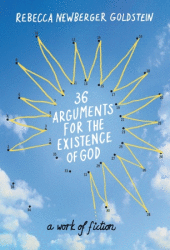 This work of fiction by Rebecca Goldstein isn't, I think, available yet, but it looks like fun. I'm a Goldstein fan, so this is eagerly-awaited. If you haven't read her biography of Spinoza, that's one to check out soon. There is an excerpt from the novel on the Edge site, including an appendix in which Goldstein assaults 36 philosophical arguments for God's existence. Such as:
24. The Argument from Perfect Justice
1. This world provides numerous instances of imperfect justice -- bad things happening to good people and good things happening to bad people.
2. It violates our sense of justice that imperfect justice may prevail.
3. There must be a transcendent realm in which perfect justice prevails (from 1 and 2).
4. A transcendent realm in which perfect justice prevails entails the Perfect Judge.
5. The Perfect Judge is God.
6. God exists.
FLAW: This is a good example of the Fallacy of Wishful Thinking. Our wishes for how the world should be need not be true; just because we want there to be some realm in which perfect justice applies does not mean that there is such a realm. In other words, there is no way to pass from Premise 2 to Premise 3 without the Fallacy of Wishful Thinking.


Page 1 of 2
Comment number 1.
At 12:21 23rd Nov 2009, Paul Robinson wrote:I don't know about her other work, but Goldstein's book on Goedel was regarded by philosophers / logicians as a hash.
Complain about this comment (Comment number 1)
Comment number 2.
At 18:07 23rd Nov 2009, grokesx wrote:Was that a joke, Paul? Commenting on an article with an example of a logical fallacy by poisoning the well?
Complain about this comment (Comment number 2)
Comment number 3.
At 22:34 23rd Nov 2009, Scotch Get wrote:From this she makes a living?
Complain about this comment (Comment number 3)
Comment number 4.
At 23:44 23rd Nov 2009, Paul Robinson wrote:No joke and no fallacy.
Complain about this comment (Comment number 4)
Comment number 5.
At 10:22 24th Nov 2009, graham veale wrote:Premises 3 could be rewritten - "if our sense of justice is reliable then injustice cannot triumph" etc.
4 "Our sense of justice is reliable"
5 "Injustice will triumph unless there is a transcendent realm where justice reigns"
But then you need some premises to introduce the perfect judge, and some to identify the judge with God. And 3 & 5 aren't convincing.
The whole thing's a straw man, of course. It's getting a pragmatic argument for the existence of God mixed up with an evidential argument. Or possibly it's bastardising the moral argument, or misrepresenting sonme argument from religious experience. Or all three.
Maybe the novel makes the point of the exercise clear. From the publisher's notes, I'd guess that's the case.
GV
Complain about this comment (Comment number 5)
Comment number 6.
At 14:35 24th Nov 2009, Heliopolitan wrote:It's a better argument than most I've seen. William Lane Craig makes a living out of recycling fallacious arguments for the existence of the Great Space Pixie, and we need not mention the amusing Plantinga for an example of a true virtuoso in the field of Just Being Wrong. Valid is no substitute for Sound.
Complain about this comment (Comment number 6)
Comment number 7.
At 15:07 24th Nov 2009, graham veale wrote:I'm not sure the above argument is valid.
The most generous interpretation I can give it is...
1) B Premise
2) (B&T)>Y Premise
3) Y>H From 1&2 (??!!!!)
B=Bad things happen
T=Bad things may triumph
Y=Yuk!
H=Something like heaven exists
Complain about this comment (Comment number 7)
Comment number 8.
At 15:09 24th Nov 2009, graham veale wrote:BTW
"It's getting a pragmatic argument for the existence of God mixed up with an evidential argument"
should read
"It's getting a pragmatic argument for the belief in God mixed up with an evidential argument for the existence of God."
Apologies all.
Complain about this comment (Comment number 8)
Comment number 9.
At 15:56 24th Nov 2009, Heliopolitan wrote:This comment was removed because the moderators found it broke the house rules. Explain.
Complain about this comment (Comment number 9)
Comment number 10.
At 17:43 24th Nov 2009, petermorrow wrote:Helio
Your comment is taking it's time appearing. Have you said something that maybe you shouldn't have and which is, now, the subject of modatorial debate, or have you been raptured and moved to another realm?
Here, hold on a minute, if you've been raptured, and I'm just about to sit down and eat.... that means.....
Complain about this comment (Comment number 10)
Comment number 11.
At 17:53 24th Nov 2009, petermorrow wrote:You know the cover of the book is almost as clever as the atheist ad thingy. Maybe it should be subtitled, "Almost a sunbeam for Jesus".
Dot to dotty, cooooooool.
Complain about this comment (Comment number 11)
Comment number 12.
At 18:57 24th Nov 2009, Parrhasios wrote:Makes me think of the old aphorism, possibly by Nash:
The rain it falls alike upon the just and unjust fella,
But mainly on the just, 'cos the unjust's got the just's umbrella.
One would like to think the unjust is in possession of the umbrella, not through theft as is sometimes posited, but because mercy, compassion and sacrifice are of greater importance to the just than any abstract notion of justice.
Complain about this comment (Comment number 12)
Comment number 13.
At 22:27 24th Nov 2009, David wrote:Space Pixies are real. I've seen them.
Complain about this comment (Comment number 13)
Comment number 14.
At 23:10 24th Nov 2009, romejellybean wrote:Parrhasios
I wish you had posted # 12 on Friday instead of today.
It was mum and dad's Golden Wedding on Saturday. I'd have written your words in gold, framed them and handed it to them as a summary of their lives.
Complain about this comment (Comment number 14)
Comment number 15.
At 23:23 24th Nov 2009, Heliopolitan wrote:Crikey - can't remember what I wrote, Peter - you know me; I don't usually flout the rules, and generally keep my comments well within the bounds of good taste and decency. Maybe the mods are a bit slow today. Come on, moderator chappies and chappesses! I'm dying to know whatever it was I said!
Complain about this comment (Comment number 15)
Comment number 16.
At 09:27 25th Nov 2009, graham veale wrote:Maybe #9's a kind of Pete Rollin's parable? We're meant to puzzle over the (not) meaning of the (not) post.
I (hope to) (probably) believe in the post (one day).
GV
Complain about this comment (Comment number 16)
Comment number 17.
At 13:00 25th Nov 2009, Heliopolitan wrote:Hi Graham,
Er... OK then :-)
Let's try a different tack - why does it MATTER whether or not we believe in god? What's the big deal? I mean, we get all het up over these arguments, but whether we come down on one side or the other, what practical difference does it make?
Complain about this comment (Comment number 17)
Comment number 18.
At 16:52 25th Nov 2009, graham veale wrote:Can I answer in a parable? And use lots of brackets? And the word 'not'?
Complain about this comment (Comment number 18)
Comment number 19.
At 18:10 25th Nov 2009, petermorrow wrote:Graham
I don't think it matters whether you use brackets or not.
Helio, you already know one of my answers to your question (what if there was no God), but you didn't get round to answering the reverse when I asked you.
So while Graham is answering his why does it matter question, would you consider answering what difference it would make if there was a God?
One thing is for sure though, we're never going to know the content of your post 9. And here, when comments pass from this realm, do you think they continue to exist, or is that it, kaput?
Complain about this comment (Comment number 19)
Comment number 20.
At 09:50 26th Nov 2009, Parrhasios wrote:RJB (#14) - hope they and you had a wonderful day - what a testimony!
David (#13) - I've seen them too (Bowie has a lot to answer for) - but it was 30+ years ago and you know I wouldn't absolutely swear they were real.
Complain about this comment (Comment number 20)
Comment number 21.
At 10:20 26th Nov 2009, Heliopolitan wrote:Hi Peter, if there turns out to be a god, that's cool. I would be most interested to have a chat with it, and would have one or two questions that I hope it would be able to clear up. No biggie.
My removed post was unfortunately snarled up by the mods, I think because of one of my proposed gastrointestinal uses of the Large Hadron Collider to put the God Hypothesis to the test. Never mind. The thrust of it was that, yes, the above argument is duff, but so are all the others - the "moral argument", the various flavours of the "ontological argument" (a fave of mine, because it employs *such* fallacious thinking), "fine tuning", "complexity" (duh), and many more. But I kinda think that is the point.
Of course, the fact that all the arguments "for" god are fallacious does not necessarily mean that there is no god, but absence of evidence is certainly evidence of absence when presence would be expected to yield evidence, and when the characteristics proposed for the pixie in question demand that evidence should be found.
Which is another reason why, if there is a god, I am entirely confident that my "belief" in the judeochristianislamic construct, or any other construct (I quite like Amun-Re), will make absolutely no difference to the outcome when/if I ever come to face with it.
If that's "faith", then I haz it, and I sleep very well at night (when my kiddies give me the opportunity).
Complain about this comment (Comment number 21)
Comment number 22.
At 10:34 26th Nov 2009, graham veale wrote:Can I tell my parable now?
Complain about this comment (Comment number 22)
Comment number 23.
At 11:26 26th Nov 2009, Heliopolitan wrote:Tower to Graham, you have clearance for take-off.
Complain about this comment (Comment number 23)
Comment number 24.
At 11:58 27th Nov 2009, Proto wrote:I agree that the argument as presented above is fallacious, but it reminds me of a related argument, which I think is sound and correct, from Marilyn McCord Adams. As someone who has always been on the line between atheism/theism, I do believe that something in my make up is consistent with the argument below. This, of course, does not imply truth.
The argument, as I remember it, is that a condition of the possibility of an optimistic world view being true is that there exists a superhuman power that is good enough and resourceful enough to make good and bring ultimate justice through the many and various horrors that riddle our world.
The atheist would not therefore be warranted in a sense of optimism or idealism, of thinking that life is worth living or for having higher purposes in their life through the suffering that exists in the world - unless of course they delude themselves.
My first post here - so "Hi".
Complain about this comment (Comment number 24)
Comment number 25.
At 12:07 27th Nov 2009, graham veale wrote:Hi Proto
Complain about this comment (Comment number 25)
Comment number 26.
At 12:18 27th Nov 2009, graham veale wrote:Graham to tower, commencing lift-off..
Once upon a time two explorers came upon a clearing in the jungle. In the clearing were growing many delicate flowers, lavender and snowdrops, rare roses and lupin. There were no weeds.
One explorer said,
"Some gardener must tend this plot."
The other disagreed, "There is no gardener."
So they pitched their tents and set a watch. No gardener was ever seen.
"But perhaps he is an invisible gardener." Said the believer.
So they set up a barbed-wire fence. They electrified it. They patrolled with bloodhounds. (For explorers always have elctrified wire and blood hounds at hand. Be prepared. That's their motto.)
But no shrieks ever suggested that some intruder has received a shock. No movements of the wire ever betray an invisible climber. The bloodhounds never give cry.
Yet still the Believer was not convinced.
"But there is a gardener, who is invisible and can make himself intangible, who is insensible to electric shocks, and who has no scent and makes no sound, a gardener who comes secretly to look after the garden which he loves."
To which the other explorer asked -
"Why does it MATTER whether or not we believe in gardener?"
Then the invisble gardener smacked the skeptic on the back of the head, and said
"Well, apart from anything else, it's nice to be acknowledged!"
GV
Complain about this comment (Comment number 26)
Comment number 27.
At 13:26 27th Nov 2009, graham veale wrote:An alternative ending has the gardener slap the skeptic and say "Electrified wire really stings your knee caps."
Complain about this comment (Comment number 27)
Comment number 28.
At 14:07 27th Nov 2009, Proto wrote:Hi Graham - nice parable.
A short reponse to Helio's comment (#17) is that it must be granted that if God does not exist that he does not matter, however, in all other scenarios, I expect He does.
Complain about this comment (Comment number 28)
Comment number 29.
At 14:20 27th Nov 2009, graham veale wrote:Proto
I suppose Anthony Flew and John Wisdom deserve some of the credit.
GV
Complain about this comment (Comment number 29)
Comment number 30.
At 16:58 27th Nov 2009, Proto wrote:Actually when I think about, even if God doesn't exist then belief in him still matters - as belief implies religion and is therefore empirically useful in a variety of areas (whilst of course not being immune from causing some harm in other ways).
Some examples of its utility from recent psychological publications:
1) Religious people, on average, are happier than non-religious people. Studies suggest that this comes from enhanced social ties in the religious community and the feeling of being connected to something beyond the self.
2) Religion provides hope and comfort in grief. Religion provides a rich depth of narrative that help people find meaning through their trials.
3) It extends life, strengthens immunity, and reduces risk of anxiety/depression. The religious experience (with its awe and wonder) has been shown to make people feel whole and at peace - reducing fear and worry.
4) The evidence indicates that people need structure and constraints in order to provide meaning and comfort in their lives - and religion provides both. Religion provides a richly textured common ethos and widely shared virtues and values within coreligionists - which helps prevent amoral and antisocial behaviour.
This is far from a complete list - merely a limited sample. I'm only here and I am probably boring you already. My point is that empirically it would seem to me that belief matters.
Complain about this comment (Comment number 30)
Comment number 31.
At 22:19 27th Nov 2009, logica_sine_vanitate wrote:"This is a good example of the Fallacy of Wishful Thinking. Our wishes for how the world should be need not be true; just because we want there to be some realm in which perfect justice applies does not mean that there is such a realm."
I find it interesting that those who subscribe to an epistemology of empiricism "start with where they are" and work outwards to construct a theory of reality. They start with their experience of the material world and then make the assumption that this is all that exists. Technically this is actually a leap of faith and also (technically) an example of the fallacy of wishful thinking. They justify this assumption by placing the burden of proof on their intellectual opponents (but on what logical basis are they able to do this?)
But let us start with where we are. Do we accept that there is such a thing as "injustice"? I think most people would say that we do have an inbuilt sense of both justice and injustice. But we cannot claim that any action is "unjust" without appealing to a standard of "justice", which therefore defines that which is not just. And this standard - like all standards and measuring rods - must be perfect (if this were not so, then the concept of "justice" would have to contain within itself some measure of "injustice" - which is nonsensical). If "injustice" exists, then logically "justice" must exist - and "exist" means precisely that: as an objective reality independent of any particular human mind.
If this is not true then justice becomes merely subjective, and subject to the whims and fancies of particular individuals and / or cultures. If the philosophy of materialism is true, then this perfect standard of justice must have derived from matter itself. But where in matter do we find such a concept? How can the organisation of matter (or should I say the self-organisation of matter) produce this perfect standard of justice? If materialists claim to believe in justice then there is a burden of proof on them to answer this question.
Here is an example of subjective justice. According to the philosophy of materialism the process of natural selection produced a particular group of people in Germany called The Nazis. They had their idea of "justice", which most of us (I hope all of us) would find utterly abhorrent. But in what way were their ideas "unjust" according to the philosophy of materialism? Matter, being impersonal, has no opinion about such moral claims.
The reality of justice does indeed imply that there is a realm of perfect justice. It is evidence that there is a reality outside of matter - a realm which objectively exists - which is characterised by perfect justice. If this realm does not exist, then justice does not exist. Any concept of justice which does exist (if this realm does not exist) is merely subjective, and any particular idea of justice is no more valid than any other - so therefore Nazi justice is just as "valid" as anti-Nazi justice. My argument cannot be refuted until such time as someone proves that the concept of "perfect justice" derives from the properties of matter itself (I wait with bated breath....).
The alternative is to deny that "justice" is a valid concept at all, and there go all ideas about law and morality. Without this validation, a justice system could only be implemented on the understanding that "there is no such thing as objective justice", and thus all laws would be imposed hypocritically and tyrannically without recourse to reason (how can you appeal to reason when reason tells you that justice has no objective validity?).
So the above-mentioned argument is not so fallacious after all. While it may not be a "proof" of the existence of the God of a particular religion, it does prove that the anti-religious, atheistic and materialistic philosophy is false.
Complain about this comment (Comment number 31)
Comment number 32.
At 22:38 27th Nov 2009, Parrhasios wrote:Proto - agree totally with your post # 30 - spot on!!
Graham - liking the parable but the explorers really missed a trick. Roses, lavender, lupins: nice enough plants but not really interesting, if you get my drift. Snowdrops, however, and they neatly appearing out of season, now that looks very like an invitation to me. Out with the chemistry set, brew yourself a few drops of galantamine, and you'd be discussing horticulture with the gardener before the night was out.
Complain about this comment (Comment number 32)
Comment number 33.
At 18:18 30th Nov 2009, Proto wrote:@lsv
"So the above-mentioned argument is not so fallacious after all. While it may not be a "proof" of the existence of the God of a particular religion, it does prove that the anti-religious, atheistic and materialistic philosophy is false."
Can you tell me what your post has to do with the blog post or anything else that anyone has written in response - or how you have shown the argument to not be fallacious? The subtle inference of a link from Materialism to Nazis in your post is both cheap and unwarranted.
If there is no God, then all things are permitted. Sure. Objective morality blah blah blah. You do understand that scientific materialists who know their science will happily concede that our subjective inclinations are not necessarily true or reliable - without undermining their materialism - which is justified merely - and demonstrably - on its utility?
The argument above in the OP as a theistic argument is fallacious. Your meandering and mostly irrelevant post does nothing to improve it.
I am not a materialist, but your post is itself guilty of fallacious reasoning if you believe that you have justified a conclusion that materialism is false.
Complain about this comment (Comment number 33)
Comment number 34.
At 23:08 30th Nov 2009, Heliopolitan wrote:Proto, LSV is an old hand at constructing really elaborate and rubbish arguments, as well as misrepresenting the position of "materialists". In fact, I (assuming I am justified in putting myself forward as the archetypal "materialist") do NOT have to assume that this world is all there is - I am perfectly happy to accept evidence for other realities if such is presented; it is simply that I reject VSL's reasoning. We have been over this before; VSL thinks that in order to make a proposition, you need to build it from whatever atoms of logic you can pull to your aid. That's dandy when you have a full and complete epistemology, but he doesn't have that (despite his pretensions), and I will be honest and admit that I can't say that for sure either. But what I CAN do is play with the higher order epistemological "structures" and work out how they inter-relate, and then pick apart those black boxes as required.
Anyway, back to the point; you correctly discern that LSV has hit a Godwin pretty quickly in his clumsy (if flamboyant) attempt to justify the inadequacy of "materialism" for formulating a system of justice. But this is just the naturalistic fallacy all over again. Sure, we cannot derive an ought from an is - that is old hat. But we cannot derive an ought from a pixie either. Gods do not help us out here.
So where, in that case, do we get our sense of justice or morality from? Not religion. Not the bible. Not from gods or belief in such. We get it from seeing how our actions influence other people and then in return ourselves. We use such observations to derive principles.
Yes, the Nazis *could* go on the rampage, and no god stopped them (a good enough reason to believe that the gods are either non-existent or completely useless). But who DID stop them? Humans. WE worked it out for ourselves. No Pixie Command Ethics. All earth-based. All done by humans for human reasons.
But you'll get used to LSV - he's not up to much really.
Complain about this comment (Comment number 34)
Comment number 35.
At 09:05 1st Dec 2009, graham veale wrote:H
I thought you had some Platonist leanings? About numbers (and presumably logic).
That would hardly make you an archetypal materialist.
A confused
GV
Complain about this comment (Comment number 35)
Comment number 36.
At 11:13 1st Dec 2009, Proto wrote:Helio, thanks for the advice.
While you are obviously more learned than LSV, can I respectfully ask why you continually use the "pixie" pejorative? It can't help your credibility and is most likely just to induce a "them and us" response from a theist. Christians, as I understand them, believe in a man who they believe to be God. There is a historical case for his existence and his works - and the kingdom foundations of their faith based on teachings of love, peace and hope.
The "do you believe in Santa?" or "Space Pixies" or "FSMs?" argumentation line I see as mere rhetoric for a provocative ideology of atheist certainty. It is an attempt to divide rather than to persuade. Apparently there are two types of people in the world - those who believe that there are two types of people in the world and those who don’t :-). I'm sure if you are pressed you will admit to being open to any possibility provided sufficient evidence is advanced. You just don't believe without evidence, right? If that is the case, I must point out that you are doing more than withholding belief in your rhetoric - you are implying a denial of the existence of a God – and mocking the beliefs of others by implying equivalence with believing in pixies.
We agree about the inappropriate nature of the Materialism/Nazi stuff above, but the reality is that any certainty of superiority can lead to dangerous behaviour. So while it can be asserted that religion and philosophy can be co-opted to manipulate the masses and motivate every kind of wicked action, the real truth is simpler. The studies show that violence and cruelty can be linked strongly to moral idealism (at group level) and high self-esteem at individual level.
The reality is that any form of moral idealism that divides into a “them” and “us” situation can ultimately lead to violence and cruelty. Certain religious dogmas have been guilty of this, as have certain other forms of moral idealism - including basic tribalism, racism, political ideologies etc.
Anything that is "anti" something else really, including being anti-religious, can cause a death count.
The battle between "them" and "us" is the mind's worst disease – and so I object to the Pixie thing. So there.
As for the problems of atheistic morality, while being totally off point in terms of the argument above as a theistic argument – I don’t see this in straight forward terms. I objected to LSV’s post on the basis that it was largely irrelevant – but I actually agree with some of it. We do as humans experience a sense of objective reality and a feeling that there is a higher court of human behaviour. The theist should believe that this law is written on the heart of the believer and unbeliever just the same – i.e. belief in God is not required to apprehend objective morality – but God’s existence is required. Ultimately we cannot tell if our inclinations and basic belief that there is some supernatural force out there which can make good on the suffering and injustice in the world is real enough to trust – but I at least would be prepared to concede that it is a very real and undeniable part of my make-up. Whether I believe in God or not – I tend to behave as if there was one – i.e. I have an optimistic worldview, believe that somehow good will prevail and I aspire to having higher purposes for my life.
The reality is that for secular human rights we are assuming a consensus among human agents that does not exist and has never existed. The problem becomes one of – “says who?” I am not confident that reason alone can produce an effective system of personal ethics in a godless world.
As for your other points – “we don’t get our morality from God” - I don’t think you can assert that. Even if you prove that blind evolutionary forces could and did develop this, you still have the Genetic fallacy to overcome. I also don’t agree that the fact that God did not stop the Nazis is a good enough reason to assume God’s to be non-existent or completely useless. It is possible that this is the best world of free agents that could still make us drawn to a loving God. You can’t know that to be wrong.
Anyway – thanks for the reply – I don’t mean to be disrespectful – I just unexpectedly had some time on my hands this morning.
Complain about this comment (Comment number 36)
Comment number 37.
At 12:23 1st Dec 2009, Heliopolitan wrote:Hi Proto,
Thanks - I use the "pixie" term quite deliberately, and I would simply ask you WHY you find it pejorative, yet the term "god" is not. Maybe you find it divisive - perhaps so. I have found that it helps a lot of people to *think*. I am not aiming at some sort of middle ground consensus here; I would rather like to kick some people out of their cognitive ruts and generate some useful discussion; useful discussion cannot proceed if people use loaded (pejorative!) terms like "god" without a proper definition of what we are talking about. But, once again, ask yourself why you feel offended on behalf of a being that you can't even name and can't even demonstrate the existence of. If I called Thor a "pixie", presumably you would not be offended? Why not? Should I be deferential to Thorists? But I'm messing with you - I like your style, and I'll maybe tone it down a bit...
We do as humans experience a sense of objective reality and a feeling that there is a higher court of human behaviour.
Indeed we do, and there are very good reasons why we should experience that subjective feeling, and these have been hashed over at length. There is absolutely NO reason to ascribe this to the actual writing-of-the-law-on-our-hearts by a god or pixie or whatever, rather than the processes of evolution acting in an intelligent social species, the members of which are critically dependent for their survival on often-complex interactions with other members of the group. FWIW, we see morality and justice to an extent in chimps and other social species, and I find it hard to believe that a pixie would really be that interested in who gets the bananas.
So, sure, I can't *disprove* a divine origin for *human* morality, but there is a lot of evidence to suggest that it has its origin within *human* groups (and even within primate groups), and no evidence at all that it is due to some *actual* imposition from outside, whether that be by gods, pixies, aliens or anything else.
You ask, "says who?" and that is indeed the question. I am not aware of any valid system of ethics that harks back to a god; it all comes down to human interaction and consistency with principles that we decide we can all adhere to. That applies as much to VSL's Nazis as to anyone else. We CAN act however we like, but that has consequences, both in terms of how events turn out, and the value that this transfers to the core ethical concepts.
It's not rocket science.
Complain about this comment (Comment number 37)
Comment number 38.
At 13:01 1st Dec 2009, Proto wrote:Helio
Either you admit that using "pixie" is designed to be controversial and pejorative in which case this makes sense:
"I would rather like to kick some people out of their cognitive ruts and generate some useful discussion"
Or you don't in which case this makes sense:
"I use the "pixie" term quite deliberately, and I would simply ask you WHY you find it pejorative, yet the term "god" is not"
They can't both make good sense.
I am saying, clearly, that you use it as a pejorative - to get a response. My point is that this approach to argumentation induces dissonance and does not persuade anyone - just perpetuates arguments.
I don't see the "Christian God" and "Pixie" hypotheses as equal in merit. I suspect you don't really either - sad to say that I am already of the opinion that rhetoric is more important to you than truth.
I could have written your last post for you - and would have bet and lost on Xenu rather than Thor.
But have it your own rhetorical way.
Complain about this comment (Comment number 38)
Comment number 39.
At 13:22 1st Dec 2009, Proto wrote:"There is absolutely NO reason to ascribe this to the actual writing-of-the-law-on-our-hearts by a god or pixie or whatever, rather than the processes of evolution acting in an intelligent social species, the members of which are critically dependent for their survival on often-complex interactions with other members of the group"
Of course it isn't rocket science - but it is hardly accepted science either. What is scientifically accepted is the conclusion - no God needed -not the method. In fact if you properly understand that all science proceeds under the assumption of methodological naturalism then you can hardly be surprised if all it can do is provide godless answers. What you are saying is possible, but it is not certain. If science is your only epistemology then you have already excluded God by definition.
The really interesting thing about socio-biology isn't just that there are many differing speculative views (it is virtually untestable) and therefore at the fringes of what we can class as scientific - but many view the evidence as showing that like it or not, morality has its origins in religion. Religion, as a binding together of people into cultures with a shared set of morals, may well have been the original glue that made a kind of group selection possible - providing a satisfying explaination for the existence of altruism and shared morality - when the models based on evolution solely at the genetic levels showe that selfish ultimately worked best. Cultures evolve and can also give selection advantages - at group level. As an example, trust and therefore trade is enhanced within the trusted boundaries of shared religious beliefs where there is a perceived accountability to a God who valued honesty - or at least a shared set of values with their origins in religious identity/culture.
Complain about this comment (Comment number 39)
Comment number 40.
At 14:56 1st Dec 2009, Heliopolitan wrote:Proto, you're good, and I like you! Thanks for joining in the fun. I don't think I am being inconsistent in my usages of the P-word - it has got *you* thinking, hasn't it? Result! Anyway, I'll park it for now; job done: Proto out of rut.
Now, you're saying that morality is explicable in purely naturalistic terms. Indeed it is. So is lightning. In neither case is it necessary any longer to invoke the gods. Sure, there is controversy over exactly *how* morality arose and its neurobiological basis, but there is no *need* to invoke gods to explain how humans make decisions, so LSV's logic (I think you agree) is rather flawed. But it is similarly flawed to suggest that just because we can't *disprove* the influence of the gods that the gods perforce are not involved. We can't do that with *anything*, but if you're trying to plug your god into a gap that isn't there, why don't you join the queue with all the other wacky beliefs (including pixies - sorry, had to bring 'em back in again) that are vying for the non-existent spot?
So you're saying religion might have been "useful" in our evolution? Well, yeah, whatever. Religion was certainly useful in my personal journey; I don't think I would be an atheist if I hadn't been an evangelical Christian until my twenties. Religion may indeed have its uses, but the key issue here, you see, is whether it is TRUE or not. I am suggesting that you have no more evidence for the truth of Christianity (OK, I'm making an assumption here - maybe you're into Serapis or Marduk) than the Muslims have for Islam, the Jews have for Judaism, or the Aragpui tribe have for Denkwaf'ligamism or Chris has for his particular wacky brand of Catholicism. You laddies are all in the same boat, and, frankly, until you can come up with something of slightly higher calibre than the foregoing, we're hardly likely to be impressed.
Essentially, just because you THINK something is true, and the belief that something is true is somehow useful/comforting to you (or even everyone in the human race), all that is evidence for is that the BELIEF is useful; it is not evidence that the belief is true. Basic logical fallacy. Look it up :-)
Cheers,
-H
Complain about this comment (Comment number 40)
Comment number 41.
At 17:21 1st Dec 2009, Proto wrote:"Proto, you're good, and I like you! Thanks for joining in the fun. I don't think I am being inconsistent in my usages of the P-word - it has got *you* thinking, hasn't it? Result! Anyway, I'll park it for now; job done: Proto out of rut."
Ah shucks. Either a genuine welcome - (in which case THANKS!) or irony (rhetorical devices being a specialism it would seem) - in which case I forgive you anyway.
I don't think it helped me particularly as I'm not in any rut to begin with. I'm in the easiest place of all to justify - uncommitted.
"Essentially, just because you THINK something is true, and the belief that something is true is somehow useful/comforting to you (or even everyone in the human race), all that is evidence for is that the BELIEF is useful; it is not evidence that the belief is true. Basic logical fallacy. Look it up :-)"
I don't tend to major on fallacies, and wasn't aware I was committing one. Feel free to point one out. I don't think you will find me advocating anywhere above (or below) that because something seems true to us, or has utility, that it necessarily true. Indeed this is the whole point of WC's original blogpost above, with which I have consistently agreed from my first contribution.
I'm also not sure if you think that you could justify materialism outside of its utility - detection being a process etc.. If you think you can, I'm all eyes and ears.
In reality I think the degree of utility, you may agree, must have a role in the justification of knowledge.
I did respond to the "why does it matter?" question you posed - and I disagreed with your level of certainty around the conclusion of non-theistic evolutionary origins of human values and morals - it just isn't that simple.
My point is this - that looking for God with science is like trying to look for dark with a torch. That's not meant to be anti-religious or pejorative - I'm just trying to summarise the fact that there is no neutral position without presuppositions.
By the way - I'm a perpetually wavering agnostic. Neither them nor us.
I'm sorry for saying that you don't value truth. We all do that I expect.
Complain about this comment (Comment number 41)
Comment number 42.
At 18:13 1st Dec 2009, petermorrow wrote:Proto
I like you too, welcome!
One of the things that interests me (as a theist) on this blog is the degree to which we all doubt. I doubt too, I doubt lots of things and, just like Helio, that doubt includes God at times aswell. Funny thing is though, my doubting God presupposes his existence, Helio's, apparently, (You'll correct me if I'm wrong H, I know you will) presupposes his non existence, which is an interesting thing, doubting a God who isn't there, but whatever. :-)
What I've never really been able to get to the bottom of though is what else is the object of someone's doubt, so I think I'll try again!
Helio
I know you doubt God, but do you ever doubt good?
And Proto
I'd guess that you should take Helio's welcome as sincere, he's been nice to me (inspite of the picks-ee malarky), sometimes I think he just like to call God names, which of course God would hear if he was there, but as Helio's an atheist that's neither here nor there, if you see what I mean! :-)
And Helio, I have to agree with you on the evangelical thing, being an evangelical until my twenties almost made me an atheist too. Flip, it might even have made Jesus an atheist! ;-)
Complain about this comment (Comment number 42)
Comment number 43.
At 22:26 1st Dec 2009, Proto wrote:Thanks for the welcome Peter.
I think the thing I respect the least is certainty - and it takes a degree of certainty to be disdainful of others. So when you say that "we all doubt" - to me it least it makes sense.
In fact as a theist, I agree with Kierkegaard when he said that it was a necessary part of faith - without which you are being merely credulous.
Complain about this comment (Comment number 43)
Comment number 44.
At 22:31 1st Dec 2009, Heliopolitan wrote:Hi chaps! Proto, the welcome is definitely sincere, but this is a comment thread on a blog - as Lady Gaga says, if it isn't rough, it isn't fun. A lot of us regulars have been around the block a few times, and I rather like your style, so please stay and play :-)
As for justifying materialism, watch you don't fall into LSV's little oubliette. I'm a scientist and an atheistic one at that, but if someone came up with evidence for anything beyond the "material", I'm all ears. However, as you will probably have noticed, the truth claims of all religions (and on this blog, specifically Christianity) are poorly evidenced and poorly argued - Christian apologetics is a transparent mess.
I think you kinda did fire off a fallacy up there wrt morality, and it's not really good enough to pretend that "materialism" invokes the same fallacy. It doesn't. In science we deal with a system; test the inputs and the outputs, and develop a model to link them. You might try to claim that the usefulness of religion is the output, and the religion itself is the input. The problem is that it is trivial(ish) to demonstrate a model that will generate those outputs from the given inputs in a purely materialistic way (i.e. via evolution), without the need to invoke ANYTHING like the religion being true itself. If you see where I'm coming from. "Materialism" (I prefer the term "methodological naturalism") does not make that error (or at least it shouldn't).
Anyway, I can certainly be convinced if someone puts up some evidence for the gods. But I am only being honest when I point out that all the arguments that come from theistic apologetics are flawed at best, and deviously misleading at worst. Have you read "God's Undertaker" by John Lennox? He would probably fall into the devious camp (although he does drop a few out-and-out clangers). Interestingly, people like Lennox and Plantinga and Craig are held up as credible philosophers. Which should make you do a double-take.
And don't worry about Peter - he's a hoary old goat like me and the other Peters and several others. I'll protect you from his rapier wit :-) I believe in good, and you can be good without god. Indeed, you can be better without it than you can with it.
Complain about this comment (Comment number 44)
Comment number 45.
At 22:51 1st Dec 2009, Heliopolitan wrote:Proto, our comments seem to have crossed in the aether. I completely agree re doubt. Doubt (as Peter is tired of hearing me propound) is good. Doubt is exhilarating. Doubt is the engine of knowledge. Faith (if we equate it with belief) is its antithesis. But if by "faith" you mean confidence, optimism, a sense of compulsion and duty, a sense of awe at the universe, then I have that in spades. But to ask me (or, worse, *tell* me) that I have to believe certain legends about a certain set of supernatural beings on the basis of ancient tales that I am actually fairly well placed to evaluate as being seriously dodgy - that is just silly.
Now, the point is that if there is a god, she knows this better than anyone else. Which means either way I win, or either way I lose. My decisions in relation to belief in this, that or other other make absolutely no difference.
So, all things considered, I prefer to approach the god question from the position of UNbelief, and I'm happy to be proven wrong. I am happy to engage with honest argument (and people like Peter and Graham have attempted to provide that, although I have massacred their feeble efforts at every turn ;-) but I would be a very miserable character if I just rolled over every time some eejit like LSV threw some feeble sophistry my way, wouldn't you think?
Cheers,
-H
Complain about this comment (Comment number 45)
Comment number 46.
At 23:52 1st Dec 2009, petermorrow wrote:H
First things first, oubliettes, what sort of oubliettes, cheese? ham? Spanish? soufflé?
Second, waddayamean 'goat'?
[Unsuitable/Broken URL removed by Moderator]
I just love my evangelicalism to pieces! :-)
Third
"I believe in good".
Genie-mac, he *believes* folks, you heard it here first.
But mind yourself, my friend, go easy. For you're only an 'o' 'o' 'o' away. Don't whistle it tomorrow! :-) (and that, for people who don't know, was a reference to more evangelical sentiment)
But I wasn't asking you to *believe*, I was asking you to doubt! (Hold on a minute, that can't be right, can it? The Christian is asking the atheist to doubt, what's going on?)
Fourth (this is for Graham BTW)
Graham, do you feel massa-creed? I don't feel massa-creed? What's atheist boy on about? I've no idea. Does he think it's Culloden or something?
Fifth
And a bit more serious, I'm happy to use words like doubt for all sorts of reasons, partly to provoke the 'certainty' rampant in some parts of the church, partly to suggest that I'm not trusting in my ability to believe, and partly simply because I do doubt. I doubt the existence of God, the character of God, the story of God, but I also doubt me, and I doubt a system of ethics constructed without the concept of God; you see Helio says, "We CAN act however we like, but that has consequences, both in terms of how events turn out, and the value that this transfers to the core ethical concepts." which is OK til you start doubting it.
Complain about this comment (Comment number 46)
Comment number 47.
At 00:09 2nd Dec 2009, petermorrow wrote:Helio
Weep with me. They removed the link to the 'sheep song'.
It was soooooooooo cool! So cool that when my kids, unknown to me, were taught it at some meeting or other we laughed and laughed and then the younger one said, "I don't want to be a sheep, I want to be a person."
Christianity - eh, eh!
Complain about this comment (Comment number 47)
Comment number 48.
At 11:32 2nd Dec 2009, Proto wrote:"I think you kinda did fire off a fallacy up there wrt morality, and it's not really good enough to pretend that "materialism" invokes the same fallacy."
If you think I am guilty of a logical fallacy - then spell it out because I can't see one. I very much doubt that I am - but will be the first to retract if you can show me one in what I have typed above. Personally I think this stems from what appears to me to be a misunderstanding of the justification of materialism on your part (perhaps your understanding is in your words a transparent mess ;-) ) - I'll try to show you how below.
"As for justifying materialism, watch you don't fall into LSV's little oubliette. I'm a scientist and an atheistic one at that, but if someone came up with evidence for anything beyond the "material", I'm all ears. However, as you will probably have noticed, the truth claims of all religions (and on this blog, specifically Christianity) are poorly evidenced and poorly argued - Christian apologetics is a transparent mess."
Helio - I'm a graduate/postgrad scientist and an agnostic one - but at least I know that you cannot justify materialism other than on the basis of its utility - or more specifically pragmatism and regression - not by applying its own evidential criteria as you are doing above. I am a methodological naturalist in terms of the practice of science - but while the practice of science requires methodological naturalism, it does not require metaphysical naturalism. You in my opinion are also a metaphysical naturalist. It drips from almost every line of type. Also, for one who says they value doubt, you sling certainty around all over the place. I think you value doubt in others, but not in yourself.
You are assuming materialism as a default position and then adopting the "king of the hill" defence - which is no way for a grown up to behave.
Detection is a process. Lightwaves to eyeballs to lenses to optical nerves to brain to cognitive biases to judgment to belief. And of course, that's just a crude simplification. But a fair one.
Our understanding of these physiological and psychological processes, however anchored they are in evidence, may not correspond at all with reality. You could be a brain in a vat, a severely disturbed mental patient in an alien world, blah, blah, blah.
Your base requirement of requiring evidence is a conclusion - not a starting point. Before justifying the materialist position, you are asking the "supernaturalist" to use materialist criteria (empirical evidence, falsifiable hypotheses, etc.) to justify his position, and then saying that your materialist position is justified because he can't.
Do you not see the the nonsensical circular reasoning there? Here, let me lay it out a little more clearly.
P1: Supernaturalism isn't justified according to materialist criteria.
P2: All worldviews must be justified according to materialist criteria.
C1: Therefore, supernaturalism isn't justified.
C2: Therefore, materialism is justified.
Ass-backwards comes to mind.
Materialism is a proposition, not an axiom, and ipso facto must be justified. And how do we best justify it? Some theory of empiricism? Rationalism? Pancritical rationalism's fallibism instead? Hmm...plain old science might work.
Intrinsic truth claims must be abandoned in favor of utility. Science gives us rational justification for provisional belief, not certainty, and for very good reason.
Materialism works. It improves our quality of life; e.g. germ theory of disease, transportation, communication, etc. And history clearly shows, the more we learn about the world through science, the more superstitions become untenable.
On the subject of supernatural claims, materialism simply points to the junkyard piled with the rusting hulks of pre-scientific beliefs, then points to the gleaming shelves of evidence and non-stop progress, and then takes the reasonable position.
I also bet you hold rational positions in the absence of the completeness of demonstration on plenty of things. For example, neuroscience hasn't conclusively proven that mind is an emergent phenomenon of the physical brain (that doesn't require a "soul" or some other form of independent agency), yet you no doubt choose to believe that the materialist view of mind is the rational position. Other examples? Abiogenesis. That you exist. There is an objective reality. etc. etc. All things that you believe without evidence. I'm sure there are many more examples.
Also, since we can prove that propositional knowledge can be obtained without direct experience - Hume's famous "Missing Shade of Blue" problem - I think it is fair to say that materialism as a holistic philosophy has limitations.
And finally - faith implies doubt, they are not opposites. Only nutjob fundamentalists don't admit to doubts - Christian Doctrine is well established with doubt as a necessary part of faith - you portray them as opposites. Read Psalm 88 for a poem of persistent hope in the face of doubt and despair. Dostoyevesky would have been proud - finding God through loneliness and anxiety - the practice of faith through doubt delivering hope.
And yes I have read Lennox's book - which I agree was slimy, although possibly for different reasons than you (I had to take a shower after reading it). For an old earth evolutionist he sure has difficulty in spelling out his views. I am surprised however that you feel that you can so easily dismiss Plantinga or Craig. They have much more interesting arguments.
Complain about this comment (Comment number 48)
Comment number 49.
At 11:36 2nd Dec 2009, Proto wrote:Doesn't this pre-moderation thing get on anyone else's nerves?
I came here because I met William Crawley (and I have to say was very impressed with him) last week for the first time in person at a lecture in Union College (Prof Livingstone's thing on Darwin/Presbyterians) - but this site could be doing with a proper forum (SMF type forum) where people can interact more easily - using quotes - getting email alerts - being able to start their own topics etc.
Just saying. Play ball.
Complain about this comment (Comment number 49)
Comment number 50.
At 14:06 2nd Dec 2009, graham veale wrote:Proto
Yeah, the pre-mod gets on everyone's nerves.
I think Plantinga gets dismissed as he defended the Ontological Argument. Also his argument against Darwinism gets him in bother with H.
(Of course his argument isn't against Darwinism. It's against Darwinism + Naturalism. Or better put - Darwinism + Naturalistic accounts of the mind. An atheist/agnostic like Dale Jacquette, who adopts a property dualism, and claims that mental events can cause physical events, won't be effected by Plantinga's argument at all. But it does work very effectively against Fodor's or Dennett's attempt to explain the properties of the mind in naturalistic terms.)
I agree Craig's arguments are interesting. I'm convinced that Fine-Tuning *supports* or *fits* Theism much better than Atheism. I can't see why anyone would object to that. Kalam, I'm not so sure about. I haven't read Craig's latest defence in the "Companion to Natural Theology."
Peter
I haven't felt massacred lately.
H
If you're Platonistic about numbers, and see mathematics as explanatorily prior to the physical multiverse, then I doubt Plantinga's argument on Darwinism would worry you at all. It wasn't aimed at your branch of atheism.
I can't see why you would have such a *strong* objection to God's existence, mind. And Dennett might want to have words with you. But the latter point probably counts in your favour.
GV
Complain about this comment (Comment number 50)
Comment number 51.
At 20:26 2nd Dec 2009, Parrhasios wrote:Proto - may I also welcome you to our little on-line agapemnon?
First let me rush to poor Helio's defence - some of us are absolutely delighted when he uses terms like sky-pixie! You have no idea what an uphill struggle it has been for me to get him whole-heartedly to embrace his hind brain. I regard his use of emotionally charged terminology as a really hopeful sign: what you might see as provocative behaviour is really just a manifestation of his Kundalini awakening. ;-)
Now, a couple of minor corrections, if you don't mind my temerity. This community is very diverse and reflects a huge range of view-points.
You said in post 41 that you expected that we all valued truth. Not so. I have not a notion what truth is and attach not the slightest value to the concept. What does it add to any statement to say of it that it is true? What does it even mean?
Then, in post 48, you said only nutjob fundamentalists do not admit to doubts. Now I freely confess that nutjob might fit the bill but I don't think there are many on the blog who would consider me a fundamentalist and I do not have any religious doubts whatsoever. I accept completely and totally the reality of my God while regarding questions about His existence as utterly meaningless.
Complain about this comment (Comment number 51)
Comment number 52.
At 22:36 2nd Dec 2009, Proto wrote:Parrhasios
Thsnks for your welcome - much appreciated.
Yes, obviously you are a diverse bunch.
I'm not surprised that someone who doesn't understand or value truth can live without doubt. That makes perfect sense.
I'm afraid however I disbelieve that it would be reflected in how you live your life. A debating position, a thought experiment, but not something I believe to be "true" about you.
For me all truths are provisional - I proceed on the basis of what I believe to be objectively true - while knowing that it may be false.
Tell me more if you can be bothered. I like the existentialists - agree in terms of the power and importance of the subjective - and their take on the ultimate absurdity of our existence - but I am too much of a scientist not to recognise that many propositions (like "God exists" or "I exist") are either objectively true or they are not.
I'm intrigued though whether this is an Eastern form of religion - or post-modernism or some such .....
Complain about this comment (Comment number 52)
Comment number 53.
At 23:07 2nd Dec 2009, petermorrow wrote:Proto
I almost responded to Parrhasios in a similar way to you, but didn't!
What you have encouraged me to say however is that there are no two contributors to this blog who agree more with regard to their form of religious words than Parrhasios and me, while at the same time deeply disagreeing with regard to their meaning!
Time and again I find myself reading Parrhasios's comments and saying, 'yes!', 'yes!', yet I reach the end and thoroughly disagree!
BTW, for the record, my 'label' is 'reasonably conservative reformed Christian'. But that's a bit of a mouthful so 'Peter' will do!
Parrhasios, I'm pretty sure you will permit me a little latitude. :-)
Complain about this comment (Comment number 53)
Comment number 54.
At 23:09 2nd Dec 2009, Heliopolitan wrote:Proto, what on earth are you on about? Just because we can't prove something, that does not mean that all bets are on - some gum trees are just not worth climbing, UNTIL you can put forward a pretty good reason. Do so, and yeah, sure, move the koalas aside. By all means keep Thor and Amun-Re and Ahura-Mazda there as options, but you do need to have a justification to bring them into the picture, otherwise you are equally justified in bringing in any half-baked pixie (hi Parrhasios! Glad to delight your certainty!).
I am not claiming "king of the hill" status. I am merely pointing out that you cannot simply invoke arbitrary whimsies without good reason. Yes, I know that does not mean that arbitrary whimsies are not necessarily TRUE - just that you can't SAY that they are true, which kinda limits their usefulness, and renders them inconsequential in any event.
Regarding fallacies, here is what I said:
Essentially, just because you THINK something is true, and the belief that something is true is somehow useful/comforting to you (or even everyone in the human race), all that is evidence for is that the BELIEF is useful; it is not evidence that the belief is true. Basic logical fallacy.
What, precisely, in that do you disagree with? In what sense is what I set out NOT a fallacy? Maybe I have misunderstood your argument; perhaps you would do better to explain your point, because it sure looks like a fallacy to me.
But back to materialism. You seem to take some sort of odd umbrage at my rejection of theistic arguments. This is not certainty on my part, but simply pointing out the FACTS that these arguments are rubbish. We've already been through a load of them in previous postings on this blog, and we can do so again if necessary. Remember that I am NOT saying that there NECESSARILY is no god - just that the arguments in favour of such a beastie are inadequate. Woefully.
Are we clear now?
Complain about this comment (Comment number 54)
Comment number 55.
At 23:39 2nd Dec 2009, petermorrow wrote:H,
"just that the arguments in favour of such a beastie are inadequate."
Well of course they are!
You don't honestly think that I think that a few of my words, or anyone else's for that matter, are going to convince you.
By a poet I know you hold in high esteem! (Mr. Lewis)
"From all my lame defeats and oh! much more
From all the victories that I seemed to score;
From cleverness shot forth on Thy behalf
at which, while angels weep, the audience laugh;
From all my proofs of Thy divinity,
Thou, who wouldst give no sign, deliver me.
Thoughts are but coins. Let me not trust, instead
of Thee, their thin-worn image of Thy head.
From all my thoughts, even from my thoughts of Thee,
O thou fair Silence, fall, and set me free.
Lord of the narrow gate and the needle's eye,
Take from me all my trumpery lest I die."
Complain about this comment (Comment number 55)
Comment number 56.
At 10:05 3rd Dec 2009, graham veale wrote:"Thor and Amun-Re..."
Helio - have you ever done any reading on these mythologies? The idea is that one reality binds nature and the divine together. The gods are personalisations of natural forces. But behind the practical polytheism lies panentheism. It's not a collection of "just so" stories. Just because it's ancient doesn't mean that it can't be sophisticated. So my reason for rejecting Geb and Baal and Amun-re - if I really had to give one - would be that I've good reasons for rejecting the pantheistic ideas that lies behind those mythologies.
GV
Complain about this comment (Comment number 56)
Comment number 57.
At 10:07 3rd Dec 2009, graham veale wrote:Proto
Why the interest in philosophy of religion?
GV
Complain about this comment (Comment number 57)
Comment number 58.
At 10:11 3rd Dec 2009, Heliopolitan wrote:Peter, indeed so. Which then raises the question: what exactly are we arguing about? If we are in agreement that the arguments for the existence of the gods are all pants, and if (to continue the mapping of Proto's revealing analogy) gods are to be defined as the ABSENCE of science, then we are just quibbling over *poetry*. It just seems that you're happy that all these arguments (whether from Plantinga, Craig, Lennox etc) are nonsense, but the only people NOT allowed to say that are the nasty uppity atheists?!?
I've said it before, if there IS a god (or gods; n>=1), then that is potentially Very Important. I happen to think (not believe) that n=0 - and you have no arguments that indicate otherwise, and when people get stroppy at me for pointing out this fact with which they *agree*, can you not understand why I get a wee bit bemused? If we are having genuine philosophical debate (rather than rhetorical bombast), what exactly is the problem (for instance) with me using the P-word? Will is in the Philosophy business; he knows very well that things get far rougher than this in many areas of philosophical discourse, and, Proto, you should know this too in the field of science.
Plantinga AND Craig AND Swinburne (and others) have all tried to make a case that effectively is: a load of duff arguments must add up to *some* argument for god. It is almost as if they think their arguments each come out with a value n=0.1, so 10 of them add up to 1, and then they slap a sticker on that pixie (there I go again - poetry letting me down) and call it YHWH and proclaim that THIS cobbled together composite pixie (reached by invalid argument as I have pointed out) must therefore be identified with the composite triune pixie that they have abstracted from that poor maligned gaggle of texts that we call the "bible".
At what point, lads, does the penny drop? I'm not telling you anything you don't already know. Come and join the Church of Jesus Christ Atheist!
https://churchofjesuschristatheist.blogspot.com
You know you want to :-)
With love (really, I mean it. You guys are excellent)
-H
Complain about this comment (Comment number 58)
Comment number 59.
At 10:17 3rd Dec 2009, Parrhasios wrote:Peter - you know I am all about latitude! I have often noted the similarities in our expressed feelings but, of-course, rather than ever disagreeing with you, I can be content merely to understand what you are saying differently. I do also owe you a reply, not forgotten, on an earlier thread - apologies I have been very busy lately.
Proto - I think some such is probably closest to the mark. My aim is to put muscular Christianity in touch with its feminine side. Think fusion food for the soul: Celtic spirituality meets liberation theology.
My 'label' - because we are all agreed on the significance of labels - is ultra liberal, Anglo-Catholic, quasi-Marxist, Christian.
I will expatiate as soon as time permits.
Complain about this comment (Comment number 59)
Comment number 60.
At 10:25 3rd Dec 2009, graham veale wrote:"Materialism works."- I'm not sure materialism follows logically from the success of science. Roger Bacon, John Philoponus etc. were strong Christian theists who prepared the way for the experimental method.
A Theist like Boyle could promote the atomic theory of matter to oppose the Aristotleian ideas that he belived were necessary for Substantiation in the Eucharist.
Put this another way. Does the Scientific method follow from the fact that there is nothing more to the universe than particles and their fundamental properties?
GV
Complain about this comment (Comment number 60)
Comment number 61.
At 11:03 3rd Dec 2009, Proto wrote:Helio
You implied that I was guilty of asserting something that was logically fallacious (and in its full context rather than your cherry picked version):
"You laddies are all in the same boat, and, frankly, until you can come up with something of slightly higher calibre than the foregoing, we're hardly likely to be impressed.
Essentially, just because you THINK something is true, and the belief that something is true is somehow useful/comforting to you (or even everyone in the human race), all that is evidence for is that the BELIEF is useful; it is not evidence that the belief is true. Basic logical fallacy. Look it up :-)"
To which I asked you to clarify whether you thought that I was guilty of a logical fallacy:
“I don't tend to major on fallacies, and wasn't aware I was committing one. Feel free to point one out. I don't think you will find me advocating anywhere above (or below) that because something seems true to us, or has utility, that it is necessarily true. Indeed this is the whole point of WC's original blogpost above, with which I have consistently agreed from my first contribution.”
You then asserted that you thought that I was:
“I think you kinda did fire off a fallacy up there wrt morality, and it's not really good enough to pretend that "materialism" invokes the same fallacy. It doesn't.”
To which I basically asked you to spell out the fallacy that I was committing. You haven’t done that, and you have gone back to quoting the fallacy of wishful thinking at me – which I agreed was fallacious from my first line of text and consistently in any contribution to this thread.
Summary : you still haven’t pointed a fallacy out in anything I have written here despite the fact that you accused me of “firing one off”. What you have highlighted as fallacious I have consistently pointed out and agreed as a fallacy. I feel like I am getting tangled up in your rhetoric and a deliberate attempt, a debating tactic, to confuse. Feel free to quote where I assert that because we wish something, or because it is useful, that it is necessarily true. Case closed as far as I am concerned. It would seem that we are in violent and consistent agreement - but you might just admit you were wrong to accuse me of fallacious reasoning.
Complain about this comment (Comment number 61)
Comment number 62.
At 11:19 3rd Dec 2009, Proto wrote:Helio,
My rant on materialism was because I took you to imply that you didn’t need to justify it – or that I was slipping in a strange premise when I stated that it should only be properly justified on the basis of its utility. To recap, what I said was:
“I'm also not sure if you think that you could justify materialism outside of its utility - detection being a process etc.. If you think you can, I'm all eyes and ears.
In reality I think the degree of utility, you may agree, must have a role in the justification of knowledge.”
You replied like this:
“As for justifying materialism, watch you don't fall into LSV's little oubliette. I'm a scientist and an atheistic one at that, but if someone came up with evidence for anything beyond the "material", I'm all ears.”
“Anyway, I can certainly be convinced if someone puts up some evidence for the gods.”
I took that as either a patronising remark about the influences of LSV on my thinking (maybe you have realised that I am hardly in that fold) - or an outline of the materialist empiricism as the only justified epistemology – and a “king of the hill” position where you assume everything must be justified on materialistic grounds –which is nonsensical and circular.
Perhaps, I admit in hindsight, that I read too much into what you said.
Also, to be clear, I am a big believer in methodological naturalism in the practice of science, and pragmatically favour this as a way of knowing about the physical world – the advances due to the careful application of the scientific method are beyond any dispute – as I hope came across above.
Complain about this comment (Comment number 62)
Comment number 63.
At 12:12 3rd Dec 2009, Heliopolitan wrote:Proto, perhaps we had some crossed wires then. So you agree that claiming that utility implies truth is a fallacy. OK that's fine - that is what I was trying to say. Maybe imputing that fallacy to *you* was premature. Still, you take my point in my last post?
Let's unpick this further:
Your base requirement of requiring evidence is a conclusion - not a starting point.
No it is not. Our base position is zero - we have nothing. To move from that position, we need evidence. There is simply no other way to move. You can believe in pixies all you like, for instance, but I am under no obligation (material, supernatural or whatever) to give you the time of day, unless you can furnish me with some evidence (and in this wider sense, I will accept *reasons*). Everyone applies this principle to a greater or lesser degree; suggesting that it is a "conclusion" is sloppy at best.
Before justifying the materialist position, you are asking the "supernaturalist" to use materialist criteria (empirical evidence, falsifiable hypotheses, etc.) to justify his position, and then saying that your materialist position is justified because he can't.
Actually, I'm not even saying that MY position is justified - just that HIS position is NOT justified. I'm not making any specific rules here - merely pointing out (correctly, as you will find ;-) that if he has no REASON for his position, then it is unjustified. Not even necessarily UNTRUE, but unjustified. This is *logically* correct.
Yes, maybe the universe is full of fluttering pixies suffusing every quark, but the only reason our hypothetical pixist can give for his position is simply that this is what he believes. Dandy - I know stacks of people who believe crazy things; this is no different. Life is too short to waste time on every nutter who comes your way. You know this.
For me, metaphysical naturalism is actually unnecessary. We have the world as it is, and that can include whatever it does. I have a scientific model built on methodological naturalism as a RESULT, not a premise, at least within the frames of reference that we can presently access. (note this is a different point to requiring evidence as a conclusion - don't get confused here). It's presumably the same model you have. Where that model *deviates* from the behaviour of the universe, therein lie the gaps so beloved of theologians. Hidey-holes for pixies. Now, if you are saying there are features of our universe that are only explicable under a theistic view, then you are EXPLICITLY claiming a god of the gaps, despite denials (I'm not saying YOU are doing this; Lennox most certainly does, as do Craig, Plantinga and even LSV, bless).
But that could all be me reading too much into things, and thinking your thoughts for you. Tell you what - why don't you spell it out? What features of the universe would be different if there *were* no god?
[Enjoying this - you're good!]
-H
Complain about this comment (Comment number 63)
Comment number 64.
At 12:16 3rd Dec 2009, Heliopolitan wrote:BTW, Proto, the next time we are having one of the famous W&T-commenters'-meals-out you are most definitely invited along. :-)
Complain about this comment (Comment number 64)
Comment number 65.
At 12:18 3rd Dec 2009, Bernards_Insight wrote:Helio, I'd suggest that, if there were no God, there would be no intelligibility in the universe.
I think that God is the only sufficient reason for their being a universe of objects and not a universe of random, formless void.
I'm just throwing that out there to see what you say, by the way. I've only been dipping in and out of the blog this last week - hope to take up my full residency again next week though! :)
Complain about this comment (Comment number 65)
Comment number 66.
At 12:21 3rd Dec 2009, Proto wrote:Graham
"Why the interest in philosophy of religion?"
I said above that I am an agnostic - but maybe my situation is more complex. I have a great interest in and respect for religions.
In fact, while not a conscious "believer" as such, I am a practicing Christian - kind of like Freeman Dyson. I have a sense of reverence and awe towards our life - and don't just believe that all theistic arguments are clearly rubbish like the very certain and dismissive Helio does. In the beginning there was nothing and then it exploded and then by blind chance self-replictating molecules became life which became conscious and which developed a sense of the divine - thereby leaving us as smart animals in an uncaring void - pathetic little clockwork humans continually winding down and struggling to find some existential purpose - does not easily compute with me as an entire worldview - nor does it seem even remotely desirable. I concede that if there is no God, life has no higher purpose or meaning and all things are permitted. I respect theism because it wars against this. It is so much easier not to believe anything.
Vonnegut wrote that he believed that religion was both impossible and necessary - and that is a good description of my own internal conflict.
I know enough about Physics, Chemistry and Biology to have a genuine sense of wonder and of mystery about what we know of the world - and I think importantly I recognise the limitations of Naturalism. One can hardly be surprised if by using the philosophy of the visible, the testable, the empirical to find the invisible, the transcendent you draw a blank. Indeed, if there is a transcendent force that exists in such a way to have caused the universe, space time etc. as we know it - an uncaused first cause – I should think it odd to think that anyone would expect that we should be able to detect it in this way.
Saying that we know how something works is fine– but saying we know how something works and then progressing that thought to the point that we are saying that this means that we now know how it originated is a category mistake.
Pascal's Wager is poorly understood - in that he wasn't saying to believe in some unlikely scenario as you have nothing to lose if you are wrong and everything to gain if you are right. He thought they were at least equally likely scenarios - and he didn't think belief came first. He thought the practice and commitment to religion came first and that belief would, somehow, follow.
It's like, if you take the FORM of Pascal's Wager, and reject concepts of heaven and hell and whatnot, but focus on the spiritual holism offered by supernatural reverence, it makes PERFECT SENSE. Except that it's a priori.
I do read some of the works of Christian Philosophers (Van Til, Clark, Plantinga, Craig, Kierkegaard, even Dostoyevsky). Of all of these I Dostoyevsky resonates most deeply with me - through our suffering, our anxiety we follow and hope for our God.
I also have read this year three books by N.T. Wright, who fascinates and interests me, one by Prof. Richard Bauckham - which also was intriguing, - and I find much in the Christian message - and a proper understanding of the Historical Jesus that is very challenging and interesting. I also see great cultural value in the practice of Christianity.
I also have read two books by F.F. Bruce and two by Tim Keller. I try to properly understand Christian theology and Biblical exegesis and interpretation.
At the end of the day I am a professional scientist and amateur theologian and philosopher. I have no formal training whatsoever in these areas but have a passion for them.
""Materialism works."- I'm not sure materialism follows logically from the success of science. Roger Bacon, John Philoponus etc. were strong Christian theists who prepared the way for the experimental method.
A Theist like Boyle could promote the atomic theory of matter to oppose the Aristotleian ideas that he belived were necessary for Substantiation in the Eucharist.
Put this another way. Does the Scientific method follow from the fact that there is nothing more to the universe than particles and their fundamental properties?"
I am saying that methodological naturalism works - but metaphysical naturalism is not required for the practice of science. By "works" I mean "is useful". As I have said above - it is necessarily restricted to the observable and testable physical universe. Science therefore has limits - although many today, I witness, do not recognise these limits. They have science as their only epistemology (scientism) - so while I am a scientist - I would not adovocate scientism. The metaphysical realm is untouchable by science - it is by definition untestable. As you point out, many scientific greats have been as I am sure you know not just scientists who happen to be religious - but scientists who looked for laws because they believed in a law giver. They believed that the rational intelligibility of the universe could only be assumed in the light of a single God. As I understand it, it is at the synthesis of Greek Philosophy with Monotheism (multiple chaotic interfering gods being scientifically problemtatic) that science as we know it today has its roots.
Complain about this comment (Comment number 66)
Comment number 67.
At 12:27 3rd Dec 2009, Bernards_Insight wrote:Great post Proto.
and welcome from me too. :)
Complain about this comment (Comment number 67)
Comment number 68.
At 12:42 3rd Dec 2009, graham veale wrote:Proto
Scarily well informed. Excellent post!
GV
Complain about this comment (Comment number 68)
Comment number 69.
At 12:46 3rd Dec 2009, Proto wrote:Helio
As Ezra Pound said, fundamental accuracy of statement is the sole morality of writing.
When you say "To move from that position, we need evidence" - as one scientist to another that implies that you are refering to actual physical observable evidence. If what you really mean is "reasons" or "motivation" then I suggest that you say "reasons" or "motivation" rather than "evidence". I don't dispute that we should, outside of our foundational knowledge, have motivated beliefs - but I do dispute that we must have evidence to support all of our beliefs.
As for the question "What features of the universe would be different if there *were* no god?" - I'm afraid as an agnostic I'm going to sit that one out. I wouldn't really be in a position to comment. I suspect a theist would answer that it wouldn't exist. There would be nothing rather than something.
"BTW, Proto, the next time we are having one of the famous W&T-commenters'-meals-out you are most definitely invited along. :-)"
How very kind. That would be great - I'd try to make it.
Complain about this comment (Comment number 69)
Comment number 70.
At 13:06 3rd Dec 2009, graham veale wrote:Proto
I think that's how Pascal intended the wager, and I think the wager works if it is "evidentially concerned". (That is if we consider evidence when considering the probability of God's existence, and don't take it as a bare logical possibility.)
Helio
That's not exactly Swinburne's approach. Swinburne is not using significance testing. He's a Bayesian, and will distinguish between the prior probability of a belief before a piece of evidence has been considered and the posterior probability, which is the updated probability after the evidence has been taken into account.
p(h/o)= p(o/h)x p(h) / p(o)
So if the observation is likelier on the hypothesis the probability of the hypothesis is raised, assuming that the prior proability of the hypothesis isn't too low. If it gets raised to more than (0.5) we can say that the hypothesis is probably true.
But of course you can use *many* observations to raise the probability of (h). And that's all Swinburne's doing. Laws of nature, Anthropic Coincidences, Consciousness, Miracles and religious experience are taken together, and not in isolation. That's perfectly acceptable in Bayesian inferences. (Understatement. It's kinda the whole point.)
So Swinburne isn't open to the "12 leaky buckets" objection. He's making a cumulative case.
Craig is quite different. He's using deductive arguments. If the premises are more plausible than their denial, then the argument makes the conclusion more reasonable than it's denial.
Plantinga doesn't adopt one method. He seems most comfortable comparing worldviews (cf. his objections to naturalism). Mainly he wants to argue that evidentialism is false, and that in the absence of good objections to Theism, we are justified in believing in God ASSUMING our belief is appropriately grounded. (You can't just pull beliefs out of the sky. But typical religious experiences will do to justify belief. It remains justified until a good objection defeats the belief.)
GV
Complain about this comment (Comment number 70)
Comment number 71.
At 13:07 3rd Dec 2009, graham veale wrote:Helio's a great fella Proto. Once you tune into his GSOH, the exchanges become great fun.
Ask him about Tegmark sometime. Fascinating stuff.
GV
Complain about this comment (Comment number 71)
Comment number 72.
At 20:13 3rd Dec 2009, petermorrow wrote:Helio(poetry) :-) #58
Nice, how you got from "inadequate", to "pants" and "no arguments" and "absence of Science" and "all these arguments... are nonsense", I mean how did that work? :-)
What I meant (and you will note that I left out the word "Woefully" and wrote in the context of convincing you) was that no matter how good my, or any argument is, an argument cannot encompass who or what God is; arguments about God are limited, they have to be limited because they are not God. But what I find interesting is that the 'primitive ancient goatherds', as some like to call them, just happened noticed this and claimed that only one was the fullness of the living God. Oddly sophisticated.
The thing however is this, or at least one of them is this, many quite cogent arguments have been presented in an attempt to suggest that we consider, quite seriously, the reality of God, and specifically the Christian one, and we're not really getting many put downs in reply except perhaps, 'slap a sticker on that pixie', which I agree might make for a good TV show, but isn't really a reply. Take for example your response to my question, what if there is a God, what if Jesus is who he said he was; is, well great, I'll ask a couple of questions of him, really an answer? Does that really deal with what Christianity claims? I mean, even if you think it is a great stonking myth like Thor you've still to knock the coconut off the coconut shy, don't you think.
Or maybe you would have a go at explaining to me why, for all my doubt, and I do hope you realise that it is real, the alternatives or objections to Christianity which have been raised here don't answer my questions at all, your church of Jesus Christ Atheist is driving me further and further towards faith.
Helio, I'm just not so sure that you have adequately dealt with the content inherent in the Christian use of the word 'god' nor am I convinced that you have adequately dealt with the statement, "Our base position is zero - we have nothing". Don't you see the contradiction in the words "we have nothing"? H, we are something, and that, right there, is a bit of a problem already. Actually, it's a huge problem.
Proto #66
I like your reading list, and note you are interested in 'Biblical exegesis and interpretation.' With that in mind, I have found Kenneth Bailey very helpful and interesting, you can get a little flavour here:
https://www.shenango.org/bailey.htm
Complain about this comment (Comment number 72)
Comment number 73.
At 06:36 4th Dec 2009, auntjason wrote:This comment was removed because the moderators found it broke the house rules. Explain.
Complain about this comment (Comment number 73)
Comment number 74.
At 14:38 5th Dec 2009, Parrhasios wrote:Proto - thank you for your reply (# 52).
I am afraid I would contend that my position is rather more than a thought experiment: it is the direct result of my life and work, tried and tested in both personal experience and front-line involvement in the trials and tribulations of others.
However, I was most interested when you said "I am too much of a scientist not to recognise that many propositions (like "God exists" or "I exist") are either objectively true or they are not".
I am deeply sceptical of binary at the best of times but I have a particular problem with the two propositions you cited as examples.
Let's take the subjects of the propositions. Science requires definition, we need to know precisely what we are talking about. The word God carries so many potential meanings, some of them contradictory, that I rather think quantum rules might apply!
I could say God and mean 'a benign transcendent yet immanent creator of the universe as revealed in Holy Scripture' - now I am probably even surer than Helio that no such being objectively exists, actually I'm a lot surer.
I could say God and mean 'a singularity of love beyond material existence and known by experience' - in which case intellectual assessment of such a proposition so as to objectivise it is inappropriate.
I could say God and mean 'a First Cause of the universe(s)' - then I would have to ask, when we speak of existence as the state brought about by such a being, how is the word meaningful when used of the being itself?
Many understandings of God at some level contain the idea that He is beyond understanding and, pace the Scholastics, beyond definition. How can a proposition with an undefined and indeed possibly undefinable subject be objectively either true or false?
We are not much better off when we turn to I as a subject. What do we mean by "I"? Do I still exist while my corpse remains intact? Ramesses II, for example, still objectively exists.
Do I still exist if the body survives but brain damage has caused my memories to have been wiped? Do I still exist if brain damage radically alters my personality?
What does 'I' mean for a person with dissociative identity disorder?
Maybe Descartes took an enormous and unwarranted leap of faith: maybe the most we can say is that what may be just a construct with the semblance of personality thinks therefore there is existence. Is a personality construct an 'I'?
Then there is existence. God certainly exists in the minds of at least some of His followers - that is objectively true. Unicorns in a sense exist - when I use the word most people will not think of a green flying pig. Unicorns exist conceptually and that is objectively true but they do not exist materially and that, I venture to suggest, is objectively true too. It may depend on the branch of science perhaps but sometimes, scientifically speaking, for something to exist conceptually is as important and significant as for it to exist materially.
I do not believe in God, I do not believe in belief. Reason is the best brain-tool to use to understand the material world, it works superbly well in that area. It is a debasement of reason to apply it outside its scope and that is what I consider belief does. It uses the faculties of one brain area to process data more appropriately handled by another.
I embrace my whole brain, I am open to all its input. We hear the voice of God in our hind-brain ( ;-) @ Helio). I know God, intimately, he lives in my heart and doubt does not ever cloud the relationship.
Complain about this comment (Comment number 74)
Comment number 75.
At 15:02 5th Dec 2009, Parrhasios wrote:PS - I hope Brian McClinton does not notice your quoting Ezra Pound - he would not be amused! :-)
Complain about this comment (Comment number 75)
Comment number 76.
At 16:40 5th Dec 2009, petermorrow wrote:Parrhasios
Boy but do I like that post 74 of yours! Not, of course, because I agree with it, but because I can relate to it!
I like the questions, they are good questions, they are questions I have asked of myself. I like the 'I' question, and, without wishing to provoke some kind of Gadarene misunderstanding, there is a sense in which each of us, even the most 'sane', is, many.
I like the 'exist' question, and, as you note, for me to exist and for a unicorn to exist are two different things. And these are only the tip of the iceberg which is us; and yet what I find most fascinating is that we cannot even discuss existence or 'I' without using the words 'existence' or 'I'. "Is a personality construct an 'I'?" you ask, and in return I (or perhaps my [do I want that 'my' there or not?] personality construct!) would ask, who or what constructed the construct, I fear we are no further on; indeed I fear that I might become lost in endless parenthesis!
You, though, are at least prepared to grapple with the consequences of 'us' being a mere construct, as you are willing to disconnect 'god' from 'existence'. Others seem unable or unwilling to walk this road; it is as if some want the benefits of being made in the image of a personal, infinite, transcendent/immanent being without acknowledging him.
Of course you will not be surprised that this is another reason why I remain a Christian in the biblical tradition. I do not find the notion of 'construct' a sufficient explanation of the greatness of humankind, indeed I would suggest that the the observations we make of ourselves and the desires we have for ourselves go well beyond 'construct'. There is great tension here, great tension.
I do empathise though, "maybe the most we can say is that what may be just a construct with the semblance of personality thinks therefore there is existence."... unless...
Complain about this comment (Comment number 76)
Comment number 77.
At 21:16 5th Dec 2009, Proto wrote:Thanks Parrhasios - and Bernard for the welcome. I'll try to come back although I think I will have to buy some serious gear and smoke it to arrive at your plane.
I’ve been thinking about the pixie thing and why it annoys me so much. It is, I think, a classic strawman – or at the very worst a false analogy. It is an obvious fabrication to prove a point. To say that because it is ridiculous the concept of god is ridiculous is logically incoherent – another analogy/strawman debating tactic.
The belief in god is deeply rooted in human history, not only in literature but in testified human experience by thousands, if not millions of people. I recognise (and accept) the alternate explanations for these experiences, but they cannot be magic-ed away with a construct like pixies that no-one believes in. The pixie thing is a false analogy because it pre-supposes the non-existence of god. The fact is that untruth is an essential part of the formulation.
For example, the statement: "belief in God is like believing in life in other galaxies" does not have the same weight as "belief in God is like believing in a sky pixie," even if both are equivalent from the standpoint of hard scientific evidence.
Complain about this comment (Comment number 77)
Comment number 78.
At 22:42 5th Dec 2009, Parrhasios wrote:Peter - will have to get that response penned soon.
Proto - glad you took a look at the recommendations of some of my historical contributions. It is nice to know that you wouldn't stoop to anything that might be construed as a dismissive debating tactic!
I agree that terms like 'sky-pixie' do not further rational debate but they do demonstrate emotional involvement. Perversely perhaps, they show that the subject matters to the contributor. I consider the engagement which derives from the subject's mattering just as important in furthering understanding as any detatched analysis.
Complain about this comment (Comment number 78)
Comment number 79.
At 10:59 6th Dec 2009, Proto wrote:Sorry Parrhasios. That last post was chemically enhanced and too dismissive.
I'll come back to you later.
Complain about this comment (Comment number 79)
Comment number 80.
At 22:11 6th Dec 2009, Proto wrote:P,
I may be misunderstanding you, but I struggle to find coherence or anything practical in your point of view. As a scientist first and foremost I value utility more than certainty – the latter being hard to achieve. Once you remove concepts like truth, existence and belief – there is nothing left to be useful.
On the matter of truth, a statement is true if it describes the way things actually are. When you say you don't understand the concept I feel that we are getting into semantics/definitions rather than having a meaningful dialogue.
When I use a word it means something specific that I can define. Knowledge is justified true belief, truth is when we describe things as they actually are etc. etc. I believe that if properly defined these words have precise meanings that are understandable and useful.
"The word God carries so many potential meanings, some of them contradictory, that I rather think quantum rules might apply!"
What you are outlining sounds to me like ignositicism/theological noncognitivism- i.e. because we can't meaningfully define (or test) a God Hypothesis it is not possible to take a position on its truth. One of the intellects that I respect most on this planet would describe himself as an ignostic - it is a strong position in a way. However while in one sense it is unassailable, you seem to me to be going further than that by saying that it is ontologically rather than epistemologically ambiguous – (your dislike of the binary answer and the concept of truth lead me to this conclusion). Nothing could be further from my world view. It is either true that a supernatural first moving necessary mind exists that created the universe and us - or it is not. It is binary.
I also think it is possible to render a meaningful definition of God. Tom Wright's plea to Christianity is to reset their view of God around the divine person and work of Jesus Christ - about whom we know quite a bit - what he said, what he did etc. is a matter of historical record.
What his purposes were - and his characteristics – can be inferred from the Gospels and other writings etc - enabling a formulation of a Christian God. You say that you can be certain that this Christian God does not exist – perhaps you believe in falsehood but not in truth? We can’t infer everything about this God, but that does not mean that we can’t define meaningful characteristics. This is often the case in things that we "know" exist. What is gravity? What is energy? What is the universe etc. etc.
Just because we can't define every detail – this has no bearing on its ontology – and if a God exists, it does not mean that we can’t infer characteristics.
As for any of us to dispute that “I exist” – I’m afraid I’m with Descartes - Cogito ergo sum. When I say “I” – I mean specifically the one who can ask the question “who am I?” is an “I”. It is the normal human subjective experience to which I refer. That takes out the corpse, Rameses, and the brain damaged - and leaves something of which we can be certain.
Aside - what is it with philosophers and the search for a deliberate distraction in language? Having just read A.J. Ayer’s “The Problem of Knowledge” , he spends the first chapter basically taking out all the spurious and secondary uses of the word “knowledge” – until he arrives at the definition that he started with and that the scientist would have always assumed....
On belief - isn’t that statement that you don’t believe in belief self-refuting?
I have some sympathy for eliminativists like Dennett – but think it must be at least a practical device for how we live our lives.
You say you don’t believe in God – but that He lives in your heart (your hind-brain?) – and I’m not sure what that means.
As I say, none of it to me is real, useful or in any sense meaningful.
Complain about this comment (Comment number 80)
Comment number 81.
At 01:29 8th Dec 2009, Parrhasios wrote:Proto
First of all truth and belief have nothing to do with utility. Our ability to use the discoveries of science has no necessary correlation with whether or not the otiose label true might be attached to those discoveries.
Is Newtonian physics true? Is Einsteinian physics true? Both are supremely useful but surely the answers to my questions must be 'It depends'. There are clearly limited circumstances in which each might perhaps be described as true (were one so inclined) but equally there are circumstances where they are patently not true, where they do not describe things as they are.
When an established scientific position is superseded any truth claims made on its behalf are obviously diminished but there is no necessary parallel diminution in its utility. That is because the reality of science has not been the uncovering of absolute truth but the formulation of useful approximations.
Moving on, with regard to the epistemology, you've got me bang to rights and, if what you are saying is basically that you suspect I don't give a fig for the ontology, hands up, it's a fair cop, I don't.
You say: "It is either true that a supernatural first moving necessary mind exists that created the universe and us - or it is not. It is binary." You knew, of-course, that I would be likely to counter propose a non-binary possibility.
Let us assume that there is the necessary mind of which you speak (an assumption I wouldn't automatically make): there is nothing in my understanding of current scientific thought which would absolutely preclude the following scenario. The necessary mind, perhaps in the grip of a moderate depression, is caught in a Hamletian agony of indecision; on the cusp of action it debates "To create or not to create?" What we name our universe might be but one of the billions of possibilities being envisioned by that mind in its dilemma. We may experience potential not actuality. Creation may be a possibility not an historical event.
You will realise that I don't lose any sleep wondering about these things, just as, while aware of the insubstantial nature of the I, I do not concern myself very much with it at all - there are far too many practical demands on what I perceive as my time.
Reading on through your response my next instinct is to shout "Whoa! - you're moving much too fast for me". From a necessary creating mind to the God of the gospels in one vertiginous leap leaves me reeling.
I think we can define what we mean by God but we absolutely cannot define God, if we could He wouldn't be God. I would agree, however, that we can define a Christian God and would contend that such a construct is eminently useful; I agree that the gospels would be a good source from which to make inferences about its nature. The problem of suffering, however, renders the traditional Judeo-Christian god, on an intellectual level, an obviously absurd fiction. The myth of redemption, I concede, connects very deeply with us on an emotional level but makes no sense whatsoever. (To the Greek, the rationalist, in me it is indeed 'foolishness').
That brings us to the hind-brain.
You stated in one of your earlier posts that "that looking for God with science is like trying to look for dark with a torch" - I agree but would go further and permit the substitution of reason for science in the analogy. I find no remotely compelling reason for belief in God but I accept the utility of religion and am a committed and practising Christian.
I think religion can be a good thing for the reasons you outlined in post # 30 above but I feel it is so much more. I feel the reality of a God I do not think exists but there is no contradiction, no conflict, because, as PeterM has correctly understood, I am quite happy to turn off the torch.
I know when we experience God it is at a deeper, perhaps some would prefer baser, level of cognition than reason. We feel Him with us when we engage with the poor, the needy, the disconsolate in love; when indignation at injustice burns within us as a hunger we are at one with His nature. The numinous walks hand in hand with social activism - faith without works is dead. I am not interested in Christian belief, I am interested in Christian practice; I am not worried about what it all means, I am concerned that we accept there is an imperative for us to do.
I don't bother much with Theology and rarely read religious books - the word of God is read from the faces of those society crushes, rejects or marginalises. If it is of interest though, a couple of Christian writers who have helped me see where I might look to find that gospel are Gustavo Gutierrez and Marcus Borg.
PS - sorry for the rushed and disjointed reply - it's late and I'm tired - also I'm not quite sure how not believing in belief is self-refuting...
Complain about this comment (Comment number 81)
Comment number 82.
At 18:27 8th Dec 2009, petermorrow wrote:Parrhasios
There is a paragraph in your post 81 which I cannot ignore! It is the one beginning, "I think we can define what we mean by God..." and then some aspects following. I have failed to ignore it because I think it highlights most clearly the substantial difference between us and goes to the heart of my understanding of God revealed in Jesus. I'll try to explain.
There are I think two main aspects to this, one, how we can know God, and two, the kind of God he is. You say, "I think we can define what we mean by God but we absolutely cannot define God, if we could He wouldn't be God." There is a sense in which I agree, as I said back a bit, if my argument for God was adequate or sufficient then the argument would be God, and I cannot adequately define or describe God. You then say, "I would agree, however, that we can define a Christian God and would contend that such a construct is eminently useful..." and again I agree, up to a point. Yes, there are aspects of the Christian God we can define/know/describe/understand, but I contend most strongly that this knowledge is not a construct, we have not made God in our own image (although we regularly contaminate our knowledge of him with our own preferences), rather what we know of the Christian God is what he has revealed of himself to us. I might put it this way, we do not know God exhaustively but what we do know is accurate.
This is my starting point in terms of our knowledge of God, I cannot know anything about God unless he communicates with me and what I know of him is limited by his communication with me.
The second aspect of this is, what kind of God is he, and you highlight suffering as rendering the Christian God "an obviously absurd fiction". Now, I'm not exactly sure what it is you are thinking of when you say this, but a number of things come to my mind.
I agree that suffering is the single biggest argument against the Christian God, or, for that matter of fact any God. It is the issue of suffering for me which is the greatest obstacle to my faith, anyone with half a heart could not think otherwise. However whichever way we look at it, Christian God or not, we are faced with the problem of suffering, remove God and we do not remove suffering and I for one, even at the most simple level, do not like the other 'answers' on offer, indeed I consider the other answers utterly hope-less.
Second, my understanding of suffering is now predicated upon God's revelation of himself. I no longer separate out my suffering (large or small irritation) from what it is God says about himself either generally or specifically in the context of Jesus and the true myth of redemption. In other words, I am learning to understand all of my theology and experience in light of the Cross.
You will realise that there is much that could be said, and know that I have mentioned this before in terms of our understanding of the 'Father God' and 'Son God' relationship, and in terms of 'good from evil', but at this point there is another thing I think I can say. You have spoken of an absurd fiction yet I suggest that it is precisely this 'theology' (which merely means words about God) which cautions me against the concept of the Christian God being mere 'myth' or 'fiction'. Who would speak of their supreme being in terms of weakness? Who would fashion the image of their God (the powerful one) in terms of defeat? Who would reduce their God to death rather than magnifying him? Surely that it why this understanding of God is "a stumbling block to Jews and foolishness to Gentiles"? Who would point to a 'common criminal' in an electric chair, a hangman's noose or a Roman cross and say, "There is my God." ?
The odd thing is this, your comments, "We feel Him with us when we engage with the poor, the needy, the disconsolate in love; when indignation at injustice burns within us as a hunger we are at one with His nature." are words I whole heartedly agree with yet, it is, I suggest, the Christian 'belief' and 'theology' I have outlined above which is the very basis we have for seeing God in the poor. I suggest that the reason we are called to serve the poor and those who suffer, to put off selfishness, is precisely because this is how God has revealed himself in Jesus.
He for our sakes became poor, it is this which is hope-full.
Complain about this comment (Comment number 82)
Comment number 83.
At 21:03 8th Dec 2009, Proto wrote:"First of all truth and belief have nothing to do with utility. Our ability to use the discoveries of science has no necessary correlation with whether or not the otiose label true might be attached to those discoveries."
I agree - science probes it does not prove - but I think the difference that we have is not about epistemology but ontology.
I do have however, as I suspect you must have to an extent, a belief in the scientific method as a justifiable epistemology. The baseline is recognising that science produces models that describe the parts of the physical world that we can observe with sets of rules that relate quantities in the model to observations that we make and that in turn makes predictions on what we would expect to observe. The more that the predictions are correct then the more confident we can be about these models (theories) – but we always fall short of “proof” – our knowledge is provisional and based on our models and observations thus far. No matter how much experimental data agrees with a theory, we can never absolutely prove it. On the other hand, even a single observation can falsify the theory if it does not agree with the predictions of the theory. These models, as I’m sure we agree, are useful.
In denying that existence of an entity as neither “is” or “isn’t”, it seems to me that what you are doing is denying logic. I say it is - A or not A. What you seem to be saying is - not A and not not A. I have no reason to believe that there is a point that logic breaks down.
“What we name our universe might be but one of the billions of possibilities being envisioned by that mind in its dilemma. We may experience potential not actuality. Creation may be a possibility not an historical event.”
Here, perhaps you understand, I must point out that I really struggle with this kind of hyper-scepticism which works on the basis of whimsical fabricated outlandish possibility (in this case I don’t concede that this is a possibility on the basis of my subjective experience - but anyway), no matter how unlikely, rather than a reasonable assessment of likelihood. It is the road to the fate of Cratylus - who having resolved never to make a statement of whose truth he could not be certain was reduced in the end simply to wagging his finger.
"The problem of suffering, however, renders the traditional Judeo-Christian god, on an intellectual level, an obviously absurd fiction. "
I agree that this is the greatest challenge for Christianity. One of the hardest things for a Christian to account for in the Genesis account is “who made the snake and why?” - Why did this God create evil in a perfect world?
I would not, however, go as far as you in saying that it is “obviously absurd fiction”. I don’t believe there is a logical problem of evil that cannot be defeated – the matter rests on your interpretation of the probabilities. For the Christian – it must however, it would seem to me, remain a mystery and to me this is unsatisfactory. The old testament and new testament in Christianity give an account of God’s response to evil –while never really defining where it comes from or why it is necessary.
The converse argument though from Marilyn McCord Adams is valid I think and makes this more intriguing - I pointed this out earlier in this thread– if there is no higher supernatural power who can make good on all this suffering and bring ultimate justice and make good – then we have no rational reason to have any optimism or higher purposes.
“I know when we experience God it is at a deeper, perhaps some would prefer baser, level of cognition than reason. We feel Him with us when we engage with the poor, the needy, the disconsolate in love; when indignation at injustice burns within us as a hunger we are at one with His nature. The numinous walks hand in hand with social activism - faith without works is dead. I am not interested in Christian belief, I am interested in Christian practice; I am not worried about what it all means, I am concerned that we accept there is an imperative for us to do.”
Here we almost agree. You have reached the same conclusion as I – for slightly different reasons.
Ultimately, those of us who champion the scientific method and logic must recognise that those tools teach us that we, as humans, are not purely rational beings who can be complete and happy, in most instances, by relying solely on the scientific method and logic. That’s no proof of God, but it is proof that we should – if we intend to respect that which is “human” – have more respect for – and interest in - spirituality. We are all a lot less rational than we think – psychological studies galore can terrify us with our deluded view of conscious control of our thoughts, beliefs and actions. It is our unconscious – our “hind brain” as you call it – that is ultimately calling the shots – and can be shown to be better at many types of complex problem solving.
I’m not sure if you have read Jonathan Haidt’s “The Happiness Hypothesis” – he is a Professor of Psychology and University of Virginia – an atheist – but in this book he plots how well religious ideas and practices cohere with what we know of human psychology – with striking and very interesting results. If you haven’t read it I thoroughly recommend it.
Complain about this comment (Comment number 83)
Comment number 84.
At 09:24 9th Dec 2009, David Bailey wrote:Phew... I've spent most of the night reading through every single comment here, and while they were generally interesting (and frustrating) I confess my poor memory can only hold the outlines and impressions of everyone's various thoughts and opinions.
If anyone hasn't done it yet I joyfully recommend going to the Edge website and reading the excerpt from the book and the Appendix containing all 36 Arguments for the Existence of God, along with refutations. Even if you don't agree with them all they're an interesting read, and thought provoking. I didn't agree with each and every one and I'm solidly an atheist.
A thought experiment to the believers out there (or those who aren't believers but find it interesting) - Imagine that a scientist performed an evil experiment: putting a child to be raised by robots in isolation. Imagine also that, despite the odds, the child grew up to be a sensible and rational adult, but with no prior exposure to religion or religious belief. Assuming you hold to some particular religious belief over others, how would you convince her/him that YOUR particular belief was true, that he/she should adopt your religion?
Re Helio and the "sky-pixie":
I have to say I somewhat enjoyed seeing him use the term. Perhaps it was meant to provoke and perhaps not, but it points out something very important about the basis for beliefs. And even more about cultural bias.
Complain about this comment (Comment number 84)
Comment number 85.
At 09:30 9th Dec 2009, graham veale wrote:David
Care to enlighten us on the basis for our beliefs and cultural bias?
GV
Complain about this comment (Comment number 85)
Comment number 86.
At 11:26 9th Dec 2009, graham veale wrote:Proto
1) Linda Zagzebski has an argument similar to Adams. In outline -
We have no option but to engage in the moral life.
Moral acts aim at certain outcomes.
No-one can be required to engage in an activity if they judge that the activity is pointless or self-defeating.
The Moral life requires some confidence that the effort to be moral is not self-defeating,
If there is no guarantee that our efforts to be moral will be successful and that our moral desires are trustworthy, we should not be under any obligation to be moral.
Moral obligation requires a guarantee that out efforts will be successful and that our desires are trustworthy. As Kant puts it, we must suppose a cause adequate to the effect – a Providential God.
2) "Psychological studies galore can terrify us with our deluded view of conscious control of our thoughts, beliefs and actions."
Which studies or experiments are you referring to here? Libet? Split-brain experiments? Just curious.
GV
Complain about this comment (Comment number 86)
Comment number 87.
At 13:56 9th Dec 2009, Parrhasios wrote:Just a quickie, if the necessary mind exists and is aware of us it is obviously either vindictive or possessed of a wicked sense of humour.
I went back to the gym yesterday for the first time since my illness and discovered my new trainer is an evangelical Christian from something like a full-Gospel church (whatever that is) - he informed me he was going to be hard on me - understatement! Hell has begun. Is anyone familiar enough with Dante to tell me in what circle of Inferno you would find squats on a balance board followed by ab-crunches on a bosu ball?
Complain about this comment (Comment number 87)
Comment number 88.
At 19:14 9th Dec 2009, petermorrow wrote:Parrhasios
"my new trainer is an evangelical Christian from something like a full-Gospel church (whatever that is)"
You should realise that there are some among those of us called evangelicals who are more committed to the gospel than Jesus!
Should your new trainer expect you to apply the same level of commitment to your fitness regime as he does to Christianity, you're done for!
Complain about this comment (Comment number 88)
Comment number 89.
At 19:17 9th Dec 2009, petermorrow wrote:BTW Parrhasios, if you think the new ab-crunch routine is tough, just wait 'til he starts promoting daily evangelical devotions. You ain't experienced tough 'til you've heard an evangelical tell you that the most committed pray before sunrise. Apparently God is happiest with our prayers the earlier they are prayed!
Complain about this comment (Comment number 89)
Comment number 90.
At 21:41 9th Dec 2009, Proto wrote:Graham
“Which studies or experiments are you referring to here? Libet? Split-brain experiments? Just curious.”
Some examples:
The work of Antonio Damasio (1990s) who found that when parts of the orbitofrontal cortex are damaged, patients lose most of their emotional lives. Their intelligence, reasoning and logical abilities remain intact but when they ought to feel emotion, they feel nothing.
The startling thing was that they do not become hyper-logical uber-rational human beings – far from it – they find themselves unable to make decisions and their lives fall apart. Human rationality, it would seem, depends critically on sophisticated emotionality.
Damasio, A (1994). Descartes Error: Emotion, Reason and the Human Brain. New York: Putnam
It would also seem that we tend to make decisions first and then justify them afterwards. There is plenty of evidence for this e.g. in July 08 New Scientist Chris Frith (Neuroscientist at University College London) writes an interesting article on the fact that our conscious reasoning is an attempt to justify a decision after it is made.
Jonathan Haidt himself has carried out studies that also demonstrate this e.g. if the question “Do you think it is acceptable that two consenting adults, who happen to be siblings, make love?” the vast majority of people answer instantly and easily “no”. When asked to justify the judgement people speak of genetic abnormalities etc. – but even if it is pointed out that birth control is used people start searching for other arguments (“it’ll harm their relationship” etc.) – but if it is pointed out that it typically brings them closer together rather than farther apart – they say “I know its wrong, I’m just having a hard time explaining why” – the point being that moral judgement is like aesthetic judgement – and a lot less “rational” than we think.
Haidt, J. , Koller, S., and Dias, M. (1993). Affect, Culture and
Morality, or is it wrong to eat your dog? Journal of Personality and Social Psychology, 65, 613-628
The work of Deanna Kuhn found that most people offered “pseudo-evidence” to justify their everyday reasoning – most people give no real evidence for their positions and most have made no effort to assess evidence for the opposing position. Any degree of “motivated reasoning” – having a distinct reason to favour a particular conclusion – makes the bias significantly more pronounced.
Kuhn, D. (1991). The Skills of Argument. Cambridge, UK. Cambridge University Press.
Over and over again the studies show that people set out on a cognitive mission to bring back reasons to support their preferred belief or action – but end up with an illusion of objectivity.
A recent study(I’d have to look it up but I will if you are interested), has shown that in carefully controlled and timed tests (monitoring by functional MRI brain activity) we make decisions before we are consciously aware of them – i.e. before we think that we made them. In split brain patients (or others with damage to the corpus callousum) the right hemisphere of the brain seems to be in conflict with the left – and the consensus is that the mind is a confederation of modules capable of working independently and even at cross-purposes. One of these modules is good at inventing convincing explanations for behaviour even when it has no knowledge of the causes of your behaviour. Our likes and dislikes (despite the fact that we may think they are rational) are heavily influenced by an unconscious like-o-meter that has affinities for things (like things that sound like our own name – hence nominative determinism) and dislikes for others (like, unfortunately it would seem, black skin). When asked on a rating scale of how much we like a person in picture – it has been shown that the pressing of a warm cup of coffee into our hands before we make our choice (as opposed to a cold glass of water) has a significant positive impact on our view of that person.
We are, it is abundantly clear, a lot less rational than we think.
Jay Ingram’s “Are you Conscious” podcast is an interesting listen on this topic. There are plenty of other thoughtful summaries (e.g. WNYC’s RadioLab also have some downloads).
Complain about this comment (Comment number 90)
Comment number 91.
At 22:27 9th Dec 2009, Proto wrote:And while you may indeed know all of this Graham, another one that terrifies me (I think we may be only a little different from lizards) is the fact that we seem to have unconscious sight - i.e. we have two separate systems for vision - one conscious and one unconscious.
Blind people can catch things.
Our conscious (more logical less emotional) brain is a fairly new evolutionary addition - as it requires language. We can build computers that go far beyond our conscious capabilities in terms of maths/logic etc. - but not a robot with our perceptions, balance and motion capabilities - or our basic instinctive (and finely tuned in an evolutionary sense) capabilitites.
Complain about this comment (Comment number 91)
Comment number 92.
At 00:58 10th Dec 2009, David Bailey wrote:Re #85: graham, I'm sorry if I came across pompous and willing to dictate your beliefs to you. It's not what I meant at all.
What I was referring to by "basis" was scientific evidence and reasoning. (I should have known better than to try to get away with that here.) Simply put, there is as much scientific evidence for the existence of a god as there is for that of a sky-pixie. That is terribly thought provoking to me.
As far as "cultural bias", I'd wager that all primitive societies around the world have had some mythical creature close to the original idea of a pixie, even a lot of contemporary societies do. I'd also wager that to those people the idea of a "sky-pixie" would not be offensive in the least, whereas the abrahamic conception of a monotheistic god might well be confusing or threatening. Hence cultural bias: the offence felt at the term "sky pixie" stems from the fact that (I'm guessing) we've all grown up in societies that take the existence of such a god as near fact.
Complain about this comment (Comment number 92)
Comment number 93.
At 10:27 10th Dec 2009, Proto wrote:David
I don't affirm a belief in God, but I wouldn't use the "sky pixie" term in a discussion for the following reasons:
1) It is a false analogy as I have pointed out above. A fallacy. Technically I also think it is a classic strawman - i.e. "Arguing against a position which you create specifically to be easy to argue against, rather than the position actually held by those who oppose your point of view.". It is a false analogy because it pre-supposes the non-existence of god. The fact is that untruth is an essential part of the formulation. This makes it a lot easier to argue against than a concept of a Divine being, backed by millennia of culture, texts, philosophical arguments, powerful subjective experiences of the divine etc.
2) It is an unnecessary mocking pejorative that will not have a positive effect on your discussion.
Would it help with you - or would it just make you more defensive in a belief that you have that is not supported by appropriate standards of scientific evidence? Here, let me try.
You believe in String Theory, dark energy, life on other planets, Abiogenesis etc. - then you must believe in a big old Pixie up in the sky. Ha Ha Ha.
Graham
When I said
"A recent study(I’d have to look it up but I will if you are interested), has shown that in carefully controlled and timed tests (monitoring by functional MRI brain activity) we make decisions before we are consciously aware of them – i.e. before we think that we made them"
I have had a look for the "recent" article/study to which I was referring that used fMRI and found it here:
https://www.nature.com/neuro/journal/v11/n5/abs/nn.2112.html
It was a study by John Dylan-Haynes published in 2008 - but it was of course a follow-on from Libet who did the original experiment on "Volitional Acts and Readiness Potential" - and I know that these are controversial experiments - Libet's conclusions being that unconscious processes in the brain are the true initiator of volitional acts, and free will therefore plays no part in their initiation.
Complain about this comment (Comment number 93)
Comment number 94.
At 14:46 10th Dec 2009, graham veale wrote:Proto
Thank you for those links. I'll certainly make use of them. In my view some of Libet's interpreter's make a leap from "some" to "all". Certainly a lot of our nervous system's interaction with the world can be captured in functionalist terms. But I need to read a lot more on free-will. That should keep me going for a while.
GV
Complain about this comment (Comment number 94)
Comment number 95.
At 15:02 10th Dec 2009, graham veale wrote:David
You didn't sound dismissive, but I did sound grumpy. I need to add more smileys (-: No offence taken.
"there is as much scientific evidence for the existence of a god as there is for that of a sky-pixie"
That simply means that you could be labouring under an Observation Selection Effect. We don't use scientific evidence to interpret texts. That doesn't mean that we don't have *evidence* of a different kind when discussing the meaning of a text, or good reasons for our interpretation.
Or take Dawkin's Boeing 747 gambit. It cannot be tested scientifically. It's a logical argument. We need to examine the meaning of the premises and the connections between them. But no experiment or observation can confirm or disconfirm his description of what God 'would' be like.
"I'd also wager that to those people the idea of a "sky-pixie" would not be offensive in the least..."
Maybe some tribe somewhere likes insulting or trivialising the gods. Who knows? But I do know that "Sky Pixie" does not capture what the Ugaritic or Egyrtian religions meant by the gods (who were *not* ultimate explanations, nor vene the proximate explanations of natural forces. They were merely their personalisations. The Primaeval Chaos was the ultimate explanation - everything else emanates from that point).
GV
Complain about this comment (Comment number 95)
Comment number 96.
At 11:38 11th Dec 2009, graham veale wrote:Proto
Certainly the work of Damasio on emotions would simply back up a key component of "Virtue Epistemology" - the idea that emotions are not non-cognitive. Emotions in fact have cognitive content, and are judgments about the external world (that they can be used as 'representations' in philosophy of mind-speak). So emotions are separated from 'moods' (like depression, which can be about nothing in particular).
Blind-sightedness simply shows that our nervous systems can interact with the environment in terms of physical inputs and outputs without input from the conscious mind.
On moral reasoning - quite often we aren't reflective enough, and the data you've given shows why. (As an example, I was recently too generous in interpreting a student's motives and explanations as he reminded me of my son.) And we can all justify our decsions after the fact.
But that doesn't mean that reflection isn't effective. And many moral beliefs are "properly basic". They need no justification, being known immediately. We should only be skeptical of these beliefs when good reasons are given to doubt them.
The following article is quite helpful
https://plato.stanford.edu/entries/morality-biology
Apologies if you're already familiar with it. I'm perusing the Free Will info you gave. Very interesting. I hope to get into it in more depth over the xmas hols. Muchos Gracias!
GV
GV
Complain about this comment (Comment number 96)
Comment number 97.
At 12:00 11th Dec 2009, graham veale wrote:Of course the crisis in the RC communion is worth discussing, as is the existence of God and contemporary secular attitudes to religion.
But we are missing the burning issue of the day -
"Can you EVER be friends with your cleaner?"
The Daily Mail has devoted two pages to this issue.
Did you know 10 per cent of women employ a cleaner, but 60 per cent of those still tidy up the house before the cleaner arrives? It's a moral conundrum! A cultural crisis!
Read more: https://www.dailymail.co.uk/femail/article-1234618/Can-EVER-friends-cleaner.html
GV
Read more: https://www.dailymail.co.uk/femail/article-1234618/Can-EVER-friends-cleaner.html
https://www.dailymail.co.uk/femail/article-1234618/Can-EVER-friends-cleaner.html
Complain about this comment (Comment number 97)
Comment number 98.
At 01:01 13th Dec 2009, Parrhasios wrote:Peter and Proto
It seems all three of us have arrived at a common commitment to Chrisian praxis. I do not yet know much of what that might mean for you, Proto, but I have engaged with Peter long enough to say with confidence that his postings accurately re-present to the blog the Christ of the Gospel.
You and I, Peter, do not come from the same place; I rather think you see the road going on somewhat longer than I would; for that part of the progress we make together, however, there could be no more agreeable companion.
I could reply to you both by points but perhaps that would miss the point so I hope you will indulge me if I present instead the Sentio of Parrhasios. I use that word because it is so multi-layered and because obviously Creed would be inappropriate!
Question and answer is liturgically fashionable so...
What do I believe?
Nothing.
What do I believe 'in'?
Nothing.
What do I think?
If the universe exists actually, as opposed to potentially, it is most likely a random and meaningless happenstance. Man is a result of a process of evolution in the course of which matter developed the characteristics we call organic; life forms became ever more complex and eventually consciousness emerged out of that complexity. As life multiplied competition for limited resources became the primary fact of existence and competitive advantage the agent of change.
We are at the top of a food chain in which the strong slaughter the weak, the clever deceive the stupid, the pack takes down the individual.
There is no morality and there is no meaning - there is only survival and reproduction: we are but a vehicle for the continuance of our genes.
Our conscious existence is no more than a by-product of the competitive advantage of perspective: religion, morality, art and indeed aspects of science are but acts in the circuses which distract the super-capacity of the reason from unhealthy and unproductive scrutiny of the grim reality of life on earth.
There is no good and no evil only success and failure. There is no command but 'Thou shalt not get caught'. The only reason to advocate morality is to make it easier first to exploit and then to prey on the gullible in a pack or team situation; the only imperative is for your deception not to be found out.
Self-preservation and self-indulgence alone make sense.
This is what I think - these are the conclusions to which reason leads me. I also think that reason does not take me beyond this - if I elect to find meaning in life I can only do so either by leaving reason behind (turning off the torch) or by using it to deceive myself as to the harsh reality of the lacrimae rerum.
What do I feel?
More than anything I feel connected. I do not feel alone. I feel I am a 'part of the main'. I know I am 'involved in mankind'.
I feel, too, there is a God and He is a God of love. I have only experiential certainty of his reality. I feel aware of Him but would propose that He is unaware of me and indeed of all material existence.
The God I know could not have created this world nor, had he power in the sense we use the term, could he stand idly by in the face of the animal suffering that is the defining quality of the struggle for survival. God stands outside existence. He has no power in or over existence but He is a source of great power: a power that shifts perspective, that decentralises the 'I'. That power enables, energises and transforms. God counterbalances the influence of reason.
My contacts with God could be described as 'just visiting': someone like Jesus lived and moved and had his being in God. His was a life of love, a life of literal self-cancellation, he epitomised the power of positive self-negation.
Connecting imaginatively with God connects us with our fellow man just as truly connecting with our fellow man brings us face to face with God. Jesus taught that it is the subduing of the self which frees us to love and he was specific that love demands commitment to the needs of all mankind, that it calls on us to advocate and implement universal social justice.
What should I do?
The important question! There is no neutrality for the Christian - we must be involved in every issue that affects mankind, we must take sides. It is not enough to say the right things, we must do them, but, equally, it is not enough to labour quietly doing good if you do not challenge the institutional evil you encounter.
The over-arching guide to all our moral dilemmas is the 'preference for the poor' - in every situation we should ask who is 'poor' here and cross over to be on their side. In the case of the abuse scandals the poor are those who have been robbed of the riches of childhood. In the case of sexuality the poor are those who are deprived of acceptance and subjected to indignities and vilification. The poor are everywhere around us and the Christian must stand by their side and add his voice to theirs in the call for justice. We should acknowledge too our own poverty and be open to the ministries of others. When, on an individual level, we ask for the privilege 'to be as Christ to you' it is meet we acknowledge that they too can 'be as Christ to us'.
Apologies for the length, I've endeavoured to gather thoughts relevant to several threads into a single more coherent answer (I hope) - to think though that you were worried, Proto, about boring people in an earlier post!
Complain about this comment (Comment number 98)
Comment number 99.
At 10:25 13th Dec 2009, Parrhasios wrote:Graham - lest you should think me silent on the great issue of the day, I could observe that my grandfather married a woman who was a maid in his uncle's house, my grandmother. They had a long and happy union into advanced old age remaining mutually devoted to the end. The memory of the almost tangible love they projected is still a blessing.
Complain about this comment (Comment number 99)
Comment number 100.
At 10:39 13th Dec 2009, romejellybean wrote:Parr post 98
What a concise piece of writing. I would also add the question, though,
What should I be?
Complain about this comment (Comment number 100)
Page 1 of 2