

To Be Straight With You
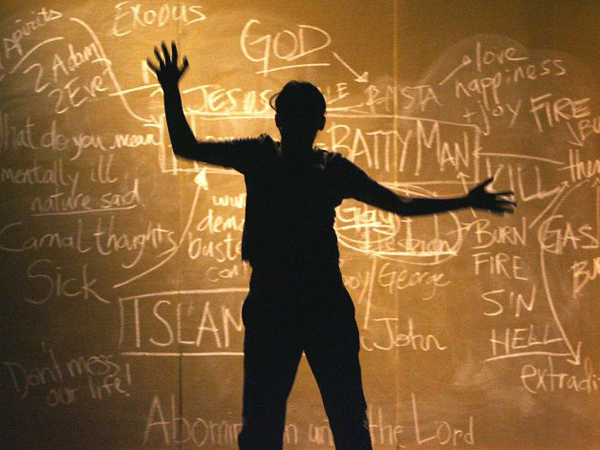 Jan Moir's Daily Mail piece about the death of Stephen Gately has now entered the record books as the most complained-against newspaper article in the history of British journalism. So far, 21,000 people have registered a complaint with the Press Complaints Commission. Moir denies that there was any homophobic undertone to her comments.
In today's Daily Mail, Janet Street Porter offers her fellow Mail columnist a few home truths about the nature and scope of homophobic abuse. This will be seen by some as a damage-limitation exercise by the Mail, but the article speaks for itself in any case. Janet Street Porter's piece also relates to the death of a gay man, but this time it is Ian Baynham, a 62-year-old civil servant who died last week after an alleged homophobic attack in London.
Stories about anti-gay attacks and other allegedly homophobic incidents are now being reported on an almost-weekly basis in the UK press and programmes like Sunday Sequence have chronicled the theological debate about same-sex relationships that has divided the worldwide Anglican Communion and other denominations too. In the past few decades, we have seen a revolution in biblical scholarship, with some interpreters calling for a reversal of the church's traditional opposition to homosexuality while others maintain a more conservative stance. The same kind of debate can be seen in non-Christian religions too. But for gay and lesbian people of faith, the debate cuts much deeper than a hermeneutical argument; it can sometimes mean losing family and friends, facing isolation, abuse, and, in some cases, physical danger.
On this week's Sunday Sequence, I talked to Lloyd Newson from DV8 Physical Theatre about their extraordinary new production 'To Be Straight With You', which comes to the Grand Opera House on Wednesday night for a three-day run. I saw the production recently in Dublin, while making a short film about it for Festival Nights. Incorporating dance, drama, film and animation, this is a remarkably rich evening of theatre and an immensely powerful exploration of the relationship between religious faith and homosexuality. Following Thursday evening's performance, I'll be chairing a panel discussion examining the themes explored in the play. The panel includes DV8's director Lloyd Newson, the human rights campaigner Peter Tatchell, Mike Davidson, director of the Christian ex-gay group Core-Issues, and Mamoun Mobayed from the Northern Ireland Muslim Family Association.


Comment number 1.
At 20:30 19th Oct 2009, John Wright wrote:An entry here about an article, with lots of links but none to the original article itself? Hmm, what does that say about our own Will's approach to the piece; obviously disapproval, maybe a subconscious intent to prevent people from drawing different conclusions than the 21,000 who wrote to a government body about it? Does this make it an issue of free speech too? What are the PCC expected to do about this and what power can they wield?
By the way, I haven't read the Moir article and none of what I just said rests on any kind of judgment about it whatsoever. (Chances are I'd agree with William, but I'll have to Google the piece to find out ;-))
Complain about this comment (Comment number 1)
Comment number 2.
At 23:09 19th Oct 2009, MarcusAureliusII wrote:This comment has been referred for further consideration. Explain.
Complain about this comment (Comment number 2)
Comment number 3.
At 23:53 19th Oct 2009, MarcusAureliusII wrote:#2 "This comment has been referred to the moderators.Explain"
Let me explain. If it reappears, reading it will make it self evident that the mere fact that it was referred proves its point beyond doubt. Anything more specific than this will probably cause this posting to be referred too.
Complain about this comment (Comment number 3)
Comment number 4.
At 10:41 20th Oct 2009, gveale wrote:"In the past few decades, we have seen a revolution in biblical scholarship, with some interpreters calling for a reversal of the church's traditional opposition to homosexuality while others maintain a more conservative stance."
Are you referring to Boswell, Countryman et al? If so I think you're in danger of overstating the case - read James Barr's or Richard Hays' comments on the revisionists. Revisionists didn't exactly carry the day in the academy.
Compare the New Perspective on Paul and the Law. That's a revolution.
It is the case that some evangelicals and more emergents took the revisionist case on board. That's not a revolution in scholarship, but it is significant.
GV
Complain about this comment (Comment number 4)
Comment number 5.
At 10:53 20th Oct 2009, nobledeebee wrote:Is there actually much of a debate outside the Anglican community( which is tearing itself apart) and a few related Christian sects?I have'nt noticed much discussion within the RC church or Islam for that matter, or Judaism.
The secular world has granted Gays equal rights, legal protection from homophobic attacks, the right to adopt and the right to civil marriages.It seems to me that the religious are playing catch up here but are still falling far behind.
Complain about this comment (Comment number 5)
Comment number 6.
At 11:26 20th Oct 2009, gveale wrote:This is cited too often as the 'last word' on the issue (Crompton wanted to argue that Western civilisation was unusually heterosexist). But the following quotation does show that the 'revolution' didn't have a huge impact on non-conservatives.
"However well-intentioned, the interpretation that Paul’s words were not directed at bona fide homosexuals in committed relationships…seems strained and unhistorical. Nowhere does Paul or any other Jewish writer of this period imply the least acceptance of same-sex relations under any circumstance. The idea that homosexuals might be redeemed by mutual devotion would have been wholly foreign to Paul or any other Jew or early Christian."
Louis Crompton , Homosexuality and Civilization (Harvard University Press, 2003
Complain about this comment (Comment number 6)
Comment number 7.
At 14:59 20th Oct 2009, Parrhasios wrote:Graham - # 6.
I agree entirely. I think the Bible is really pretty clear on the matter - wrong, of-course, but clear.
Complain about this comment (Comment number 7)
Comment number 8.
At 16:57 20th Oct 2009, Orthodox-tradition wrote:A few points
1) I would like to see Mr Gately's civil partner take the mail and Ms Moir to the high court to see exactly how sturdy her provocative claims are.
2) Most complained about article in history of British journalism.....? It should be said that public feeling could never before coalesce as quickly it does do today and with such an easy outlet, ie there has never before been a time when two variables like twitter and e-complaints have been so accessible to so many people.
3)Have to agree with GV's nobledee's and Parrhasius' scepticism about the "revolution" in scholarship on this issue. It is a very fringe endeavour; even as Parrhasios blasts it as "wrong" he correctly imo identifies the biblical record as "clear".
I would be more open minded than that; I am always interested to hear the arguments. My problem is that they all seem to either turn the meaning of language on its head (rendering further reading of the bible as meaningless) or else rely on arguments from silence.
Neither make for sound scholarship.
4) I am disturbed by the apparently seamless connection, above, between physical attacks on gay people and theological traditions which view homosexual practise as contrary to the divine order;-
"Stories about anti-gay attacks and other allegedly homophobic incidents are now being reported on an almost-weekly basis in the UK press and programmes like Sunday Sequence have chronicled the theological debate about same-sex relationships that has divided the worldwide Anglican Communion and other denominations too."
The ASA has already slammed the Gay Police Association for making such misleading connections;-
https://www.asa.org.uk/asa/adjudications/Public/TF_ADJ_41843.htm
Maybe there is another angle to this that I am missing. In my personal experience it is people who are opposed to faith who display the most physical aggression towards gay people.
There is nowhere in the teachings of the church ie the new testament that gives the slightest endorsement of physically attacking ANYONE on grounds of sin. On the contrary.
Has W&T uncovered better evidence regarding homophobic attacks and traditional theology since the ASA made its ruling?
OT
Complain about this comment (Comment number 8)
Comment number 9.
At 21:05 20th Oct 2009, John Wright wrote:Take her to COURT? For what? What crime has been committed in the exercise of freedom of speech?
Complain about this comment (Comment number 9)
Comment number 10.
At 21:37 20th Oct 2009, logica_sine_vanitate wrote:The Jan Moir thread seems dodgy at the moment, so here's another comment about it, following OT's remark about this subject...
Whatever one's views about homosexuality, I fail to see how a Christian can support Jan Moir's article. Her allegations are unsubstantiated, her tone is spiteful and her timing completely callous.
Let's go through them...
Unsubstantiated allegations: the cause of death is not a natural one. This is contrary to the official results of the post-mortem. Moir claims that the circumstances surrounding his death are "sleazy". Where is her evidence? This is a serious case. Someone has died, and she is alleging a cause which has so far eluded the authorities. Perhaps she should present her evidence to them, which is her responsibility. She writes about Gately's mother "insisting" that her son died of a heart condition, but Moir expresses this in such a way as to suggest that such a theory cannot be true, and is nothing more than the wishful thinking of a grieving mother. Where is Moir's evidence to support this allegation?
Spiteful tone: she made much of the fact that Stephen Gately couldn't sing and that he was merely a "decorous addition" to Boyzone. In other words, he was untalented. That is a matter of opinion. His coming out as gay is described as "being smoked out of the closet".
Callous timing: one day before Stephen's funeral.
If it is consistent with Christianity to make false accusations against someone just because you disapprove of his lifestyle, and then insult that person's memory just as he is about to be buried, then Christianity is not something that I can associate with the love, righteousness and justice of God.
But thankfully this behaviour is not consistent with true Christianity, and as a Christian I regard Moir's article as defamatory. Whether she could appeal to some technicality in a court of law to evade the lawsuit she most certainly deserves is another matter. But those who support her, need to ask themselves whether they would like to be on the receiving end of her "guesswork". And how would she react if someone treated her as she has treated the family and friends of Stephen Gately?
"Do to others as you would want them to do to you." Who said that I wonder?....
Like I said, this has nothing to do with approval of homosexuality, and everything to do with justice and truth.
Complain about this comment (Comment number 10)
Comment number 11.
At 22:04 20th Oct 2009, logica_sine_vanitate wrote:#10 -
After my last referral, which may or may not finally end up in the bin, I think I will give up on this "freedom of speech" fantasy.
Daily Mail columnists can say what they like, but obviously not little ol' me.
Hey ho.
Complain about this comment (Comment number 11)
Comment number 12.
At 22:39 20th Oct 2009, John Wright wrote:LSV- So you are glad that the Daily Mail columnist got to say what she liked? You agree with me that no government agency such as the PCC should be involved, then.
Complain about this comment (Comment number 12)
Comment number 13.
At 23:01 20th Oct 2009, logica_sine_vanitate wrote:#12 -
Yeah, I agree, let's all just say whatever we like about anyone else. Since unrestricted freedom of speech means that there is absolutely no censorship, then we have to agree that words can have no negative or destructive effect at all on people's lives. Neither can they have a constructive effect.
Why bother worrying about such minor inconveniences as truth, respect or constructive argument?
In fact, taken to its logical conclusion, unrestricted freedom of speech means that words are valueless, so why do we even bother contributing to this blog??
So perhaps the moderators were right to block my comment. They, like me, obviously believe that words are dynamite, and therefore we need to be careful what we say.
Pity some other sections of the British media don't see it that way...
Complain about this comment (Comment number 13)
Comment number 14.
At 23:56 20th Oct 2009, romejellybean wrote:I think people should be able to say what they like about who they like - as long as the law is changed to make access to the courts for ordinary people as easy as it is for the rich.
Complain about this comment (Comment number 14)
Comment number 15.
At 01:25 21st Oct 2009, Will_Crawley wrote:We can debate whether the new perspective on biblical accounts of same-sex sexual relationships constitutes a hermeneuticsl 'revolution' or something less dramatic than that -- though I suspect this will rather depend on the perspective of the person commenting. Certainly there is now a large body of new scholarship challenging previous readings or offering new contextualisations of older readings. I stand by my use of the term 'revolution' even though it is clearly the case that debate continues within the academy (as it does with the new perspective on Paul). The issue, for many scholars, is not whether the bible condemns same-sex sexual contact (that's accepted), but why it does so. Understanding why the writers of those key texts took that view is important. That contextualusation may lead to revised moral-theological readings. The same can be said for the debate about the equality of women and slavery. Understanding why the biblical texts say what they do about women and slavery may lead a reader to challenge misogeny and racism today (while accepting that misogenist and racist material can be found in the bible). Similarly, recognising that the same-sex sexual contact described in the bible is cultural worlds away from the modern experience of same-sex 'relationships' has prompted new approaches to those texts by many scholars, pastors and church members. Those kinds of new readings have paved the way for changes in church teaching and policy in a variety of demominations across the world --from England to Australia. The revolution, I would suggest, links hermeneutics and church practice in many if not all of those cases. Those who disagree with that revolution are entitled to do so -- and they make their case theologically, politically and even medically -- but it is empirically obvious that a revolution is what we are talking about in various churches across the world.
Complain about this comment (Comment number 15)
Comment number 16.
At 02:34 21st Oct 2009, romejellybean wrote:William
Pretty impressive for half one in the morning!
Complain about this comment (Comment number 16)
Comment number 17.
At 09:41 21st Oct 2009, gveale wrote:"We can debate whether the new perspective on biblical accounts of same-sex sexual relationships constitutes a hermeneuticsl 'revolution' or something less dramatic than that -- though I suspect this will rather depend on the perspective of the person commenting."
Something ironic about that! LOL (:
Complain about this comment (Comment number 17)
Comment number 18.
At 09:50 21st Oct 2009, mccamley wrote:It's got nothing to do with scholarship - it's all about attempting to impose a new view on old texts so that we can pretend the bible meant one thing for three thousand years but suddenly after a dose of Hollywood and ECUSA it means something entirely different.
Thankfully in the Catholic Church we have an institution protected and inspired by the Holy Spirit.
Complain about this comment (Comment number 18)
Comment number 19.
At 09:51 21st Oct 2009, gveale wrote:A sea-change in ethics and theology? Maybe there's a little more debate in conservative circles. But that debate is present in evangelical literature in the 1970's.
But a revolution in the opinions of NT scholars on a scale comparable with the New Perspective on Paul? The revisionists exist, but haven't gained widespread acceptance *outside conservative circles*. Whereas the NPP has forced conservative evangelical critics like Seifrid and Gathercole to qualify and revise conservative views to meet the challenge of Sander's evidence. Our view of Paul and 1st Century Judaism has changed.
Maybe it all depends on what we mean by revolution. If it just means 'debate' then maybe so. But James Barr's perspective skews his opinions? I'd take a little more convincing.
Complain about this comment (Comment number 19)
Comment number 20.
At 09:55 21st Oct 2009, gveale wrote:"Similarly, recognising that the same-sex sexual contact described in the bible is cultural worlds away from the modern experience of same-sex 'relationships' ...
Again, that's highly contentious. And it isn't conservative scholars doing all the contending. Take Martha Nussbaum's testimony to the supreme court.
Okay. I know the point Will's making and I'm being picky. Time for caffeine.
GV
Complain about this comment (Comment number 20)
Comment number 21.
At 10:01 21st Oct 2009, nobledeebee wrote:Will, I sometimes have problems understanding exactly what you mean.In the piece at the start of this blog you mention the divisions within the Anglican communion, which are obvious, even to an outsider, but you also say there are divisions in other denominations but fail to elaborate. Again in point 15 you say "new readings have paved the way for changes in church teaching....in a variety of denominations across the world" but you don't give any examples.You also refer to "the church" as opposed to the Anglican communion and other denominations I get the feeling, maybe wrongly, that you are running several different arguments into each other and blurring your meaning in the process.Could you expand on some of these points please?
Complain about this comment (Comment number 21)
Comment number 22.
At 10:11 21st Oct 2009, gveale wrote:The Moir thread is down again. So I'll say it here - Will was entirely accurate and balanced in his reporting Moir's article. Moir was insanely cruel.
If anything Will was too restrained.
GV
Complain about this comment (Comment number 22)
Comment number 23.
At 11:09 21st Oct 2009, brianmcclinton wrote:I agree that Moir was cruel. It seems to be a characteristic of some journalists to be nasty and personal about other people. They seem to work on the principle that stirring up muck is good for evertone, especially themselves.
Moreover, she committed the worst crime of all of a truth-seeker: jumping in to speculate before she knows anything about the facts. But why let the truth get in the way of a bit of poisonous gossip?
Add these failings to the widespread homophobia in the wider society and the gay victim doesn't stand a chance.
As to whether this homophobia has its origins in religious dogma, I don't think there is much doubt about this. People with hate in their hearts will always look to 'authority' to bolster their nastiness. For them the fact it is there in so-called sacred texts is literally a 'godsend'. They are not much interested in the theological niceties, merely that so-called founts of morality such as the Bible or the Koran say that gays should be put to death.
I think that William is right: you theologians on this blog should be concerned with WHY the writers of these texts took these anti-gay views.
Saying that God intended man and woman for each other in marriage is not very satisfactory. Why? For children? Many marriages are childless. And are they supposed to stop having sex when they cannot any longer have children? What is so damned WRONG about same-sex relationships that God cannot countenance it? Why did he create so many humans with this propensity? Again, many men and women are not married (Jesus included - so did God set a bad example himself?), so should they never have sex?. Billions of men and women have had sex outside marriage down the millennia. Was this wrong? Many animals have homosexual relationships. Is this wrong? The questions are endless; the theological explanations are pathetic.
Complain about this comment (Comment number 23)
Comment number 24.
At 12:14 21st Oct 2009, romejellybean wrote:MCC
I'd like to ask you some genuine questions. I've come across people who sound like you before. People who appear dogmatic, triumphalistic, arrogantly sure about their church when historical evidence PROVES that in the past we have been murderous, ruthless, genocidal, evil in so many ways etc.. and that we have, on many occasions, completely ignored the Holy Spirit. (We'll leave abuse and cover up on the back burner for now.)
Carl Rahner said that we in this age have been "gifted a critical distance from the cross of Jesus Christ." He means that science, archaeology, history, technology, theology, scripture study etc.. have been given to us in a way that no other age has enjoyed, these tremendous insights into who we are, what life is, who God is.
We have been given the ability to reflect on our existence in a way that no other age has been given, ever. Why do you insist on showing contempt for this gift? What do you hope to gain for God, or for the Church or for yourself by expressing such arrogant views which appear to make you look obtuse, narrow-minded and bigotted.
Jesus doesnt need your protection. The Church doesnt require your absolute assent. Are you so terrified of what you might find if you begin to pull back the layers?
Its okay to be broken, MCC, to not be perfect.
I have watched Catholics be so sure of themselves on subjects like homosexuality and abortion, reiterating to anyone who would listen, how evil abortion is, how terrible gays are. Then their daughter got pregnant outside marriage, their son came out or was exposed as gay. Suddenly, things didnt seem so clear cut any more. Suddenly, they experienced the suffering that others, people whom they had previously condemned, were going through.
Could you maybe try and be less dogmatic and think about what you are saying.
"What I want is mercy, not sacrifice."
Complain about this comment (Comment number 24)
Comment number 25.
At 12:43 21st Oct 2009, gveale wrote:On the media
The English Press generally seemed devastated that there wasn't a murder mystery here. "Celebrity Leads Hedonistic Lifestyle! Sometimes! Maybe!" isn't headline of the year. (In fact the Mail often serialises celebrity 'biographies' which generally list some old thesps' sexual conquests and infidelities.)Beyond an obituary, with a focus on gays in mainstream youth culture, there wasn't anything newsworthy here.
Moir has saved the day for the Press. She's created a story 'ex nihilo'. Now journalists can write about Moir writing about nothing. Stories about nothing. Welcome to the world of churnalism.
GV
Complain about this comment (Comment number 25)
Comment number 26.
At 12:47 21st Oct 2009, gveale wrote:Brian
I refer you to the many many many many answers I gave so long ago.
GV
Complain about this comment (Comment number 26)
Comment number 27.
At 13:02 21st Oct 2009, Bernards_Insight wrote:I don't normally take part in these kinds of debate, but I've a wee bit of time, so I'd like to give a wee reply to Brian;
"As to whether this homophobia has its origins in religious dogma, I don't think there is much doubt about this. People with hate in their hearts will always look to 'authority' to bolster their nastiness."
First you say that homophobis ORIGINATES in religious dogma, then you say that religious dogma BOLSTERS the nastiness and hate in people's hearts.
You go on to say that the religious texts are a Godsend, presumably because they can be used to bolster already existing prejudices.
Surely this means that the nastiness and hatred is already there, and all you are saying is that people can use all sorts of authority to justify their already deep-seated hatred. I wouldn't argue with that.
Your final paragraph I think displays an entirely superficial view of dogma on sexuality.
"Saying that God intended man and woman for each other in marriage is not very satisfactory. Why? For children? Many marriages are childless. And are they supposed to stop having sex when they cannot any longer have children? What is so damned WRONG about same-sex relationships that God cannot countenance it"
As I understand it, marriage is not solely FOR CHILDREN. Marriage is supposed to a a spiritual and emotional union of devotion between two people, and that spiritual and emotional union can, with grace, find itself fulfilled by the creation of new life. But emotional, spiritual and sexual union are not SOLELY for procreation - I don't know of any church dogma to that effect. So your first few questions miss the mark altogether.
So, given the view of marriage that I have outlined above, the question becomes "can a fully emotional, spiritual and sexual union occur between two people of the same sex". Obviously that depends on how you view such a "spritual, emotional and sexual union".
I think you should be aware that that is the main question, and that the other questions you ask also miss the mark.
"Again, many men and women are not married (Jesus included - so did God set a bad example himself?), so should they never have sex?"
No. Jesus didn't have sex...I'm not sure what you're getting at. If you value a union like I have outlined below, it makes sense for the ideal of such a union to be a devotion to one person. That devotion to one person, if you are religious, can be expressed before God in marriage.
"Billions of men and women have had sex outside marriage down the millennia. Was this wrong"
If it was not in the context of the completing and devotional relationship that i have mentioned, then yes it was. Outside of that respectful union, sex is almost always an objectification of the other person, and a case of using other people for your own sexual ends. Even if this is fully accepted by both partners, I still think it is a perversion of the sexual union. Perhaps those unmarried people were in such a union, but hadn't expressed it before God in marriage. I can make no judgment on that, as I could never know.
"Many animals have homosexual relationships. Is this wrong?"
Probably not. Animals are on the whole motivated by blind instinct. They are not spiritual or fully emotional creatures. The question of whether they are in a committed union does not arise. You might as well ask if it is wrong for an animal to eat another animal alive.
Most of those questions are silly, and if they are anything to go by, you don't seem to know much about the theological view of sexuality.
I think a reasonable view is to see sexual activity as an element of spiritual union. If you don't see it this way, but as a purely physical operation that derives only physical pleasure, you are free to call the theological view silly. I think a reduction of sex to physical pleasure is silly. What are we to do? Who can prove it?
The question is whether a spritual union between two complementary personalities that results in a completion, and in some ways a reconciliation between ones own gender aspects, is possible between two people of the same sex.
I think this is the question that churches should be asking, and I believe many of them are.
My own view is undetermined. On the one hand, I know from experience that sometimes a loving union between a man and a woman can in someway complete that person in a way that seems to involve a balance of respect and difference between the sexes. I think that a man and woman who are in love in some way constitute a "cosmically fulfilling" relationship in which opposites are reconciled in a spirit of pure love and devotion. The question is whether such a cosmically fulfilling union can occur between two people of the same sex.
I realise that this is very obscure, but again, it is not something that I have devoted a lot of thought to. However, I feel that it is the pertinent question that churches should be asking, not these facile ones about gay animals and not having sex unless you have a baby nine months later.
My own view is that I don't know. Gender is a funny thing, and the feeling of completeness that comes from a loving relationship may entail much more, or much less, than a cosmic balancing of genders in a single union. We know virtually nothing about people's gender subconscious, and the emotional conflicts and proggressions that derives from gender, and love of the other.
I suppose my only point in this post is not that homosexuality is right or wrong, but that we should stop reducing it to silly questions about animals having sex and about marriage being solely for procreation.
Marriage is about a union that completes and fulfills a person. It could be thought that it does so in a way that reconciles the genders in perfect harmoney and complementarity. That is how I have always understood the theological view, and, if you wish to call it pathetic, that is what you have to engage with, not this straw man about people only having sex to have children.
Complain about this comment (Comment number 27)
Comment number 28.
At 13:14 21st Oct 2009, Bernards_Insight wrote:Of course, no doubt the reply will be that I'm talking a lot of obfuscated nonsense. Probably "cosmically fulfilling relationship" means absolutely nothing. Then again, probably "loving relationship" and "devotion to the other" means nother either. I wonder where we draw the line. After all, it's probably just our memes telling us to have as much sex as we can, eh?
Complain about this comment (Comment number 28)
Comment number 29.
At 13:36 21st Oct 2009, logica_sine_vanitate wrote:Readers might like to have a look through some of the Will & Testament threads from February this year:
Jeremy Marks and the ex-gay movement
British Christians challenge hate church
Hello kettle, it's the pot calling...
I am certainly not going to rewrite all my posts on the subject of the Bible and homosexuality (to be honest, an exhausting exercise in reinventing the wheel).
I think there's enough information in the above-mentioned threads to make it clear that there are legitimate reasons why Christians differ in their interpretation of the biblical texts concerning this subject.
Complain about this comment (Comment number 29)
Comment number 30.
At 14:18 21st Oct 2009, sizzlingsazzle wrote:Jan Moir's article was one of the worst pieces of journalism I have seen in a long time. Now, I'm no fan of the Daily Mail or it's politics but this article was of the sort of quality I would expect to see in some tittle tattle gossip magazine and fell well below the standard I would (hope to) expect of any newspaper!
Sadly, working in the media has lead me to believe that very few in this industry take the responsibility of the profession very seriously. I see the power of the media in every day life, I see young girls obsessing about being too fat, too flat chested, young men talking about young girls in a way that is at best disrespectful and worst frankly shocking - and I consider myself somewhat open minded!
I believe in free speech but unlike Jan Moir I also believe that if your willing to put it out there, you have to be willing to take it too. In that respect I am not sure if I am more offended by the article or the "apology" that was issued which fell woefully short, in my opinion, of showing any understanding of the outrage and feeling her words had created! I also whole-heartedly believe in the truth but this article was nothing about gaining access to the truth. Assumption upon assumption was made, with no evidence to back it up - even at one stage challenging the coroner's report.
Janet Street Porter's response was, on the other hand, quite a brilliant piece of journalism. Love her or hate her, she hit the nail on the head with that article, reminding us all that rather that focusing on speculation and (trumped up) scandal in the lives of celebrities, there are others in this world facing prejudice and losing their lives in the process.
I'm not an expert on religion and personally do not assign to any religion. I'm not gay but I have close family and friends who are and the idea that they would not be welcome to worship within a religion because of (what I believe) the way the were born (gay!) kind of misses the point of what being Christian should be about. Kindness, love, tolerance...
My personal point of view is that there is room for reform, for the church to adjust to modern society and stop alienating people. And sorry MCC but you naivety on the Catholic religion, where priests have been exposed as gay ion many cases, actually made me choke as I was sipping my drink
Complain about this comment (Comment number 30)
Comment number 31.
At 15:24 21st Oct 2009, Will_Crawley wrote:Some replies:
gveale: "But a revolution in the opinions of NT scholars on a scale comparable with the New Perspective on Paul? The revisionists exist, but haven't gained widespread acceptance *outside conservative circles*. Whereas the NPP has forced conservative evangelical critics like Seifrid and Gathercole to qualify and revise conservative views to meet the challenge of Sander's evidence. Our view of Paul and 1st Century Judaism has changed."
First, I have never suggested a revolution comparable to the new perspective on Paul. In fact, it was GV who invoked the comparison (only to deny it), not me. In response, I pointed out that the New Perspective on Paul also has its detractors, many of whom I have interviewed on Sunday Sequence. So, no, I am not making the comparison with Pauline studies. I am simply saying -- and frankly I am astonished to see this disputed -- that the last few decades have witnessed a hermeneutical revolution on the question of homosexuality in the Bible. Second, that revolution in thinking does not mean a complete consensus (and, again, I have never suggested otherwise) just as the revolution on the question of women and the Bible does not amount to consensus, but it is a revolution. In fact, if you look at the question of women's equality, it's probably still the case that the majority of christian churches (catholic, orthodox, conservative and fundamentialist Protestant, etc.) maintain a traditionalist view in practice. The fact that they are resisting the new readings of the scriptures, vis-a-vis women, should not be seen as evidence that no revolution has taken place in feminist hermeneutics. As for the scholars you mention, GV, you can take it that I am certainly familiar with their work (in fact, I've met or interviewed all those you've namechecked, with the exception of John Boswell, who died before I became a journalist or took an interest in these questions).
So -- I feel I need to repeat myself because so much of what i've said above, which should be pretty uncontroversial as a statement of where we are, globally, on this debate, has been garbled:
(1) There is no consensus on this question amongst scholars (on or any controversial questions, by definition),
(2) Nevertheless, a well-documented hermeneutical revolution has taken place in recent decades, producing a library of new scholarship, not just the one or two texts that have been noted here;
(3) That hermeneutical revolution has its supporters and its opponents, but it has, without argument, major implications for church politics and polity in denominations across the world (which I've been reporting on for at least 7 years!); and
(4) And anything I, or anyone else, says on the theology of sexuality vis-a-vis the Bible will be regarded as 'contentious' by others.
I don't know how much clearer I can be; but that's a blunt and explicit account of what I've already said in the post, which emphasizes that the new reading of the Bible on the question of homosexuality has its supporters and opponents. Quite honestly, if someone cannot see this cultural and hermeneutical revolution taking place, I wonder if they are paying attention to theological scholarship or religious news on a weekly basis.
Nobledeebee:
"Will, I sometimes have problems understanding exactly what you mean.In the piece at the start of this blog you mention the divisions within the Anglican communion, which are obvious, even to an outsider, but you also say there are divisions in other denominations but fail to elaborate. Again in point 15 you say "new readings have paved the way for changes in church teaching....in a variety of denominations across the world" but you don't give any examples.You also refer to "the church" as opposed to the Anglican communion and other denominations I get the feeling, maybe wrongly, that you are running several different arguments into each other and blurring your meaning in the process.Could you expand on some of these points please?"
Divisions in other denominations: By this I mean that other Protestant denominations (beyond Anglicanism) have also been fighting about homosexuality in their supreme courts for quite some time. The Church of Scotland permitted the installation of a partnered gay minister this summer, and that has produced some resignations from the ministry in Scotland (and that debate, be assured, has not gone away). Some Presbyterian denominations (not all) in England, Canada and Australia have voted to ordain partnered gay ministers too -- after quite divisive debates within their Assembly bodies. Some Methodist denominations (again, not all), and other congregationalist churches have similarly changed their practice and policy. We also report on debates about sexuality within Judaism, with some liberal synagogues becoming inclusive in respect of gay members, etc.
Your point about running arguments together: There is no 'argument' in the post. It is a a simple series of statements reporting the existence of a (surely well-reported) controversy about homosexuality in various churches. I point out -- merely a factual statement, again -- that the Anglican Communion is not alone in facing a divisive debate about this issue. Surely no one could deny that plain statement of fact?
Complain about this comment (Comment number 31)
Comment number 32.
At 16:03 21st Oct 2009, gveale wrote:I'll very quickly respond to the idea that the 'revisionist' exegetes have a case. (I'm just cutting and pasting from old notes, and most of this is on other threads.) I've yet to see the following points answered.
1) Paul contention that female-female and male-male intercourse was "contrary to nature" reflects the influence of the Stoic objection to homosexuality.It is a characteristic Stoic appeal to the providence of Nature, which has matched and fitted the sexes to each other.
Jewish writers in Paul’s day and beyond rejected all forms of homosexual activity. Given the rabbinic rejection, it is extraorinarily unlikely 'a priori' that Paul would make room for homosexual relationships.
So the a posteriori evidence for tolerance on Paul's part would need to be very very good to sustain revisionism. But the evidence is that Paul is relying on the critique 'from nature' prompted by Jewish and Graeco-Roman moralists.
2) This also makes it extremely unlikely that Paul's issue was with exploitation. The mention of lesbian relationships, and the language of nature rule this out. Lesbianism in antiquity did not normally emulate male exploitative practices. And the nature argument is ineffective against exploitation.
2) Paul in Rom 1:24-27 rejects homosexual practice because it is a violation of the God’s creation of "male and female" as a sexual pair in
Genesis. The text does not say or even infer that men and women exchanged or left behind committed relationships with either sex for exploitative relationships with either sex.
3) Rom 1:27 specifically indicts male homosexual relations that
involve mutual, reciprocal affections — "males, having left behind the natural use of the female, were inflamed with their yearning for one another". Coercion or exploitation is not the issue. Nor would fidelity help if the very attraction is against 'natural use'.
4) "Inflamed" indicates inordinate desire overpowering rationality. It's the **degree of the desire**, measured against the persons ability to control it. That leads to Paul's condemnation. It's interesting to compare Plato - Plato does not see "contrary to nature" as implying no innate sexual urges for the male but rather as implying incompatibility with embodied structures (woman as the sexual complement to man). To act "contrary to nature" is to demonstrate an inability to control innate passions in a manner that accords with nature’s structures. In fact Plato may have believed that homosexual desire was to be expected.
So the idea that the ancients had no idea of innate homosexual desire is unsubstantiated, and it misses Paul's point. And secular 'revisionists' (Thomas K Hubbard etc) are now arguing that the ancients weren't too far from our concept of orientation in some indviduals.
4) It simply isn't the case that Paul would have been unaware of consenting homosexual relationships and attachments. We know of some Greco-Roman moralists who acknowledged the existenceof loving homosexual relationships while rejecting even these as unnatural. Most of the 'pre-Christian' polemics against homosexual partnerships assume that they are generally tolerated. Take Martha Nussbaum's testimony to the Colorado Supreme Court in 1993.
"...in all of these [pre-Christian Mediterranean] traditions and civilizations, same-sex romantic relationships, attachments, and sexual conduct were highly regarded. . . . Such relationships were never considered shameful."
"...in Greek culture of the fifth and fourth centuries b.c., and on, really, through to the first century a.d. where Christianity starts to have a big impact, homosexual acts between consenting males, and in rarer cases between consenting females, are attested as received with great approval."
I don't think that revisionism is a dirty word. But the idea that conseravtives, and only conservatives, have a problem with revisionists is a myth. Just read James Barr's curt treatment in 'Biblical Faith and Natural Theology'. I do get irate when we won't let ancient texts speak for themselves. I also get irate when new light on Romans 1 from the Stoics (like Barr's) gets ignored because it doesn't suit a particular ethic.
Now if theologians and Christian ethicists want to pull in other principles to relativise these texts fine. Make the arguments in such a way that would not also make polyfidelity and polyamory permissible. Secular ethicists take these for granted. Where, exactly, would the Christian objection lie?
GV
Complain about this comment (Comment number 32)
Comment number 33.
At 16:15 21st Oct 2009, gveale wrote:Now I think that a revolution in Pauline sexual ethics is overstated.
But what is not overstated - and I think this may be Will's point - is a revolution in hermeneutics. It is often perceived as an act of 'violence' to decide on one privileged reading of a text.
Now the revisionist case is not very convincing, but it exists. It is possible to read the texts that way. (That's aeons away from saying that these readings are likely to get you anywhere near the aims of the text or the mind of the apostle).
The mere possibility that another reading is possible makes some evangelicals, and many emergents reluctant to decide on a meaning. Brian McClaren is an excellent example of this style of leadership. The question is left open and unresolved.
So if Will is making a wider point about Christian's (even conservative Christian's) reluctance to decide on a privileged reading of, say, Romans 1, or Paul's view of the atonement, or whatever, then I agree.
And that's worth discussing.
For example - is there a privileged reading of the Moir piece? Is there a true reading? Can we decide on it?
And will science ever be able to answer those questions? (-;
GV
Complain about this comment (Comment number 33)
Comment number 34.
At 16:20 21st Oct 2009, gveale wrote:Bernard
"a spritual union between two complementary personalities"
How on earth can you substantiate that? And personalities change over time. If I get too grumpy, can my wife dump me and move on to someone more fulfilling?
Cosmic fulfillment is a big ask of a marriage, in any case. I'm not having a go. I'm just pointing out the problems when you drop the teleology in the Biblical/Christian ethic. You just get left with societies status quo, and a few homilies about love.
BTW - Bernard Cullen would be a philosopher involved in scientific research - right?
GV
Complain about this comment (Comment number 34)
Comment number 35.
At 16:53 21st Oct 2009, gveale wrote:Will
In fairness, I did say I was being unduly picky over one word - "revolution". Yes, I can (and could) see *exactly* what you're saying. And I was being a wee bit mischievous.(You'll know what I mean if I say I was in a Puranish kind of mood.) Which I copped to, but perhaps not clearly enough.
What I forgot is that there are some unpleasant suggestions that you or the beeb are being biased in your reporting. Actually, I think you've been getting some fairly nasty posts lately- (is that going too far? I don't think so.)I wasn't joining in.
I think the revolution in hermeneutics made revisionism about Romans 1 etc. mainstream, and that's interesting and worth discussing. It really seems to be that revolution that's causing the crisis, so far as I can see. For the record I more or less agree with what you wrote.
But I'm an redneck fundamentalist, and I've disagreed with you before (it's usually fun). And I think that you have been absolutely fair and balanced in your reporting. That INCLUDES the 'Dean' thread, and the Polanski thread. I am absolutley bewildered at the comments aimed at you there.
GV
PS I didn't get to see "Losing Our Religion". But the lady teachers here still think you're lovely, and they liked it. As did nearly *every* evangelical I've spoken to who watched it. So as a programme it worked. You must be doing something right.
And it takes a bit of guts to put yourself in a programme about religion in Northern Ireland. EVERYONE's an opinion - and generally that opinion is that everyone else is wrong. The easy option would have been to leave yourself out.
I hope that does something to answer charges of smugness, self-satisfied reviews etc.
Complain about this comment (Comment number 35)
Comment number 36.
At 17:10 21st Oct 2009, gveale wrote:post 32 was written waaay before post 31, and is not a reply to that post.
Complain about this comment (Comment number 36)
Comment number 37.
At 23:01 21st Oct 2009, MarcusAureliusII wrote:"The issue, for many scholars, is not whether the bible condemns same-sex sexual contact (that's accepted), but why it does so. Understanding why the writers of those key texts took that view is important. That contextualusation may lead to revised moral-theological readings. The same can be said for the debate about the equality of women and slavery. Understanding why the biblical texts say what they do about women and slavery may lead a reader to challenge misogeny and racism today (while accepting that misogenist and racist material can be found in the bible)."
Well that's the crux of it in a nutshell. At least in the narrowest sense of the debate, religious text and culturally accepted norms in contemporary society. How do you reconcile what is stated explicitly from texts written thousands of years ago with what we will and will not tolerate today? When you can't argue the denotation of words, one method is to argue their connotation, their implied meaning. Another is to try to force them to remain in the context of the era they were written in by finding translational errors or differences in the historical meaning of the words at the time they were written. Another is to negate the absoluteness of their truth. Another is to find some hidden implied meaning or sense that could only be discovered in later centuries that those contemporary to those words couldn't understand. But whatever method you choose or invent, the fact remains that when you do this, you open up an entirely new can of worms, the can of relativism. That problem is simple, if one aspect of a religion doesn't mean what it appears to, can be re-interpreted, or just plain ignored, why can't the rest of it? How can a relgion which claims to tell the true word of god be only part true itself? Those who resist bending their religion to larger society demand that society bend to their religion. They will never yield, they are as convinced they are right as those who would alter the religion to conform. It's a dilemma with no evident resolution. Of course from the perspective of someone on the outside of this looking in, it has all the fascination of theater of the absurd. But I suppose if you are on the inside where this is all swirling around, it can at the least be confusing and you want to grab on to something to escape being swept up in the maelstrom.
Complain about this comment (Comment number 37)
Comment number 38.
At 10:26 22nd Oct 2009, brianmcclinton wrote:Bernard (27):
We have been around this bush before.
1. Homophobia both originates in and is bolstered by religious dogma.
2. Religious thinkers/teachers/philosophers on this blog probably don’t go around beating up gays. But to take an extreme case, Adolf Hitler never killed anybody as far as we know, yet we would not say that he was not at least partly responsible for anti-Semitism in 1930s/1940s Germany. The point, Bernard, is that any prominent ideology which criticises a group of people on grounds of their race, religion, sexuality etc helps to create a climate of opinion in which actual hatred flourishes. This is especially true if that ideology achieves hegemony in the society (Nazism in Germany and conservative Christianity in NI).
3. Thus the most homophobic societies in the world are generally the most religious because homphobia as an ideology derives predominantly from Christianity and Islam. They are the religions which most strongly condemn homosexuality (e.g. by reference to ‘sacred texts’ advocating stoning of gays etc.) It is hardly surprising that NI, one of the most religious societies in western Europe, is also, according to one study, the homophobic capital of the western world.
4. The most liberal and least religious societies in Europe - the Netherlands and Scandinavian countries - are the most tolerant towards gays. The strongest cases of homophobia in the Netherlands overwhelmingly involve Muslims attacking other Muslims.
5. Let us look at what happened in Ireland after Stephen Gately’s death. The Irish Mail on Sunday carried four pages on the funeral, and other Irish papers gave extensive coverage. The Sunday Independent featured it over 7 pages, including a poem by Joseph O’Connor, which ended:
Sweet Prince, rest you easy,
Liffey Gulls cry your name”.
In general, the Irish press put the Daily Mail to shame. As the Independent suggested, when Stephen Gately was young, it was probably unthinkable that an openly gay man would be welcomed home in a Catholic church in Dublin’s inner city for a resolutely Catholic funeral, ‘his husband recognised as if they had been a more traditional couple’.
This use of the word ‘husband’ without inverted commas was repeated elsewhere. In an editorial, the Sunday Tribune reminded us that, ironically, it was in 1993, the same year that Boyzone was formed, that homosexuality was finally decriminalised in Ireland and that it is only this year, after his death, that civil partnerships will finally become law. The paper attributed the transformation in no small part to today’s teenagers and their greater tolerance. In Gately’s case, his young fans confidently asserted their pop idol’s right to be gay and proud of it.
6. So perhaps a combination of the internet (over Moir’s poisonous piece) and today’s youth can defeat the bigotry and intolerance of some journalists and religious believers. Perhaps, in some ways, the public are ahead of the media, the politicians and the churches.
7. This may also be the case in NI. But what is clear is that some religious philosophers on this blog need to shake off their blinkered obsession with antiquated desert writings and smell the coffee. The demand by gays to be treated with equality and respect is right and will prevail, whether they like it or not.
8. The divisions you set up between other animals and us are exaggerated. Yoyu seem to be saying that sexual union for humans is wrong if there is no ‘spiritual union’ as well. Is mutual consent enough for a ‘spiritual union’? If not, how would we recognise this mysterious ‘spiritual’ union? As an atheist, can I have a ‘spiritual’ union? It seems somewhat arrogant to imply that only believers can have 'spiritual' unions and therefore only they can have moral sex, don't you think?
Complain about this comment (Comment number 38)
Comment number 39.
At 10:54 22nd Oct 2009, Bernards_Insight wrote:Brian;
I'm no expert on sexuality, love or devotion, but I do believe all three exist.
"Yoyu seem to be saying that sexual union for humans is wrong if there is no ‘spiritual union’ as well"
Yes.
"Is mutual consent enough for a ‘spiritual union’?"
I would suggest it's more than that. Most people tend to think that love and devotion involve more than consent to sex.
"If not, how would we recognise this mysterious ‘spiritual’ union?"
I don't think it's mysterious. You probably know it full well. If you've ever felt more than lust then you've probably at least caught a glimpse of it.
"As an atheist, can I have a ‘spiritual’ union? It seems somewhat arrogant to imply that only believers can have 'spiritual' unions and therefore only they can have moral sex, don't you think?"
It would be, yes. I'd never suggest that.
I'm just trying to provoke a wee bit of reflection here Brian, by the way, I am not offering dogma or answers. I do not know in any way shape or form if homosexuals can have the same kind of spiritual union that a man and a woman have. I haven't a clue. Sexuality, fulfilment, devotion and love are things about which I can only speak for myself. However, I don't think the suggestion that the complete fulfilment of such a union MAY NOT be open to same sex relationships should be automatically panned as bigoted and offensive.
Complain about this comment (Comment number 39)
Comment number 40.
At 12:07 22nd Oct 2009, brianmcclinton wrote:Bernard:
I notice you ignore the connection between idea and actions in the wider society, a symbiosis that any philosopher must surely discern. Keynes suggested that ideas determine the course of history. Remember his other famous remark: "The ideas of economists and political philosophers, both when they are right and when they are wrong, are more powerful than is commonly understood. Indeed the world is ruled by little else. Practical men, who believe themselves to be quite exempt from any intellectual influence, are usually the slaves of some defunct economist".
So 'spiritual' means feeling more than lust. How do you know that other animals feel only 'lust'? There are lots of examples of caring unions and love in the animal world. Are they just 'instinct'?
The suggestion that the complete fulfilment of a 'spiritual' union MAY NOT be open to same sex relationships has no rational foundation. On what evidence do you base this suggestion? And don't you think it's homophobic to suggest that same-sex relationships cannot fulfil this proper 'spiritual' union? And why is it 'wrong' not to have a 'spiritual' union? What is wrong with other kinds of union if they are by adult mutual consent?
As a philosopher, you should clarify the philosophical bases upon which such discriminatory judgments are based. That means not simply quoting obsolete middle eastern scriptures.
Complain about this comment (Comment number 40)
Comment number 41.
At 12:23 22nd Oct 2009, gveale wrote:Brian
Would you like me to count how many questions you just begged? Fair enough we disagree. But I don't recall you making any final, devastating critcism of my faith or my scriptures in our past exchanges.
So it isn't obvious that I'm being irrational or that I suffer from a phobia. Or if it is, I haven't discerned where you've shown that I am. Is it too much to ask for more tolerant language on your part? A little understanding of different belief systems? An attempt to enter into the way another person thinks? You can still profoundly disagree with them afterwards, you know. It's quite safe.
The downside is you don't get to be dismissive. But there you go.
GV
Complain about this comment (Comment number 41)
Comment number 42.
At 12:53 22nd Oct 2009, Bernards_Insight wrote:"How do you know that other animals feel only 'lust'".
I don't. I'm making a tentative suggestion, based on the difference between animal behaviour and human behaviour. Maybe animals get married in secret. Maybe they write sonnets and love songs to each other on the sly.
"The suggestion that the complete fulfilment of a 'spiritual' union MAY NOT be open to same sex relationships has no rational foundation. On what evidence do you base this suggestion?"
As it's a suggestion, I don't have any conclusive evidence. People have written about the spiritual fulfilment of a joining of the sexes, and qabout the completion of opposites in a single loving respectful relationship.
I think this is something like the Church's view, although to be fair I don't think it has been adequately considered. But if you could possibly conceive of the possibility of a relationship that somehow completes the incompleteness of gender alienation, then it makes sense to think of that in heterosexual terms.
But again, gender's a funny thing, and I suspect none of us have thought adequately about it. I'm merely making a suggestion about one particular view of a particular type of relationship that is seen as priveleged by certain people.
You don't have to believe this type of relationship exists. You can believe it exists but that it has nothing to do with a union of sexual opposites. Or you can believe that that type of relationship does exist, but that it should not be seen as priveleged or aspirational.
But my disagreeing with that, suggesting that there is such a fulfilling relationship, that something inherent about that relationship involves a conjunction of sexes and genders, and that that kind of relationship is the most fulfiling, should not be taken as intolerance or offensive.
Perhaps you think that my holding monogamous marriage as an ideal means that I hate all unmarried people, but it doesn't. Neither does my holding a particular type of fulfilling relationship between two sexes as the ideal mean that I hate all gay people.
Complain about this comment (Comment number 42)
Comment number 43.
At 12:53 22nd Oct 2009, brianmcclinton wrote:Bernard:
On the morality of animals, I suggest you read
https://chronicle.com/article/Moral-in-ToothClaw/48800/
it's on the Arts and Letters Daily site which is one of William's favourites
Graham:
Being irrational on one issue doesn't imply general irrationality on all issues.
Complain about this comment (Comment number 43)
Comment number 44.
At 13:14 22nd Oct 2009, Bernards_Insight wrote:Very interesting, although given the apparent behavourist view of humans in that article, I'm not surprised it doesn't fully express the differences between humans and animals.
Still, that's quite a swerve ball. I don't know if animals have "morality" or not. given that we have patently failed on this blog to agree about what "morality" is, it's open season really.
I wonder can they have spiritual devotional relationships too?
Again, no doubt we can't agree what spiritual is either.
Complain about this comment (Comment number 44)
Comment number 45.
At 15:47 22nd Oct 2009, gveale wrote:Brian
Fair comment. excuse the grumpiness on my part.
GV
Complain about this comment (Comment number 45)
Comment number 46.
At 00:14 23rd Oct 2009, Parrhasios wrote:Went to see To Be Straight With You this evening. One of the most visually stunning productions I have ever seen. I would thoroughly recommend anyone who possibly can to catch the last show tomorrow (Friday) evening.
I think most people will recognise that it is a propaganda piece, something I mean as a compliment. It appears meant to convey an experience: the extremely distressing experience of living as a homosexual in a society which rejects, often brutally, something essential to a person's sense of self. I defy anyone sit through it allowing themselves to empathise with characters and repeat the canard that it is possible 'to hate the sin but love the sinner'. It is not.
Complain about this comment (Comment number 46)
Comment number 47.
At 16:36 23rd Oct 2009, MarcusAureliusII wrote:One good way to censor postings without actually censoring them here is to refer them to the moderator. Posting number 2 was referred to the moderators four days ago and hasn't been decided on yet. Even if it hasn't broken the rules and is ultimately published, nobody will read it. A novel tactic of censorship, a new arrow in its quiver for BBC. Perhaps someone should check to see if the moderator is still breathing. Perhaps he died in his cubicle and nobody has discovered the body yet.
Complain about this comment (Comment number 47)
Comment number 48.
At 12:53 24th Oct 2009, Orthodox-tradition wrote:IN response to Will Crawley, post15
Yes there have been "revolutions" in the thinking of some people about theology and sexuality but it is more complicated than that.
Judaeo-Christian thinking on homosexual practise has been consistant for some 4000 years. You appear to be implying that nobody can understand what biblical "truth" is on this matter or that there is no such thing as biblical truth on this "matter".
Gay commentator Matthew Parris and many other gay people like him pur scorn on the idea that the bible is not clear on homosexuality.
He knows that bible is consistent from start to finish that sex was created for lifelong-male-female marriage; homosexuality is never mentioned except in a negative context.
But as GV points out, rejecting this viewpoint means that you have no biblical argument against any other sort of sexual taboo or practise, because advocates will always find a "new" qualification to get around any biblical prohibition.
Another point is that we rarely ever define what we mean by being "gay". As I understand it, the modern western concept of being "gay" is a very recent social construction. Or put is another way, it is a social identity that has been created very recently.
The significance of this is that even people who have same sex attraction are not forced to choose a gay identity. Many choose to remain with their wives and families and to reject their same sex attractions. These people reject the homosexual feelings in the same way that married men like myself do not jump into bed with women we are not married to.
OT
Complain about this comment (Comment number 48)
Comment number 49.
At 17:47 24th Oct 2009, Jonathan Boyd wrote:Parrhasios, just because some people struggle to separate the two doesn't make it impossible. If you tell conservative Christians with gay friends that they clearly hate their friends because they disapprove of their lifestyle, they'll probably think you're a little mad. There are prominent atheists who are very outspoken against Christianity, to the extent where you could say they hate it - but if someone accused them of hating all Christians, how would you respond? Can someone hate religion without hating religious people?
Complain about this comment (Comment number 49)
Comment number 50.
At 16:33 1st Nov 2009, Parrhasios wrote:Jonathan - if someone hates religion then I suspect that person's religious friends would do well to question his or her relationship with them. Religion, taken seriously, can become part of a person's identity, bound up intimately in the beliefs, values, and practices which shape a person's sense of self. If you reject at the level of hate something essential to the core of a person then something of that hatred must adhere to the person for whom the thing you hate is part of what they are.
In our society today sexuality is perceived as an identity issue. Sex, particularly where the participants are same gender, is not something you do, something extraneous: it is rather at the heart of what a person perceives himself or herself to be. To tell a gay person you hate homosexual activity is nothing less than an assault on that person's identity and dignity.
Complain about this comment (Comment number 50)
Comment number 51.
At 11:58 2nd Nov 2009, Bernards_Insight wrote:"In our society today sexuality is perceived as an identity issue. Sex, particularly where the participants are same gender, is not something you do, something extraneous: it is rather at the heart of what a person perceives himself or herself to be. To tell a gay person you hate homosexual activity is nothing less than an assault on that person's identity and dignity"
Is this situation desirable though? Should sexuality define us?
Obviously I can't imagine a situation where I was persecuted for my heterosexuality, but if I was, would I see it as an attack on my very person? I like to think I'm much more than that.
Complain about this comment (Comment number 51)
Comment number 52.
At 18:15 2nd Nov 2009, ger_1987 wrote:I come from Uruguay, a South American country, that in the latter years has achieved big advances in the acceptance and the respect of the sexuality of the persons.
Many people with conservative ideas see these advances like a danger to their own familiar stability and to society as a whole: they consider that the homosexuality it is a passing fashion, and that they should not express their real feeling in front of others.
Nevertheless, no heterosexual has to defend any aspect of their private life... thay are allowed to do whatever they consider is right, and they do not have to ask anybody for permission or approval. Then why should gays do that?
Are gays unable to love, to respect and to look after each other? If the religions promote the respect to the neighbor and the love for on all the things and even ourselves: Why do we keep on insisting on isolating to a sector of the population?
Complain about this comment (Comment number 52)
Comment number 53.
At 23:24 2nd Nov 2009, Jonathan Boyd wrote:Parrhasios, if people chose to define themselves by something, then that is their choice. I do not define myself in terms of sexuality, therefore I am under compulsion to hate a homosexuality if I hate homosexual activity.
Let's turn this around for a moment. If a homosexual person finds the idea of heterosexual sex totally antithetical to their identity, what does that say about their ability to empathise with heterosexuals?
ger_1987, I'll keep this short because I don't have any intention of engaging in a protracted discussion. The Christian rationale for attitudes towards sexuality comes down to our Created nature and divine commands. To suggest to someone that it is okay to live outside of what God has commanded and in fact in direct defiance of him, would be terribly unloving. That said, there is nothing in the Bible about isolating people with a sinful lifestyle. On the contrary, it was sinners who Jesus went straight to to talk to. As for differences between treatment of heterosexuals and homosexuals, the Bible is fairly strict on adultery and other forms of sexual immorality. And as for homosexuals feeling that it is unfair to not be able to have sex well the Bible is against any sex outside of marriage so its a little self-absorbed for homosexuals to complain about that as if they're the only ones.
Complain about this comment (Comment number 53)
Comment number 54.
At 09:45 3rd Nov 2009, Parrhasios wrote:Bernard and Jonathan
I would not allow sexuality, or anything else for that matter, to define me. I think the only word which should follow I am is human. Being able to choose to self-define or not is, however, a luxury not afforded to minority groups in our society and that includes many LGBT people.
If a person is seen to be gay that, more than anything else, defines them for a large section of society and shapes the assumptions that are held about them. It is nothing more than self-defence then which causes many gay people to take a gay identity and to seek to transform it, to make it work for them instead of against them.
To suggest that this identity is taken merely as a matter of choice is to fail to grasp the reality of what it means to be a member of a misunderstood, reviled, and oppressed minority in an intolerant society. I acknowledge that society is changing and with those changes the need for a gay identity will fade but we are not there yet. I had a very interesting conversation with a gay friend at the weekend in which he said he didn't like gay clubs as they represented a ghetto mentality: he preferred to socialise as a gay man in straight clubs. This is a healthy and wholesome development but many are not yet nearly ready for it - both in the gay and straight communities.
It is in this context, Jonathan, that I counsel against the light and unthinking use of words like hate. You are within your rights to accept a biblical position on homosexual activity, you could point out that you believe such activity is displeasing to God, but, if you say you hate it, you personalise it in a wholly unacceptable way.
Your comments about gay people's possible feeling about heterosexuality show that you need to understand a lot more about this issue, to think a lot more about it, before you should venture to comment.
Complain about this comment (Comment number 54)
Comment number 55.
At 11:03 3rd Nov 2009, Bernards_Insight wrote:Parrhasios;
I'm pretty much in agreement with you. i can certainly see how minorities can take that aspect of themselves for which they are persecuted and, in a form of agressive self-defence, make it the defining point of their lives.
But that seems to me to be an example of an unfortunate self-fulfilling prophecy rather than a good thing.
I really don't mean to be facile, and I apologise if the following analogy comes across that way, but the point your making reminds me a little of the issue of body weight.
Now, many many people the world over are ridiculed for the shape of their bodies. Many people are totally destroyed by this ridicule, particularly young girls. it deeply scars and traumatises thousands of people the world over - or, should I say, the developed world over.
I remember a while ago watching a thing on the news about how "big girls" are taking back their pride - some magazines and fashion shows were catering for "bigger" women. However, some of the women were actually unhealthily overweight. In the bid to counteract the ridicule and abuse suffered by overweight people, they instead sought to actually glamourise these people's weight.
That, in my opinion was a completely understandable reaction, and in many ways it was a positive thing. But it remains true that being overweight IS unhealthy.
Now, again, forgive the broad strokes of this analogy - i'm really just trying to raise some questions.
I can completely understand why people who are persecuted for their sexuality may come to wish to actually define themselves in a positive way by their sexuality. When the rest of society defines them in this way, it makes sense that they should, in a form of self-defence, come to glorify in that.
That is totally understandable, but is it right? Surely, the best way for overweight people to counter ridicule and abuse is to grasp that there is so much more to them than their weight - that their weight isn't, in fact, their very being, but is a peripheral, arbitrary thing. Maybe, in their own time, without force or pressure, they might wish to change.
Isn't this the ideal? But, practically and realistically, what is more likely to happen is that Beth Ditto (pop culture reference) will appear on magazines telling people that she is happy being morbidly obese, and that if people don't like it, stuff them.
That is perfectly understandable, but it's hardly the ideal.
Complain about this comment (Comment number 55)
Comment number 56.
At 11:14 4th Nov 2009, romejellybeen wrote:Ger_1987
I would have a different response to your questions than the one you get from Jonathon Boyd. The clue is in Jonathon's first sentence - I dont have time to engage, here's your answer, take it or leave it, comes across.
God hates gays and so must you if you want to be accepted by God, seems to be JB's thrust.
Seems to me, Ger, that you have already seen through that one in your own country.
People will often use religion to mask their own prejudices, to give justification to some pretty inhuman behaviour.
In actual fact, Jesus Christ says very little about sexuality and even less about homosexuality. He does, however, wipe the floor with religious people who persecute others for their perceived 'sin.' He asks us not to judge people in that way but rather to look at our own selves and recognise our own sinfulness. When we do that genuinely, it would then become impossible to point an accusing finger at others.
I think, from what you have said, you are on the right path, you have engaged with a difficult subject, obviously thought deeply about it and have seen how cruel people can be when they allow religion to override love.
Mercy before sacrifice, love before law!
Complain about this comment (Comment number 56)
Comment number 57.
At 16:34 4th Nov 2009, Parrhasios wrote:Bernard - an interesting and quite understandable response. I am not in any shape or form an idealist, pragmatism shapes just about all my thought, so you will understand the very different basis of my position.
In an ideal world one would rise above adversity, ignore taunts, and triumph over discrimination.
In the real world possibly the most horrible consequence of homophobic (or indeed fattist) bigotry is a feeling of crushing isolation. One feels not only alone but powerless, despised, rejected. It requires enormous strength of both will and character to overcome the captivity of oppression unaided, strength which many of those affected (stigmatised since childhood) simply do not possess.
This is why identity is important for the marginalised in a way that it is not for the mainstream: it is an outward and visible sign of inclusion, of belonging, and of acceptance. It confers strength. It validates a person's sense of self. It says I am not alone: I am part of a community. It says I am not weak: I am strong.
In the case of homosexuality I think there is a slight disanology with the situation you cite - I believe there is nothing remotely unhealthy with gay sex, nothing disordered, no counter-indications to indulgence. I accept that you might not wholly agree with me here but, for me, there is no concern about harm to weigh against the advantages of solidarity.
Complain about this comment (Comment number 57)
Comment number 58.
At 16:44 4th Nov 2009, graham veale wrote:RJB
"God hates gays and so must you if you want to be accepted by God, seems to be JB's thrust."
Can't say that I picked that up from J Boyd's post. To be fair it seemed a bit gruff - but hateful?
"Many people with conservative ideas see these advances like a danger to their own familiar stability and to **society as a whole**..."
Now there's an interesting point. Should the Church even be trying to regain the cultural high ground? Or is the Church called to live differently than the society around it?
Of course this is assuming an evangelical view of the Church.
GV
Complain about this comment (Comment number 58)
Comment number 59.
At 18:06 4th Nov 2009, romejellybean wrote:GV and JB
Apologies. JB, you are describing church attitudes not giving personal feeling or opinion. It is some of the church attitudes as decribed by JB, which are hateful. Sorry!
By the way, I have had real problems over last few days about signing in, I cant get back to my original moniker. So it may appear as John Smith, roamjellybean or even romejellybeen. Just trying to work it out at the moment.
Complain about this comment (Comment number 59)
Comment number 60.
At 18:55 4th Nov 2009, graham veale wrote:RJB
You mean John Smith isn't your secret identity?
Durn it, who wuz that masked man!
I thought #56 didn't sound right. #59 makes it clear.
I'm a bit puzzled over the term "hateful". Or maybe curious about your use of it.
The Church is bound to assert some norm in sexual matters. Even if it's "promote affection". Does that mean the Church is 'hateful' to those who find they can't live inside that norm? Can the Church accept the politics of "Sexual Identity"?
You also would be quite prescriptive in your financial ethics, (and I'd probably have a lot of symnpathy with your prescriptions.) I'm just wondering how this ties up with your openess on sexual ethics. I mean - prescrptions don't preclude love. They can be loving. Can't they?
I don't know. What do you think? You've thought more about the Church and politics than most, so I'd appreciate your thoughts.
Graham
Complain about this comment (Comment number 60)
Comment number 61.
At 10:56 5th Nov 2009, romejellybean wrote:GV
Does the Church have a right to proclaim on sexual ethics? I'd say it has come pretty close to losing that right over recent decades. As an Irishman in Killarney told me after the Brendan Smith and Bishop Casey affairs hit the public domain, "No longer does a wee man in a black frock get to tell me what I can and cant do in the privacy of my own bedroom."
Or as one journalist stated in her column after John Paul's sermon on contraception, in Phoenix Park, "Everyone was so excited and jumping up and down. You couldnt really hear what he was saying for the coils rattling."
Big credibility problem for the Church.
Financial ethics? Cynics might say that's a contradiction in terms. Again, their is an ideal and then there is reality. Many claim that the Church sold its soul at the Edict of Milan where, in return for money, land, position and power, the Church compromised its values. (Christians were allowed to fight in the Roman Army, unthinkable up to that point.)
We can come forward to recent times where Opus Dei bailed out the Vatican to the tune of millions in return for a Sainthood for their founder, Papal protection and licence to do what they please, to who ever they please, with their warped 'spirituality.'
However, I would certainly commend the Church and its work in the last century regarding the emergence of rampant Capitalism.
Rerum Novarum 1891 is still seen as one of the most powerful encyclicals ever issued where the Church preached on the rights of the worker.
Quadragesimo Anno 1931 spoke of the immorality of keeping economic control in the hands of the few and looked at the principle of subsidiarity.
John XXIII's Mater et Magistra and Pacem in Terris also dealt with economics, private property, ownership and social responsibility.
Populorum Progressio preached that there has to be a decentralised solution to economic problems.
Laborem Exercens, Sollicitudo Rei Sociallis and Centisimus Annus (John Paul II) were all highly critical of rampant Capitalism (and Communism) with the latter encyclical going right back to Rerum Novarum and speaking of "A preferential Option for the Poor."
For me, that last statement is where ALL Church teaching stands or falls. Does Church teaching on economics side with the poor and their struggle? Does it stand against those who are greedy, who lust for power, who would oppress the poor? I'd say it does, especially over the last 130 years.
(However, there are always inconsistencies. Post French Revolution, Catholic Orders began to see education as a basic right for the poor. They set about educating the underclasses free of charge, seeing education as a way out of poverty for the masses. How then did we eventually arrive at a situation where some of the highest fee paying schools in Europe were, eh, Catholic?!! Somebody lost the script somewhere along the line, surely.)
When we apply the same criteria (preferential option for the poor) to Church Teaching on sexual morality, does it stand? There are those who would say no, not always. Church Teaching on contraception can be seen as an attack on the poor, for example. And on homosexuality the Church could be said to be attacking the poor with its 'intrinsically evil/disordered' stance. There's also the highly hypocritical position that if every homosexual catholic priest actually left the Church, it would fall apart.
(Some magnificent teaching on marriage, family, faithful love etc.. but it falls apart as soon as you step outside the family unit.) The Church has to address that in the same way that it addressed the problem of 'money.'
So if you are pointing out that I seem to be quite willing to accept historical and traditional church teaching with regard to economics, but not with regard to sexuality, I hope the above explains a bit about why.
RJB.
Complain about this comment (Comment number 61)
Comment number 62.
At 15:26 5th Nov 2009, graham veale wrote:"If you are pointing out that I seem to be quite willing to accept historical and traditional church teaching with regard to economics, but not with regard to sexuality..."
I'm not claiming that you're incoherent or inconsistent or anything like that. I'm a Prod at the end of the day. So I agree with the RC Church in many issues and disagree with it on many others.
"Does the Church have a right to proclaim on sexual ethics? I'd say it has come pretty close to losing that right over recent decades."
This is were Prods and RCs get all confuddled with each other. You're identifying the Church with the institution. To me the Church is the family of Faith. Only those who have actively taken Jesus as Savior and Lord are "in".
""A preferential Option for the Poor."For me, that last statement is where ALL Church teaching stands or falls. Does Church teaching on economics side with the poor and their struggle?"
The 'poor' extends to the 'poor in spirit'. So the Church has to side with the spiritually hungry, without neglecting the financially poor.
"And on homosexuality the Church could be said to be attacking the poor with its 'intrinsically evil/disordered' stance."
So the question is can sexual expression feed the poor in spirit?
As for 'intrinsically evil/disordered', would the Magisterium apply that to heterosexual desires for sex outside marriage? Or is that phrase reserved for homosexuals?
At least I think those are the questions. It's been a crazy afternoon.
GV
Complain about this comment (Comment number 62)
Comment number 63.
At 17:09 5th Nov 2009, romejellybean wrote:GV
I assumed that you were referring to the teaching of the Church as in those who claim 'authority.' I wouldnt have harped on about encyclicals if I had thought you were just meaning 'the folk.' That took me ages, lol!!
I think my borders would possibly be a bit broader than yours when it comes to who the Church is, GV. We all have to cope with our moral shortcomings and listing some as acceptable and others, not, has got the church into a mess in the sexuality department.
I watched today the programme 'witness' with the last of the war veterans talking about what happened in the trenches. Harry Patch was one of them. I've watched it all week and have to say I've been reduced to tears each day.
I listened as they described the carnage, the violence, the terror and the complete futility of it.
Then I had this crazy thought. I wonder if any of these men were homosexual?
Men fighting, maiming, murdering each other or men loving each other - which is offensive to God?
The Church justifies one and frowns on the other.
Yes GV, I'd call some church teaching hateful, intrinsically evil and disordered as well.
Complain about this comment (Comment number 63)
Comment number 64.
At 08:48 6th Nov 2009, graham veale wrote:JohnSmith
The info. on the encyclicals was very helpful (can't claim to be up to speed on those, and I probably should be. It'd be nice to add nihil obstat to my posts!) I'll get back to the rest of your post later.
GV
Complain about this comment (Comment number 64)
Comment number 65.
At 15:37 6th Nov 2009, Jonathan Boyd wrote:RJB,
Regarding my comments about not having time, it was a busy week and commenting on a blog full of faceless names falls rather far down my list of priorities.
I’m not sure where you think I said that God hates gays or singles them out beyond any other sinner, whether they be an adulterer, a thief, or a worshipper of idols. Nor can I see where I said that acceptability towards God is dependent on hating gays. That would be something a Galatian heresy that I would thoroughly condemn. The only condition for being accepted by God is accepting Christ as Lord and Saviour - he is the mediator and redeemer and no moral or ethical code can take his place or do something that he cannot. However if someone does enter into a relationship of faith with God, they should as a consequence begin the process of conforming to his likeness which will include adopting his attitude towards sexuality, which itself includes the idea of recognising particular sexual activities as a deviation from his created order and offer the possibility of redemption and repentance to those engaged in it.
As for Jesus, any time he spoke about sexuality, he affirmed the sexual ethics of the OT. he certainly never said that the OT attitude towards homosexuality was wrong. Given what the OT says, that Jesus took it as a given and that Paul reiterated the OT position, you can’t go and say that there is a biblical justification given for homosexuality.
Finally, there is a massive difference between pronouncing something as sinful and persecuting someone. Pointing out the presence of sin in someone’s life is something of a necessity in order to bring them them to repentance. If you see someone involved in a harmful activity, wouldn’t you war them? Or would that be persecution? It seems to be that in debates about sexual ethics, people are far too quick to start throwing stones. To misrepresent my position and slur my character then go on to say ‘how cruel people can be when they allow religion to override love. Mercy before sacrifice, love before law!’ is somewhat galling.
Parrhasios,
At which point did I generalise about homosexual attitudes towards hetrosexuals that made you reply in such a condescending manner as if you are the arbiter of who may speak and who may not?
If I say that I am called to hate a sin but love the person who commits it, then the only way in which I am personalising it is in the direction of love. If someone is to take the first half of what I say and ignore the second half so that they can get offended, then quite frankly the problem is with them personalising something that was not personal. I don’t see how a refusal to understand a clearly stated position makes the position unacceptable in any legitimate manner, otherwise any position could be said to be unacceptable simply by someone arbitrarily deciding to take offence.
As for comparing God’s attitude to my own, is it not somewhat absurd to dictate that believers in God should not adopt the same attitude as the God they worship and fall into line with his system of ethics? Does that not strike at the very heart of freedom of religion?
You must also be more careful with your own reading of what I was saying.
John Smith,
You make your point about God approving and the church frowning in a somewhat pejorative manner. If the question had been asked in these terms - Men defending their homes, their families, acting out of duty devotion and loyalty, even to the point of death or men committing acts of perversion in total opposition to their nature, embracing darkness and openly rebelling against the source of all goodness and love - if it had been asked in those terms, would you have been happy that it was a level-headed, unbiased question? Of course not, because it’s a leading question, with the answer presupposed.
In addition, you had presuppositions within your question that properly are part of the debate, such as the issue of love and the relevance of any ranking of sin. Taking the last issue first, there are indications in the Bible that there are degrees of sin, but that that excuses no level of it, nor could God be said to be more ‘pleased’ with one level than another, in much the same way that killing twenty people and stealing £1000 from a charity are different without either being pleasing or acceptable. Taking the issue of love, love of neighbour (including love of spouse/partner/significant other) is inseparable from the issue of love of God. If God has created mankind to exist in heterosexual relationships and condemns anything that falls out side his pattern of sexuality, then it cannot said to be loving towards God to engage in a homosexual relationship. Such actions cannot then be justified by saying that the people involved love each other. That may be, but their actions show a disregard for God and even open rebellion against him and his plan for mankind - something he would hardly approve of.
Complain about this comment (Comment number 65)
Comment number 66.
At 16:54 6th Nov 2009, romejellybean wrote:Jonathon
The words I referred to were used by the World War I veterans themselves. Their statements were very 'loaded' and extremely perjorative. I heard none of them describe the experience of trench warfare in terms of devotion, duty etc.. What they went through, according to them, was evil.
I chose the example quite deliberately to drag this conversation out of the realm of comfy theologizing and conceptualizing to where it counts, where it hurts.
And there is such a thing as a hierarchy of good and evil.
1.2 million killed in Iraq over ten years doesnt nauseate our churches, but a church funeral for a gay boy band member outrageous many of them.
(I've had trouble signing in this week JB, and have had to settle eventually for the above moniker. I am actually RJB and you will see an apology above for my reaction to your earlier post. You dont in fact hate gay people, you just dont like what God created them to be. My mistake.)
Complain about this comment (Comment number 66)
Comment number 67.
At 19:19 6th Nov 2009, Parrhasios wrote:Jonathan - # 65
You asked (in post # 53): If a homosexual person finds the idea of heterosexual sex totally antithetical to their identity, what does that say about their ability to empathise with heterosexuals? There have been a few excusable (and indeed a few inexcusable) postings on the blog by people who know nothing about the complexities of human sexuality but I have seldom read a more astoundingly clueless question. It was that query which caused me to caution you: not to challenge your right to speak as you wished, rather only to suggest it might be prudent to avoid the exposure of such ignorance.
I am sorry to say that I think I have read you very well indeed - you have taken on board nothing of what I said about careless (if I were to be charitable) use of affective terms like hate. If you punch someone hard in the kidneys I suggest it would be difficult to convince them that you are a loving person with a loving purpose - even if your punch were delivered with the best intentions in the world.
Christianity has been blighted for centuries by Christians who think it incumbent upon them to reflect their warped view of God to a world which, if it is not grateful, must expect horrendous consequences. As far as I am concerned this is not just a great big fat nonsense, it is a great big fat evil. Traditional evangelical Biblical Christianity in the hands of those who have not even mastered the tone of love is nothing less than a calumny against God and a perversion of the gospel of Christ.
Complain about this comment (Comment number 67)
Comment number 68.
At 23:39 6th Nov 2009, romejellybean wrote:Parrhasios
Now you understand why sometimes my posts contain some anger.
RJB
Complain about this comment (Comment number 68)
Comment number 69.
At 12:07 7th Nov 2009, graham veale wrote:John Smith
"You dont in fact hate gay people, you just dont like what God created them to be. My mistake."
Okay, this is maybe what I should have been discussing earlier in the week. You're accepting that sexual orientation should be accepted as partly constituting a person's identity.
Now Jonathan may counter that a person is not born gay, in the way that a person is born black. That gay identity is a human construct.
But then so is national identity and cultural identity. And we accept -and the Church (Prod or Cat)accepts - that cultural identity can be accepted as partly constituting a person's identity. So we translate the bible into local dialects.
Now when a person comes to Christ, the self dies. "I live. Yet not I. Christ lives in me." Does that mean that certain "identities" are not compatible with conversion to Christ? That certain "identities" must die? (There is a difference between orientation and identity. The latter is not explicable by biology).
I think that's near the heart of our disagreement on this issue. I think the issue of "conversion" might need discussed a little more. For my own benefit. The importance of personal trust and personal acceptance of Christ as Lord. And whether a person is part of the Church without this.
I don't think that Evangelicals are aware of the range of views within Catholicism on this issue, and the freedom of thought that exists since Vatican II. Cardinal Dulles sounds like a moralist, Peter Kreeft like an evangelical, and Richard Neuhaus like a universalist when it comes to the issue of salvation. And this doesn't even begin to take liberation theology into account.
I know that Bernard more or less agrees with Peter Morrow and me on these issues, yet can profoundly disagree with us on the sacraments and the authority of the Church. So at some stage it would be nice to renew a conversation on these issues.
GV
Complain about this comment (Comment number 69)
Comment number 70.
At 12:49 7th Nov 2009, Parrhasios wrote:RJB - I like it when you're angry! ;-)
Love often leads to anger and Jesus strikes me as being much more an often exceedingly angry activist than the meek and mild do-gooder of Victorian imagination. I hope you would agree with me that anger, when it expresses outrage at oppression and compalcency, is an authentic articulation of the voice of Christ and a perfect expression of His love.
Love does not, however, speak with the voice of cold detatchment; it does not do forensic analysis or legalistic dissection; love could not read the Bible cover to cover without shuddering and without protesting.
Jonathan - let me expand on why I found your question so mind-blowingly incomprehensible. I would love to know how you came to the conclusion that gay people might find heterosexual sex anithetical to their identity. Have you heard P A McLaughlin denounce heterosexuality on the Nolan Show as an 'abomination'? Does the Lesbian and Gay Christian Movement host a hate-filled website called godhatesstraights.com? Do gay men beat-up heterosexuals in public parks for the fun of it? Has Bishop Gene Robinson called heterosexuality intrinsically disordered?
Gay people are generally healthily disinterested in heterosexual activity and do not perceive heterosexual people as a homogenous community. I find it difficult to conceive of sexuality as being a barrier to empathy in any gay person I know.
Complain about this comment (Comment number 70)
Comment number 71.
At 13:09 7th Nov 2009, Parrhasios wrote:Graham - if you (or your students) are interested in a liberal Anglican perspective on salvation and conversion, here goes.
I'm not really remotely interested in any concept of Salvation which envisages it as a largely passive process, the acceptance of something done for one. God does not condemn; the only things we need to be saved from are our selfishness and the consequences of indulging our baser instincts. The process of salvation is the attempt to vanquish the centrality of the self.
Conversion, I can agree, is accepting the lordship of Christ in one's life: surrendering one's own selfish will to His. It is the taking to heart of Christ's agenda and making its priorities ours.
Complain about this comment (Comment number 71)
Comment number 72.
At 16:15 7th Nov 2009, puretruthseeker wrote:RJB
In your post at 63 you say, “I’d call some church teachings hateful, intrinsically evil and disordered as well” If that is the case, are those particularly hateful, intrinsically evil and disordered teachings inspired of God or do you think it may have been Satan who inspired them?
With regards the ‘homosexual’ debate, did not God marry Adam and Eve with the words, “Therefore shall a man leave his father and mother, and shall cleave unto his wife, and they shall be one flesh”?
Did God not establish the pattern right from the start with children leaving their fathers and mothers and cleaving to their partners as husbands and wives and becoming fathers and mothers themselves?
Surely warnings were given throughout the Bible that to deviate from this course would be going contrary to the wise commands of a God who wanted the best for His children. (Gen 19; Lev 18:22; Deut 23:17; Isa 3:9; Rom 1:27; 1Cor 6:9; 1Tim 1:10; Jude 1:7) Could it be any clearer?
Sometimes I think that to appear just and reasonable, we view that which is good as bad and that which is wrong to be right. We think ourselves wiser than God at times or think He has got hipper since the 60s.
I believe that God authorised and sanctified marriage as the proper way for His children to live together once they become adult; to create families and enjoy the gift of sex. All sexual acts and relationships outside of this are wrong. Would you agree? There really is no argument or debate I think. We don’t argue, debate or rationalise other wrongdoings such as murder, lying or stealing. God’s way is the only way and anything outside that is wrong, including paedophilia, bestiality, necrophilia, rape, swinging, adultery, prostitution, incest, casual relationships and homosexuality. All sex outside of marriage is considered as fornication. Because most people have had sex outside of marriage doesn’t make it right. We shouldn’t wink at it. The New Testament warns against fornication; stating its seriousness and consequences. (Matt 5:32; Acts 15:20, 21:25; 1Cor 5:9-12, 6:9-13, 7:2, 10:8; Gal 5:19-21; Eph 5:3-5; Col 3:5-6; 1Thes 4:3; Rev 17:2, 19:2.)
In the same way that the teachings of Jesus tell us it’s wrong to lie, steal and kill, it is wrong to fornicate. If someone is involved in breaking any of these rules then they can have no part in the things of God. They can be part of the world but not part of the Kingdom unless they repent and turn from the wrong they are doing. Is this not so? Why can’t we just accept the word of God?
I am sure God does not hate the person who is involved in homosexual practices as He does not hate someone who tells lies at times or steals occasionally. He may dislike the things they do because He knows that ultimately they will bring misery rather than happiness – but I’m sure He loves each of His children, more than we can imagine. Have I got it wrong?
Complain about this comment (Comment number 72)
Comment number 73.
At 17:54 7th Nov 2009, romejellybean wrote:Well there's enough there to keep me going til well past the Xfactor. Right,
GV
I observed the earlier discussion about sexual orientation and a person's identity, but didnt comment. My observation is that it is so often society which defines a person as gay, but never defines a person as hetero. (Much to the annoyance of many gay people.)
I'd say Parrhasios sums up exactly my feelings on that subject in his post # 70.
Going beyond whether a person is born gay, whether it is learned behaviour (inclination), dont you see a pattern in those who almost manically condemn gay people/gay-ness, armed of course with their Bibles?
You really come to the crux of the matter, for me, when you state, "Now when a person comes to Christ, the self dies." Do you see what you have done there?
You are tantamount to saying that the heterosexual male can take a wife, have sex, have children, all without stepping AWAY from Christ. The homosexual, on the other hand, according to what I think you are saying, automatically shuts himself off from Christ by being who he is. You have defined the homosexual negatively, without even realising that, that is exactly what you have done.
A person does not lose who he or she is when they come to Christ. They become more fully and honestly and beautifully who they always were. No more fear about revealing themselves, no more worries about rejection, ridicule, persecution.
Another blogger on a different thread gave a magnificent statement earlier in the week about the Universe not being defined by a bunch of apes on one piece of rock, in one area, of one universe. Wow, at last! Perspective!!
An innocent man is dragged off the street, beaten, spat on, found guilty on trumped up charges, stripped naked in front of his family, whipped, scarred and eventually violently nailed to a tree where he dies an excruciating death, his bowels emptying infront of everyone. (That last bit isnt recorded in the Bible but it happened.)
Whether homosexuality is genetic or learned is utterly irrelevant to this man. He has very little concern over two men finding comfort in one another sexually. This same man though, I believe, feels every single blow when human beings murder each other en masse and then claim they are doing his will. (Homosexuality is a sin crying out for God's vengeance???? Havent these people heard of the two World Wars? Havent they heard of Hiroshima and Nagasaki?) Perspective, please.
If Christianity was actually practicising the Gospel and standing up against war, injustice, poverty, corruption, we'd have very little time to sit back and wax eloquently about a person's sexuality.
The Church, in the main, does not see the person. It only sees the homosexual. That for me is hateful and is anti-Christ.
Why dont Christians just leave judgement to God?
Complain about this comment (Comment number 73)
Comment number 74.
At 17:56 7th Nov 2009, romejellybean wrote:Parrhasios
Yet again, you articulate extremely well who I believe Christ was/is and what Christianity should be.
Complain about this comment (Comment number 74)
Comment number 75.
At 18:13 7th Nov 2009, romejellybean wrote:PTS
Welcome back.
We're kinda never really going to agree because our starting points are very different. You give to the Bible a power I wouldnt give to it.
Yes, I've had incredible spiritual moments with the scriptures, moments of clarity, times when it has soothed me and times when it has challenged me.
There are also times when it has just given me a sore head!!
There is no doubt in my mind that the Bible has been used to exploit, to induce guilt, to oppress, to confuse, to ostracize, to legitimize evil, and most definitely, to control.. One of the the things it has certainly achieved is to focus so many people's attention on the 'sins' of others that they have lost the central message of Christ.
I think that the Bible can become very damaging in the hands of some people and I think it can be used to do great harm to those who are vulnerable.
I would go as far as saying that we have at times, used every other book in the Bible to crush the life out of the four important ones.
Complain about this comment (Comment number 75)
Comment number 76.
At 02:06 8th Nov 2009, puretruthseeker wrote:rjb ref 75
Thanks for the welcome back. I was just having a look when I was checking my mail and Im not planning to be around too much.
Anyway, I give the Bible such power even though I don’t accept it as infallible. I believe that it has been tampered with and many valuable parts are probably missing. It has lost something in the translation. Even if we go back to the times of King James, some words have changed their meaning. To go 5 times further back again, it is reasonable to assume that many Greek and Hebrews words have changed their meaning too. But, it is the richest source of the gospel of Jesus Christ and what He means to us. I don’t accept any “understanding” provided by councils, seminaries or commentators promoting their own pop theology. So, the Bible is all I have in my quest to get closer to God. And I’m not talking about just trying to read it to get close, I’m referring to heeding it’s counsel as well as I can.
I’m sorry to hear about the sore head as it is something I have yet to suffer from when reading.
You say, “There is no doubt in my mind that the Bible has been used to exploit, to induce guilt, to oppress, to confuse, to ostracize, to legitimize evil, and most definitely, to control.. “
Yes, I agree with all that.
You go on, “One of the things it has certainly achieved is to focus so many people's attention on the 'sins' of others that they have lost the central message of Christ.”
I agree with you here as well. I’m sure you will accept though, that part of that central message is for our attention to be focused on our own sin.
Again I agree with, “I think that the Bible can become very damaging in the hands of some people and I think it can be used to do great harm to those who are vulnerable”.
Now, I can’t agree with this however, “I would go as far as saying that we have at times, used every other book in the Bible to crush the life out of the four important ones”.
I believe that Jesus called and ordained representatives giving them authority and power to instruct the developing Church. Those same representatives wrote those four important books you refer to as they wrote the other ones that you claim choke the life out of the four. Now, should we ignore or disregard them because we find them difficult to understand or apply their teachings in our lives? Are the words that Luke, Paul, Peter, James, John and Jude wrote not as relevant today as they were 2000 years ago?
As well as that, do we not learn the lessons of the people that God has chosen in Old Testament times? Are they not important? Did Jesus Christ Himself not refer to these scriptures when He taught?
I believe my understanding of God would diminish if I restricted my instruction to the four Gospels.
Complain about this comment (Comment number 76)
Comment number 77.
At 16:39 8th Nov 2009, Bernards_Insight wrote:PTS; "at times we think God has got hipper since the 60s" is my favourite line so far.
:)
Complain about this comment (Comment number 77)
Comment number 78.
At 18:43 8th Nov 2009, puretruthseeker wrote:rjb
I suppose when we read a post from a contributor, we try to understand where that person is coming from. To help me do that I asked you a specific question. I was interested in you view with regards where you thought inspiration came for those teachings you referred to earlier. Maybe I could ask the question again.
In your post at 63 you say, “I’d call some church teachings hateful, intrinsically evil and disordered as well” If that is the case, are those particularly hateful, intrinsically evil and disordered teachings inspired of God or do you think it may have been Satan who inspired them?
Complain about this comment (Comment number 78)
Comment number 79.
At 22:14 8th Nov 2009, romejellybean wrote:Hi PTS
Apologies, I didnt realise you were asking me a specific question.
I've addressed something of what you are asking me on other threads over the ;ast few months.
I've argued before that I believe that the pinnacle of God's revelation is in human praxis, human history. I believe he reveals himself especially in the poor.
There is some magnificent wisdom, insight and inspiration in the Old Testament. But there is also a whole load of you, know what, in it. The journey to the Promised Land had some people behaving pretty poorly indeed, to put it mildly.
I refuse to accept any longer in my life the notion of a horned devil. I am not going to allow war mongers, drug barons, corrupt politicians, obnoxiously greedy corporate business men, arms dealers etc.. off the hook by pointing to some mythical figure instead. Satan has a grey suit on and appears cloaked in complete resectability and credibility.
The terror imposed by religion on its gullable followers through things like hell-fire, demons with pitch forks, is an evil. I fully realise you will not agree with that position and that for you, Satan is a reality.
Hell is a reality here on earth for millions of people and it is their fellow human beings who have created that Hell.
Complain about this comment (Comment number 79)
Comment number 80.
At 23:22 8th Nov 2009, Jonathan Boyd wrote:gv,
On the subject of whether or not people or born gay, I don’t regard the question of orientation as relevant because temptation and predisposition are not sins in of themselves. Men generally struggle with lust, but being born with a sex drive isn’t wrong. It’s the conscious, deliberate attitude towards that is adopted and the consequent actions taken that are right or wrong. I hope that makes my view clearer.
RJB/John Smith,
Apologies if you had stated elsewhere that you were one and the same person and I somehow missed that.
Regarding the statement by veterans, I’m aware of why the veterans said the things they way they did, however their attitude towards World War I should not form the basis for a theology of sex. If God his views clear, isn’t that a better basis?
I’m not sure why you’re reaffirming the hierarchy of good and evil as I already said that the Bible does indicate that some sins are worse than others. What you say in no way addresses the issue I raised about any sin being wrong and it being less worse than another not excusing it. As for the issue of Iraq and funerals, you’re making massive generalisations, talking about very different issues and dodging the actual issue of theology. I doubt many churches object to a funeral, though many would object to the lifestyle of many that was symbolised by that one person (spot the large differences there with what you said). I imagine that many of those would also see the deaths in Iraq (whether they be 120,000 or 1.2 million or somewhere in between) as a tragedy, with various views on who is responsible and whether it was right or wrong to go on - that is very much a grey area and in no way comparable to the issue of sexual ethics.
On the subject of revelation and satan, how do you decide which bits of scripture to believe and which bits not to - it seems to me like you’re picking and choosing? If you’re doing that, why not abandon it all together and just keep the worldview you’ve constructed? If on the other hand you believe in the authority of scripture, why not take on board what it says about Christ being the pinnacle of revelation, about the OT being authoritative as Christ himself said, about hell being worse than anything on earth and about the devil being real (while in no way excusing anyone’s wickedness)?
Parrhasios,
You seem to be continuing to misread my question which was presented as a hypothetical, not a generalisation of homosexual views. I in no way indicated that I think any particular view is common among homosexuals, or that particular actions are common. If you were less intent on demonising people and more intent on discussion, then me might have moved on from the question by now. If you think no homosexual has ever had that attitude, you’re naive and if you think that the existence of homophobes means that no-one can hate the sin and love the sinner, then you need to justify your logic.
Regarding hate, what exactly was careless about my use of it? I was very clear to define what was and was not hated. If I clearly say that I am called to hate an action a person engages in, or a lifestyle they enjoy, yet also say that the hate is not directed at their person or identity, but rather that I am called to love their person, what is careless about my words? If they take offence, how is that my fault? Having read back through the previous posts, the word ‘hate’ was introduced long before I joined the discussion - in fact my first comment was in reply to your challenge ‘I defy anyone sit through it allowing themselves to empathise with characters and repeat the canard that it is possible 'to hate the sin but love the sinner'. It is not.’ You suggested that it is impossible to hate the sin but love the sinner, I challenged you to demonstrate that and you have in response told me not to use the word hate - how absurd is that? How much more absurd is it for you to go on to all me and countless other Christians evil, guilty of calumny against God and perverting the gospel of Christ?
How about you move away from the moral hypocrisy and sweeping generalisations and instead address the issue of theology and ethics. If a Christian’s ethical base is God and God is against homosexuality while loving homosexuals, what is wrong with Christians doing likewise? If you disagree with my claim about God’s attitude, give your reasons for disagreement and we can talk. If you think Christians shouldn’t follow God’s lead, explain your logic, especially given what you’ve said about the lordship of Christ.
I would also question your comment in post 71 about God not condemning. I’m sorry, but I have to ask, have you read the Bible? God does plenty of condemning and judging of wickedness. He sent Christ to save, but that salvation is necessary precisely because there is condemnation. If your views on salvation come from some humanistic perspective, then fine, you’re entitled to your view, but if you’re claiming to represent any sort of Christian position, you have to ignore massive parts of the Bible.
Complain about this comment (Comment number 80)
Comment number 81.
At 00:11 9th Nov 2009, romejellybean wrote:JB
Just one quick point for now. The old pick n' mix argument is used all the time against Christians who decide to discern for themselves, in conscience, which rules or teachings to follow and which not to follow.
In one foul swoop such a Christian is apparently disarmed, his basis for belief swiped away, his credibility gone. Personally, I think that is such a hypocritical argument which was demolished long ago.
Orthodox or fundamentalist Christians actually pick and choose all the time what they are going to live by and what they will quietly ignore.
Top of their list of Christ's rules to be obeyed - sexual behaviour (especially of other people's)
Bottom of their list of Christ's rules to be obeyed - Do not judge.
I agree with you, the Church should have a moral code which its members should attempt to adhere to. But lets base that Christian moral code on the fundamental tenets of Christ's teaching - Do not judge.
I also do not accept your attempts to limit such serious matters to the realm of theologizing. Down from the mountain, JB, if you are not going to listen to the tears and groans from the trenches, your Bible is a waste of time. You've just removed it from where it actually does speak powerfully.
Complain about this comment (Comment number 81)
Comment number 82.
At 00:34 9th Nov 2009, puretruthseeker wrote:rjb
Some of what you say I find useful and I think that you view religion as being to blame for as much human suffering as it has tried to alleviate. If that is the case, I would agree with you.
However, I think that the Church that Jesus established in purity probably died out about 70 years after His resurrection. Thereafter, I believe sects proliferated until Constantine got involved in “Christianity”. Whereas the original Christian had authority, power, revelation and the mind of God, the Roman Church only had authority – man’s authority. For this reason, they entertained as much error as truth. So, for me, the Catholic Church does not represent God, nor for that matter do any of the Protestant ones. Because of this, religion has imposed evil on it’s gullible followers through the misconceptions it teaches. Those teachings if not inspired by God must have been inspired by some other force.
In the absence of truth being taught in the Christian Church, I can understand turning to shared experience of critical reflection and action in seeking to transform society. But, what about the transformation of ourselves? Surely, this was a central strand of the gospel.
I believe that many have tried to create God in their own individual image. For too long the Church has fed us this notion of a big white glowing God. Today though, many prefer to view Him with his hair in a pony tail and sporting a goatee beard. They see Him wearing a beret, John Lennon glasses, Dr Marten boots, and combat trousers. When relaxing, they would hope, He sips cappuccino, smokes the best skunk and reads Marx. I can’t wait for the revolution.
The journey to the “promised land” reveals a lot about human nature and the patience of God. The Old Testament is a record – maybe not a perfect record – of God’s dealing with mankind right from the start of creation. (That’s got to have some value). What it does show me is that God’s ‘people’ (those He had chosen to undertake a particular task) didn’t always follow His counsel and they would turn away and then somewhere up ahead, God would directly intervene again. I feel that God will intervene again one last time before the end.
As with regards “Satan”, I am sure that the horns and the pitch-fork things are just a crude way to frighten innocent little kids and vulnerable adults – a control mechanism. I have no doubt, however, that he exists as a sophisticated spirit and can influence when allowed, probably more so than the Holy Ghost get the chance to influence when invited. In fact, Satan doesn’t ask to be invited, his influence is everywhere – especially in the Churches.
The reason that I do believe in something opposite and opposed to God is that in everything we experience, there is an opposite. Light – dark, hot – cold, good –bad, wet – dry, pleasure – pain, happy –sad, etc. If there is a Christ, there has to be an antichrist.
Complain about this comment (Comment number 82)
Comment number 83.
At 08:27 9th Nov 2009, romejellybean wrote:Hi PTS
A book which really changed me and made me (at last) have the courage to step away from the hold which religious terrorism had over me, was "God of Surprises" by Gerry Hughes SJ. Well worth a read and I genuinely recommend it to you.
In it, he describes how two children are taken to visit Uncle George every Sunday. Uncle George lives in a large forboding mansion in the countryside.
When they get there, the children knock on the door. The door slowly creeks open and an old man with a long beard and a short temper appears.
He grabs the boy and girl and, taking them from their parents, he leads them down the spirral stairs to the basement. As they descend, the temperature gets hotter and hotter and the children begin to hear the disturbing sound of unearthly screams.
They come to a huge door which uncle George slowly cranks open. The children shake at the nightmarish scene which confronts them. Demons with pitchforks, loading children into furnaces.
Uncle George turns to the boy and girl and bellows, "If you dont come here and visit me every Sunday, thats where you are going!!" He then closes the door and takes the petrified children back upstairs.
They cling to mum and dad as they walk home, horrified at what they have just seen. Mum suddemly looks down at them and says, "Dont you just love uncle George with all your heart, with all your soul and with all your mind and with all your strength?"
The two children nod their heads in obedience.
Actually, they dont love uncle George at all. They despise him, he is an ogre. But at a very tender and impressionable age, religious schizophrenia has already set in.
Been there, done that, PTS, and I certainly dont intend to return to it.
Complain about this comment (Comment number 83)
Comment number 84.
At 15:19 9th Nov 2009, graham veale wrote:Hopefully I'll get back to this thread tomorrow. Lots of challenging, interesting, thought provoking posts.
GV
Complain about this comment (Comment number 84)
Comment number 85.
At 16:29 9th Nov 2009, puretruthseeker wrote:rjb
Thanks. Il have to check out the book.
I get the analogy but I think that it was not uncle George who brought them to the cellar. Instead, it was an imposter who claimed to be one of uncle George's servants and who told them that they would have to make a payment to him every week when they came to call with uncle George who could not be visited personally as he was too busy elsewhere. When these children had their own children, the imposter tricked them in the same way and so each generation have become victims of this great lie.
I know you value the teachings of Jesus Christ but do you accept that Jesus is Jehovah - the God of the Old Testament - working under the direction of God the Father? At no time, whether in OT or NT times has He acted the role of uncle George. Rather, it has been those who, for whatever reason, took upon them the role of representing Jesus without the necessary authority we read about in the New Testament. I am convinced that Satan has infiltrated the Christian Church and has caused false notions to be propagated along with some truths. The more I learn about Christianity the more I'm convinced.
Well did Jehovah say in Isaiah 29:13 "...Forasmuch as this people draw near me with their mouth, and with their lips do honour me, but have removed their hearts far from me, and their fear towards me is taught by the precepts of men". This is where false religion has brought us to.
So, I can understand you when you say, 'been there and done it' but can you honestly say that you have been to see the real 'uncle George'?
Complain about this comment (Comment number 85)
Comment number 86.
At 19:43 9th Nov 2009, Parrhasios wrote:Jonathan - let me respond point-by point.
1. Your hypothetical question. I consider it an ill-judged and essentially ignorant projection of attitude but, taking it at face value, I believe if a homosexual considered "the idea of heterosexual sex totally antithetical to their identity" then, yes, absolutely such a view would seriously compromise that person's ability to empathise with heterosexual people.
2. Hate. I thought I had demonstrated in post # 50 the rationale for the assertion I made in an earlier post that it is not possible, in the case of homosexuality, to hate the sin but love the sinner. That post dealt with why I consider the distinction you want to make impossible. I have a more general problem with the word hate when used by a 'Christian' in any context - you see I just don't think that's possible either! I consider even the idea of hate totally antithetical to my conception of Christianity. Guess you've noticed the distinct lack of empathy already.
3. Theology and Morals. God is love. That's my theology - end of. Love is the basis of morality. God can have no interest whatever in human sexual behaviour as He is most unlikely even to be aware of our existence. A God who is aware would be at least potentially evil or at best totally amoral. Christians can, however, connect with God and should allow their experience of His nature, essentially His Love, to shape their morality and direct their lives. This notion of God should illuminate, too, my views on condemnation and judgment.
4. The Bible and 'Christianity'. I utterly reject the notion that I might be a 'Humanist' - I am a liberal Christian in the Anglican tradition. One of the reasons I started contributing to this blog was a desire to reclaim the Gospel from the perversions of evangelicalism. I am tired of wishy-washy woolly liberals who don't stand up for what we believe and fail to make Christ's case with vigour and clarity. I am an aggressive sassy liberal who knows his Bible extremely well and who is not willing to tolerate the appropriation of what truth it contains by a faction whose warped understanding of its nature quenches its light. Having said that I have come across one or two evangelicals on the site for whom there may just possibly be some hope...
Complain about this comment (Comment number 86)
Comment number 87.
At 21:42 9th Nov 2009, petermorrow wrote:Parrhasios
"Having said that I have come across one or two evangelicals on the site for whom there may just possibly be some hope..."
Does that mean I should be praying for your conversion, or mine! :-)
Complain about this comment (Comment number 87)
Comment number 88.
At 23:21 9th Nov 2009, Jonathan Boyd wrote:RJB/John Smith,
You’re dodging the pick and mix argument by saying that it was ‘demolished long ago’. That’s another claim rather than an explanation of your position. Neither does attacking those you consider to be ‘orthodox’ or ‘fundamentalist’ Christians. You seem to have a theme of making sweeping generalisations about groups of people then claiming that the highest virtue is to not judge. Do you not see the inconsistency there? How can you attack the Iraq war then run round telling people not to judge when they critique your sexual ethics?
Tell me, why do you consider ‘do not judge’ to be the central tenet of Christ’s teaching? The idea is there in the gospels (though you are talking about it stripped of all context), but it is hardly the central idea. Was Jesus wrong when he suggested that the best way of summing up the law is love God and love your neighbour? If he was wrong about that, why was he right about not judging (although wrong about the place it should have)? If he was right, then where does that leave your claims?
As for applying the Bible to ‘the trenches’, does it not make sense to make sure you understand it correctly before you apply it? Imagine sending a doctor out to perform surgery before you’ve checked that they understand anything about anatomy. I’m not saying that I don’t think Christians should listen to tears and groans; I’m saying that the should respond to the problems of this world on the basis of what God says rather than what people would like him to say. Just because somebody is sad, doesn’t make them right and just because they find a statement offensive doesn’t make it wrong.
Parrhasios,
Do you not think that you’re being very judgemental and presumptuous with their theories about what lies behind questions? Or generally for that matter?
Regarding hate, you said that because some homosexuals regard their sexuality as part of their identity, you cannot separate attitude towards sexuality from attitude towards the person. I pointed out that since I do not equate sexuality with identity, I am perfectly capable of separating the two attitudes. You are limiting intentions to what the hearer is willing to differentiate which is absurd. The issue of hearing is relevant in a pastoral context and demands sensitivity in explaining things, but in terms of making a definitive statement about whether someone is capable of separating attitude towards sexuality and attitude towards person, it is irrelevant.
Furthermore, God is quite willing to talk about hate and does so on various occasions throughout the Bible. How does your conception of Christianity deal wit that? Do you ignore those occasions? Do you think followers of God should not adopt his attitude? Do you think they should adopt his attitude on other matters, but not this one? Whichever your answer is, what is your basis for it?
Regarding theology and morals, isn’t your theology a little simplistic and ill-defined? What is love? What is the response of love to unlove? What is the response of love to rebellion? How does love act to discipline? How does love act to redeem? How does love act to protect? Who does God love? In what way does he love? It sounds very profound and noble to say that your theology boils down to love, but unless you elaborate on that, you’re really not saying anything at all.
The rest of your statement about theology seems very confusing. You call yourself a Christian, claim to not be wooly and think Christians can interact with God, yet you don’t think he’s aware of our existence. That sounds utter non-sensical. If he’s God, how can he not be aware of our existence? How can we interact with him without him being aware? How can he be loving towards us without being aware of us? How could he send Jesus (and Jesus be God) without being aware of us? Why do you think God is love if you don’t think he’s actively revealing himself to us? When you say that he’s unaware of us and by extension our sexuality, why do you think that there is so much in the Bible about sexual ethics? Why does God talk about having a bride? What is the book of Hosea about and why does it use the imagery of adultery and prostitution?
As for your views on condemnation and judgement, you’re still ducking the question - what do you make of those bits of the Bible which feature these? If you accept them, what light does that shed on love? If you don’t accept them, what led you to decide that statements directly about love are okay, but statements that conflict with your own preconceptions of what love is are wrong? Where is your consistent and clear approach to truth and light?
Regarding the Bible and Christianity, why do you care about making Christ’s case and why do you regard the Bible as light? If God isn’t aware of us, what authority do either of them have? What is the gospel and why does it matter at all? At the moment it seems like God is very much an optional extra in your ‘theology’.
Complain about this comment (Comment number 88)
Comment number 89.
At 00:18 10th Nov 2009, Parrhasios wrote:Jonathan - am very busy - aim to get back to you before the end of the week.
Peter - as conversion is a process aiming at perfection perhaps we might both continue to pray for each other - and not forget of-course the blog's other contributors and readers.
Complain about this comment (Comment number 89)
Comment number 90.
At 02:08 10th Nov 2009, puretruthseeker wrote:Everybody has their own entrenched perception here and nobody is for changing a jot or tittle of it. Sometimes, I think this blogging is such a waste of time. I have been positing a view right from the start that the problem with Christianity is that the church that Jesus established ceased to exist around the end of the 1st century with the death of the last surviving apostle John. If we view the early church as a mirror that shattered, each group since has grasped a shard and said, "here is Christ". Unfortunately, the whole mirror needs to be restored for the full gospel to be understood. I thinks this explains so much including the mixture of truth and false doctrine taught by the plethora of churches since. I must have posted 40 or 50 messages stating this view and no one yet has as much as said "wise up" or "I think you may have something there". It's as if my words must not appear on the screens of the other contributors. Maybe this is just a dream.
Complain about this comment (Comment number 90)
Comment number 91.
At 09:40 10th Nov 2009, Parrhasios wrote:PTS - I hope you noted my earlier reply to you at the end of the Peter Rollins thread.
I would like to know, in the light of your comment above, how much have your core opinions changed since you began commenting on the blog?
My essential reaction is "Wise up" but I think I do understand where you are coming from and when time permits I will enlarge on that.
Stick around!
Complain about this comment (Comment number 91)
Comment number 92.
At 10:25 10th Nov 2009, romejellybean wrote:JB
You ask at least 36 questions in post # 88. I assume you dont mean myself and Parrhasios to answer them all. As you posted earlier, there is more to do in life than engage in blog sites.
I'll take what I see as the main points.
You speak of "sweeping statements" and come out with the most sweeping of them all: "God said... therefore..." Claiming God as your source kinda leaves you in an almighty powerful position. However, I could smother the issues (as you do) by asking 136 questions on that alone. What God? What did he say? How do you know? Where is your proof? etc.. ad nauseam.
You continue to attempt to seperate sexual morality from morality itself. By this seperation you can then award it a platform and a relevance much higher than it deserves. The rights and wrongs of war can be debated but the rules of sexual morality are somehow beyond debate and written in stone?
Jesus has very little to say on sexual matters and when the subject does crop up, what he has to say is actually about judging others harshly (the woman caught in adultery) and hypocrisy (his comments about the Pharisees and divorce.)
The observations of the men in the trenches are not to be dismissed as readily as you would dismiss them. I believe they are scripture. To limit God's revelation to a book is theologically and philosophically puerile. When I listened to these men, I heard God as fully and as powerfully as he is to be heard.
Parrhasios is correct in his views on war and here's why - the Church's teaching on the Primacy of Conscience. As a Catholic I am morally obliged to follow my conscience when conscience and church teaching collide. When church teaching and the scriptures collide, which do we follow? Isnt it incumbent upon us to wrestle with the issues for ourselves? It is certainly easier to simply say, "I'll just do what I'm told." What a cop out.
You are guilty of exactly the charges you level against me about 'pick and mix' religion. You seem to think that 'Thou shalt not kill' is up for debate yet your beliefs on sex are not to be questioned.
The fundamental tenets of Jesus' teaching are, as far as I can see -
Love your neighbour (even your enemy.)
Do not judge.
Do not be a hypocrite.
Forgive.
Have a care for the poor.
Act justly.
Dont strive after power and wealth.
Be a peacemaker.
And it is in all of these ways that we show our love for God, not in our 'religious' practice alone.
Of course we are obliged to unpack these things intellectually, but not to the extent where we begin to cloud their clarity and their purity, as I believe your stance does.
There is a connection between war and, for example, attitudes towards homosexuality. Thou shalt not kill - we can kill someone stone dead by what we say about them, by gossip.
Thou shalt not steal - we can steal someone's reputation, their dignity, their self worth etc..
Finally, for the moment, your comments about 'judging others' and those who speak out against war, are actually devoid of any gospel justification.
The context of Jesus' comments on not judging are those religious people who take it upon themselves to condemn the perceived sins of others. This is not one page or one incident in the gospels. It is a theme which comes through time and time again in Jesus' comments to, and about, the Pharisees.
He is never angry with those who commit sexual sins, in fact, deals with such people with tremendous compassion. He is almost perptually angry with religious hypocrites. This is plainly demonstrable in the gospels.
To place those who speak out against war, who strive for justice and peace in the same boat as religious hypocrites, as you do, is a very serious corruption of the gospel of Jesus Christ.
I would even go so far as saying it is a sin against the Holy Spirit.
Complain about this comment (Comment number 92)
Comment number 93.
At 16:06 10th Nov 2009, graham veale wrote:"My observation is that it is so often society which defines a person as gay, but never defines a person as hetero. (Much to the annoyance of many gay people.)"
It's an important observation that "gay" identity is not just constructed by those with Same Sex desires. Furthermore, a person can be given an identity that they've never chosen. However, "heterosexism" is a term that many wish to see replace "homophobia". Heteroseual identity is seen as dominant. There is not one 'gay' identity. (Compare 'Queer' theorists with their opponents). And neither is there one heterosexual identity - and that identity can be at odds with Scripture.
Think of the heterosexual identity associated with "Lads" culture - a sort of post-modern update of Playboy. You can see it in "Zoo" and "Nuts" magazines, FHM, Maxim etc. It tolerates - in fact welcomes - expressions of lesbian sexuality, but rejects expressions of male homosexuality. This might seem inconsistent, but female sexuality exists for male consumption on this worldview. In fact, everything exists for male consumption.
Defenders of laddism can be quite articulate. "Loaded" magazine's readership was once described as "50% Sun readers and 50% Guardian readers". And there is little difference between the assumed interests of the readers of "Loaded" and the readers of "Esquire". For whatever reason, an identity has been carved out for heterosexual males. The market demands a certain set of behaviors.
Male sexuality is not as open to fidelity as female sexuality. Which isn't a politically correct conclusion, but an evidentially warranted conclusion nevertheless. (See the work of Brad Wilcox on "Soft Patriarchy", or Daniel Nettle's reasearch in this area). Marriage, commitment, etc. has long been viewed as a limitation on male sexuality. In fact this prompted the disciples protest that it would be better not to marry. In their estimation, men could not meet the standard of one woman for life.
"Do you see what you have done there? You are tantamount to saying that the heterosexual male can take a wife, have sex, have children, all without stepping AWAY from Christ.The homosexual, on the other hand, according to what I think you are saying, automatically shuts himself off from Christ by being who he is. You have defined the homosexual negatively, without even realising that, that is exactly what you have done."
Well, no. I think that we're in danger of confusing Strong Same Sex Preferences and Sexual Identity. I should not be identified with my sexual inclinations. I might be inclined to have a fling with someone else's wife. I might be inclined to peruse "Zoo" and "Nuts". But having heterosexual desires doesn't make all my inclinations natural or right. I can't use the Soap Opera plea of "I can't help how I feel".
"Whether homosexuality is genetic or learned is utterly irrelevant to this man. He has very little concern over two men finding comfort in one another sexually."
First of all, the same man expressed very strong judgments about our private sexual thoughts. Effectively, he judged me as an adulterer.
Second, you can't rip a first century Jewish Rabbi out of his historical context. The idea that he would have approved of committed homosexual relationships is, to put it gently, improbable.
Third, this man wanted considerably more in sexual relationships than "comfort". His use of the term "porneia" and his refelections of the Creationa account show that he accepted and strengthened the Jewish concpetion of marriage.
Fourth, you may in fact be insisting that homosexuals conform to heterosexual standards of fidelity. Homosexuals may be tolerated insofar as they conform to heterosexual ideals for marriage. (One partner at a time, hopefully for life.)But those heterosexual ideals are tied into perceptions about human fertility and the needs of children. And this is an argument of Queer Theorists, following Michel Foucault. It's not an argument constructed by Christian apologists.
Now I agree that there is an issue of perspective. It is relatively easy to make moral judgments about actions that hold no attraction to you. It's much more difficult to confront injustices that society tolerates.
And there is an issue of personal justice. I'm married, and have children. Which is something I've wanted from childhood. So can I demand that others make sacrifices that I am not sure that I'd be willing to make myself?
Now, heterosexuals often do make similar sacrifices. There is not a 1-1 correspondence between males and females in the Evangelical church. The 'ban' on extra-marital sexual relationships means that many evangelical singles must forgo sexual relationships for their entire lives. (Those outside Religious Communities are rarely tolerant of rules that prohibit sexual intercourse in their relationships.)If they compromised on their moral beliefs they would find sexual partners.
There is a huge body of literature for evangelical church leaders on the issue of "singles" (as if they're another species). Unfortunately the Evangelical Church spends so much time affirming the value of sex that it leaves singles feeling odd, perverse, and alone. And there is a lot of anecdotal evidence that young singles are leaving the Church as they have scant possibilty of finding a sexual partner if they "wait for marriage". If Evangelicals keep rabbiting on about the sexual positions found in the Song of Songs (I kid you not, there are Evangelical books describing these), you can hardly blame them.
Of course there is always the *chance* that a marriage partner will be found. So perhaps there is hope that eludes the homosexual. In some cases, that I know personally, that just isn't the case. Hence the movement out of the Evangelical Church into a "normal" lifestyle.
Okay, that post meandered. I just think that the issues you're raising are very important for evangelicals.I don't agree that Evangelicals should rethink the morality of homosexual relationships. (If you scan way, way back under my name, you'll see why I don't believe that a rethink is merited). But we do need to think beyond a set of rules about sexuality, and sex guides for married couples. (Which is about as far as popular preaching and publishing go).
And we should rethink the way that we treat those who are unmarried through no choice of their own. For pities sake, we even have a word for them - "Singles". Ugh!
GV
Complain about this comment (Comment number 93)
Comment number 94.
At 20:33 10th Nov 2009, petermorrow wrote:#90 PTS writes, "Everybody has their own entrenched perception here and nobody is for changing a jot or tittle of it. Sometimes, I think this blogging is such a waste of time."
I have to say, due to a number of factors, among them an extremely demanding work environment and a lack of time, that I find myself nurturing some sympathy for that view. It's been working on me for some weeks now and I'm in a broody mood and all that has been furthered by some of the recent comments on this thread (and others), but it was this one, by Parrhasios which has hastened me along this particular road.
Parrhasios writes, #71 "Conversion, I can agree, is accepting the lordship of Christ in one's life: surrendering one's own selfish will to His. It is the taking to heart of Christ's agenda and making its priorities ours." And here's the thing which bothers me, I'm bothered because I agree.
I have absolutely no quarrel whatsoever with those words; if I were the pledge taking type (and I am not) I would ascent to every phoneme, I would write them down and nail them to my front door. I would stick them to my fridge, type them up, print them out, frame them and hang them on my wall, and then make them my screen saver. And furthermore, if I were a self dedicating, mission attending, alter calling Christian, I would raise my hand and say 'Amen', 'Amen' and 'Amen' again and rehearse them as some kind of benediction.
But not only will I do none of those things, more importantly, it is my suspicion (actually it is stronger than a suspicion) that although Parrhasios and I might ascent to that form of words, Parrhasios and I mean something entirely different by them.
And so, whither communication?
Here, on this blog, I have had my horizons broadened, I have learned lots, I have appreciated the interaction, but PTS is right, none of us are for changing; we may understand one another better but in many ways my Reformed (capital 'R') evangelical (lower case 'e') Christianity is stronger than it was 18 months ago. My exchanges with the atheists on here have diminished my doubt (sorry Helio) and my interaction with more liberal Christians has increased my faith in the real life, flesh and blood, redemptive and eternal King Jesus. (I'm almost getting creedal!) Chalcedon anyone?
I desperately wish my brand of church/christianity was more compassionate, I wish it would engage more outside of it's own walls. I wish it would listen to the hurt, the pain the rejection in our community. I wish it would love more. I wish it understand the gospel in terms of social justice, the poor and the outsider. I wish it would understand that at times we are the Pharisees and I wish we were less judgmental. I wish we would understand and pursue the concept of 'Kingdom', but in the end, it is my view that what we make of Jesus defines our faith. Jesus loves us, yes, but he also requires our worship. In him and because of him we will either live or die.
And I am confronted with his sincerity and my guile, his faithfulness and my treachery, his meekness and my pride and I am confronted with his death... and my life, and, in the words of the book of Revelation, "out of his mouth goeth a sharp sword, that with it he should smite the nations and he shall rule them with a rod of iron and he treadeth the winepress of the fierceness and wrath of God. And he hath on his vesture and on his thigh written, King of Kings and Lord of Lords."
Complain about this comment (Comment number 94)
Comment number 95.
At 10:07 11th Nov 2009, Parrhasios wrote:Peter - I think you touched on the two principal values of the blog to commentators in post # 94. Do not underestimate them!
The blog enables us each to test and clarify our own position for ourselves. It facilitates an understanding, too, of other people's perspectives and the thought or faith processes which lie behind them. (I now no longer consider evangelicals as necessarily the servants of Satan - and you and one or two others are largely responsible for that).
As an exercise in communication, if you had the inclination and time permitting, perhaps you could say what the words you quoted mean to you and, when I can fit it in, I will expand on what they mean to me.
Complain about this comment (Comment number 95)
Comment number 96.
At 22:17 11th Nov 2009, petermorrow wrote:Parrhasios
"As an exercise in communication, if you had the inclination and time permitting, perhaps you could say what the words you quoted mean to you and, when I can fit it in, I will expand on what they mean to me."
I'll try. Perhaps the best way to go about this is context or assumptions, I'll start there anyway.
I understand God to be both transcendent and imminent, Jesus to be the exact representation of God and a real human being. I understand him to have been born to a virgin, dead, buried and raised to life... you know, all that creedal stuff.
When I think of the 'lordship' of Christ it has many implications. One, he (Jesus, the only Christ) is alive, two, he actually is a King, in charge and active in the affairs of this world, three, that one day we will all see him and actively acknowledge that position either in love or with resentment. That's all more creedal stuff.
At a personal level, and here's where it gets interesting, and I'm only scratching the surface of 'how' it all works, I consider it to be important that we surrender our own selfish will to His, take to heart Christ's agenda and make its priorities ours but, and a really big but, I do not consider myself able to do that and so I need an advocate, or an 'other', or a rescuer. (I'm not so much bothered by the name as I am by the function.)
So God absolutely is active in salvation, it is something he did, and does, it is something to be accepted (I would prefer the word recognised) yet it is not a passive process, I am involved. God does condemn, he condemns injustice, evil, lack of mercy, greed and so on, yet, he is slow to anger, compassionate and gracious, abounding in love and faithfulness. This mercy (whatever) is directly seen in the death and resurrection of Jesus his Son, and, like I said to you many months ago, there is no disagreement between those we call Father and Son, they are at one in this activity, they delight to bring good out of evil, that among other things is the story of God, the story he tells of himself in this world. And that is why I have hope in a broken world. He is the beginning and the end, he is making all things (including me) new and so on.
And needless to say I think it all true, real, actual, authentic, factual, literal; on this point there isn't a metaphor in sight!!
:-)
Complain about this comment (Comment number 96)
Comment number 97.
At 00:10 12th Nov 2009, Parrhasios wrote:Peter - thanks for your reply. It may be Sunday before I will have the time to frame an appropriate response.
Complain about this comment (Comment number 97)
Comment number 98.
At 10:51 21st Nov 2009, Jonathan Boyd wrote:This isn't an attempt to reopen a debate that didn't seem to be going anywhere. Just providing some information for anyone who is genuinely interested in the question of whether it is possible to hate the sin and love the sinner. A number of Christian leaders from various denominations recently came together to sign the [Unsuitable/Broken URL removed by Moderator]Manhattan Declaration: A Call of Christian Conscience which spends some time discussing the issue of homosexuality. If you're interested in the question, some of the statements there might be interesting.
Complain about this comment (Comment number 98)
Comment number 99.
At 21:01 22nd Nov 2009, Orthodox-tradition wrote:I'm still mystified how W&T, above, makes the seamless connection between violence against gay people and traditional Christian beliefs.
The Gay Police Association got into hot water over the very same thing, remember?;-
https://www.dailymail.co.uk/news/article-410967/Gay-Police-Association-banned-using-Christian-hate-crime-advert.html
I also believe that Will's post number 15 is potentially very misleading, ref slavery and women in the bible.
Nowhere in the bible does it even hint that it is sinful to be a slave or a woman.
In fact, much of the bible actually shows extensive leadership in these matters by protecting people in these categories in ways alien to surrounding culture of the time in which it was written.
There is a definitely rising trajectory from the start to finish in liberating slaves and women from the middle eastern culture. To my mind the rising trajectory was arguably intended to keep rising after the canon closed.
Paul said that in Christ;- 28 There is neither Jew nor Greek, there is neither bond nor free, there is neither male nor female: for ye are all one in Christ Jesus.
Remember, being a slave or woman was never a sin in the bible. In contrast, it is a valid question to ask whether homosexuality is a real identity eg in the same legal or biological manner as slavery or being female. In fact being gay is a modern social construction. Many people with same sex attraction refuse to identify themselves as "gay" and reject such feelings.
ref hermeneutics, homosexual practise is consistently opposed from start to finish in stark terms in the bible, while Paul also mentioned people from that background who have been redeemed by Christ.
Yes, but the fact that the biblical teaching on slaves and women was so ambigious shows that it cannot be trusted as a permenant standard on homosexuality???? Correct?
Well, Christ openly said that God only allowed divorce in the old testament because of the hardness of the hearts of the Israelites.
In other words, teaching and attitudes on slaves, women and divorce explicitly changed from OT to NT and Christ said the reason for this ref divorce was that God was pastorally trying to lead his people to a better way. It is not unreasonable to believe that this was the reason for the changing standards on slavery and the role of women too.
Remeber, the letter to Philemon was an open letter to a church leader urging him to free his slave. read it carefully!
https://www.biblegateway.com/passage/?search=Philemon%201&version=NKJV
"For perhaps he departed for a while for this purpose, that you might receive him forever, 16 no longer as a slave but more than a slave—a beloved brother, especially to me but how much more to you, both in the flesh and in the Lord."
I'm not saying I have got it all right, but I am saying this argument holds together well the theology and history of the church.
If God now means to tell us that homosexual practise is fine, then the very same arguments can be used to justify many other sexual practise in the face of scripture eg adultery and sex before marriage, group sex. its all ok so long as they are consenting adults who love each other???
We also need to be careful that we are not assuming that our cultural normals on feminism, slavery and homosexuality are absoltuely true and righetous with an authority that we refuse to consider for the whole counsel of the bible!
I understand that the argument is oft thrown at people like me that we are being judgemental. Perhaps.
Remember, Christ slammed fornication using the same broad term of sexual abandon as used to condemn the sexual practise of sodom in the book of Jude.
I suggest that it is one thing to condemn gay people as lesser or less righteous than supposedly orthodox Christians. I think that is certainly counter to the New Testament spirit.
I suggest it is entirely another matter for someone to confess they are as weak and fallen as any gay man but to point out that Christ asks us both to live up to the same standard of holiness.
And that the same Christ that died and bled to give me a get out of jail card also died for my gay brothers and sisters (ie siblings by creation).
I have never known what it is like to have gay feelings but I do know what it is like to wrestle with sin, guilt, condemnation, failure....and to know the hope forgiveness and grace of Christ that lifts me up.
I believe if we are determined to walk in the right direction and trusting in Christ to pick us up and dust is down when we fall, we are on the way.
I also believe that muddying these waters is certainly not loving to people who wrestle with same sex attraction any more that it would be loving to tell me it is ok to leave my wife for a new one, if I have "fallen out of love" with my spouse.
OT
Ps A challenging and honest book on the subject;-
https://www.amazon.co.uk/Slaves-Women-Homosexuals-Exploring-Hermeneutics/dp/1842271865
Complain about this comment (Comment number 99)
Comment number 100.
At 12:03 23rd Nov 2009, Jonathan Boyd wrote:Why was my last post referred to the moderators? It was a link to the Manhattan Declaration, a statement affirming, and calling upon society to defend the sanctity of human life, the dignity of marriage as the conjugal union of husband and wife, and the rights of conscience and religious liberty. Why is someone trying to stifle debate by preventing evangelicals stating their concern for ethics and desire to treat homosexuals with love and compassion?
Here is some of what the declaration had to say:
We acknowledge that there are those who are disposed towards homosexual and polyamorous conduct and relationships, just as there are those who are disposed towards other forms of immoral conduct. We have compassion for those so disposed; we respect them as human beings possessing profound, inherent, and equal dignity; and we pay tribute to the men and women who strive, often with little assistance, to resist the temptation to yield to desires that they, no less than we, regard as wayward. We stand with them, even when they falter. We, no less than they, are sinners who have fallen short of God’s intention for our lives. We, no less than they, are in constant need of God’s patience, love and forgiveness. We call on the entire Christian community to resist sexual immorality, and at the same time refrain from disdainful condemnation of those who yield to it. Our rejection of sin, though resolute, must never become the rejection of sinners. For every sinner, regardless of the sin, is loved by God, who seeks not our destruction but rather the conversion of our hearts. Jesus calls all who wander from the path of virtue to “a more excellent way.” As his disciples we will reach out in love to assist all who hear the call and wish to answer it.
Complain about this comment (Comment number 100)