

The Codex Sinaiticus goes online
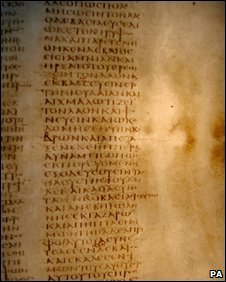 The codex sinaiticus is one of the most important documents in existence. It's a hand-written copy of the Greek Bible from the 4th century. Now, images of more than half of the 4th century biblical manuscript have been made available online by the British Library.
Here's some background history on this extraordinary document.
Use the search engine here.


Comment number 1.
At 11:33 6th Jul 2009, joshrenalds2009 wrote:This comment was removed because the moderators found it broke the house rules. Explain.
Complain about this comment (Comment number 1)
Comment number 2.
At 12:38 6th Jul 2009, Gill_kcd wrote:To anyone interested in reading more about the rediscovery of the oldest known Bible manuscripts, I heartily recommend Janet Soskice's recent book, 'Sisters of Sinai: How Two Lady Adventurers Found the Hidden Gospels' (Chatto and Windus, 2009). Soskice is a Cambridge academic and writes with great knowledge and authority, but also with tremendous warmth and sympathy for her subject and protagonists (manuscript scholarship plus human interest!). The Codex Sinaiticus is discussed in 'Sisters of Sinai', though largely as background to the later manuscript discoveries at St Catherine's monastery by the late-Victorian Lewis sisters. 'Sisters of Sinai' will also be of particular interest to Irish Presbyterian readers, since the story of the Lewises' manuscript discoveries turns out to be closely interconnected with the sisters' role in the foundation of Westminster College, the Presbyterian seminary in Cambridge.
Complain about this comment (Comment number 2)
Comment number 3.
At 14:15 6th Jul 2009, aldomandolo wrote:This comment was removed because the moderators found it broke the house rules. Explain.
Complain about this comment (Comment number 3)
Comment number 4.
At 15:29 6th Jul 2009, PeterKlaver wrote:The BBC news had a piece on it too. Parts of it rather worrying for fundie literalists:
https://news.bbc.co.uk/2/hi/uk_news/magazine/7651105.stm
"For those who believe the Bible is the inerrant, unaltered word of God, there will be some very uncomfortable questions to answer. It shows there have been thousands of alterations to today's bible.
The Codex, probably the oldest Bible we have, also has books which are missing from the Authorised Version that most Christians are familiar with today - and it does not have crucial verses relating to the Resurrection."
I'm waiting with eager anticipation for cries of liberal, anti-christian BBC bias by one of our regulars.:)
Complain about this comment (Comment number 4)
Comment number 5.
At 15:46 6th Jul 2009, Heliopolitan wrote:Will, you need to get Bart Ehrman on SunSeq at some point.
Complain about this comment (Comment number 5)
Comment number 6.
At 16:13 6th Jul 2009, MarcusAureliusII wrote:Finally pastorphilip will have an authoritative source we can agree on and debate. I'm brushing up on my ancient Greek this very minute just for such opportinities. How about you pastrphilip? You a phi beta kappa on this yet? You the alpha and the omega. Read any ancient Greek works in their original language recently? Herodotus? Thucydides? Lysistrata? Oedipus Rex?
Complain about this comment (Comment number 6)
Comment number 7.
At 18:06 6th Jul 2009, petermorrow wrote:I'm afraid there isn't really any news here except the fact that the Codex is now online.
Complain about this comment (Comment number 7)
Comment number 8.
At 18:14 6th Jul 2009, MarcusAureliusII wrote:pastorphilip, can you translate this into ancient Greek :-)
https://www.youtube.com/watch?v=mScdJURKGWM
Complain about this comment (Comment number 8)
Comment number 9.
At 18:24 6th Jul 2009, petermorrow wrote:Marcus
Can you translate it into English?
Complain about this comment (Comment number 9)
Comment number 10.
At 18:37 6th Jul 2009, Orthodox-tradition wrote:Hi Peter Klaver
ref post 4.
Biblical mss can be divided into two streams, byzantine/majority and alexandrian/western.
byzantine mss were the ones preferred by the majority of early greek speaking churches.
the churches were not so keen on the alexandrian mss because these tended to downplay key doctrines, such as the divinity of Christ.
In other words, the early greek speaking churches did not trust the family of mss from which codex sinaiticus comes from.
should you?
The proposed strengths of alexandrian mss are that they are the earliest existing mss still available.
but it has been argued that they may still exist because they were not in everyday use by any church so did not suffer from wear and tear etc.
All traditional English speaking bibles were based on the byzantine tradition mss up until the KJV, if I am not mistaken.
I use a wide variety of translations including kjv btw.
OT
Complain about this comment (Comment number 10)
Comment number 11.
At 18:42 6th Jul 2009, Orthodox-tradition wrote:ps I understand greek speaking churches today still trust in byzantine tradition mss as opposed to alexandrian mss such as codex sinaiticus.
alexandrian mss are always substantially shorter than byzantine because so many verses are missing in comparison to byztantine mss.
Complain about this comment (Comment number 11)
Comment number 12.
At 22:17 6th Jul 2009, John Wright wrote:OT- You appear to be admitting that there was more than one 'version' of Christianity in the early days. What makes you think you inherited the right one?
Complain about this comment (Comment number 12)
Comment number 13.
At 22:20 6th Jul 2009, John Wright wrote:Oh, and I second the call for Bart Ehrman as a guest on Sequence. I've read several of his books, which have the appeal of being a layperson-friendly examination of early Christianity and the bible... he'd be a great guest and if Will doesn't book him soon, I will!
Complain about this comment (Comment number 13)
Comment number 14.
At 22:25 6th Jul 2009, Heliopolitan wrote:"Downplay the divinity of Christ" or flat-out refute it? Arius was right, and yiz should all be Unitarians. This "Trinity" nonsense was one of the most disastrousest things to happen to religious thought since Jehovah said, "No, on second thoughts, Abraham, I think I'll have the mutton instead of the long pig."
Complain about this comment (Comment number 14)
Comment number 15.
At 23:50 6th Jul 2009, petermorrow wrote:Goodness me, did he say that in Aramaic, Hebrew, Greek or Syriac?
Complain about this comment (Comment number 15)
Comment number 16.
At 09:00 7th Jul 2009, Heliopolitan wrote:In Gangsta-Rap, I think. The beauty of mythology is that it accretes monkeys as it is passed from person to person, and gets translated from language to language across a dynamic culture. Pretty soon you end up with a whole heaving conglomeration of monkeys.
Complain about this comment (Comment number 16)
Comment number 17.
At 11:35 7th Jul 2009, petermorrow wrote:I know; isn't it great how the story of Jesus can be communicated from culture to culture, age to age allowing for and encouraging a variety of expressions without loosing it's central message or having to impose any particular national or cultural identity on others.
Art and music and science and knowledge and beauty in all of their cultural expressions are gifts from God.
You know Helio, every time you advance in your scientific knowledge and bring something new to society, every time a new concerto is written, new art is produced, new orchards or forests are planted, new houses are built, new stars are observed and named, we are fulfilling God's instructions to establish human culture on the earth.
Fill the earth and subdue it, my friend.
Or put the codex sinaiticus online, I'm quite sure that counts too. :-)
Complain about this comment (Comment number 17)
Comment number 18.
At 12:17 7th Jul 2009, PeterKlaver wrote:Petermorrow, I'm deeply disappointed in you.
"Art and music and science and knowledge and beauty in all of their cultural expressions are gifts from God. You know Helio, every time you advance in your scientific knowledge and bring something new to society, every time a new concerto is written, new art is produced, new orchards or forests are planted, new houses are built, new stars are observed and named, we are fulfilling God's instructions to establish human culture on the earth."
Obviously, you've been reading too many of the brainless posts by fundies on the WhiteWell threads. And I am sorry to say, you're starting to sound awfully much like them. So much so Helio, that I'm afraid we must conclude that we've lost one. He seemed to be doing so well. He had great potential to outgrow the Magic sky pixie tales that for a while only seemed to moderately cloud his thinking. Such a great loss, when he often seemed on the verge of casting of his irrational demons.
A solemn moment of silence people, as we mourn the passing of the mind of one of the pleasant christians on this blog. May the FSM have mercy on his mind. Because I damn well won't, now that he's become one the unthinking horde!
Complain about this comment (Comment number 18)
Comment number 19.
At 12:41 7th Jul 2009, petermorrow wrote:You know Peter, that's a curious response, which you might begin to answer by explaining at what point I ever denied the existence of God, and continue by explaining how celebrating 'art', 'music', 'advancement of knowledge', horticulture, engineering and construction, 'science for the benefit of society', 'human culture', and most anything else you care to mention is 'unthinking'. Pardon me for promoting humanity, education, and leisure.
I think too you misread some of the trouble with Fundamentalism, in that it's often, if not mostly, opposed to culture.
But sure, if all you can say is that I've stopped thinking because I still accept the reality of God, I'll not worry too much about your response.
Tell you what Peter, why don't you tell me what to think and then I can switch off completely.
Complain about this comment (Comment number 19)
Comment number 20.
At 12:49 7th Jul 2009, petermorrow wrote:Or Peter, you could ask me what I mean when I speak of Christianity and culture, or, better still, tell me in your words what you think I said, instead of making assumptions and jumping to conclusions; you know, conversation, communication, understanding, clarity, debate, thought, reflection... but sure, if it suits you, call me whatever you wish.
Goodness me, surely the big news of your day isn't that you remembered that I'm a Christian.
Complain about this comment (Comment number 20)
Comment number 21.
At 13:01 7th Jul 2009, petermorrow wrote:This comment was removed because the moderators found it broke the house rules. Explain.
Complain about this comment (Comment number 21)
Comment number 22.
At 13:57 7th Jul 2009, petermorrow wrote:OK, this is ridiculous.
Over the months there have been many references to the God of the bible on this blog. He has been accused of many things, at one point being referred to as Josef Fritzl, although many of the comments have been in a similar vein. This God has been dismissed among other things as evil and so on.
At no point (and I'm one of the Christians on here) have I ever objected to anyone's comments, debated yes, but never, ever, asked for a comment to be removed. The whole point of the blog is controversy, is it not, says so at the top.
Now, in response to PK's post 18, when he suggested I was brainless, I referred in post 21, in my final comment in a list of satirical comments about converting to atheism, to my real, actual, negative and abusive attitude to the God I happen to believe exists. It was a punch line, which included a letter, the 6th letter of the alphabet as it happens, followed by a word, a 3 letter word, which included the 6th letter of the alphabet twice and with it the letter 'o', I'd probably better not give the order incase the order of the letters is offensive.
Here's the weird thing about this blog now, people get called names, no action taken, atheists criticise God, no action taken, yet a Christian who has defended (ad nauseam, and to the point where even he is bored) broad historical and traditional Christianity goes and makes an honest comment about his own attitude at times to the God he says he follows and it gets referred.
Others can be abusive about the Christian God they don't believe exists, but Christians can't refer negatively to themselves or the God they actually do believe in.
It's becoming pointless.
Peter K, I actually like you antagonism towards Christianity, at least you're honest, but (whoever it was) the act of referring my post 21 has left me with little to say, pity that cos I was up for the fight.
:-)
Complain about this comment (Comment number 22)
Comment number 23.
At 14:04 7th Jul 2009, PeterKlaver wrote:Hello petermorrow,
Woops....I think you may have taken my post a bit too serious and gotten worked up about it. Let me respond to the posts that didn't get referred later when I have more time (and maybe yours re-appears).
I don't mind any language people post, I didn't refer your post to the mods. What you say about atheists being able to say anything isn't 100% true. I had posts referred to the mods on the first WW thread, when I said I welcomed the day christianity would be thrown onto the thrash heap of human thinking, along with most other religions. That wouldn't have been referred to the mods a few months ago. The new banning spree seems pretty broadly aimed.
Complain about this comment (Comment number 23)
Comment number 24.
At 14:05 7th Jul 2009, petermorrow wrote:One more thing.
To the ever mysterious and unknown people (probably other Christians) who refer comments cos they can't stand free speech, you may not have liked my reference to my (yes my own, about me...) attitude to God, you may not like my honesty, but the reason I can actually be honest about it is because I have actually grasped what forgiveness is.
Complain about this comment (Comment number 24)
Comment number 25.
At 14:12 7th Jul 2009, petermorrow wrote:Peter
On the basis of what I wrote in post 21 I suspect it was a fellow believer who referred me, I didn't for one minute think it was you.
Of course you are quite right, atheist and Christian alike have had posts referred, my point however is that worse things than what I said here have been allowed to stand, I have no gripe with that, but what does bug me and it bugs me immensely is that some people on here don't seem to be able to deal with honesty and it is really rather weird that Christians aren't allowed, by some, to be honest about themselves or what they believe, goodness, honest Christianity, whatever next?
Complain about this comment (Comment number 25)
Comment number 26.
At 14:36 7th Jul 2009, John Wright wrote:Eff it all, Peter.
Complain about this comment (Comment number 26)
Comment number 27.
At 16:01 7th Jul 2009, Heliopolitan wrote:I thought God was ineffable anyway...
PeterM, PeterK is having his wicked way with you - we *do* actually like you, remember? As for fulfilling god's instructions, isn't it convenient that god issued a few instructions that happen to overlap with our natural proclivities? Game on, I think, and who knows where such honest and dedicated inquiry may take us?
As a Christian, it was open and honest inquiry (and a due disregard for much of what passes for "apologetics" that wouldn't even pass muster as a bowl of porridge) that led me to atheism - which is why I am a Christian Atheist.
But back to the main thing - this codex does show how "dynamic" and unfixed the "canonical" texts were, and demonstrates to an unsuspecting Christian world that Bart Ehrman has pretty much hit the nail on the head. You base a lot of your theology on very very shaky foundations if you go anywhere near that flimsy text that is the bible.
Complain about this comment (Comment number 27)
Comment number 28.
At 16:18 7th Jul 2009, John Wright wrote:"You base a lot of your theology on very very shaky foundations if you go anywhere near that flimsy text that is the bible."
Or at least understand what it is, how it came to be bound between a wraparound leather cover in that particular order, and understand its limitations and particularly how the traditional evangelical understanding is flawed at best, downright ludicrous and utterly deceiving at worst.
Complain about this comment (Comment number 28)
Comment number 29.
At 16:21 7th Jul 2009, kwpaxton wrote:Is this not the reason you are mistake, that you do not understand the Scriptures or the power of God? Gospel of Mark 12:24 (NASB)
This was the reply of Jesus Christ to the Sadducees (a Jewish sect of aristocrats, many of them Levitical priests, who did not believe in the afterlife they were therefore sad you see sorry, old fundamentalist joke) who thought they had the ultimate argument from the Law (the Torah) to disprove belief in eternity.
Jesus goes on to prove from the Law that there is an afterlife. The Gospel of Matthew also includes the rebuke above but the Gospel of Luke does not. The Gospel of John does not include the incident at all. This would be one of those variances the article refers to. But the three accounts include the rebuttal from Scripture (the Law). That is the nature of these recorded accounts recalled, written, and preserved by different authors at different places and times, capturing what had been passed along orally for decades and how good is your memory? But the part of Christs answer to the Sadducees challenge regarding eternity is the same in all three.
A couple of years ago the National Geographic told about the discovery of the Gospel of Judas and declared with great glee something like, This will change the history of Christianity. Most folks have forgotten the claim, Christian history remains unchanged, though some, Ehrman for example, can still be seen holding it up in the moonlight and worshipping it. So this articles implication too, like a smudge on clean linen will be washed away with the passage of time. Still the smudge is all the authors, he can hold it up and declare, I made that the day I single handedly refuted Christian fundamentalism for all time. as long as he wishes, perhaps his grandchildren will be impressed, or amused at least.
Nevertheless, he does well to wrestle with this I pray he never ceases. Certainly this interaction with God's word, now hes engaged it, will never cease to wrestle with him. It did not turn out well for the Sadducees. You see they were politically correct, which served them well as long as there was Jewish state. But they disappear from history altogether with the destruction of Jerusalem by the Romans.
Complain about this comment (Comment number 29)
Comment number 30.
At 16:48 7th Jul 2009, Dylan_Dog wrote:PeterM,
You had a post removed!You!? Bloody hell things are getting ridiculous when one of PeterM's posts gets complained about.
Anyway PeterM liking what you have to say about 'honesty' on these threads.
Helio is right, we do like you!
Regards
DD
Complain about this comment (Comment number 30)
Comment number 31.
At 18:38 7th Jul 2009, Heliopolitan wrote:DD, yep - it's a bit like hearing your aunt Mildred say a naughty word.
Kwpaxton, you are getting there. Keep reading the bible - it'll make an atheist of you yet :-) Welcome aboard.
Complain about this comment (Comment number 31)
Comment number 32.
At 19:00 7th Jul 2009, Orthodox-tradition wrote:ref post 22 PM
You say you like Peter Klaver's antgaonism towards Christianity because its honest.
I believe I may have scriptural grounds to support the idea that God has a similar view towards Mr Klaver;-
Revelation 3
And to the angel of the church of the Laodiceans write,
These things says the Amen, the Faithful and True Witness, the Beginning of the creation of God: 15 I know your works, that you are neither cold nor hot. I could wish you were cold or hot. 16 So then, because you are lukewarm, and neither cold nor hot, I will vomit you out of My mouth."
OT
Complain about this comment (Comment number 32)
Comment number 33.
At 19:31 7th Jul 2009, Orthodox-tradition wrote:John Wright
You said: "You appear to be admitting that there was more than one 'version' of Christianity in the early days. What makes you think you inherited the right one?"
I can just hear the echoes of all the times you debated this with your Presbyterian minister dad in NI, John!
Actually what I was saying was that all down through history and right up until today, the Christians who actually knew and spoke greek fluently tended to reject the alexandrian mss, of which codex sinaiticus is one. why? Between their faith and their linguistic instincts they just did.
Most of the early greek speaking Christians preferred the Byzantive texts, which is why they are also called the "majority" text.
There certainly were all sorts of "versions" of Christianity in the early days.
Peter writes about some of these "versions" in 2 Peter 2&3;-
https://www.biblegateway.com/passage/?book_id=68&chapter=2&version=50
The key doctrine was always the divinity of Christ, but while alexandrian mss downplay this, it always comes shining through anyway.
Examples from alexandrian mss;-
Each time Christ says "I am" the bread of life, the door, the light of the world, the way the truth and the life, he is assigning to himself the Jewish name for God.
When the soldiers asked him in Gethsemanae if he was Jesus he said "I am" and a squad of toughened Roman soldiers fell to the ground. why?
Also, even in the lesser mss He accepts peoples' worship without blinking an eye, forgives people for sins against other people and is clearly sinless.
Astrologers followed a star to his birth. The sky blackened at his death.
He walked on water. His tomb was empty. He ate fish after he had been killed.
This is the testimony of even the lesser mss. Even the stones will cry out and testify John.
Another angle is that a common thread through all scripture is the battle for the heart and soul of man between worshipping Jehovah and Baal.
In a broad brush stroke, Jehovah loves man and sacrificed his Son for him.
In contrast Baal blesses the "termination" of babies.
Baal always endorses moral relativism but Christ placed a very high value on obedience to scripture.
Baal makes no real moral demands of his followers at all, but Christ demands everything.
I suggest you can make a clear distinction between orthodox Christianity and other "versions" using some of those principals John.
But the main reason I believe I inherited the "right" Christianity is because I believe I have encountered the same man who came out of that tomb, in real life, and that he is ultimately my only source of hope in life and death.
OT
Complain about this comment (Comment number 33)
Comment number 34.
At 19:56 7th Jul 2009, Dylan_Dog wrote:Likewise OT
When I read this passage in the Bible I believe that Jesus is talking about you;- (and looking at comments in recent threads, it appears that some Christian posters agree with me and Jesus)
Matt 23:27
Woe unto you, scribes and Pharisees, hypocrites! for ye are like unto whited sepulchres, which indeed appear beautiful outward, but are within full of dead men's bones, and of all uncleanness.
DD
Complain about this comment (Comment number 34)
Comment number 35.
At 19:58 7th Jul 2009, petermorrow wrote:Helio
What are you telling me that I don't already know, you haven't already told me, or we haven't already debated?
Beyond that here's an interesting one from Ehrman
From chapter one of his Book 'God's Problem', "The problem of suffering became for me the problem of faith". In fact I found reading chapter one from the the 'Look Inside' Amazon link from Ehrman's website to be so intriguing that I plan buying it and making it my second read of the summer. I'll finish Kenneth Bailey's 'Jesus Through Middle Eastern Eyes, Cultural Studies in the Gospels', first though. I take it you're familiar with him?
Complain about this comment (Comment number 35)
Comment number 36.
At 20:03 7th Jul 2009, Dylan_Dog wrote:"In contrast Baal blesses the "termination" of babies."
Just like YHWH then...Exodus 12 12
Ahh but this passage is quote mining, doesn't actually mean what it says, it was YHWH showing his love etc insert apologetic here etc
Complain about this comment (Comment number 36)
Comment number 37.
At 20:42 7th Jul 2009, MarcusAureliusII wrote:petermorrow;
"atheists criticise God, no action taken"
Let he who is without sin throw the first asteroid.
Complain about this comment (Comment number 37)
Comment number 38.
At 20:47 7th Jul 2009, logica_sine_vanitate wrote:#17 - petermorrow -
Thanks for your comments, with which I wholeheartedly agree.
The Bible is not the Koran, for which there is only one authentic "divinely dictated" verbally infallible document in one sacred language (Arabic) - although I am aware that there may be different "recitations" of the Koran, but essentially the idea is that there is one unified text. Unlike Islam, Christianity is supposed to be above culture, and able to assimilate different cultures, while rooted in the historical development of the nation of Israel through which the Messiah was revealed. The biblical documents bear witness to historical events, and are not to be treated as a legal textbook.
The textual variants seem to worry a very few Christians. Of course, those who, for whatever reason, have an axe to grind about Christianity, seize on these "discrepancies" with barely disguised glee. But, I'm afraid this cynical rejoicing is a form of psychological self-stimulation (I won't use the word I really wanted to, for fear of the moderator's disapproval!). They may have their little bit of fun with Mr Ehrman, or others of his ilk, but we've heard it all before. As a theology graduate (and, no, not from some little evangelical bible college, but from a major university faculty, which was actually quite liberal) I have sat through lectures disputing the Pauline authorship of various NT books, and none of the reasoning was supported by convincing evidence. This sort of stuff may turn on the cynics among us, but if they think this is going to turn millions of people from their Christian faith, then I feel seriously sorry for them.
None of the major doctrines of the Bible are established by variant readings, and there is so much repetition and the opportunity for cross-referencing, that such variations are really peripheral. As for fraud - well that has to be proven, just as "fraud" today in any area of life has to be supported by evidence and not based on supposition.
I do question the concept of "verbal inspiration". In fact, such a concept can only work in the original languages anyway. As a very rusty student of the biblical languages I can say that Hebrew words have a variety of meanings and there is a certain ambiguity at times (for example, there are no tenses, strictly speaking, but just two forms of action: completed and incomplete). Furthermore, without the Masoretic pointing, there is further scope for confusion. However, you cannot separate the Jewish Scriptures - what we call the Old Testament - from the religious traditions of the nation of Israel. So there is an understanding handed down the generations as to how the Scripture should be read. But there is scope for a certain freedom in Bible translation, and this helps with the cultural contextualisation of the faith.
As a Christian am I bothered that there are some possible ambiguities in Scripture? Does it shake my faith? If it did, then I would not have much of a faith. True faith is based on the God who is actually real, and not just a theory, and I would be worried if my faith had to be based on a Koranic concept of the Bible, where there was a prescribed "foreign" (i.e. original language word) for everything. Such a Scripture would be culturally bound, which is not the case with the Bible. So coming back to your comment, Peter, about culture, you have hit the nail on the head here.
Is it not also interesting that even a "perfect" verbally accurate text, such as the Koran, is subject to all sorts of different interpretations, which lead to horrendous consequences, as I am sure we well know.
So, to the cynics, all I can say is this: have fun with this subject. I hope you enjoy yourselves. But just remember, we've heard it all before....
(By the way... the "book of nature" on which some people rely for their "revelation of truth" isn't exactly without its difficulties either. Ponder that, those of you who are quick to criticise other people's beliefs).
Complain about this comment (Comment number 38)
Comment number 39.
At 23:07 7th Jul 2009, Heliopolitan wrote:VSL, that was out of the top drawer. Unless you've been kipping for the past 2KY, you'll be aware that Christians have been quite literally killing each other over such nonsensical trifles, as well as "clarifying" various errors by injecting their corrections into the "canonical" text. The lesson from the variants is NOT some sort of casting doubt on the core doctrines (which themselves are very dubious - I mean, the resurrection - come ON! How stupid is THAT?), but they cast light on how the whole sorry mess came about. Just as our genes provide evidence of our evolutionary relationships to other species, the mistakes, interpolations, fakeries, embellishments etc in the bible allow us to construct phylogenies of their derivation, and we can glimpse the myths and tales that the collection arose from, as Judaism and Christianity evolved (and continue to evolve).
For me, it was reading the bible that established that it was a purely human creation - to me, that makes it more valuable than the mere prattling of some narcissistic space pixie. It makes Jesus the Nazarene more interesting than some fake god. It makes the embellishments of the author of the Greek wrapper of Matthew more intriguing, because we can see the germs of the disputes that arose between the early Jewish Christians and their gentile competitors.
It's all quite delicious, and the wonderful irony is that the people who have the *most* respect for the bible and its authors are the atheists and agnostics who treat it as it is - a human creation, dealing with human reactions to human issues. Calling it the "Word of God" is really rather seedy and disrespectful.
Complain about this comment (Comment number 39)
Comment number 40.
At 00:01 8th Jul 2009, logica_sine_vanitate wrote:#39 - Heliop - "Unless you've been kipping for the past 2KY, you'll be aware that Christians have been quite literally killing each other over such nonsensical trifles, as well as "clarifying" various errors by injecting their corrections into the "canonical" text."
Not sure who "VSL" is (I suppose it doesn't matter if it is referring to me - as long as the Latin case endings stay the same then the meaning isn't really changed - so good try, better luck next time).
However, assuming that you are fulfilling a deep need to be funny, then I take your point, but what I meant when I wrote that "The textual variants seem to worry a very few Christians" was to do with these variants causing them to lose their faith completely. At least that is my experience, and I've been around "the Christian world" for quite some time. The situation may be different in your little neck of the woods.
I do agree that some who "adhere to the Christian faith" (let me phrase it like that) have engaged in bloody civil war over "trifles" (as you so eloquently put it, although you'll notice that I have expurgated the word "nonsensical").
Everything else you have said I thoroughly and happily disagree with, but then again you're entitled to your opinion, as I am to mine (after all, I can't help my "God gene" now, can I?).
Complain about this comment (Comment number 40)
Comment number 41.
At 04:47 8th Jul 2009, John Wright wrote:OT-
"I can just hear the echoes of all the times you debated this with your Presbyterian minister dad in NI, John!"
You're right... I did many times!, though much more often with other people who I felt freer to debate!
"I suggest you can make a clear distinction between orthodox Christianity and other "versions" using some of those principals John."
I remain to be convinced that what we call 'orthodox' Christianity today didn't come about merely by arbitrary and historical means which are to a significant degree accidental. It seems curious that the version of Christianity which survived was the one best placed to succeed, in the seat of the Roman Empire, the Roman church. And, of course, what we inherited is that version.
"But the main reason I believe I inherited the "right" Christianity is because I believe I have encountered the same man who came out of that tomb, in real life, and that he is ultimately my only source of hope in life and death."
That's a very respectable answer. Who can argue with experience? Yes, it's subjective in the same way that the experiences of a psychic or a witch-doctor are subjective, but nobody can question the validity of your personal experience: that's yours, and yours alone.
Complain about this comment (Comment number 41)
Comment number 42.
At 10:19 8th Jul 2009, PeterKlaver wrote:Hello petermorrow,
I have some more time now.
"You know Peter, that's a curious response, which you might begin to answer by explaining at what point I ever denied the existence of God,"
I didn't say that. I said, in a none too serious way, the opposite, that your mind was moderately burned with the Magic sky pixie belief.
"and continue by explaining how celebrating 'art', 'music', 'advancement of knowledge', horticulture, engineering and construction, 'science for the benefit of society', 'human culture', and most anything else you care to mention is 'unthinking'."
It isn't, and I didn't say it was. It was your 'ode to god' blurp about everything being according to gods instructions (the way some believers will try to sell you anything, 'It's gods will') that I was referring to, see part that I quoted.
"But sure, if all you can say is that I've stopped thinking because I still accept the reality of God, I'll not worry too much about your response.
Tell you what Peter, why don't you tell me what to think and then I can switch off completely."
As I said in post 23, you seem to have taken things rather too awfully serious (when I'm praying to the FSM to have mercy on your mind, it should have provided a small hint).:D
Interesting follow-up though, with a post getting removed and subsequent posts following that.
Complain about this comment (Comment number 42)
Comment number 43.
At 10:31 8th Jul 2009, PeterKlaver wrote:that should read 'burdened', not 'burned'
Complain about this comment (Comment number 43)
Comment number 44.
At 23:08 8th Jul 2009, Heliopolitan wrote:LSV, is this about "losing their faith completely"? Maybe the punters you encounter in your perambulations around the "Christian world" (whatever that is) are a slightly self-selected bunch. I progressed to non-belief, and a significant impulse for that came from the fact that "scripture" is unreliable; even if the "over-arching message" is clear (and it isn't; you interpret it through a lens of serious monkey-laden tradition, and keep piling the monkeys on like there was no tomorrow), if we view it as a divinely inspired corpus, we are fooling ourselves. I *know* that many other people have travelled this route, but most of us don't waste our time faffing about on Will's exemplary blog like I do :-)
But the textual variants are *interesting* because they tell us about its history; like genetic polymorphisms, we can track ideas, embellishments, additional "clarifications", etc etc. What you get is a far more fascinating story than the dopey "word of god" nonsense that is still promulgated by some Christians.
But you can't see this; you are still caught in the monkey trap. Let go of the nuts.
Complain about this comment (Comment number 44)
Comment number 45.
At 18:02 9th Jul 2009, Orthodox-tradition wrote:Helio old buddy...
Some interesting turns of phrase there....and all the Egyptology... you're not on the square are you?
(BTW interesting to see you are going so public online nowadays).
John Wright
sorry for the delay in coming back. Surely you didnt have to go all the way to the states to speak your mind? joke!
I have lived outside NI and I can appreciate getting away from it all.
Anyway, I was quite surprised that you skipped over the main part of my last post (which was for the most part objective) and instead only hit me on the one subjective line I wrote!!??
Try again?
I fully accept your point that that testimony is subjective, but ultimately beyond being impossible to refute, it is equally possible that it is completely true!
Are you actually looking for the truth about what the "true version" of Christianity is?
Or are you actually quite happy tilting at windmills for the time being?
It seems to me that your question hinges completely on whether Christ is truly God and rose from the dead. Everything else is small fry imo, doctrinally speaking.
Do you believe Christ is God or not John? What are your reasons?
Dylan Dog
Apologies for being obscure but that was intended to be a genuine compliment to PK.
In other words, God prefers people who are hot or cold about Him and vomits out people who are lukewarm fence sitters.
A fiery Christian-killing Saul of Tarsus he welcomed with both arms!
I suggest God is quite pleased that PK is not lukewarm about Him!
peace
OT
Complain about this comment (Comment number 45)
Comment number 46.
At 18:22 9th Jul 2009, Orthodox-tradition wrote:Peter Morrow
I missed your comment about your attitude to God, but I note that you have previously said that you h*te God (just in case I get pulled too).
(Werent you told why your post was pulled?)
Is this what you were saying?
Why? I find it so hard to get my head around this.....?
While we are on the subject, it also seems at times like you h*te His church or at least like you have a default chip on your shoulder against it.
I guess you might say you are only opposing deadweight religion, not the actual church.
But if people are innocently caught up in this, is it really God's attitude to smite them for it, or might reasonable persuasion be closer to Christ's attitude?
He did die for the church after all, and it does seem that the NT letters are full of pastoral concern and gentless in how his bride should be treated??
I suggest the church deserves the benefit of the doubt, at least on the first contact on any particular occasion.
eg I know you go pretty mad when people use theological language, even moderate stuff which the athiests well understand.
I take you point that the language may still hinder true communication, quite right. But lashing out at people on account of this????
Is there a connection between this and your h*te for God?
In saying all this, I have found some of your posts very thought provoking, in a constructive way, so I am not trying to do you down.
peace
OT
Complain about this comment (Comment number 46)
Comment number 47.
At 18:34 9th Jul 2009, Orthodox-tradition wrote:Guys
I wonder if it might be of interest to regular posters to give a brief description of their religious upbringing?
Mine was a sort of a pretty low-key Presbyterian one, the bible was never really mentioned and nor did religion really impose on our lives (except for playing footie on a Sunday).
I see JW had a pretty "evangelical" upbringing, which he know eyes with suspicion.
Peter Klaver had a pretty strong Catholic upbringing, which he was none too keen about either.
It would be a real hoot if it turned out that all the regular posters here had "rebelled" against the position of their parents.
Helio? Dylan Dog? Peter Morrow? LSV? MAII? anyone else?
Have you guys reversed your parents views on religion now that you have freedom to make your own choices??
cheers
OT
Complain about this comment (Comment number 47)
Comment number 48.
At 20:36 9th Jul 2009, petermorrow wrote:OT
Thanks for your questions in post 46. In a way I'm kinda glad you asked, and it prompts me to think that maybe I should have explained this in the past. In answering this it may also be that I touch on the question you are asking about 'religious upbringing'.
But where to begin? Goodness, not sure. I'm tempted to say that I was raised in a Christian home, but that sounds too much like a testimony! :-)
Let's run with the idea of me saying that I hate, have hated, God. The letter, not word you understand, that I used in the post which was removed was basically a reference to me having said that I hate God, but in a more direct way, a kind of abusive prayer if you like. (it got pulled for including a abbreviated swear word)
All of this revolves around honesty.
The evangelical world I am familiar with is chock-a-block full of people who are very quick (too quick, I think now) to speak of their love for, commitment to, passion for, dedication to, God. A quick perusal of most of our modern hymns is enough to identify this sentiment; basically what all of them are saying is, 'God, I'm so amazingly dedicated to you, I love you more and more everyday, I'm just so full of admiration for you', and so on. Now not only are they all written in the first person, referring to my love, my dedication, my commitment and so on, but the truth is that no one, absolutely no one, none of us, who call ourselves Christians actually think, feel, or live like this all the time. (If we think we do, we're kidding ourselves) Not even the bible speaks of people relating to God like this all the time, and I just got tired singing things which weren't always true. In addition to all that, I came to the conclusion that a lot of what is called 'faith', seems to be faith in ourselves, in other words, faith in 'our ability to believe', faith in 'our dedication' and so on, good things get talked up as 'blessings', bad things get ignored.
I could be wrong here OT, but it doesn't seem honest.
I'm also faced with the dilemma that no one, maybe I should say few, in our churches want to speak about doubts, worries, fears, disappointments, discouragements and the like, everything must always and forever be, 'well with our souls', to misquote a hymn. You say I should give the church the benefit of the doubt, perhaps, but I've been asking these questions for a long time, I've seen the church mistreat people, seen the church exclude people, not for what might be called 'sin', but just for being 'hard to handle'. These people could and wish to be of great benefit to the church, they are people who wish to contribute but because they don't toe the party line they are ignored.
But back to my 'hatred'. Maybe this will explain it to you. In light of all the statements of sincerity we make to God in our services week after week, it is odd, is it not, that all to easily we fail to act like Christians on Monday. The truth of the matter is that my heart, on many occasions, is full of resentment, selfishness and so on; I am not the person I am called to be. I don't, 'hunger and thirst for righteousness', for example and so I must face the fact, that for all my protestations of devotion, I do not live a devoted life, rather, having affirmed God's existence on Sunday I proceed to live as what might be called a 'practical atheist' during the week. Is it not reasonable then to say that I have 'hated' God, are these not the facts.
But not only, would I suggest, are these the facts, I also argue it is important that we as Christians acknowledge our lack of devotion for it is only against this backdrop that the (what shall we say) brightness of God's attitude towards us, shines brightest. The theological word is grace, but why do I tend not to use these words, because I find that their overuse has devalued them, indeed at times it seems that we use 'theological' words in the same way others use swear words, cheaply and glibly, four letter words are pronounced 'wrong', but do we not misuse God's name and character all the time?
OT I want the church to stop, (in fact I'm going to argue that it desperately needs to stop) being fixated on it's subculture. I want the church to stop assuming that all of it's programmes, be they building programmes or programmes of worship are worthwhile. Why? Because I grew up in a subculture which was positive and helpful and safe, but it was one in which I did not learn how to love my enemy, or forgive others, or show mercy, or, if truth be told, nor was it one where we were honest about our sin.
OT, our churches do a lot of positive things but sometimes we forget Jesus. Yet it is Jesus who is the righteous man of Psalm 1, it is Jesus who is devoted to God, it is Jesus who is fully committed, it is Jesus in whom I am called to trust, and when I do I find I am told things I do not like but if I am to be the Christian I say I am I have no option but to listen to what he said and face up to the facts about my attitude and my actions.
I need, we all need at times, the god who inspired Psalm 88, the Psalm which appears to end without hope (!), why, because in the end, God doesn't need me, or my pretended devotion, I need Him.
Wouldn't it be good, every once in a while, if a preacher told us that God's commitment to us is worth more than our commitment to Him. Wouldn't it be good if the preacher told us that faith is dynamic, that it develops and progresses, that the bible is full of worship and complaint. Wouldn't it be good if we remembered that God's people wrestled with him, remembered that Peter denied him (with curses), remember that Abraham pawned off his wife to protect himself that Paul and Barnabas had a big bust up and went their separate ways? We need a bit of honesty in the church, and yes sometimes I hate God.
As for the lashing out, yes I was particularly cross on this thread and I've said some tough things about the church, but the other side of it is that it has taken over a year for anyone (any other Christian contributer) to ask me what I'm getting at, you are the first. We in the church have got to stop pretending we're holy, and the people I've learned most from are the Christians who recognise they're 'normal', that like everyone else they mess up; they tend to be those who forgive most too.
Regards
Peter
(Up-bringing? Conservative, Presbyterian in the 'Keswick' mould, boy were we the real thing!! :-) )
Complain about this comment (Comment number 48)
Comment number 49.
At 21:07 9th Jul 2009, logica_sine_vanitate wrote:#44 - Helio - "Let go of the nuts."
You seem to be quite an evangelist for your version of the "good news".
Suppose I decided to, as you put it, "let go of the nuts" - in other words, "convert to atheism" - what would my reasons be? Let me run through why I could conceivably do such a thing. (By the way ... as I was driving to work today I was behind a car with one of those "Darwin" fish badges - have you seen them? It's a parody of the "Jesus fish", but this one has little legs on it, symbolising the transition of life from water to dry land - a truly miraculous feat, don't you think? I'd be fascinated to learn more about the transitional arrangements for life between sea and dry land within evolutionary thinking. Perhaps you could put your evangelist's hat on and explain this impossibility to me?)
Now ... where do I start? Hmmm...
1. I suppose the first reason would be: "because atheism is true". Well, of course, that is what atheists think, but why should I believe that? Clearly I should not believe that some point of view is true simply because some bloke tells me it is, and derides any other opinion. That, of course, does not and should not count as evidence in any court of law. Obviously there needs to be some kind of evidence to support this claim. The only evidence I can see is that some people seem to insist that when a naturalistic explanation is found for any phenomenon we encounter in our lives that that explanation should be accepted as the true one, and all other explanations should then be discarded. These other explanations may have had their place in earlier eras, when people were more ignorant, but now we have, as it were, "come of age" (this is the "myth of progress" which seems to intoxicate some people).
Well, this is an interesting hypothesis, but it doesn't convince me, because I have yet to be presented with the irrefutable proof that supports the presupposition that "a naturalistic explanation should always be accepted as the true one". So I am not being bloody-minded or deliberately awkward when I say that I have not been persuaded of the truth of this particular philosophy. And furthermore, there are problems with naturalism epistemologically, but I think I have written enough about that elsewhere (although I know my thoughts went down like a lead balloon, and I feel a little irritated at myself for having reacted badly to that).
2. I suppose I could consider atheism as a kind of "liberation" from living under the heavy and oppressive yoke of religious belief. This idea could have some mileage, I admit. I remember reading one "deconversion testimony" about some chap who obviously had had a pretty bad experience of Christianity, and one phrase he used has stuck in my mind: he found "comfort in science and reason". I cannot help feeling a tremendous sympathy with such a person, as I too find "comfort in science and reason" when faced with some of the nonsense that is associated with religion. The trouble is that "science and reason" does not lead me to atheism, but actually in the opposite direction.
Furthermore, I don't feel a great motivation to embrace atheism because of some kind of "religious bondage" I am having to endure. This is because I am not actually under that kind of heavy yoke (or even a not-so-heavy yoke for that matter). I don't say this lightly, because I know exactly what religious bondage and extreme religious manipulation feels like. I kind of don't like religion very much actually, especially since I have had some truly dire experiences at the hands of "Christians" - experiences which have produced destructive consequences that I am still living with. So therefore, someone might ask: why the heck are you a Christian, if that religion has caused you so much pain and anguish?
My answer is that the alternative to religion is actually Jesus Christ. There is a choice: "Christianity" (as a dogmatic system) or Christ. Or let's put it another way: religion or the grace of God. Since God is the one who has liberated me from religious oppression, why would I then deny his existence? Doesn't sound very logical to me.
3. Perhaps I could embrace atheism, because that philosophy is more affirming of the human race, whereas Christianity with its apparently oppressive God is hostile to the human race with all its stuff about Adam and Eve and the fall, original sin, hell and damnation etc. After all, how can we love a God who seems to have such bitter hatred towards all but the most subservient and obsequiously pious people, and who has no qualms about torturing most people forever, because they had the nerve to snub him?
If that particular interpretation of Christian doctrine is true, then, yes, I would gladly become an atheist. In fact, I am already an atheist as far as that is concerned, as I don't believe that such a God exists. The "double-predestination total-depravity limited-atonement" God does not exist in my philosophy. Does that make me an atheist then? Neither does the Arminian "if you don't stuff a tract in his hand on the street corner then that person is going to hell and his blood is on your head" type God exist either. So I guess I'm a double atheist then. What other "Gods" do I not believe in? "The anti-Catholic God", "The anti-Protestant God" etc. So there we have it: there are at least four "Christian Gods" I don't believe exist: so that makes me a quadruple atheist. But even though I am a very serious case of "atheism" as I have explained, that does not rule out another type of God...
But coming back to "affirming the human race" - I am actually (don't laugh) ... a humanist. Yes, a Christian can be a humanist. In fact, I would go so far as to say that only Christians can be humanists. An atheist can hardly be a humanist, since for him the human race has no more intrinsic value than a stone, a blade of grass or, in fact, the contents of a sewer. But for a Christian, man is "made in the image of God", and God revealed himself as a man, thus affirming the eternal value of humanity.
4. But what about all the suffering in the world? Surely, surely, surely, all this makes a mockery of the idea of "God"!! If there is any argument that could tempt me to sympathise with atheism it is this one. But there is a problem. I don't pretend to understand all the reasons for the appalling experiences many people go through. But why are we so angry about it, if this is simply nothing more than the outworking of the evolutionary process? Why fight against evil, if it is just nature "taking its course"? Where does this feeling that "these things should not be" come from? That dubious collection of writings called the Bible does actually offer an explanation.
Dare I quote C.S. Lewis (a former atheist) on this one?: "The defiance of the good atheist hurled at an apparently ruthless and idiotic cosmos is really an unconscious homage to something in or behind that cosmos which he recognises as infinitely valuable and authoritative: for if mercy and justice were really only private whims of his own with no objective and impersonal roots, and if he realised this, he could not go on being indignant. The fact that he arraigns heaven itself for disregarding them means that at some level of his mind he knows they are enthroned in a higher heaven still." (De Futilitate, Christians Reflections).
So to sum up in Bertrand Russell fashion: this is why "I am not an atheist".
But having said that, I am even less of an adherent to certain forms of Christianity. So I get a little irritated when "people of faith" are all lumped together in one crude category. I recognise that not all atheists are Stalins, Pol Pots, Kim Il Sungs and Enver Hoxhas. So at least please extend to me the same courtesy.
Oh blast - I'm "off topic"! I'm supposed to be writing about textual variants in the Bible... Oh well, another long essay coming up.... :-)
Complain about this comment (Comment number 49)
Comment number 50.
At 22:07 9th Jul 2009, logica_sine_vanitate wrote:#47 - OT - "It would be a real hoot if it turned out that all the regular posters here had "rebelled" against the position of their parents."
OT, you wouldn't happen to have been a psychologist in another life, would you? (In a manner of speaking, you understand).
Let's just say - for the sake of argument - that my parents were very pious fundamentalist evangelicals, of a particularly Calvinistic bent, and with a strong emphasis on original sin, and above all a deep seated belief that the greatest sin of all was homosexuality. Does that mean that my criticism of Calvinism, my questions about the "orthodox" understanding of original sin, and my slightly liberal tendencies concerning homosexuality in the church can all be dismissed as a childish reaction towards my parents?
I am actually not going to divulge what my parents were like during my childhood, because I feel your question is not relevant. We should be arguing about the issues objectively, not trying to explain away people's beliefs with reference to their upbringing.
Sorry to be a spoilsport.
Complain about this comment (Comment number 50)
Comment number 51.
At 19:17 10th Jul 2009, Orthodox-tradition wrote:Peter M
Thanks for you detailed response.
If I may say tongue in cheek, it almost sounds like you have a bit of an Elijah complex, ie he complained to the Lord that only he was left faithful, but God had to remind him how many others there still were that were faithful.
I find I can sing very few hymns or songs in church at present. I have heard a few differnet pastors say that Christians dont so much tell lies as sing them.
I note Jesus never once told anyone he loved them, according to the Gospels, to support what you are saying.
I have repeatedly expressed my reservations about Christian subculture.
I too am only too aware I am not the person I am called to be.
I recently came to the conclusion that the main reason we suffer this isbecause we dont daily offer ourselves in totality to God so that he can deal with these issues.
imo Christian subculture suggests the Christian life should be a breeze and we should live as "normal" people. But deep down I dont believe we should really be the same as unbelievers, it just doesnt make sense.
nor that Christian growth can happen without dedication nor sacrifice. I am saying this looking at the hill I have to climb, not at the hill I have climbed.
I can agree that every waking moment of my life is not filled with spiritual elation, I find working at marriage and child raising soon knocks that out of you.
But it seems something else again to actually say that you have an ongoing attitude of hate to God. Unless that is you are saying that you interpret your lack of practical ongoing devotion as hatred.
If so perhaps you should spell it out.
To be honest sometimes I find your attitude to other sincere Christians a bit brutal in a way you wouldnt dream of being to unbelievers.
Many people, myself included, agree with so much of what you say, or are are open to persuasion. But I have felt in the past that you have been pretty brutal about expressing your views in this regard.
I can understand it if people are being willfully stubborn or ignorant, but not if you havent taken the trouble to find out first.
Dont forget, you had previously identified me as a co-reformed evangelical etc etc and those are just labels and traditions I am so trying to get away from.
In my congregation we have been actively trying to address many of the points you mention. But I dont pin my hopes or security primarily in a congregation or church leader, as it just feels so insecure.
peace
OT
My favourite thing you have said to date was about being committed to people in the church context, rather than to programmes etc.
Complain about this comment (Comment number 51)
Comment number 52.
At 19:20 10th Jul 2009, Orthodox-tradition wrote:LSV
no sweat, it wasnt a compulsory question on the paper.
but to suggest it isnt relevant....hmmmm.
I suggest the examples of JW and PK strongly suggest the opposite.
Are you really saing that our formative environment has no bearing on which sides of an argument we might latch into as "truth" ?
I really find that hard to swallow personally, but thanks for engaging.
peace
OT
Complain about this comment (Comment number 52)
Comment number 53.
At 19:43 10th Jul 2009, Orthodox-tradition wrote:Helio
nah you arent on the square are you? it is just your obsession with egyptology comin thru, aint it?
;-)
OT
Complain about this comment (Comment number 53)
Comment number 54.
At 23:08 10th Jul 2009, petermorrow wrote:OT
I do appreciate you willingness to pursue a conversation but before we move on a little more clarification is in order. I'm going to refer here to the thoughts on the other thread as well.
First up my attitude of hatred. On the other thread (post 112) you said, "are these the people in church you hate", but OT I haven't actually spoken of hatred for other people, I have said that "sometimes I hate God", so let's explain this thought a bit more.
In saying this I mean that I have identified it as an attitude in me; it is the reality of a disconnect between what I say, by way of devotion on Sunday, and how I live. Or to give another example, it describes at times my response to what Jesus demands of me. To further develop the idea I have related this attitude to a dynamic faith which both worships and complains against God and I have related it to concepts in the Psalms or a common thread which runs through biblical history in the characters we meet along the way.
I think therefore that when you speak of an ongoing hatred in me you say more than I am saying, and I'm certainly not saying that I hate people in the church and I'm not sure what you mean by this comment, "I note Jesus never once told anyone he loved them, according to the Gospels, to support what you are saying."
Now the concept of Elijah. Now I know you referred to this as tongue in cheek but in a sense it's important. Actually I'm saying the opposite of me being faithful. I'm saying that I'm really not that faithful at all, I'm certainly not as faithful as the rhetoric I used to use and I'm saying that I'm not and never have been as faithful as the popular rhetoric used in the evangelical church. That's just the way it is.
By way of illustration, and I hope this doesn't confuse things more, I'll respond to one of your comments in post 51. You say, "I recently came to the conclusion that the main reason we suffer this is because we don't daily offer ourselves in totality to God so that he can deal with these issues."
In a way that's a good example of just what I don't think we can live up to. OT, I'll never be able to "offer myself in totality to God." Not that I haven't tried, for along with my evangelical Presbyterianism came the ever so evangelical experiences of 'dedicating oneself to God', Christian conferences where 'everyone promises to do just a bit better for Jesus this year than they did last year', and all the other kinds of fervour that go with this expression of church. OT, actually I've given up on all of this, because I'm not faithful, and all that kind of Christianity did was to lead me to pride and judgementalism, why, because like a good 'elder brother', I saw myself as the one 'staying at home', doing my best, being a good Pharisee with no time for those less dedicated than me. It's not that I hate 'elder brothers', I am one of them.
But in contrast what I have come to understand is that grace (because of Jesus) doesn't actually demand any of these things. It's not my performance which counts. Grace doesn't need me to prove myself; but so often it seems to me that the church is saying over and over that people have to measure up before God will accept them. This is why the sub culture of church bugs me so much, cos it masks grace. It implies, very strongly, that others must become like us if they are to know God. The WW thread was a good example of this, all that 'my pastor's better than your pastor' stuff. Yet in the middle of that City Church hit the headlines for offering shelter to a displaced community.
Maybe I have been a bit brutal about the church, but grace it seems is thin on the ground and my contention remains that the community of God's people, the church, is where we ought to be learning to love and forgive and be as generous as possible to the community around us, maybe in this context our talk of a generous God will make more sense.
And a further point of clarification, my acknowledgment that I am not a particularly devoted Christian and my contention that none of us really are is meant to free us from having to pretend we are and, hopefully, it will also result in me being a little less exclusive in my attitude to those outside the church.
Maybe a quote from a Philip Yancey book, 'Whats so Amazing About Grace?', will help explain; to a woman in desperate states the question was asked, "had she ever thought of going to a church for help. I will never forget the look of pure, naive shock that crossed her face. 'Church!' she cried. 'Why would I ever go there? I was already feeling terrible about myself. They'd just make me feel worse.' "
No doubt we'll have to continue this conversation further, but that's OK.
Complain about this comment (Comment number 54)
Comment number 55.
At 12:09 11th Jul 2009, Orthodox-tradition wrote:Peter
I am so thinking about becoming a teacher this week. Two months off, two weeks at Christmas, two at Easter. What will you be doing? SO jealous.
isnt our attitude to God reflected in our attitude to people?
you made that connection yourself in your own life and to be honest there does seem to be a connection in your attitude to both. You seem to have the same attitude to God and his people at least in part, and it regularly grates imo.
I hear what you are saying about honesty but I also perceive that the elijah complex is still relevant because it appears you treat most people as though you have a superior understanding in these matters, if not in righteousness.
What on earth is to stop you surrendering yourself to God daily Peter?
When I say that I dont mean a cringing - "God sorry I didnt live up to your standards but here I am and will try to do better today".
That is exactly the opposite of what I mean.
I am talking about volunteering every cell of our being every day to be drenched in God's grace BECAUSE we can't live up to his standards and because we know that he knows that.
If we are talking honesty, I feel a little patronised with the Yancey quote, and it aint the first time.
That is what I mean by the Elijah complex. You seem to think you are the only one that has a handle on God's attitude to Pariahs.
You admit to being brutal with the church ie I am part of that church.
Why stick a knife in your own hand?
Isnt the church run by the people who turned up?
It seems like a rather bitter stream you are drinking from.
I agree with your concerns but the attitude we respond with is what is 100% within our control.
From what I can see many church leaders are quite despondent about leading their churches. Are you a practical support to any part of the church in the areas you speak of or are you just a private gurner?
To be fair, maybe I am stilling not getting your 100%.
gotta go, later
OT
Complain about this comment (Comment number 55)
Comment number 56.
At 12:12 11th Jul 2009, Orthodox-tradition wrote:fyi just on the whitewell theme and the women in desperate need, I know of at least a few prostituting women who were welcomed with open arms in that particular church...
As God said to Elijah, you are not as alone as you think you are.
Complain about this comment (Comment number 56)
Comment number 57.
At 12:45 11th Jul 2009, logica_sine_vanitate wrote:#52 - OT - "Are you really saing that our formative environment has no bearing on which sides of an argument we might latch into as "truth" ?"
I am not saying that, but are you saying that you can simply dismiss people's views by saying: "Oh, well, you would say that because you are just reacting against a bad Christian upbringing" - or something to that effect?
I find that approach incredibly patronising, as it treats people like nothing more than obstreperous little children. It's also a denial of the Christian concept of free-will, where people are not simply victims of their upbringing. In fact, it sounds little different from the atheists and all their naturalistic determinism.
Are your theological views simply the result of your conditioning? You would feel rightly insulted if I dismissed your views in this manner.
In fact, if we take this approach to its logical conclusion then I suggest that William shuts down this blog, since none of us have anything to say to each other, since we have all been preprogrammed by our "formative environment".
By the way... with reference to your correspondence with PeterM: due to some bad experiences I have had in church life I have to confess that I am a "lone gunner", "lone ranger" and "loose cannon". What's "worrying" is that I am rather pleased with this state of affairs. Still, at least I am in good company, since Elijah was "taken aside" by God to have some quality time with Him for a number of years away from the control freakery and manipulations of religious people.
Perhaps I am being very unbiblical, but then again I can't help my conditioning... :-)
Complain about this comment (Comment number 57)
Comment number 58.
At 21:02 11th Jul 2009, petermorrow wrote:OT
Sometimes I think that our approach to the world is so different that we will never understand one another, but I'm willing to keep trying.
Can I ask though, before we continue that you accept my explanation of my words. I have no problem whatsoever in clarifying over and over, in fact I think it's essential where people do not meet face to face, but you added to my words that which was not there, in your last post. I had said, "I haven't actually spoken of hatred for other people", but you persisted in telling me I must and then added, that I had a knife in my hand and that I seemed to be bitter. OT if I say that I don't hate people in the church, can you accept that, and recognise that there is another way of understanding what I am saying. I think too that we need to move away from this idea of personalizing criticism, as far as I can tell the only person I have specifically criticized is me; I'm not going after you or your church, or anyone other specific person, issues yes, people no.
Now, more clarification and understand please that I simply can't touch on everything you mentioned this post will be long enough.
You ask, "Are you a practical support to any part of the church in the areas you speak of or are you just a private gurner? Now I don't want to sound like Bart Ehrman in his book 'God's Problem', who felt the need to go out of his way to establish his evangelical credentials, nor like Paul, in Philippians, 'tribe of Benjamin' and all that, but maybe this will answer your concerns. The reason I am so familiar with the broad evangelical church is that I have been up to my ears in it all my life and without going into specifics I have participated, and do participate fully. I hope this is enough to alleviate your fears of, "private gurner". I will say this though, criticism of the church is often met with the response, 'stop grumbling', rarely is the default position, 'OK, I hear you, let's talk that through' (and again, when I use the word 'you' in the last sentence I don't mean, you, OT!)
However let's go on. As I've said lots of times, I speak as an insider, in fact to all intents and purposes if you were to meet me in a church context you would see someone who looks just like every other committed member. I am one of the people who turn up regularly, but here's the but, and I'd really like you to try and hear this; two things, one at a personal level, the other an observation. Sometimes when I participate in the weekly meeting I think a Father Ted thought, "Ah, Ted, it's all (missing word cos I don't want this removed), y'know." And so I ask, are these thoughts permissible, most Christians I know run away from them! (the answer to the dilemma of course is God's commitment to me!) And then again I think, 'Are we really only existing for ourselves, does for example Philip Yancey have a point when he writes what he does?' Are these questions allowed in church? I ask them not as someone against the church but as one who is for it, but sometimes OT I get the impression that no one is really listening and being 'fully involved' is of no assistance in getting one's voice heard.
You've said quite a bit more, but let's pursue the Yancey thing. Why do you feel patronised, I wasn't getting at you, Yancey certainly wasn't getting at you, he was, rather, bringing to the attention of the church something real, a real sentiment held by a real person. I'm not denying that churches do good things I stated that already on this thread, but surely we can't ignore people like Yancey either. Are our churches welcoming places, are we known as the people to go to when you really need help, or are we communicating something else? What can we learn about ourselves from those outside the church? And this has nothing to do with me thinking I have it right, I've said that already too, what it has to do with is looking hard questions about who we are straight in the eye and asking, "what does this say about me?" For example when I first came across Yancey or others like him, Tony Campolo is another (and I don't like everything they say they're not my heros or anything mad like that), although I was uncomfortable with what they said, I had to ask, have they a point?
So OT, is there a point to any of the following questions? (you will recognise most of them from my comments on the blog)
Does our subculture accurately reflect what the church is supposed to be?
When people look at the church do they see people who moralize, or compassion and grace?
Is there room in the church for people whose faith is like 'Magic FM in the Chilterns: it comes and goes.'? The quote has been attributed to Boris Johnston.
Am I or anyone else allowed to to say, 'Ya know what, sometimes I don't love Jesus.' without the evangelical Sanhedrin coming down on us?
Should we question the existence, for example, of the PMS? Was it a disaster waiting to happen?
Should we note that the WW thread contained more in-house, 'unintelligible to the uninitiated', language than is useful for the communication of what we call good news? (and I'm not passing comment on anything else they have done or are doing, I'm just noting a problem, and remember it was the WW thread which contained personal abuse and threats against Graham Veale to the extent he felt he had to take a break from posting)
Is it reasonable to say that celebrations of the 1859 revival have the whiff of Protestant superstition about them?
Should we debate whether or not our mainstream churches need so much pomp and circumstance and money spent on property? Perhaps you are not a member of one so this doesn't bother you.
Should I ask, as I have done, what people mean when they say we should be totally devoted to Jesus, and not have to put up with being called awkward? Is there a plain straightforward English explanation to the concept of being devoted to Jesus. (btw, mums changing nappies is one way of putting it as far as I'm concerned)
Is it reasonable to suggest that all of the above questions are about issues and not people?
You say my comments regularly grate, I'm sorry about that, but do you think you are any closer to understanding what I'm trying to get at?
One more thing, "What on earth is to stop you surrendering yourself to God daily Peter?", The answer is simple, me. That's the biblical answer. The hero of the story is Jesus, not me, he's the who one did the 'surrendering', as an old Puritan prayer puts it,
"Accept His sincerity for my guile
His devotedness for my waywardness
His death for my life"
The Valley of Vision - it's worth a read.
Complain about this comment (Comment number 58)
Comment number 59.
At 22:28 11th Jul 2009, Heliopolitan wrote:Blimey, Peter, you are closer to the truth than you think. Keep it up, dude, and with a bit of time and a bit more thought, you will come to understand why many Christians have become atheists, even if you don't take that step yourself (yet, although I would strongly recommend it).
Incidentally, a VERY good blog from a young atheist who until somewhat recently was an evangelical Christian is https://commonsenseatheism.com - plenty there to think about.
ATB,
-H
Complain about this comment (Comment number 59)
Comment number 60.
At 23:46 11th Jul 2009, petermorrow wrote:"Blimey, Peter, you are closer to the truth than you think."
And sometimes Helio, you're wild predictable!!
All the best back. :-)
Complain about this comment (Comment number 60)
Comment number 61.
At 00:17 12th Jul 2009, logica_sine_vanitate wrote:#59 - Helio - "...you will come to understand why many Christians have become atheists, even if you don't take that step yourself (yet, although I would strongly recommend it)."
Helio, sorry to push into your conversation with Peter, but since this is a public forum I thought I would just ask you a couple of questions.
I'm not trying to be funny or anything, but let's imagine a world in which religion and belief in God has finally been debunked. All that "superstitious nonsense" (as you would undoubtedly call it) has died a death, and we are now living in an atheist paradise.
OK, suppose you succeed in your work of evangelism, and I become one of your converts (just for the sake of argument, you understand). Could you please explain how the following will work:
1. A concept of "right and wrong" consistent with the philosophy of natural selection and survival of the fittest. You (and your "co-idealogues" on the blog you linked to) are obviously concerned about suffering - and presumably its eradication - so how would this "suffering" be overcome in your atheist paradise? How would criminals be dealt with, for instance? Would they just be seen as mentally ill - i.e. without moral conscience? Will people even be viewed as "responsible beings" in your naturalistic deterministic world?
2. Freedom of speech, thought and conscience. How would this be managed in this new world? Suppose some sad person started looking up at the stars and dared to think those terrible thoughts about such things as "is there an ultimate meaning and purpose to life?" or "could there be some reality more complex than us, from which or whom we derived?" etc etc. Suppose they had logical arguments? Suppose you could not refute such arguments, since the idea of complexity begetting complexity is hardly illogical (whereas simplicity begetting complexity is rather more difficult)? Would you legislate against such people? Would you send them all to the lunatic asylum for daring to think logically? How exactly, in your paradise, would you deal with such forbidden thinking?
I am sure I have a lot more questions to ask about "the atheist life" (as the alternative to "the Christian life"), but that's enough for now.
But I have a little sneaky feeling that atheism is nothing more than a protest movement, and once "religion" is destroyed you'll not have much to talk about. (I know you'll strenuously deny that, but I wonder....)
PS - I had a look at the blog - the argument from design particularly amused me. There was a truly "profound" comment about David Hume's ideas. I quote the blog:
"He (Hume) pointed out that, even if you start with a completely chaotic, random, unstable universe, given enough time some forms are going to come into being, purely by chance, that are stable and orderly. And because they're stable and orderly, they're going to last longer than the forms that are unstable and chaotic."
Isn't it wonderful that fragile, complex, delicate and intricate life forms living on the surface of a rock blindly hurtling through space can survive all the onslaughts of brutal impersonal nature - and for millions of years without interruption! A truly heart-warming idea.
But I really don't think I could convert to atheism. I just don't have enough faith. You see, you need far more "faith" to be an atheist than to be a Christian. I just can't make that leap into believing what David Hume was suggesting. So, I will just have to live out my days in my tragic state of "unbelief".
Complain about this comment (Comment number 61)
Comment number 62.
At 13:58 12th Jul 2009, petermorrow wrote:Helio
I've been thinking about what you said, and I paid another visit to the common sense atheism site you linked to. I'd been there before but this I time read Luke's story about loosing his faith and I guess that if the three of us were in the same room we'd have a lot in common we could talk about (there's something disturbingly homogeneous about Western evangelicalism). Anyway, having read that, Bart's first chapter in 'God's Problem', listened a lot to you and outlined some of my thinking above I'm going to come at this from another direction, this'll probably disappoint you, but whatever. (OT will probably want to read this too)
The questions I asked in the post above, and I could add lots more to the list, relate to Christianity as we are familiar with it, the subculture as I've called it, or we could say the trappings of faith, and the reason I have asked these and other questions is simple, what, if they were all removed, would be left? (To take one's faith apart is at least an honest exercise.) And the answer is simple, as Luke Muehlhauser points out, what we are left with is Jesus. Here's what he says, "By this time I had little interest in church structure or petty doctrinal disputes. I just wanted to be like Jesus. So I decided I should try to find out who Jesus actually was. I began to study the Historical Jesus." You can see where any of my questions, which I've been asking for a long time, would fit into his comments. And it is true, in the end, when all the trappings are removed, what we are left with is Jesus, and on this, faith must stand or fall.
And here's where you and I, or Bart and I, or Luke and I will part company. Each of you have explained that your faith was lost as you studied the bible, or the historical Jesus; you guys do not find the accounts to be reliable, note this for example from Luke's website, "They (the gospels) are riddled with contradictions, legends, and known lies" (he sounds a lot like you!), you guys don't find the accounts sufficiently reliable, but I do, you all say that they can't be a record of God's communication to us, but I can. Honestly Helio, I haven't read anything that is a faith breaker here, there simply isn't enough to drag me out of faith and indeed in most cases I have found that far too much is made of supposed 'contradiction, legend or lies'.
Now maybe you will reply that I need to keep on believing, maybe you will suggest that I want to hold on to my faith, that it's too frightening to let go (Bart Ehrman is still supposed to break out in a cold sweat at the thought of hell, had you read that?), maybe I'm like him. But consider what else I've said on this thread, that at times my attitude is one of antagonism towards God, and consider the fact that maybe I tried not to believe. Maybe I want not to accept the veracity of the gospels because of their implications for me, maybe I want not to believe because of the mind numbing repetitiveness of a lot of evangelicalism, I could go on here, but for the benefit of OT I'll refer to the words of C.S. Lewis and say that there are times when I am the "most dejected and reluctant (of) convert(s)", that I am "a prodigal who is brought in kicking, struggling, resentful, and darting his eyes in every direction for a chance of escape." Lewis of course goes on to describe what this tells us about God, but I won't bore you, you don't think God exists, so there's nothing to say, is there, but here's the relevant thing, this Chrsitian, me, has tried not to believe, I still find myself looking for "a chance of escape", but, like moths and flames, I am drawn, irresistibly; whether I like it or not, my faith in a man called Jesus keeps growing stronger, and that in-spite of me.
Complain about this comment (Comment number 62)
Comment number 63.
At 21:45 12th Jul 2009, Heliopolitan wrote:Peter, thanks for that; I am able to identify a great deal with what you say (and it seems you can identify a great deal with what I say). As you say, where we part company seems to be in the area of belief in Jesus. Yes, I know it is possible to rationalise the contradictions, impossibilites, embellishments and flat-out falsehoods that are in the gospels; from my viewpoint, there came a stage where I could not reconcile that approach with this being the Plan that I *had* to believe, or I was not going to be among the "saved". Actually, I would rather know the truth than believe a comfortable lie. If Jesus *did* rise from the dead, I wanted to know that. I didn't care about evolution (I had already dismissed creationist nonsense many years before), and I didn't even worry that much that much of the "history" in the Old Testament was untrue. What mattered was Jesus. Not Saul Paulus, not Peter, not Irenaeus, but Jesus.
When you break that all down, you realise how appallingly Jesus was treated by his biographers and hagiographers and epistoliers. How these flawed "historians" are documenting a *belief*, and not the real man behind it all. How, at Calvary, we do not have a divine messiah, knowing that his actions will save the world, but an ordinary man, dying a horrible death like so many others, completely oblivious to what would be done with his story.
My last prayer as a believer making the transition to atheism was when I surrendered my trust entirely to god - I declared that I did not believe any more, and that if god really *did* exist, I had faith in god that he would find a way to convince me. Needless to say, that has not happened, and the arguments of the apologists, which once seemed so convincing, were readily observed to be dross.
Now, I am perfectly satisfied that if there is a god, he does not want me to believe in him. So either way round, we have reached a mutually satisfactory arrangement ;-)
And (I don't think I've mentioned this before on this forum) the place where I prayed that last prayer? The place where Jesus was finally revealed to me? The place where things suddenly snapped into focus? You have probably heard of it, and perhaps even been there.
Gethsemane.
Complain about this comment (Comment number 63)
Comment number 64.
At 22:07 12th Jul 2009, Heliopolitan wrote:LSV, sorry for the delay - no probs in butting in - as you say, this is a public forum, and I've maybe been a wee bit hard on you in the past. You ask a couple of questions that I've heard before, and I hope I can communicate why I don't find them a problem at all (having thought about these things a great deal). They are not bad questions, but they deserve some reflection on the part of the questioner as well as the questioned.
OK, suppose you succeed in your work of evangelism, and I become one of your converts (just for the sake of argument, you understand). Could you please explain how the following will work:
1. A concept of "right and wrong" consistent with the philosophy of natural selection and survival of the fittest.
I would want to avoid a naturalistic fallacy - you can't derive "ought" from "is". But our behaviour to each other, as a social species is very much exposed to natural selection, and indeed, altrusitic behaviour is one of the key concepts covered in a great deal of the evolutionary literature, most notably (perhaps) in "The Selfish Gene" by Dawkins, way back in 1976. Natural selection *works*, and for complex critters such as us, we have to navigate the complexities of a social situation where there are lots of similar critters, and we're all competing for mates and resources, and we need to form alliances and remember past favours and slights in order to do this. Our moral *sense* derives from this. The factors that then make us make decisions are often different, and the heuristics that we collectively impose (or even evolve towards!) become our moral markers. This is what happens now, naturally, in human societies. Morality is how we behave in relation to each other; there is no need to invoke an external validator into the system.
It does mean that we are free to suggest the best "values" to base our morality upon. I would suggest that equality of all people is a pretty core value, as is doing unto others as you would have them do unto you. I think the latter of these is pretty universal in ethics (and fits very well with evolutionary game theory). The former is a bit more radical, but serves very well as an overarching ethical line in the sand, don't you think?
How would criminals be dealt with, for instance? Would they just be seen as mentally ill - i.e. without moral conscience? Will people even be viewed as "responsible beings" in your naturalistic deterministic world?
Of course we have to be responsible for our actions. Our laws and societal mores are not based on some esoteric concept of external validation, but on problem-solving as we have it, here and now. Scientists do not build up from the base - we start with where we are now, and push the boundaries outwards. Some philosophers have trouble grasping this, which is a bit of a shame. It does lead them to say some very silly things.
2. Freedom of speech, thought and conscience. How would this be managed in this new world?
Probably the same way as it is in any secular society. Freedom of speech, thought and conscience are far better protected under secular systems than under theocracies or totalitarian dictatorships. I do not espouse DOGMATISM - I espouse freedom of speech, thought, and conscience! And debate and analysis. People are free to believe what they want, but I am free to challenge them and free to declare myself a freethinker and an atheist. What's the problem with that?
But I have a little sneaky feeling that atheism is nothing more than a protest movement, and once "religion" is destroyed you'll not have much to talk about. (I know you'll strenuously deny that, but I wonder....)
Well, many atheists do feel that the discussion about *religion* will wane as (if) religion wanes, and that's not surprising. My position is freethought, and there is a lot more to that project than dealing with infantile superstitions about space pixies.
Isn't it wonderful that fragile, complex, delicate and intricate life forms living on the surface of a rock blindly hurtling through space can survive all the onslaughts of brutal impersonal nature - and for millions of years without interruption! A truly heart-warming idea.
Yes, isn't it marvellous? Yet those onslaughts are what shaped us and sculpted us; without them, we would not be as we are. The evolution of life is one of the most spectacular and amazing facets of our understanding of the universe. We don't shirk problems because they are "difficult"; quite the reverse. La vie scientifique.
But I really don't think I could convert to atheism. I just don't have enough faith. You see, you need far more "faith" to be an atheist than to be a Christian.
I am a Christian. An atheistic Christian. I hope my reply to Peter goes some short way to explaining that. I appreciate that you may not fully "get it" at this point. But your wider point is correct. You DO need to make some intellectual effort to be a freethinker; lazy people will continue to sit secure in their "beliefs" without having the courage to challenge them. You don't strike me as such a lazy person, and I hope you will take my little jibes as encouragement to continue on your journey :-)
ATB,
-H
Complain about this comment (Comment number 64)
Comment number 65.
At 23:39 12th Jul 2009, petermorrow wrote:Well H, things have sure gone and gotten 'all deep and meaningful' around here, but I do appreciate your candor, especially in your last comments.
Goodness, what shall I say, you make me feel like an olive in a press, or thumbs in a thumb screw (and that's no off the cuff glib remark of the kind you and I like so much); but god forsaking us, yeah, I hear ya, it's why I like Psalm 88 (and Cowper), so much better than apologetics. In fact sometimes it's just better to say nothing.
Maybe we'll get the chance to cover this ground again sometime. :-)
BTW, sorry, but I have to ask, surely you're not telling me you wanted a sign? :-(
Complain about this comment (Comment number 65)
Comment number 66.
At 07:36 13th Jul 2009, Heliopolitan wrote:Hi Peter,
No, I didn't want a sign. Nothing as tacky as that (which is one reason why I view the resurrection itself as a tacky stunt-fable). A good argument might have helped, but really what I wanted was the truth. That's all. It wasn't that I had "stopped believing" - it was that I got a different perspective on the bible, on humans, on how people relate to stories, and how they relate to each other.
Anyway, it was a process; a lot of that was about how I was feeling at the time, and as you can imagine, it was psychologically quite a difficult process. But it's like a lot of journeys - after the struggle across the mountain pass, you get to the other side, and this extraordinary and beautiful vista opens up before you.
Nowadays, I have helped a number of people make the same journey, and I do think it is important that intelligent Christians understand that there are people who have sincerely and earnestly looked into religion, and reject it for very valid and supportable reasons. We are not rebelling against god - we don't *believe* in god. We are not immoral; we take our relationships with our fellow humans and our fragile planet very seriously. We see what religion does and has done in society, and how it is often a cause for conflict as well as unity. Even if it didn't have its darker side, it is still not *true*.
Cheers,
-H
Complain about this comment (Comment number 66)
Comment number 67.
At 12:11 13th Jul 2009, petermorrow wrote:Helio
Well I'm sure glad you weren't after a sign, and yes, I do get what you say about people looking sincerely into religion; I suppose one of the things which bothers me about church is that there's a lot of 'just believe-ism' about.
Having said that, a number of things you have said intrigue me. Well intrigue is a bit strong actually, it's probably more that there are things you have said which I hear differently.
For example, "How these flawed 'historians' are documenting a *belief*, and not the real man behind it all."
And I'm thinking, mmm, yes... (and I'd want to debate some of the specific words you used, but) the writers wanted to convey a particular insight about Jesus, they were doing more than simply recording words and deeds, they were providing a context in which to understand Jesus. Or put it this way, from the Kenneth Bailey book I mentioned, quoting an Anglican, Kenneth Cragg, he writes, "(the gospels are) not neutrality, bare record, empty chronology, but living participation and heart involvement. For Jesus' story like all significant history, cannot be told without belonging with the telling in mind and soul. Christian faith is fact, but not bear fact; it is poetry but not imagination."
I'm not sure that there's a whole pile of difference in the approach so described and you saying, "we take our relationships with our fellow humans and our fragile planet very seriously." Isn't that 'belonging', isn't that 'telling in mind and soul'?
Then you write, "How at Calvary" we have, "an ordinary man, dying a horrible death like so many others", emm yes, that's kind of the point; or even in the same sentence, "we do not have a divine messiah, knowing that his actions will save the world", well it depends what you mean, you seem to be writing and thinking as if there was no tension in the life of Jesus regarding who he was and what he was doing. And you write as if there should be no tension in faith. Sometimes in our churches we fail to notice the humanity of it all. Sometimes we fail to note the humanity of Jesus.
I don't want to bore you, I've actually appreciated this conversation with you and OT, and in the same way you have highlighted that you think it is important to realise that some people "reject it (religion) for very valid and supportable reasons", so it is also the case that some people look 'not believing' in the eye yet continue in faith for "very valid and supportable reasons".
Regards
Peter
Complain about this comment (Comment number 67)
Comment number 68.
At 12:31 13th Jul 2009, PeterKlaver wrote:Hello peter
"there's a lot of 'just believe-ism' about"
Applause, truer words aren't spoken very frequently I think.
Complain about this comment (Comment number 68)
Comment number 69.
At 08:52 14th Jul 2009, Heliopolitan wrote:Hi PeterM,
"Signs" are for the dim - Mary O'Treestump is evidence enough for that.
the [Gospel] writers wanted to convey a particular insight about Jesus, they were doing more than simply recording words and deeds, they were providing a context in which to understand Jesus.
Yes indeed. I am not denying that whoever wrote the three primary gospels (Mark, Q & John) had particular ideas about Jesus; the question is whether those ideas were *true* (or, indeed, whether they overlapped - there is a lot of Theofilla in the cracks). I maintain that we have no reason to *trust* the gospellers, and certainly no reason to trust the later accretion-merchant, Saul Paulus. I appreciate that you don't see it this way; it's a perspective that you should at least investigate before heading off to the apologists :-)
Christian faith is fact, but not bear fact; it is poetry but not imagination."
Well, I would disagree with Bailey there. Clearly some very extraordinary stories are reported conflictingly in the gospels (as they are in writings of all religions); we already know that people embellish stories and get wrong ends of sticks, and interpret the mundane in cosmic terms - what none of the apologists have been able to do is to show that the magic aspects of these stories represent actual events. They extrapolate and interpolate unforgivably - but that is what humans do. You don't need to dig too far to see that for yourself.
you seem to be writing and thinking as if there was no tension in the life of Jesus regarding who he was and what he was doing.
Well, we'll never know; the gospels do not provide us with anything close to the evidence required to validate the claims of Christianity. They remain flawed documents; as such, whatever reality they purport to convey has to be suspect, since we already know they contain fabrications and flights of fancy.
And you write as if there should be no tension in faith.
I don't really care about that. I want to know what is True, and papering over the contradictions and fabrications and calling that "tension in faith" is not a road I can take with any intellectual integrity. If I were to do that, I might as well call myself a scientologist and spend my day giving electric shocks to my tomatoes. The "tension in faith" is telling you something important.
so it is also the case that some people look 'not believing' in the eye yet continue in faith for "very valid and supportable reasons".
I agree that that is what people tell themselves; my problem is this: I know that my unbelief stems from honesty and a desire for the truth. Some "Christians" would claim that that means that a god who is supposed to *embody* truth is going to punish me for rejecting his "son". Can you at least see why I regard *that* as the greatest pile of steaming nonsense?
The deal is this: if salvation is by grace and grace alone, then "belief" is not required, and hard scepticism is really the only appropriate response to any of the claims of religion. If now we see as through a glass darkly, *believing* all this guff, especially resurrections and miracles and stuff, is pretty darned premature to say the least.
At least, that's my opinion :-)
ATB,
-H
Complain about this comment (Comment number 69)
Comment number 70.
At 08:53 14th Jul 2009, Heliopolitan wrote:[I should have made a joke about the "bear fact" - maybe it's like the Bear Necessities of Life]
Complain about this comment (Comment number 70)
Comment number 71.
At 12:16 14th Jul 2009, petermorrow wrote:Hi Helio
'bear' with me on this one if you don't mind.
It might be interesting to come back to some of your other points at a later stage, but, would you mind rewriting your last two paragraphs, beginning, "My problem is this:" using different words, especially replacing 'grace', "belief", *believing*, and 'hard scepticism', and explain who you think the Chrisitians are who are saying that and identify if you can what you think this means they are saying about themselves.
Complain about this comment (Comment number 71)
Comment number 72.
At 18:50 14th Jul 2009, Orthodox-tradition wrote:Hi Helio
Interesting to see how public you are going online these days, no problem with me you understand...
anyway, interesting to see you say that your last post was your opinion.
So often you seem to present your beliefs as un fait accompli but without actually justifying them.
The spirit of what you write is that you are absolutely certain that the gospels are unreliable but you never really attempt to justify this.
Could it be your faith position overrides your rational position?
Also regarding Gethsemane - it is a well established principle in Christendom that our hearts may want something very different to our minds. Just because we pray something with our mouths and minds it does not necessarily mean that our hearts are truly in it. They can actually want exactly the opposite!
Speaking in general terms here, not presuming to know your innermost desires, fyi.
best regards
OT
PS couldnt help but wondering why you are so fascinated with studying Egyptology??? A civilisation so imbibed with superstitution and gods???
It just doesnt add up for someone who is so set against belief in the supernatural???
Complain about this comment (Comment number 72)
Comment number 73.
At 18:59 14th Jul 2009, Orthodox-tradition wrote:Peter Morrow
Thanks for your lengthy response, which I dont have time to do justice to.
I guess my main point was , and is, not actually in what you say.
It is more in the way you say it.
You seem to assume that you are the only one with such thoughts and concerns.
Sort of comes across with the little homeworks/riddles you set instead of saying what you mean.
;-)
In many ways I think we agree that so much of the "noise" and sin in the church is also plain and evident in the gospels and NT; most of the NT is actually written to correct "wandering sheep" so, objectively, we should not be surprised to find similar faults in the church today.
I find a very useful author in this regard is George Verwer. He deals with the reality of superspirituality in an honest yet gracious and humourous way, and yet his objective is always to lead people to productive lives in spite of our corporate failings.
I guess his self-deprecating manner makes it easier to swallow that we all bring our own character flaws and sin into the church.
Peter Klaver's endorsement of your "just believism" comment is imo also greatly justified.
However, Christ described us as sheep, which are pretty stupid animals indeed. That is no accident. Perhaps each one of us is as barmy as sheep, from God's perspective??
And that does not in any way seem to stop Him reaching out the hand of friendship to us all, imo.
Peace
OT
Complain about this comment (Comment number 73)
Comment number 74.
At 19:24 14th Jul 2009, petermorrow wrote:OT
Let's come at this from a completely different direction.
Given the knowledge you now have of me, and the opinion you have formed of me, I'd be interested to know what you might say to me if I were a member of your church.
This is not a riddle (I didn't actually think I was writing any, but that's by the by) or a trick question, I'm just interested, and it'll give me something to reflect on.
Regards
Peter
Complain about this comment (Comment number 74)
Comment number 75.
At 18:21 15th Jul 2009, Orthodox-tradition wrote:Hi Peter
1. There is no way I am going to try and sum you up as a person.
2. If you havent got it from the above posts, we are going to draw a line under it!
peace
OT
Complain about this comment (Comment number 75)
Comment number 76.
At 23:04 15th Jul 2009, Heliopolitan wrote:OT, Egypt was no more riddled with gods than Northern Ireland is. Indeed, to understand Christianity (and as you might have guessed I AM interested in it, and why people believe it) you probably need to understand ancient Egyptian religion. After all, that is where we got the Trinity from (as discussed previously), and many other doctrines of the early Christian church were kicked off in Alexandria by Egyptian converts, bringing their syncretisms with them.
The Egyptian concept of god was commonly misrepresented as a belief in many gods; certainly this would have been the case among the common public, just as today the less educated believe in silly stuff like Balaam's donkey, Noah's Flood and creationism. The thinking folks viewed god, Netjer, as a single divine essence, but with different facets to its overall form, so gods could morph into each other, or display different attributes depending on the situation. As a religion, it was remarkably flexible (though not infinitely so, as the Amarna period and its aftermath show!).
But I digress. It is not that I dislike religion. I regard it as fascinating, in a similar way to the fact that I regard the malaria parasite as fascinating. Cancer is fascinating.
Cheers,
-H
Complain about this comment (Comment number 76)
Comment number 77.
At 18:24 16th Jul 2009, Orthodox-tradition wrote:Helio
At the start of Genesis you alreayd have the trinity -"Let us make man in our image".
Also, when Christ was baptised you had the Father in Heaven affirming his Son on earth and the spirit in the form a dove coming down from heaven.
Is it really the trinity you have a problem with or perhaps moreso Christ as God?
The dying and resurrecting God was also a pagan pre-christian tradition, as you know. But what if this was a spiritual reaction to a prohesied messiah? Or a spiritual preparation for a messiah? Please DONT give me unargued absolute fundamentalist opinion for a response. I respect you more than that.
Christ accepted worship in the NT and allowed people to call him Lord and God. The early church in Jerusalem clearly considered him God.
And even if you dont accept this, the huge burden of early tradition which always saw this in the gospels and NT poses a serious problem if you are seriously going to argue that Egyptian Christians invented the divinity of Christ.
ARE YOU A FREEMASON?
Sorry to be blunt, you didnt seem to take the subtle approach.
VSL? Perambulation? Egyptology? An aversion to the God-man?
I had to ask!
Sorry
;-)
OT
Complain about this comment (Comment number 77)
Comment number 78.
At 21:28 16th Jul 2009, Heliopolitan wrote:OT, the answer lies in the human understanding of myth. Mythology is not just something we hark back to in ancient times, but simply stories. I did not say that the Alexandrians invented the idea of Jesus as a god-bloke, but the concept of the Trinity.
Am I a freemason? Certainly not. You should study Egyptian religion. It would put a lot of your superstitions about the Sinaitic-Canaanite moon god YHWH-El into perspective.
Complain about this comment (Comment number 78)
Comment number 79.
At 21:21 18th Jul 2009, petermorrow wrote:OT
Apologies for the delayed reply I've been away for a few days with the family.
I think, OT, all I really should say is this; over and over this past few months I have explained that I am not going after you, that I have not been criticising you, or being personal in anyway. The interesting thing of course, and I have asked, on more than one occasion, that it stop, is that others have been quite personal in their references and descriptions towards you.
I really do hope you understand this, as I hope you understand that whatever I have said about the church, and in whatever manner it has come across, has been said in the hope that somewhere along the line, popular Christianity will, pause, catch it's breath and reflect on where it is going; unfortunately, as you said to Helio, the subtle approach is not often the most profitable one.
What concerns me, OT, regarding the church, is that we learn and communicate a faith which isn't going to flicker out come the first light of morning or the first time someone mentions, 'moon god' or 'Codex Sinaiticus', surely you agree with me on that.
Maybe OT it will be helpful if I say that I've met too many people who have been hurt by the church and too many people who have been given no answers, too many people who have said to me, "it just doesn't work".
Complain about this comment (Comment number 79)