

Religulous
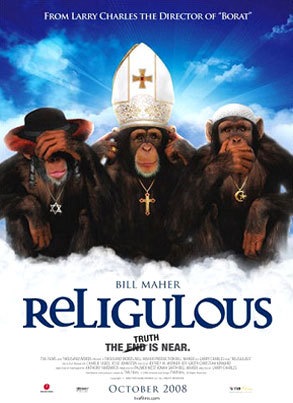 In the most recent edition of the Everyday Ethics podcast, we review Bill Maher's documentary Religulous. Maher is convinced that atheists, particularly American atheists, need to become more visible. He's also convinced that religious belief is both ridiculous and dangerous. Put those two commitments together and you get an at times painfully funny satire. maher's personality is all over it: he's sharp-witted, intelligent, and a natural performer. His pieces-to-camera are filmed like stand-up routines with various religious centres as backdrops. And his guests appear, for the most part, to be intellectually challenged -- with the exception of the Vatican astronomer, who comes across, uniquely in this film, as an intelligent believer. So what should we make of it? It's essentially a straw man argument in cinematic form. Find a bunch of less than intelligent advocates of religion, interview them with a view to comedic effect, edit the results carefully, and you end up with a hatchet job (albeit a very funny one). We asked a priest (fr Alan McGuckian), a comedian (Nuala McKeever) and a humanist (Brian McClinton) to go see Religulous, and you can listen to their responses to the film in the podcast or on the iPlayer. Brian makes the point that this is satire in the tradition of Gulliver's Travels, where exaggeration, overstatement and full-blown hyperbole are deployed as powerful rhetorical devices. And, it is true, you couldn't put these people on the screen if they didn't exist. incidentally, 'moderate' believers don't get let off the hook here. Maher says the moderates are enablers -- like 'mafia wives', they make it possible for the extremists to function. Whatever else you can say about Religulous, it is, I think, an important film that deserves serious attention. If you see it, prepare to laugh a lot, and think a fair bit too; if you are particularly sensitive to blasphemy, the usual health warnings apply.


Comment number 1.
At 11:55 29th Apr 2009, Heliopolitan wrote:I haven't seen it yet, but I'm not really looking forward to it that much. It strikes me, as Will says, as a bit more of a hatchet job, than a fair analysis. Still, funny is always good, and if it results in more people being confident in their non-belief in magic sky pixies, so much the better. After all, churches are full of people who don't *really* believe all that God and Jesus stuff; they go along (sometimes in the pulpit, or perhaps especially in the pulpit) because of tradition, community and structure. They use religion not as a corpus of beliefs, but as a social scaffold, and maybe that's no bad thing.
-H
Complain about this comment (Comment number 1)
Comment number 2.
At 12:09 29th Apr 2009, Bernards_Insight wrote:What do you all think of the comment that "intelligent believers" enable the "less intelligent".
Seems that's only a fair point if you've already decided that the "intelligent" believers aren't so intelligent after all.
I.e, it seems to be simply an attempt to extend the straw man argument (which asks the views of particularly dumb people) to those for whom the argument has no effect, because they're not so dumb.
In other words, rather than provide genuine arguments against those of the "intelligent" believers, he seems content to dismiss them by association.
No matter what those people's arguments are, they can't be taken seriously, because they enable others with no arguments to hold an unsubstantiated view.
Seems to me that that could be applied equally to science. After all, scientists "enable" those who know nothing about science to hold an unquestioning view of reality.
Complain about this comment (Comment number 2)
Comment number 3.
At 12:19 29th Apr 2009, The Christian Hippy wrote:REDICULOUS
Complain about this comment (Comment number 3)
Comment number 4.
At 12:46 29th Apr 2009, PeterKlaver wrote:I've seen it. It did provide laughs and it is indeed focused mostly on less bright believers. I don't know if that makes it necessarily as unbalanced and as much of a hatchet job as some say. Suppose half the movie had been dedicated to interviews with people like the priest from the Vatican observatory and half to interviews with people like the truck drivers. I don't have data on the level of thinking that believers worldwide put into their faith. But my hunch is that a 50-50% division would make it unbalanced in favour of believers in a similar but opposite way that Religulous is unbalanced against them. And would those who complain about the unbalanced way believers are portrayed be as vocal to complain how unfairly positive believers would then be portrayed? Probably not.
Complain about this comment (Comment number 4)
Comment number 5.
At 12:50 29th Apr 2009, brianmcclinton wrote:Puritan:
Are you colour blind? The title is neither Rediculous nor Ridigulous (William, note the third last line of your comment). If you mean that it is 'communist' - nonsense. Go and see it before you judge it.
Also, William, it wasn't Gulliver's Travels I mentioned but A Modest Proposal. But, fair enough, they're both satires - and by an Irish cleric. In fact, satire is a long Irish tradition and is found among the ancient Gaelic poets.
The point about comedy and laughter killing fear is made by Jorge, the Spanish monk in Eco's The Name of the Rose. He doesn't want anyone to read Aristotle's lost book on Comedy, the Second of his two treatises on Poetics (the first is on tragedy). Eco surmises that there is only copy in existence and it is in the library of the monastery where Jorge was once the librarian. To Jorge, laughter is the worst heresy because it destroys fear - fear of the Devil, and fear of God. And for him Christianity is founded on fear.
Complain about this comment (Comment number 5)
Comment number 6.
At 12:56 29th Apr 2009, gveale wrote:Will
In what sense is the film "important"? A sort of "Basic Instict moment - mainstream cinema breaks another of it's taboos? Or is it the artistic quality? Or is it that it is an interesting snap shot from the Bush era?
GV
Complain about this comment (Comment number 6)
Comment number 7.
At 13:06 29th Apr 2009, Bernards_Insight wrote:"I don't have data on the level of thinking that believers worldwide put into their faith. But my hunch is that a 50-50% division would make it unbalanced in favour of believers in a similar but opposite way that Religulous is unbalanced against them"
Peter, that argument is nonsense. When attempting to document a particular issue, the generally accepted practice is to interview people who know what they are talking about. The intellectual level of the highest proportion of people who accept the view is irrelevant.
How would a documentary on gravity fare if it interviewed a representative sample of the population that accepts the fact of gravity, rather than interview those physicists who study it? I daresay some comedy moments would be gleaned from that, too.
Complain about this comment (Comment number 7)
Comment number 8.
At 13:12 29th Apr 2009, Les-Reid wrote:Believers say that Bill Maher sets up a straw man argument because he talks to ordinary believers, rather than theologians. His interviewees are being described as "unintelligent" and "dumb". Is that an admission that religious beliefs are mainly held by foolish people? Indeed, are the interviewees being categorised in this way simply because they hold religious beliefs? How else do their critics arrive at the conclusion that they are "unintelligent" and "dumb"?
I do not see any harm in Maher addressing ordinary believers, rather than theologians. Are religious beliefs such complicated things that only experts with post-grad qualifications can express them? Maher is quite right to ask ordinary believers if they really do find stories about talking snakes and supernatural stunts all that credible. So long as religions peddle such stuff, then it is commendable that sceptics like Maher go into the street and point out how ridiculous such tales are. And to do so over a wide range of varieties of religion seems to me to be a very worthwhile exercise which makes a very serious point.
Complain about this comment (Comment number 8)
Comment number 9.
At 13:14 29th Apr 2009, Bernards_Insight wrote:Les....see my argument above.
Again, I am sure a documentary on gravity that only interviewed people with absolutely no background in physics would have its comedy moments, and would show up many misunderstandings.
Does that refute gravity?
Don't talk nonsense.
Complain about this comment (Comment number 9)
Comment number 10.
At 13:30 29th Apr 2009, PeterKlaver wrote:Hello Bernard,
"When attempting to document a particular issue, the generally accepted practice is to interview people who know what they are talking about. The intellectual level of the highest proportion of people who accept the view is irrelevant."
Nonsense. Riligulous is about showing what you get when people believe. Of course the intellectual level of the average believer is very relevant there.
Your comparison to gravity is entirely wrong as well, in that what you ask in is not what the movie was about. You said
"Does that refute gravity?"
No it wouldn't, but it would certainly be a valid conclusion to say that the fine details of how the theory of relativity explains gravity is beyond most people. You could certainly say that most don't have much of a clue when comes to it. And that is what Riligulous says about the religious views of many people. Perfectly valid conclusion and entirely relevant to what the film was about.
I'm inclined to ask you a similar sort of question I asked Graham on the Bertrand Russell thread (I assume/hope you can respond without getting slightly emotional, as he did): did you actually see it? From your posts in this thread my suspicion is that the answer would be no.
Complain about this comment (Comment number 10)
Comment number 11.
At 13:32 29th Apr 2009, Bernards_Insight wrote:"No it wouldn't, but it would certainly be a valid conclusion to say that the fine details of how the theory of relativity explains gravity is beyond most people. You could certainly say that most don't have much of a clue when comes to it. And that is what Riligulous says about the religious views of many people. Perfectly valid conclusion and entirely relevant to what the film was about."
Fair enough. If that's the only conclusion, then that's all well and good. I haven't seen the film, so I don't know.
When Will called it a straw man argument I assumed an implied argument against religious belief in general.
If the conclusion is "a lot of people don't have much of a clue when it comes to it", then I'm ok with that. Which could be said for almost ANYTHING
Complain about this comment (Comment number 11)
Comment number 12.
At 13:34 29th Apr 2009, Bernards_Insight wrote:So, yes, the answer is "no". i didn't think it was even out yet. I was responding to William's comments about it.
Have you seen it then, yeah?
Complain about this comment (Comment number 12)
Comment number 13.
At 13:38 29th Apr 2009, PeterKlaver wrote:Hi Bernard,
Riligulous is certainly not about whether the fundamental tenets of christianity, islam or judaism are true.
But I'll meet you halfway.
I must admit that the overall tone of the movie is 'Look at all that BS'. In that sense, there is some smearing of religion overall by the dimwit examples. Your criticism in post 2 about "dismiss them by association" does have some validity.
Complain about this comment (Comment number 13)
Comment number 14.
At 13:45 29th Apr 2009, PeterKlaver wrote:"Have you seen it then, yeah? "
Yes. Watched it at a friends house (who I thoroughly suspect had obtained it via an internet download of very dodgy legal status).
Complain about this comment (Comment number 14)
Comment number 15.
At 13:57 29th Apr 2009, Heliopolitan wrote:But this is one of those things, ism't it? I'm all for raising atheist consciousness, and helping atheists realise that they *are* atheists, but I don't think it necessarily helps by parading religiots about and showing how silly they are.
I do prefer a bit more thoughtful analysis (and thanks to the main chaps such as Graham & Bernie & PeterM who are willing to join in the fun) because I think the truth or falsity of religious propositions *is* an important question; if Jesus *did* die on a cross & rise from the dead to save me from my sins, that would be an important thing, and I would need to have some very good reasons to consider it nonsense, other than the daft behaviour of some primates who should know better. As it is, I do think the historical and philosophical evidence is strongly *against* Christianity, and I think it's a fiction. I don't subscribe to the Richard Carrier view https://www.richardcarrier.blogspot.com/ that Jesus was altogether a myth, but I am as certain as I can be that the silliness of religion itself is strong evidence that a sensible god would NOT choose such a fickle medium to reveal itself to humankind. Religion, and religious myths (such as the resurrection) are human creations, and represent precisely the *wrong* way to interact with the Great Whatever.
So I hope Bill Maher's movie is followed up by some more thought-provoking material in the future.
Complain about this comment (Comment number 15)
Comment number 16.
At 14:28 29th Apr 2009, cary wrote:i just can't buy that "moderates enable extremists" argument. by that line of thinking would it not be fair to say that moderate political positions should not be held because they encourage the extremist fringe?
i've yet to read a review or hear an interivew with Maher that actually convinced me there is anything i am going to hear that's new and worth spending the money for a ticket to see this on the big screen.
a straw man is an argument set up to be defeated. and a straw man argument is pretty easy to defeat because they are just that: set up. the position being put forward only stands up as long as you ignore the beneficial aspects of religious belief and expression, and ignore the actual content and outworking of faith amongst those who don't hold to literal readings of religious texts.
i don't need it pointed out that many of the beliefs held by certain kinds of believers are ridiculous, or that that religious belief is not synonymous with intelligence levels.
would it be good for a laugh? probably. fundamentalists and biblical literalists are easy targets and it may make for good humour but bill hicks (RIP) was tackling fundamentalism over 15 years ago with the southern baptist culture in which he had been raised, and was greatly astute at it.
if Maher thinks there's benefit to be gained from debating with the least intelligent versions of faith, then i'll leave him to it. i don't buy the starting argument. as with hitchens, it's flawed from the get go: *any* belief can take on ridiculous or dangerous forms. even atheism.
i'm totally up for american atheists being more visible. but i fear the bar needs to be raised way higher than a straw man argument before it can be considered "important" as well as funny.
Complain about this comment (Comment number 16)
Comment number 17.
At 16:26 29th Apr 2009, John Wright wrote:Maher is an entertaining fellow. I often agree with him (he's described himself as a libertarian in the past, though I doubt the purity of that claim). He's a controversialist, used to ruffling feathers. And his HBO show Real Time is fun. But this is not a proper critique of theism, funny or not. If anything it's a critique of the MANNER in which theism is held by ordinary believers, and I'm happy to agree with him. But he isn't seriously attempting to understand theistic belief and deal with the theology itself, for that he would have invited someone intelligent on the film.
He's joined the Michael Moore Institute of Filmmaking, whose central lesson is this: find a perfect strawman who confirms every stereotype you wish to portray, set him up, and then knock him down with gusto. Yahoo! Fun, but utterly useless as discourse.
Complain about this comment (Comment number 17)
Comment number 18.
At 16:29 29th Apr 2009, brianmcclinton wrote:Bernard:
What do you mean by 'documentary'? He was not presenting facts objectively, if that's what you mean. He made a satire whose prime target was the religious right (it was made before Obama's election).
Probably, to use a portmanteau word in keeping with the film's title, 'mockumentary' would be more appropriate. He was seeking to 'poke fun' at weird beliefs. The fact is that many religious beliefs ARE weird. The people he spoke to may appear to be 'odd' or 'extreme' - like the Holocaust-denying orthodox Jew or the preacher called Jose de Jesus Miranda who believes he is the descendant of Jesus - but, as Maher points out, he does not wear fruit on his head. In my experience most people are only 'normal' at a distance: the closer we get, the madder they become. The best we can hope for is that the human race keeps its insanity under wraps and doesn't inflict it on too many others. I suppose we elect politicians to keep us on a relatively sane, sceptical and cautious path.
So, while people are quite entitled to believe whatever nonsense they like, they are not entitled to foist it on the rest of humanity unless we ask for it. Problems arise when we elect people who are less sceptical and rational than the best. The film opens with a quote from Bush to the effect that his foreign policy was dictated by God. In other words, his decision to go to war and invade Iraq was the result of a a divine command, not the will of the people. Blair believed much the same thing and has said that he will be answerable to God.
The trouble is that religious belief tends to give some leaders an inner certainty which can be dangerous. Bush, Blair and Al Qaeda all believe that God will guide them, so that earthly disapproval doesn’t matter, even if it comes from religious leaders themselves. Thus Islamic terrorists ignore the condemnation of Islamic leaders and Blair, although a closet Catholic at the time, ignored the pope who opposed the Iraq war.
I am not saying that religious leaders cannot have their own, private religious faith, but they should accept that in a democracy they are ultimately responsible to the people, not to their God. The leader who – Joan of Arc-like – claims that God is telling him to do this or do that is a rather frightening individual who could do anything, even drop a bomb on millions, because ‘God’ tells him it is the right thing to do.
Blair led Britain to war even though he knew most of his Cabinet started out opposing it, nearly all of his party were against it and a large section of the population protested against it. It was from his religion that he found the strength to enter a war in the face of this opposition. But it is the strength of a medieval autocrat, not of a democratic politician. It is the old doctrine of ‘the divine right of kings’ in modern dress.
Many of us also prefer our leaders to be more sceptical and cautious and to approach the world’s problems with an open mind. The certitude displayed by so many of Maher's interviewees is not the wisest quality in a complex and volatile planet, least of all in our politicians. It can lead to hasty and dangerous decisions made in the interests of only one section of the community – Christians, Protestants, Catholics, Jews or Muslims – rather than in the interests of the people as a whole.
In a liberal democracy, leaders should act responsibly in the general interest. This means they have to balance the rights of the majority with the rights of individuals and minorities. If that implies transcending their own deeply held religious faith, then so be it. I think that Obama knows that, whereas neither Bush nor Blair did.
Complain about this comment (Comment number 18)
Comment number 19.
At 16:49 29th Apr 2009, gveale wrote:Where's John Wright when you need him? There's a type of "shock-jock" humour at work in Maher that I just don't "get". If you're out there John, I could use a little insight.
Now as for Religion and silly statements, I'm with Bernard. A comedy that edits out the boring replies and leaves in the funny replies isn't exactly scientific. You could also mock a mathematician or physicist who *did* have a good grasp of their subject matter ("so... you're the sort of idiot who thinks that three angles of a triangle don't have to add up to 180 degrees?"; "Is it a particle or is it a wave? Can't you guys figure out the difference?").
And Einstein, Hesienberg and co. had to deal with this sort of lampooning from the student body in pre-war Germany. Johannes Stark, who won the Nobel Prize for Physics in 1919, led the attack. He wanted an Aryan physics that was hard-headed, and practical. He despised Einstein and Heisenberg's "Jewish" physics for valuing Mathematical and abstract thought over observation and prediction. Even Planck and Heisenberg could not undo the damage to German Universities.
It wasn't just the persecution of Jewish scientists, but the ridiculing of anyone associated with their ideas (Heisenberg wasn't Jewish), that did so much damage to Physics departments. So we actually have historical examples where the best scientific theories where effectively ridiculed. (The disatrous effect on German Physics departments is outlined in Richard Evan's "The Third Reich in Power"; Stark and Philipp Lenard's "Aryan Science" is described in Walter Gratzer's "The Undergrowth of Science (Oxford)").
So I don't think that Maher has established much of a case against religion.
There are two big HOWEVERS.
ONE Is a rigorous argument the point of this sort of film? Take Morgan Spurlock's "Super Size Me". It was deeply convincing - even though I didn't believe a single statistic that Spurlock gave (when he bothered). Furthermore, the point of the film - eating nothing but McDonald's for thirty days could be very bad for you - was a teensy bit obvious in the first place. And why McDonald's? Thirty days at the local sweet-shop wouldn't be healthy. Should I hate sweet shops?
So Spurlock could get me to hate McD's without much of an argument, and without new information (that I could trust at any rate). And he had a profound effect on other viewers too. Now is that a bad thing or a good thing? Is it wrong to be able to sway your audience without reference to the facts? Is this sort of cinema intrinsically harmful? I don't know. But I do know that rigorous arguments aren't of it's essence.
TWO Peter Morrow and I have both expressed concern at a type of Evangelicalism that is big on enthusiasm, and short on thought. Apparently idiocy leaves more room for the Spirit to work.
Now some folk will dismiss you as an idiot because you are religious. (Can't win, don't try). Or you could sound like you hold an idiotic idea because you cannot express yourself with the clarity that you wish. (Put me in that bracket, and close the door after me.) But to pride yourself in idiocy is a different matter. Churches that preach "keeping it real" can sound all to unrealistic when asked questions by serious seekers. SO maybe "Religulous" might actually be doing us a favour?
GV
Complain about this comment (Comment number 19)
Comment number 20.
At 16:50 29th Apr 2009, gveale wrote:PK
Hmm - another post that mentions or alludes to my previous posts without actually mentioning me. Perhaps some sort of truce would be in order?
(-:
But a clarification on Wisdom and knowledge. Take a child who beleives that it is wicked and wrong to be cruel and that it is good to show compassion(obviously that's not how the child would express those ideas, but you'll get the point). Than take a highly intelligent philosopher who has constructed a rigorous, scientifically informed theory that would justify cruelty and harshness.
Now the philosopher has knowledge, but the child has wisdom, in this area at least.
Two points need to be made about this state of affairs.
(1) The child should grow up to develop the knowledge necessary to defend it's ideas. Knowledge is not devalued by valuing Wisdom.
(2) The child is not as wise as someone who has acquired wisdom over a long period of time. The child's wisdom does not extend over much of our experience of life. You can grow in Wisdom just as you can grow in Knowledge. Both should be pursued.
GV
Complain about this comment (Comment number 20)
Comment number 21.
At 17:09 29th Apr 2009, Les-Reid wrote:I find it amazing that believers claim that you need a PhD in theology to explain what it is that you believe. I thought that faith was a simple matter that anyone could understand. Now it is being ranked beside quantum physics. Now that is what Maher would call totally religulous!
Maher's shows us that Voltaire was right: people who believe in absurdities can be led to commit atrocities. Nonsense can be lethal. He is right to go into the street and question the nonsensical beliefs that ordinary people have been encouraged to hold.
Complain about this comment (Comment number 21)
Comment number 22.
At 17:54 29th Apr 2009, petermorrow wrote:"I find it amazing that believers claim that you need a PhD in theology to explain what it is that you believe."
Only catching up here Les, but who was it said that, I must have missed it.
Interestingly, from what I have gleaned, most people seem to recognise the movie for what it is, a bit of a p take.
Funny thing is I've often thought that something like this needs done, in fact, all any of us need to do is switch on the 'god' type channels on cable or satellite TV and we can see christians making dumb assed movies about themselves all the time. Tip, if you're stuck for something to do and need a laugh on the weekend, try a bit of Christian TV, only trouble is that after you have laughed, you'll swear, or chuck something at the screen. Actually Bill could have probably have saved a bundle of money by using clips from the christians to make his movie, there's plenty of material. (BTW I've only seen the web trailers)
Here's the thing, my view is that there's a lot in religion that needs laughed at, and here's what else, in the end, a bit like the wizard in Oz, behind the curtain, behind all the smoke and mirrors, Christianity is surprisingly ordinary. It's supposed to be ordinary, the sort of thing which happens in everyday life. In the end, its the story of the God who says, look, I'm going to walk on dusty streets and be a normal human being. Weird thing is this, for some atheists, God being 'normal' isn't enough evidence with God being denied because he isn't supernatural enough.
Brian, have to agree with you this time, world leaders bombing other countries after 'hearing from God' - dangerous. Seems to me God has already spoken, said something about loving enemies.
Complain about this comment (Comment number 22)
Comment number 23.
At 18:02 29th Apr 2009, John Wright wrote:GV- I'm here, and exactly when you need me! Dadaaaaaa!
This is about polemic as sport. I engage in it myself every day, dealing with serious topics in a manner which aims to entertain more than inform, on balance. Setting up strawmen and knocking them down is fun (though for the record I try to be honest and avoid strawmen on my own show, even though I'm espousing one opinion on the issues I'm discussing.) But what William does, for example, is different than what I do. William's show deals with these topics in a manner which aims to shed some serious journalistic light on them. What I do (and what Maher does) is different: it's an attempt to entertain more than anything.
But in the process of entertaining, the question is whether you're still being honest about the dynamics of the debate: I don't think Maher is in this film.
Complain about this comment (Comment number 23)
Comment number 24.
At 19:14 29th Apr 2009, romejellybean wrote:If Maher and Moore are accused of being less than honest and biased, good on them.
Along with The Daily Show with Jon Stewart, The Simpsons and Family Guy, they might help balance the years of covert propaganda fed to a less than discerning American public by the likes of Star Trek, Sgt Bilko up to the present day's CEO of propaganda, Bill O'Reilly and Fox "News."
Someone once asked me what I did on a Sunday if I couldnt think of a sermon. I replied sarcastically that I would normally watch an opinion piece on FOX News, then say the exact opposite from the pulpit. In general, I wouldnt be too far away from the truth.
Complain about this comment (Comment number 24)
Comment number 25.
At 20:02 29th Apr 2009, PeterKlaver wrote:Hello Graham,
In post 20 you spoke about knowledge and wisdom. But my comment that brought about the mixing of this thread with the Bertrand Russell thread was aimed at something other than what you said in post 20. On the other thread you said
"What the Bible does criticise is pride in our achievements, be they political, financial or intellectual. And perhaps this is what irked Russell. If we take Scripture seriously an illiterate peasant and a small child can have a greater wisdom than Russell's, simply bcause they have faith."
As I said on the other thread, that last sentence (my italics added) in particular is a fine example of faith being a catalyst for anti-intellectualism. Valuing the wisdom of someone like Russell as less than that of an illiterate peasant who has faith, for FSMs sake. Your post 20 says something else. A skeptic might think of it as you trying to wriggle from under what was a bad initial post.
Complain about this comment (Comment number 25)
Comment number 26.
At 21:13 29th Apr 2009, brianmcclinton wrote:Graham (19):
Good grief, man! We are not discussing a scientific treatise. You say: "A comedy that edits out the boring replies and leaves in the funny replies isn't exactly scientific". What is a 'scientific comedy'. That's a new form or genre to me.
One of the functions of comedy is to contrast the reality with the ideal, to expose foibles, hypocrisies and contradictions and to prick the bubbles of power, pomp and authority. Religion is a particularly apt target because it is prone to such contrasts. Two obvious examples in Christianity are:
(a) The pacifist Jesus contrasted with the warmongering Christians (as Peter has indicated)
(b) The poor Jesus contrasted with the rich Christians and the wealthy churches.
Satire is partly important for its shock value. In this case it can either:
(1) shake the believers out of their complacency or induce them to face up to the contrasts and do something to lessen them;
(2) shake non-believers, don't knows etc, out of their apathy and induce them to stand up to religious power and influence where they think it is detrimental to human progress.
Maher believes that religious power is dangerous because it feeds a common human desire for self-destruction. He also derides the believers who attack the 'arrogance' of atheists while themselves presuming to know what their god thinks and presuming to know that the universe had a beginning and for presuming to know what will happen when they die. He says he doesn't know the answer to any of these big questions and is therefore agnostic. In an age obsessed with belief, his message is necessary. As Peter Ustinov suggested: "beliefs divide people; doubt unites them".
Complain about this comment (Comment number 26)
Comment number 27.
At 06:50 30th Apr 2009, Toronthab wrote:It's soooo disappointing, one feels embarassed for people like Maher who desperately pass themselves off as the clever boys, the 'with it' in crowd, and who are so utterly trite, deceptive and frankly just dishonest.
He is truly an entertainer, but he's the joke. When one reads even a little philosphy particularly from philosophers who avoided the dead ends of Hume's empricism and the self-contardictory precepts of Kantian idealism, one can catch glimpses of how mired most are in trite ideology, scientims utterly without rational foundations. Feser's "The Last Superstition; a refutation of the new atheism" is an easy to read treat that frankly shows philosophical illiterates like Maher and Dawkins for what they are. Demagogues. One should read Feser's criticism to at least gain a little insight into the issues or risk dying as one lives:confused.
Complain about this comment (Comment number 27)
Comment number 28.
At 09:15 30th Apr 2009, nobledeebee wrote:I would like to make 2 points. As far as I can see this film is definitely satire rather than documentary. It should be approached like spitting image. Full of grotesque characters who make us laugh with their ridiculous behaviour but representative of powerful inluences and organisations in the real world.
Secondly, the gulf between theists and atheists is really highglighted by their reactions to the film. Theists like to claim that their views are nothing like those portayed in the film because they are articulate, intelligent, people with "moderate" religous views, however, William then puts forward the Catholic astronomer as a rare example of an intelligent religious person interviewed in the film. But hang on, unless he is a hypocrite he has to believe in transubstanation, that contraception is wrong, in intercession, that dead popes can cure you of cancer, and that gays are immoral, to name just a few incredible things. To an atheist these views are just as daft, no matter how many tomes are quoted in their defense, as the views of the crudest redneck from Alabama. Ultimately both are an appeal to belief in magic.
Complain about this comment (Comment number 28)
Comment number 29.
At 09:52 30th Apr 2009, brianmcclinton wrote:Toronthab:
A demagogue is usually defined as an orator or leader who excites the passions and prejudices of his audience and who arouses fervour by appealing to the lowest emotions of a mass audience, such as fear or hatred. Just like Paisley or the Pope. But Dawkins or Maher? That's stretching it a bit.
Complain about this comment (Comment number 29)
Comment number 30.
At 09:55 30th Apr 2009, gveale wrote:PK
Yes, it was a bad post. I didn't realise that you were referring to that sentence so no wiggling or wriggling. But you are entirely correct. "Faith" means absolutely nothing unless you define what it is that you have faith in. I left that out, and made it sound as if a blind leap of faith all by itself made a person wise. And of course that's nonsense. Many people made such a leap for the Fuhrer.
So, yes, a bad post on my part. I hope that I've cleared up the confusion.
Truce? (-;
GV
Complain about this comment (Comment number 30)
Comment number 31.
At 10:02 30th Apr 2009, brianmcclinton wrote:NDB:
You say that "the gulf between theists and atheists is really highlighted by their reactions to the film". I don't think that this is necessarily correct. The priest, William, Nuala and I all liked the film, and only one or perhaps two of us is an atheist (or part atheist: I am agnostic about much the same things as Maher is; Nuala may be similar but more 'spiritual').
I agree, though, that many theists might try to dissociate themselves from the 'lunatic fringe' represented by many of Maher's interviewees but ignore their own daft religious assumptions. No matter how you dress up most Abrahamic faiths, they are more or less mad.
Complain about this comment (Comment number 31)
Comment number 32.
At 10:10 30th Apr 2009, Bernards_Insight wrote:Les;
"I find it amazing that believers claim that you need a PhD in theology to explain what it is that you believe. I thought that faith was a simple matter that anyone could understand".
No. Faith is a simple matter that anyone can have. Understanding its full basis and implications is something altogether different.
Again, I could make an analogy with science...
"most believe don't understand the full ground and implications of the theory of gravity, but we all accept it.
Yet if a non-scientist were asked all sorts of questions about how ridiculous it is to claim that big things spontaneously attract smaller things, I'm sure some absurdities could be forced out.
As for what exactly the film is...As I say, I haven't seen it.
If it attempts to characterise certain minority elements of Christianity as having some outlandish beliefs, then that's all well and good. I'm with Peter Morrow on that.
If it claims to make any inference beyond the small groups of people that it interviewed to make any sort of comment on "religion in general" then it's just a ridiculous straw man argument. Simple as that.
Complain about this comment (Comment number 32)
Comment number 33.
At 10:11 30th Apr 2009, gveale wrote:Brian
"We are not discussing a scientific treatise. You say: "A comedy that edits out the boring replies and leaves in the funny replies isn't exactly scientific". What is a 'scientific comedy'."
I agree, and this is why I referenced Spurlock's "SuperSize Me". I don't know if you have seen it, but you should. As a critique it is awful - but as a piece of rhetoric it is absolutely brilliant. I knew the objections before the film started, and yet I was totally carried away.
So I've been thinking - maybe rejecting Christianity because you have watched "Religulous" is a bad idea. BUT - maybe we should argue that such films are meant to motivate action. SO "Religulous" should function to (i) Reassure skeptics (ii) Motivate the Religious to check the rationality of their beliefs, and to present their beliefs in a rational manner (iii) Motivate others to check the facts carefully before embracing a religion. From what you say in the rest of your post, I think we're agreed.
I don't know if that's what Maher or Spurlock intended. But that seems to be a justification for this sort of film. If you want to check the facts, read a book or do a bit of research. Don't expect cinema to give you a shortcut. It is not that sort of medium.
This does take me to another issue. Did Maher have to be so offensive? Didn't he lose an important audience? Is there a danger that satirists can become shocking *just for the sake of being shocking*. I've said to PK that faith with no object has no value. Can't the same be said of satire? Or am I missing something?
I'll come back to doubt later.
GV
Complain about this comment (Comment number 33)
Comment number 34.
At 10:12 30th Apr 2009, gveale wrote:John
Thanks - the same questions apply. As questions, not as a polemic. I'm curious.
GV
Complain about this comment (Comment number 34)
Comment number 35.
At 10:13 30th Apr 2009, Bernards_Insight wrote:"I agree, though, that many theists might try to dissociate themselves from the 'lunatic fringe' represented by many of Maher's interviewees but ignore their own daft religious assumptions"
Brian, that's quite an assumption there.
Especially since, in all your time on this blog you have yet to show that any of our religious views are "daft"...far from it, in fact.
When discussing metaphysics you generally change the subject to political power structures, and when discussiong aesthetics you generally change the subject to historical criticism.
Complain about this comment (Comment number 35)
Comment number 36.
At 10:41 30th Apr 2009, nobledeebee wrote:Hi Brian,
I was referring to the views posted here, not the comments in the studio, and William did call it a straw man argument.
Complain about this comment (Comment number 36)
Comment number 37.
At 10:44 30th Apr 2009, brianmcclinton wrote:Bernard:
Most of the other daft assumptions are hardly rocket science. NDB listed transubstantiation and the healing power of dead popes. He could also have added papal infallibility and the immaculate conception. But some common Christian assumptions that are, well, shall we say, highly fanciful include:
(1) Being born of a virgin 2,000 years ago
(2) Walking on water
(3) Turning water into wine
(4) Giving the blind their sight back
(5) Turning 5 loaves and two fish into a meal for 5,000
(6) Raising people from the dead
(7) Resurrecting oneself.
Complain about this comment (Comment number 37)
Comment number 38.
At 10:47 30th Apr 2009, brianmcclinton wrote:Graham:
Fair enough until the last paragraph. Define 'offensive'.
Complain about this comment (Comment number 38)
Comment number 39.
At 11:11 30th Apr 2009, PeterKlaver wrote:Hello Graham,
Yes, I have added some bits of nastiness aimed at you in recent posts. I can make an effort to leave that out. But if I were to give my 'unmagnified', neutral appraisal of what I think of some of your posts you probably still won't like it. While the aim would be to just give a point of view, there would occasionally be some 'collateral damage' to your mood anyway, given what I think of some of your views.
Complain about this comment (Comment number 39)
Comment number 40.
At 11:14 30th Apr 2009, Bernards_Insight wrote:Brian, you're right, they're not rocket science.
Is it so fanciful to believe that, for very good reasons, sometimes unique things have happened in history?
You know, it's quite fanciful that an explosion of nothingness created the entire universe, but I can accept it as a unique event.
I can also accept the detailed qualifications of the concept "substance" that are involved in transsubstantiation.
the thing is, these things only seem fanciful when you don't fully grasp the metaphysics of love and reason.
It may be easy to have a laugh at those things without even thinking about their metaphysical ground, but really you're only doing so through ignorance.
Complain about this comment (Comment number 40)
Comment number 41.
At 11:25 30th Apr 2009, gveale wrote:PK
Forget it.
GV
Complain about this comment (Comment number 41)
Comment number 42.
At 11:34 30th Apr 2009, PeterKlaver wrote:Hello Bernard,
"Again, I could make an analogy with science...
"most believe don't understand the full ground and implications of the theory of gravity, but we all accept it."
True, but not complete. There's lots of things people are mostly ignorant of but still accept. However, there are few things people are ignorant about yet get all worked up about. Have you had people at your door trying to convert you to or away from the theory of relativity? When you mention the dreadfully unequal position of slaves in the Persian empire at a birthday party, do you run the risk of offending the birthday boy? Do people demand automatic respect for certain ideas in the world of psychology without being able to present studies that gave evidence for those ideas?
Religion is not unique in the ignorant adherents of an idea being cocksure of themselves and behaving unpleasantly as a result. Talk to your average racist or political extremist protester holding up a vulgar banner and my expectation for their intellect isn't very high either. But religion is among that (fortunately small) group of ideas that has such a powerfully retarding effect on the minds of its adherents. In that way, peoples mostly ignorant acceptance of gravity is rather different from their ignorant acceptance of dumb religious views.
Complain about this comment (Comment number 42)
Comment number 43.
At 11:48 30th Apr 2009, gveale wrote:Brian
Okay, to make it clear why I'm asking the question. In RE GCSE we have to look at the issue of "obscenity" and blasphemy in the Media. Now it's difficult (but not impossible) to get a rigorous definition of either. That's one issue. Another is, even if we can define them, does that mean that we should censor this sort of material. And a third is, even if we shouldn't censor them, does that make being obscene or blasphemous correct.
Now some posters here feature (anonymously) in my lessons. It's important that my students get opinions from those who disagree with me. SO I'm looking for good arguments to justify the use of material that certain groups find offensive.
By "offensive" here, let's just mean "material that trivialises and degrades another persons most cherished beliefs." That suits my purposes for class.
Now John says this sort of material is "polemic as sport". So I think the argument would be that many find this material fun and entertaining, and it's a bit sinister if society can control how we express our sense of humour. So if we start insisting that offensive material have a point, we've already gone too far.
So, do you have anything to add to this? You have a deep knowledge of FreeThinking texts that were deemed "offensive" at the time (although probably not offensive in the sense described above). So I reckon you'd have a few insights that I haven't considered.
GV
Complain about this comment (Comment number 43)
Comment number 44.
At 12:14 30th Apr 2009, Bernards_Insight wrote:"However, there are few things people are ignorant about yet get all worked up about"
yes, fair enough. i can accept that.
It's the nature of it, I suppose. It's obviously a very important issue.
I don't think this follows, though;
"But religion is among that (fortunately small) group of ideas that has such a powerfully retarding effect on the minds of its adherents"
Because many people don't examine the finer details, that doesn't mean that the entire edifice of religious thought retards the mind. To extend your analogy, you might as well say uneducated political extremists implies that "political thought" in general retards the mind.
No...it is a problem when people cannot adequately express their religious views. But the views themselves need not be "retarded"
Complain about this comment (Comment number 44)
Comment number 45.
At 12:23 30th Apr 2009, nobledeebee wrote:Hi Gv, have you noticed that they are trying to frame an offence of blasphemous libel in the Republic at this very moment. The very issues you are discussing with your class are being debated in the southern media, so it could be a good example for your class to discuss.
Complain about this comment (Comment number 45)
Comment number 46.
At 12:30 30th Apr 2009, gveale wrote:ND
No, I hadn't noticed that! Thanks - with this film, and that law, I've got a good debate here.
GV
Complain about this comment (Comment number 46)
Comment number 47.
At 13:21 30th Apr 2009, gveale wrote:PK
Just noticed
"there would occasionally be some 'collateral damage' to your mood anyway."
Don't worry yourself petal. My mood is fine. I just thought that it's nice to be nice. But if the self confessed nastiness and ad hominems make you feel good, just you fire ahead my son, and don't let anyone make you feel bad about it.
GV
Complain about this comment (Comment number 47)
Comment number 48.
At 15:14 30th Apr 2009, Bernards_Insight wrote:Ha! I've just realised that we're talking about a film with the tagline "From the Director of Borat!"
Ha, makes sense now. Fair enough then.
Complain about this comment (Comment number 48)
Comment number 49.
At 16:02 30th Apr 2009, brianmcclinton wrote:Graham:
On obscenity, D.H. Lawrence said that what is pornography to one man is the laughter of genius to another.
A perfect example is one of the greatest masterpieces of all time, Michelangelo's Sistine Chapel painting.
Pope Julius II, who commissioned the work, surveyed it 'with great satisfaction' (Condivi, The Life of Michelangelo), but a later, Pope Hadrian VI, described it as a 'bathroom of nudes'. Ruskin in the 19th century condemned Michelangelo as 'the chief captain of evil' because he had replaced the innocent piety of early Renaissance Christian art with the turbulent energies of a dangerous sensualism.
Or consider another Michelangelo masterpiece, his statue of David. When a replica was offered as a gift by the municipality of Florence to the municipality of Jerusalem to mark the supposed 3,000 anniversary of David's conquest of the city, the proposed gift evoked a storm in the city, with religious factions in the municipality declaring that the naked figure was pornographic and should not be accepted. In the end, it was declined and another fully clad replica of a different statue was donated instead.
Complain about this comment (Comment number 49)
Comment number 50.
At 16:16 30th Apr 2009, brianmcclinton wrote:Graham:
I should have added that the Jerusalem authorities demonstrate just how silly religious belief can become. Imagine turning down a replica of the greatest sculpture by the greatest artist who ever lived.
Complain about this comment (Comment number 50)
Comment number 51.
At 16:21 30th Apr 2009, John Wright wrote:Yeah, look, it's entertainment, that doesn't mean it can't contribute usefully to the debate - that line is one I try to find balance on everyday in my work - but its PRIMARY purpose is to make you laugh, and possibly to make people who already agree with Maher go "YEAH!" often. I have a friend who knows Bill Maher and hangs out with him a bit; I guess he does what you see on the tin, it isn't an act. And, as I say, I like Maher while often disagreeing with him.
GV- I wish I would have gotten you for R.E.
Complain about this comment (Comment number 51)
Comment number 52.
At 17:00 30th Apr 2009, PeterKlaver wrote:Hello Bernard,
"I don't think this follows, though;
"But religion is among that (fortunately small) group of ideas that has such a powerfully retarding effect on the minds of its adherents"
Because many people don't examine the finer details, that doesn't mean that the entire edifice of religious thought retards the mind. To extend your analogy, you might as well say uneducated political extremists implies that "political thought" in general retards the mind."
You are right. My statement was wholly unqualified, whereas it should of course not apply to religious views in general.
Complain about this comment (Comment number 52)
Comment number 53.
At 17:06 30th Apr 2009, PeterKlaver wrote:Hello ND, GV,
Pharyngula had a blog post on that blasphemy law with a link to a short article with some bits of info:
https://scienceblogs.com/pharyngula/2009/04/say_ireland_you_might_want_to.php
Complain about this comment (Comment number 53)
Comment number 54.
At 17:08 30th Apr 2009, PeterKlaver wrote:Hello Graham,
"Don't worry yourself petal. My mood is fine. I just thought that it's nice to be nice. But if the self confessed nastiness and ad hominems make you feel good, just you fire ahead my son, and don't let anyone make you feel bad about it."
The point was actually the opposite, that if I leave out the ad hominems and state things in neutral language, you might still not like it very well either.......
Let me think about it a bit.
Complain about this comment (Comment number 54)
Comment number 55.
At 18:44 30th Apr 2009, Les-Reid wrote:Returning to the argument that Maher should have questioned theologians, rather than ordinary believers, I would point out that professional theologians are compromised by their financial commitment. As Mencken said: you will never persuade a man to the truth of statement, if his salary depends upon him holding the opposite view. Professional theologians are therefore the last people to approach when investigating the truth of commonly held religious beliefs. They would put themselves out of a job if they declared such beliefs to be ridiculous. Hence the laughter when a Catholic priest does just that in the course of the film.
Imagine the situation if Maher had been investigating astrology. Should he question professional astrologers? What advantage is there in that, as compared to asking ordinary horoscope-users? The professional astrologer is compromised by his/her financial connection and is less likely to admit that it is ridiculous to think that, for example, a planet many millions of miles away can influence the course of one's love life. Likewise, the pope is the last person who will admit that stories of virgin births merely fire-side yarns from an ancient culture.
There is a better chance that the ordinary believer still retains some shreds of common sense, as compared to a professional theologian.
Complain about this comment (Comment number 55)
Comment number 56.
At 20:43 30th Apr 2009, petermorrow wrote:Les
You are concerned that professional theologians are compromised by their financial commitment. Maybe, but I’m wondering what the substantial point is. That an unrealistically high proportion are unbelievers, liars, charlatans? Well, yes, we have them, and boy can they get themselves noticed and gather a crowd! The Vaudeville TV variety, selling their gold dust, prayer handkerchiefs and the presence of god shrink wrapped in three CD boxed sets are probably (no, that should be definitely) on the make, but ministers not believing their sermons? academic theologians telling porkys? I’m not sure it’s a catch all argument. Apart from anything else there are a vast number of well informed christian ministers/bible teachers who hold down other jobs and aren’t paid for their church work. Sometimes it comes down to the denomination they are aligned to.
One of the things we have to do here is to distinguish between the ‘sub-culture’ of religion, the ‘trappings’ of ‘faith’ and what people actually believe about, for example, Christianity and human character. Unfortunately in my experience the church is high on it’s ‘sub-culture’, you know, concerts, music bands, magazines and the like, and low on substance, things like love for enemies, humility, forgiveness, kindness, and so on. It’s pretty appalling really, for people who say they follow the way of grace.
You see Les, the problems and contradictions we face in the church are greater than the idea that some are in it for the money, and much, much greater than our funny little idiosyncrasies. As I’ve been saying a lot recently many of the objections to the life of the church made by some of you guys are already pointed up in the bible, even the money thing and how the church should deal with it. The problems that we face are really that too many of us who say we believe are not at all like the people we should be. In the end Christianity isn’t about religious practice, it’s about cultivating trustworthy characters and the sermon on the mount is a good place to start, and here’s the thing, there isn’t a ritual, a weird symbol or a funny hat mentioned, not once! Like I said earlier on this thread, much of it is pretty normal (but hard to find) stuff.
Complain about this comment (Comment number 56)
Comment number 57.
At 22:51 30th Apr 2009, brianmcclinton wrote:Graham:
Just before Questiion Time, as you have probably gathered, I am pretty liberal on freedom of expression. I don't think that adults should be told what they should or should not watch or read or hear. Mill is more or less right on this topic (you might add: "no has the right to shut fire in a crowded theatre" to his few exceptions).
I have already referred to obscenity. What of offence? Well, Orwell is right here: "If liberty means anything at all, it means the right to tell people what they do not want to hear". The fact is that every opinion will probably 'offend' someone who doesn't agree with it. As Salman Rushdie put it, "The giving of offence can never be a basis for censorship, or freedom of opinion would perish instantly".
As for blasphemy, religion does not deserve special treatment. After all, it and its representatives CAN: incite followers to violence; threaten or even take the lives of novelists, dramatists and film directors; treat women abominably; discriminate against gays or even have them executed; abuse and enslave children; and censor art and literature. The proposed Blasphemy Libel law in Ireland is presumably a late April Fool's joke (or, at least, I hope so).
Complain about this comment (Comment number 57)
Comment number 58.
At 00:24 1st May 2009, MarcusAureliusII wrote:I'm an American atheist who was dragged kicking and screaming against his will and better judgement to waste time watching this movie. I didn't find it funny or enlightening, just boring. I kept looking at my watch hoping it would soon be over. Religion plays no role in my life and never did. I don't want to be more visible and I don't have a bone to pick with anyone who wants to believe whatever they choose so long as they leave me alone. From my experience, that is a reasonable expectation in America and one other atheists here enjoy as well. I think most people who take up a crusade against religion in America have been somehow burned and scarred or indoctrinated at an early age by someone who was. That or they are believers with serious doubts they can't resolve. In NI, it seems like a different story. The role religion plays in society imposes itself on most lives it seems to me from what I can tell. It was once like that in America a very long time ago. And the movie was a straw man Maher set up, not a dispassionate examination of the shortcomings of any particular theology or theology in general and not a careful expose' of those practices of some religions that are antithetical to our democracy. I also don't enjoy his TV show either. He's trite and boring IMO.
Complain about this comment (Comment number 58)
Comment number 59.
At 00:27 1st May 2009, Peter wrote:Answers in Genesis definitely don't like the film:
https://www.answersingenesis.org/articles/am/v3/n2/mahering-religious-beliefs
Another entry in the rising genre called “mockumentaries,” satirizing religion, spilled off projector reels this Easter season.
Bill Maher
Comedian and acerbic social commentator Bill Maher sneaked past security at Answers in Genesis (AiG) headquarters to obtain footage for this anti-religion film. Religulous takes shots at Christians and the supposed social ills that come from organized religion.
The ambush at AiG is recounted at Bill Maher’s AiG deception hits the headlines. Ironically, Maher was incensed when some audience members sneaked into his own HBO cable television show, loudly interrupting his live program. A movie review of Religulous will be posted at www.AnswersInGenesis.org/go/religulous.
Maher apparently tried to get an interview with Ham under false pretenses
https://blogs.answersingenesis.org/aroundtheworld/2007/02/11/bill-mahers-aig-deception-hits-the-headlines/
Still, I can't see myself enjoying the film as satire isn't really my type of thing.
Complain about this comment (Comment number 59)
Comment number 60.
At 10:00 1st May 2009, gveale wrote:PK
#47 was just a bit of ribbing - bottom line the blog is meant to be a fun distraction, so the substantial point is I don't mind what you post.
Complain about this comment (Comment number 60)
Comment number 61.
At 10:03 1st May 2009, gveale wrote:Brian, JW, PK, ND,
Thanks: this stuff is great. Some good quotes. This should give my classes plenty of food for thought.
GV
Complain about this comment (Comment number 61)
Comment number 62.
At 10:23 1st May 2009, gveale wrote:Brian
Your thoughts on Religion are apposite. I think my deepest concern about Blasphemy laws is that a legal definition of Blasphemy will either have to be void of all meaning, or give preferential treatment to one religion.
Religion is difficult to define, but it includes (without a shadow of a doubt) groups that are guilty of the crimes you outline. Consider - there are substantial arguments that would conclude that Nazism was a Religion or that Communist Russia had a State religion(I wouldn't agree, but they are substantial arguments).
Is Scientology a religion? Undoubtedly. Does it deserve legal protection from Blasphemy? What would that involve? Mocking Tom Cruise's height? Travolta's waistline? What about Satanism? Or Devil worship - which meets some definitions of Religion, but is in fact based on Blasphemy (subverting Christian Rituals)?
Religious belief cannot be considered in the abstract. We need to ask what the Religious Belief is *in*? What set of doctrines or practices are being promoted?
GV
Complain about this comment (Comment number 62)
Comment number 63.
At 12:41 1st May 2009, Heliopolitan wrote:Blasphemy is not just a right - it is a *duty*.
That piece of halibut was good enough for Jehovah.
-H
Complain about this comment (Comment number 63)
Comment number 64.
At 21:50 1st May 2009, petermorrow wrote:Ah, blasphemy...
Here's an interesting piece from 'The National Secular Society' - "De-baptise yourself". I mean what does that entail, lots of towels? Sun dried atheists? Freeze dried secularists perhaps. Are they hydrophobic?
https://www.secularism.org.uk/debaptism.html
And an extract from a letter,
"I'm no longer a Catholic, and this is how I did it. I sent a letter to the Bishop of the diocese where I was baptised. I presented evidence of long-standing atheism, and I was insulting to the Catholic Church in particular, and theism in general, hoping to be excommunicated as a result."
I mean what does, "I was insulting to the Catholic Church in particular, and theism in general" mean, what is," evidence of long-standing atheism"?
Perhaps one has to submit evidence of posting on this blog, maybe one has to say Jesus was Horus, (no, Mithras, no, Dionysus, no, wait a minute, Baal, emm Krishna, yep that's it, Krishna, must be, sounds like Christ, yes Jesus was a homophone) who would know? Maybe you blow raspberries at the priest.
But here's the real weird thing, some 'freethinkers' seem to think they can only be declared apostate by a Bishop, now that's novel.
Complain about this comment (Comment number 64)
Comment number 65.
At 11:48 2nd May 2009, brianmcclinton wrote:Graham (63):
I agree. And some religious believers might find themselves victims of the laws. Let's return to the divine Michelangelo and the Sistine Chapel painting. In the scene where God creates plants, he is displaying his big arse. Is this obscene? Blasphemous? Should we destroy the greatest artistic feat in western civilisation because the artist had 'the laughter of genius' at God? (Michelangelo was a religious man, after all).
Even John Waters in yesterday's Irish Times thinks the proposed law is an ass. "Nothing can be removed from the judgment of laughter, including God and religion".
Complain about this comment (Comment number 65)
Comment number 66.
At 11:52 4th May 2009, Orthodox-tradition wrote:This film reminds me of this blog.
I am coming to the conclusion that most of this blog consists of athiests throwing straw man arguments about simpler minded believers at more thoughtful believers to whom their crticisms obviously don't apply.
The athiests never seem to twig that there are so many Christians passing through here that obviously do read their bibles and find considered positions on history, philosophy and science.
However I don't want to spoil the athiests' fun, they are obviously having such a great time.
One of my favourite examples is John Wright dismissing Christianity because he does not believe in "the sinner's prayer" as the beginning and end of salvation.
He seems to conveniently forget that none of the Christians on this thread appear to believe in it either.
No matter, all great fun!
;-)
PS John, I know you enjoyed Easter at a church service this year! All prodigals and "nervous liberals" are welcome to return to the fold btw!
Complain about this comment (Comment number 66)
Comment number 67.
At 14:20 4th May 2009, brianmcclinton wrote:Orthodox Tradition:
To which category do you belong? A straw man? Or a thoughful Christian? Can we vote on it?
Complain about this comment (Comment number 67)
Comment number 68.
At 20:44 4th May 2009, John Wright wrote:OT- Of course, I wasn't dismissing Christianity by being skeptical about the importance of what they call the 'sinner's prayer'... just dismissing the kind of Christianity whose spotlight is trained to ignore the myriad approaches to the Christian faith except it. That said, I did enjoy Easter at Saddleback - I'm sure you would have too - it was wonderful to be in the company of so many joyous, beautiful Southern Californians celebrating the beliefs they hold dearest... even if some of those beliefs are, imo, erroneous.
Getting belief 'right' isn't everything, you know. As I walked past the hundreds of people being baptized underneath waterfalls in the gorgeous campus gardens, without formality or liturgy or solemnity, smiling and laughing and eating and drinking together, I felt quite at home and content with my thoughts that, no matter whether or not these people were 'right' about the many points of theology that formed the foundations of their activities on that day in that place, the world would simply be better if everyone was behaving exactly like them.
Complain about this comment (Comment number 68)
Comment number 69.
At 11:44 5th May 2009, gveale wrote:John
You went to SaddleBack? Did you blog on this? I'd like your opinions.
GV
Complain about this comment (Comment number 69)
Comment number 70.
At 16:44 5th May 2009, John Wright wrote:GV,
I've been to Saddleback a good few times (I don't live too far away and I'm often in the area). I don't remember blogging on it, although I definitely tweeted a couple of times from the service which was broadcast on Fox News, the Armed Forces network around the world, and reached about 50,000 people who were there at Easter time.
I thought it was the best primer on evangelicalism I'd ever heard. Warren's message was to retell the evangelical account of the history of everything in five acts: God created everything, we screwed it up, Jesus came and died to correct it, now it's our choice to accept, then he comes again. Between each 'act' there was a response in music, a fabulous guitar-drum-keyboard band backed by a full orchestral brass and string section and a large choir. It was the best of evangelicalism, period. The fact that I don't really consider myself much of an evangelical didn't matter to me (though of course it would if I was there every week). Outside the huge glass doors on each side of the auditorium there are waterfalls and pools they use to baptize people after the services, something they were doing liberally for everyone who said they had 'committed' that morning. Hundreds of people were doing so at the service I was at, one of 23 services total.
Easter at Saddleback is an experience, for sure - this was the 30th anniversary of the church which started in a local school assembly hall on Easter Sunday 1979. I like Warren, and I can see why his church grew.
In the episode of South Park entitled, All About The Mormons, a Mormon family moves to South Park. Gary, one of the children, is the target of mocking and a plan to beat him by Cartman, Kyle, Stan and Kenny. The episode goes on to soundly lampoon the theology of the LDS Church, before the big finale: Stan finally realizes that what they believe is not necessarily the most pertinent facet of Garys family: its the fact that they are good people, have good family values and have compassion for others.
As Richard Dawkins said in his interview with Crawley: Whats so special about belief? Saddleback Church sent home 50,000 shopping bags that day with the people who showed up, and at least 20,000 were expected to return full of food so that the church could send them out to people struggling in the recession. If that's what they're doing, what's so important about theology?
Complain about this comment (Comment number 70)
Comment number 71.
At 19:51 5th May 2009, Orthodox-tradition wrote:John
I dont believe we should be primarily judging people by beliefs, your experience of fellowshi was great.
But we do need doctrine if the new testament is to mean anything at all.
shalom
Complain about this comment (Comment number 71)
Comment number 72.
At 20:47 5th May 2009, John Wright wrote:OT- That said, I'd much rather be in a building full of people who engage each other by disagreeing than a room full of people who are there because they all agree - yes - even on the 'fundamentals'. This blog is a fine example of 'fellowship' imo. :-)
Complain about this comment (Comment number 72)
Comment number 73.
At 19:10 6th May 2009, Orthodox-tradition wrote:Hi John
You might prefer to be in a building of people who disagree - but what does God prefer?
Perhaps you are reacting against artificial and uninformed uniformity in churches? Understandable to a point.
In mature Christians I see an easy acceptance of differing viewpoints and emphases on many aspects of doctrine and belief.
But the biggie that unites Christians is that they believe God became man, sacrficed himself to reconcile us to God, and rose again after three days.
:-)
Complain about this comment (Comment number 73)
Comment number 74.
At 20:27 16th May 2009, logica_sine_vanitate wrote:I suppose it's a sad reflection on the views of those who have no coherent and logical arguments that they need to resort to mockery.
Actually it's quite a relief to us believers that humanists have had to rely on such methods. We can see that they have at last discovered that they can no longer defend their views with logic and reason. Hardly surprising given that logic does not and cannot arise out of matter, which of course means that naturalism is self-contradictory. It's a pity that they seem incapable of understanding that.
Having watched a certain Professor Dawkins this morning give his five minutes worth on the BBC website, I couldn't help noticing that he admitted that he was not an atheist, but actually an agnostic, and also he presented not one single piece of evidence to support his contentions. All he offered was his own entirely subjective prejudice, without any foundation at all in logic. Despite his agnosticism he still felt it was his duty to try to undermine other people's faith in God, despite having no proof that believers were wrong, while continually maintaining that his only desire was to know the truth and rely on evidence!
If that is not worthy of mockery I don't know what is!
Complain about this comment (Comment number 74)