

Reproductive rights in Northern Ireland
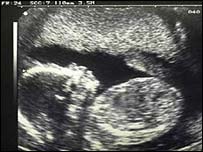 This proposed amendment to the Abortion Act (1967) would make the termination of a pregnancy as available in Northern Ireland as it is in Great Britain. Presumably, if the Northern Ireland political parties could agree on a deal for the devolution of criminal justice to Stormont, Westminster would not be able to legislate for an extention of this legislation to Northern Ireland. Some think the threat of an abortion amendment may encourage political leaders here to agree the terms of such a deal sooner than they might otherwise do. Perhaps, for example, a justice minister could be selected, on a cross-community basis, by Assembly members.
In the absence of any deal of that kind paving the way for the devolution of policing and criminal justice to Stormont, the abortion amendment may be debated at Westminster in the Autumn. We'll explore its implications on tomorrow's Sunday Sequence with the Liberal Democrat MP Dr Evan Harris, one of the amendment's co-signatories, and the DUP's Jeffrey Donaldson MP, junior minister in the Office of First and Deputy First Minister.
The four largest churches in Northern Ireland oppose the extension of the Abortion Act to this part of the United Kingdom; as do most political parties here. The amendment is supported locally by campaigners for women's reproductive rights and others who argue that the current law in Northern Ireland is, at best, confusing. Another voice recently raised in suppose of equal treatment for women across the UK in respect of abortion rights is the Belfast Humanist Group. I include their statement of support for the amendment below the fold.
PRESS RELEASE from Belfast Humanist Group
The Belfast Humanist Group welcomes the proposal of the all-party Parliamentary group to extend abortion facilities to Northern Ireland. Since Northern Ireland is part of the UK, the same rights and facilities should be available here as elsewhere in the UK.
Of course, Catholics and evangelicals will oppose this development. We, the members of the Belfast Humanist Group, say to them, "The facility to have an abortion is not compulsory. If you do not wish to use it, that is your choice. But you should allow others to use it when they feel it is necessary."
In cases of rape, for example, Humanists and many other people feel that an abortion may be necessary. Why should a rape victim be forced to bear the rapist's child? Forcing the victim to have that child is merely adding to the violence of the attack. It is intolerable. The horror of the rape would be extended throughout the pregnancy and a child would be a living reminder of that brutal crime. An early abortion in such cases is the most humane and sensible way to proceed. If Catholics and evangelicals prefer to force the victim to bear the rapist's child, then that is their choice, but they should allow others to opt for an abortion.
The morning-after pill aborts the fertilised egg when it is still just a clump of cells. A clump of cells has no more moral status than a sperm or the unfertilised egg ejected during a period. It takes many weeks for a fertilised egg to become capable of independent existence. Humanists accept the view generally held in the UK that a foetus achieves the moral status of an independent human being at 24 weeks. That view was recently reaffirmed in Parliament and it forms the basis of British law on abortion.
Likewise, most people in the UK are in favour of contraception and so contraceptives are available throughout the country. Contraception is a facility like abortion. If Catholics and evangelicals have religious objections to contraception, then they are free to exercise that choice. But if you choose not to use a facility like contraception or abortion, then you should recognise the rights of other people to choose differently and to use those facilities.
There is a common tendency to talk about Northern Ireland as if there are only two communities here, Protestants and Catholics. That is not the case. Census returns show that there are nearly 200,000 people here who are neither Protestant nor Catholic. Many of them are non-religious and completely disagree with the anti-abortion stance of Catholics and evangelicals. Those people welcome the proposal to extend the Abortion Act to Northern Ireland. Many liberal Christians also agree. It is with all those people in mind that the members of the Belfast Humanist Group say that the people of Northern Ireland should have the same rights and facilities as their fellow citizens elsewhere in the UK.
Les Reid
Chair
Belfast Humanist Group


Comment number 1.
At 21:35 26th Jul 2008, jovialPTL wrote:This statement from the humanists is very strange. They say they believe a foetus is a human being at 24 weeks. Does that mean they oppose all abortions after that point?
Complain about this comment (Comment number 1)
Comment number 2.
At 22:40 26th Jul 2008, petermorrow wrote:24 weeks mmmmmmm........
What about 23 weeks, 6 days, 23 hours, 59 minutes and 59 and one half seconds?
Complain about this comment (Comment number 2)
Comment number 3.
At 23:18 26th Jul 2008, portwyne wrote:I note the Belfast Humanists' statement claims, possibly correctly I am sorry to say, that 'many' liberal Christians would welcome the extension of the 1967 Abortion Act to Northern Ireland. This is not the opinion of all liberal Christians and I, for one, certainly hold very strong anti-abortion views.
I have no quibble with contraception, the morning-after pill or the use of embryonic stem cells for medical research - my problem with abortion basically comes with termination of a pregnancy once the foetus has developed its first remarkable human characteristics, say shortly after implantation.
When a foetus begins to appear like a tiny human it becomes a symbol, perhaps the most potent and sacred symbol there is, of our humanity.
I do not consider the issue to be so much one of the competing rights of the mother and the child as one of the dignity of mankind. It diminishes society's respect for the value of human life in general if we permit the destruction of this emblem of life in all its vulnerability and potential for anything but the most compelling reason - such as a clear and unambiguous physical threat to the life of the mother.
A society which conspires in the perversion of perhaps this most primal of all archetypes, the notion of mother as life-nurturer, into mother as life-destroyer has ruptured the instinctual consensus of generations and seriously eroded the very foundations of human morality.
Complain about this comment (Comment number 3)
Comment number 4.
At 23:33 26th Jul 2008, brianmcclinton wrote:Portwyne:
It is indeed a horrible thought that if we had had abortion in Northern Ireland since 1967 then our society would have so diminshed the value of human life that republican and loyalist terrorists would have killed even more people than the 3,600 needlessly slaughtered over the last 30 years. Thank goodness they were restrained by a society that showed ‘respect for the value of human life’.
Complain about this comment (Comment number 4)
Comment number 5.
At 23:35 26th Jul 2008, gveale wrote:I'm with you three - and isn't it good to know that wee Jeffry will be defending our views in the morning.
I'd almost prefer Iris Robinson. At least she gets the laughs.
Graham Veale
Complain about this comment (Comment number 5)
Comment number 6.
At 00:02 27th Jul 2008, portwyne wrote:Brian
I am open to correction of-course but I think I detected the tiniest hint of sarcasm in your post (#4).
I, however, feel that I could, seriously, have made that very point. When we look at the history of the 'Troubles' in Northern Ireland one of the most surprising things is that the war was, in fact so contained and that active participants in the 'armed' conflict were so few in number. Given the duration of the campaign the casualty figure was not high and I would not lightly dismiss the respect our society has for life as a factor limiting the more widespread involvement of either community in either military or para-military terrorism.
Complain about this comment (Comment number 6)
Comment number 7.
At 00:07 27th Jul 2008, petermorrow wrote:Pardon me Brian, but you've lost me; was your response to portwyne an argument?
Graham: Yes Jeffery, a wee man with a wee idea (and a fish badge). Then again that's better than a 'big man' with no idea.
Come to think of it, on the issue or 'reproductive rights', it's not actually the reproduction bit I have the problem with.
Portwyne - very eloquent.
Complain about this comment (Comment number 7)
Comment number 8.
At 12:25 27th Jul 2008, brianmcclinton wrote:Peter:
I was simply making the point that Irish society does not have a good record on 'respect for the value of life' even with its ban on abortion. In some ways, the Irish pioneered the modern practice of killing innocent civilians in the latter part of the 19th century.
Walk into any library in NI and what is the most filled subject? War. There seems to be an endless fascination with it.
Portwyne thinks 3,600 unnecessary killings is not high. On a proportionate basis in Great Britain multiply the figure by about 40 and you get over 150,000.
I look at history and I look at events in my own life, and frankly I do not see much evidence of a greater respect for the value of human life in Ireland compared to many other countries in Europe where abortion has been legal for decades.
So the foetus as a symbol of our humanity is a non-starter. A better symbol of our humanity would be how we treat real living people. We treat our old people worse than most European countries. We have more children in poverty than in many other European countries. We treat our minorities worse than in most other European countries.
Ireland's respect for the value of human life? Humbug.
The ban of abortion is an indictment of our shoddy treatment of women throughout the island and our relegation of them to the status of second-class citizens. What it really symbolises is the poisonous patriarchy that is island, north and south.
It is curious, too, that people arguing for 'freedom' from the big brother state on another thread rush to defend the state imposing fundamental restrictions on women's rights over their own body. Sheer hypocrisy of the first order.
Complain about this comment (Comment number 8)
Comment number 9.
At 12:26 27th Jul 2008, brianmcclinton wrote:Second last para; 'island' should of course be 'Ireland'.
Complain about this comment (Comment number 9)
Comment number 10.
At 12:53 27th Jul 2008, Peter wrote:I've said this before and I'll say it again.
In the past there has been a very subtle difference between the stance on abortion by the fundamentalist/evangelical Protestant churches and the Roman Catholic church. Protestant churches, while not being in favour of the 1967 act being extended to the province, generally will allow abortian under certain circumstances (does Iris Robinson accept this ?). For example, were the mother's life is in danger if the child is born, if the baby is going to be born severely disabled, or in the case of rape. Someone correct if I'm wrong, but as far as I know the Roman Catholic church does not allow abortion under any circumstances. Hence the highly embarrassing cases that have hit the headlines in the ROI recently. i.e. the health authorities there prevented two women from travelling to England to have abortions for the very resasons that I've highlighted. The situations were resolved but only after they went to the high court. The abortion law in the ROI is in fact written into the constitution and this is what Garret Fitzgerald tried to change during his so called constitutional crusade.
As I have said before, has the position of the Protestant churches now changed and are they taking a much harder line on abortion ? Does Iris Robinson favour abortion under certain circumstances ?
Complain about this comment (Comment number 10)
Comment number 11.
At 13:26 27th Jul 2008, jovialPTL wrote:I thought Jeffrey Donaldson did a great job this morning on Sunday Sequence. Evan Harris should focus on his own constituency and let the elected politicians of Northern Ireland represent the views of people here. Well done Jeffrey.
Complain about this comment (Comment number 11)
Comment number 12.
At 17:06 27th Jul 2008, petermorrow wrote:Hi Brian
First of all I'm wondering if you are including me in the set of first degree hypocrites? If you are, you'd be correct to do so, I'm hypocritical about all sorts of things, but I'll save you the detail.
I'm not sure however that what I have done is to defend the state. Yes I have, on previous threads, argued against abortion but that argument would be my argument regardless of the position of the state. A stance against abortion need not be linked with the decisions of state. I am not arguing about the law here, I am arguing for a particular view on abortion. Rights don't have to be linked to law. Personally I do not consider that my rights are either derived from the state nor hindered by it.
The other thing I find interesting is that you are making other connections or contrasts which do not need to be made. That fact that society does not respect life in one area, e.g. murder in the name of nationalism, does not mean that seeking to value it in another is rendered null and void. If abortion is to be acceptable it must be acceptable for some other reason. As for a symbol of humanity, yes, how we treat the living is important, but it is *another* expression of our respect for humanity, not necessarily a 'better' one.
You also mention the shoddy treatment of women throughout the island, you are indeed correct, mistreatment of women can be a problem, however I'm not so sure that the abortion issue is the one which is the best which is the best indicator of this problem. The are men who are pro abortion and women who are against, and unless you are going to try to argue that the women against abortion are only against it because they have been too long subject to male dominance and have no mind of their own, (and that would be inane) then we ought to listen to their voice too.
The core issue is human life, what is it, when it begins, and what do we do with it. Justification for abortion, from what I can see, is based on the idea that prior to 23 weeks, 6 days, 23 hours, 59 mins, and 60 secs (i.e. 24 weeks) the foetus is not morally human or not morally an independent human to refer to the press release above. A couple of things are curious, the use of the word independent for example - must one be independent to be granted the moral status of a human being? That would rule out a lot of people from being morally human. And the idea that a clump of cells have no more moral status than sperm or unfertilized eggs? Well the 'clump' of cells are not either sperm or eggs, they are a new entity, and whatever they are or are not, they are human.
Complain about this comment (Comment number 12)
Comment number 13.
At 17:10 27th Jul 2008, petermorrow wrote:PTL
From what I gathered the debate this morning on Sunday Sequence majored on whether or not the devolved assembly had or had not the right to determine the law with regard to abortion. Jeffrey, leading with this issue, left himself having to argue on the rights of the assembly rather than on the right (i.e. morality) of the issue.
The issue is not about what the assembly or the law has the right to do, it is, as I have suggested to Brian, about understanding what a human being is and is not, there was no mention of this. In saying that the law should reflect what the society wants, Jeffery defeated his own argument leaving him in the position of having to defend the right of parliaments to pass laws he does not like simply because it reflects the will of the people. This of course is the untenable position a person puts himself in trying to act as a Christian in a secular assembly
Jeffery, for what ever reason, while against abortion, was not free this morning to coherently explain his reasons for that view and was instead drawn into a fruitless debate about the devolved assembly verses the London Parliament. Had he not been an MP, MLA, he would not have been open to the accusation of trying to implement ‘God’s Law’ and could have spoken with much more freedom about what we might understand human life to be.
Complain about this comment (Comment number 13)
Comment number 14.
At 18:40 27th Jul 2008, U11831742 wrote:Peter I don't think the debate was fruitless. Jeffrey D made much of his willingness to have the assembly consider extending NI law to include rape, then when pushed it was clear he was against that too. Evan Harris was right on the politics and on the ethics today. Westminster has a right to set law here even if people dont like it.
Complain about this comment (Comment number 14)
Comment number 15.
At 19:40 27th Jul 2008, petermorrow wrote:Augustine
"Jeffrey D made much of his willingness to have the assembly consider extending NI laws to include rape, and then when pushed it was clear he was against that too."
Exactly! That's what you call playing the Assembly card because you think you can get your way. I imagine that if the polls indicated that the majority of MLA's were in favour of the Abortion Act (1967) being amended in relation to NI that Jeffrey would have had a different argument. He'd have to, if he opposed abortion. You can't go relying on the political process just because it's in your favour; you actually have to have a position on the issues of the day, state what they are and why you hold them.
Complain about this comment (Comment number 15)
Comment number 16.
At 20:16 27th Jul 2008, Peter wrote:Peter I don't think the debate was fruitless. Jeffrey D made much of his willingness to have the assembly consider extending NI law to include rape, then when pushed it was clear he was against that too. Evan Harris was right on the politics and on the ethics today
This is the point I'm trying to make. The Protestant churches, as far as I know, accept abortion under this, and the other circumstances that I've mentioned (i.e. when the child is going to be born severly disabled or when the mother's life is in danger). Does Jeffrey and Iris accept that abortion is permisible under these circumstances ? I don't think the Catholic church allows abortion, even for these reasons.
Also, the ROI's laws on abortion are even more archaic than those in NI. Am I correct in thinking that there's nothing to stop any women travelling to England to have an abortion (for no matter what reason) ? In the ROI the health authorities seem to have the power to physically prevent someone from travelling (as happened recently)
I think if there was a proper debate in the assembly on the subject you may find there are greater differences between the DUP and Sinn Fein on this subject than you might imagine.
Complain about this comment (Comment number 16)
Comment number 17.
At 21:07 27th Jul 2008, Peter wrote:It seems i'm slightly wrong about the situation down south in that thousands of women travel to England for abortions every year, as in NI.The case in question involved a 17 year old girl who was in the care of the local authority:
https://www.independent.co.uk/news/world/europe/irish-girl-17-wins-right-to-go-to-england-for-abortion-448197.html
https://www.rte.ie/news/2007/0509/abortion.html
Surely though, under these circumstances abortion is a perfectly reasonable option ?
Complain about this comment (Comment number 17)
Comment number 18.
At 22:16 27th Jul 2008, portwyne wrote:Brian
I have an ABSOLUTE respect for human life and I utterly deplore any killing but when you look at other conflict zones of the twentieth century it is simply a statistical fact that, especially when spread over the duration of the Troubles, the casualty count in Northern Ireland was surprisingly low and the toll of non-combatants even lower. The vast bulk of the populace in both the traditions did not translate their mutual hatred into actual violence. There are undoubtedly many reasons for this but I would posit as JUST ONE of them a shared understanding of the inherent value of life.
I am not sure from reading your fifth paragraph you understand the nature of a symbol. It is psychologically naive to underestimate the effect on both individual and collective consciousness of the symbology of the foetus and the mother (parent) embodied in a society's law and practice. To my mind failure to value the unborn child activates an emblematic process which indicates it is OK to ride roughshod over the weak and helpless, it is fine to be selfish, there is no such thing as binding ties, all love is conditional, relationships are disposable... the list goes on.
Let me be as controversial as Iris. I would consider the action of a woman violating the sanctity of her womb to procure the abortion of her unborn child morally analogous to rape.
Complain about this comment (Comment number 18)
Comment number 19.
At 22:54 27th Jul 2008, brianmcclinton wrote:Hi Peter (#12):
You say that a stance against abortion need not be linked with the decisions of state and that rights don't have to be linked to law. You also say that you do not consider that your rights are either derived from the state nor hindered by it. Really? This is a very sweeping statement. Peter, surely there are laws which hinder your rights? And if you were a woman who wanted an abortion you would think that the law definitely hindered your rights because it would be a criminal offence to have one in NI.
You also say that because society does not respect life in one area, e.g. murder in the name of nationalism, does not mean that seeking to value it in another is rendered null and void. No; but it was Portwyyne who made the analogy in the first place, when he suggested that abortion diminishes society's respect for the value of human life in general. I was merely pointing out that Ireland, which bans abortion, doesn't rank highly on a scale of valuing life in many of its lived aspects (terrorism, women's rights, child poverty, old age).
Are you saying, Peter, that the law should not prohibit abortion and that women should have the right to choose, or not?
What I find puzzling about many opinions on this question is the certainty with which people know when life begins, even though philosophers and religions have argued about it for centuries.
As far as Christians are concerned, the Bible says nothing on the subject, and Aquinas and others didn't believe that a foetus had a soul until 'quickening'. Peter Henderson is right: historically evangelical Protestants supported abortion until recently. Muslim scholars differ as to when life begins, but they universally agree that a woman's l life takes precedence over the life of the foetus. This is because the mother is considered the 'original source of life', while the foetus is only a 'potential' life.
On an earlier thread, I outlined non-religious criteria for when a person begins: sentience, emotionality, reason, capacity to communicate, self-awareness and moral agency. On none of these criteria does a foetus become a person before about 6 months.
The point is that with these different and unresolved views, what right has any religious group to impose their 'truth' on the rest of us? We do live in a liberal pluralist democracy, not a thecracy, after all.
If the law permits abortion, then people can make a choice. There would be nothing to compel a woman to have an abortion if her conscience is against it. Instead, what we have in NI is a religious view imposed on everyone. Not very liberal. Not very pluralist.
Complain about this comment (Comment number 19)
Comment number 20.
At 00:48 28th Jul 2008, petermorrow wrote:Brian
I have given your my views on abortion before, so in summary I shall simply say that I think that abortion is immoral but, like war, sometimes a necessary evil. "Necessary evil" means extreme, unwelcome circumstances in which one life is only put at risk when another is in danger and with the emphasis on *saving* human life, whatever form it takes.
You say the bible says nothing. Well it does actually, but let's leave the bible out of this one. You continue play the, 'the religious have no right to tell the rest of us what to do’ card, so here is the beginning of a non-religious argument against abortion.
Why is it wrong to kill? And let's begin with not killing real live independent people like you and me, we're all agreed on that one. Good question. Why do we fear death? Why do we grieve when someone dies? (even under 'normal' natural circumstances) Could it be because death brings to an end all that we hoped to be, to experience, to enjoy, to become? Isn't death the great enemy because it robs us of our future? Why then should a potential person (and rephrase the term 'potential person' anyway you like) be any different; surely robbing this potential person of it's future, it's 'all I hope to be' is equally unacceptable and an equal denial of rights?
Complain about this comment (Comment number 20)
Comment number 21.
At 10:02 28th Jul 2008, brianmcclinton wrote:Hi Peter:
I must be even more respectfdul of human life because I am not convinced that war is EVER a necessary evil, not even WW2 which is generally touted as a good example of a 'just war'.
I believe that it is wrong to kill a human being. That does not include an embryo or early foetus, but it does include fellow Irish people, Afghans, Russians, Chinese, Iraqis, Iranians, etc. etc.
I believe that it is important to show respect to the VALUE OF A LIVED HUMAN LIFE. That means that people should be adequately clothed, fed, educated and cared for when they are ill. In these areas we have a LONG way to go.
If we expended as much mental energy in defending these rights as some people seem to do defending a foetus, then we might make real progress. But as usual so much of the human race prefers to chase shadows.
Complain about this comment (Comment number 21)
Comment number 22.
At 11:07 28th Jul 2008, petermorrow wrote:Hi Brian
Let's leave the war issue aside except to say that if you are ever under immediate threat then we'll not have to bother with defending you. That might save some money for other good causes. Sorry no actually I can't. Are you suggesting that those, Jews for example, facing the threat of extermination in huge numbers should have been ignored. Stuff 'em, not worth fighting for. Schindler should have made a shopping list instead, the movie wouldn't have been as good though.
Or take recent news events about Radovan Karadizic, ought we to let him write poetry, or develop his web site? Waste of time I suppose, the intelligence agencies or NATO troops tracking him, putting their lives at risk, or the UN getting involved in the Balkans war to bring it to an end; they did kill people, rather than standing on the hill tops pleading with them to stop. Then again why am I even bothering? I wasn't arguing for war, I was arguing against abortion, making allowances for exceptional circumstances, like war, calling it a necessary evil with the emphasis being on saving life. War - evil - same sentence, which bit did you not get?
Anyway you didn’t actually deal with the argument, you avoided it, and that was only part one. You say it is wrong to kill a human being, "fellow Irish people, Afghans, Russians, Chinese, Iraqis, Iranians, etc. etc." - agreed. Don't set up contrasts which don't exist. Interestingly however having used the term 'human being' you went on to defend abortion on the basis that an early foetus is not a 'human being'. Now apart from the fact that you didn't define human being, in my argument I didn't actually use the label human being - I was flexible - I gave you some wiggle room on the issue of personhood. My argument was about the future. Respecting the value of the potential of a future life, not just the "LIVED" (that’s past tense btw) life. My argument was about the future, you know, that which improves as we seek to establish all those things we agree on, health, nurture, education, the elimination of poverty and so on. We do not need to discuss the areas on which we are agreed, they do not support your case.
So please deal with my argument. What do you think of death, what are some of the reasons it is so terrible? What do you think of grieving over a lost future? Do you only value that which has already been? No hopes, no dreams, no plans?
Complain about this comment (Comment number 22)
Comment number 23.
At 11:59 28th Jul 2008, Les-Reid wrote:It is noticeable that there has been little reference in the course of this discussion to the plight of a rape victim who wants an abortion.
The Belfast Humanist Group placed that issue to the fore of their statement because they believe that forcing a rape victim to bear the rapist's child is a brutal, inhumane act. When the Government of the RoI attempted to do just that in the X case, it provoked outrage from people of ordinary human decency everywhere. Only a religious fanatic would force a rape victim to go through with that pregnancy and bring the rapist's offspring into the world.
A fertilised egg is not a conscious human being and should not be treated as such.
Religious believers who think that fertilised eggs have souls create moral problems for themselves due to those assertions of blind faith. That is their problem. They should not seek to impose their unjustifiable beliefs on others.
Complain about this comment (Comment number 23)
Comment number 24.
At 13:37 28th Jul 2008, gveale wrote:Brian/Les
1. Why should we grant "persons" rights?
2. "Sentience, emotionality, reason, capacity to communicate, self-awareness and moral agency" are criteria for personhood. Personhood comes in degrees on this definition. Furthermore, it would make infanticide and involuntary euthanasia permissible. Peter Singer, Helga Kuhse,
and Jonathan Glover have all drawn this conclusion.
3. It also leads to the odd conclusion that we should give a pig more rights than a newborn child. Or should I say "neo-nate"? Wouldn't want to introduce emotional language into the debate.
4. This lends weight to Portwyne's argument from the "symbolism" of the unborn child. Once abortion on demand becomes acceptable, then, logically, other forms of killing become acceptable, however distasteful we might find them.
5. This isn't a "slippery slope" argument. Nothing compels us to go down this path. I'm simply pointing out that we have created the option.
6. As to pregnancies resulting from rape - in this case a woman did not voluntarily have sexual intercourse, knowing that (even with birth control) she could get pregnant. She has lost all control of her body. Whatever the morality of abortion in this instance, I, for one, do not want to give the law this level of control over our bodies. (I am drawing on JJThompson's article "Unplugging the Violinist", and Mary Anne Warren's response).
7. The Roman Catholic argument against abortion does not depend on the fertilised egg having a soul - it depends on the priniciple that every individual human life is worthy of respect, and that to take an innocent human life is murder. To reduce the Roman Catholic postion to talk about souls is either a disingenuous argument, or shows a lack of familiarity with the debate.
8. In either case, nice to hear from you again Les. We had a public debate on miracles many moons ago at QUB. Very enjoyable, but never got to thank you properly.
Graham Veale
Complain about this comment (Comment number 24)
Comment number 25.
At 14:37 28th Jul 2008, brianmcclinton wrote:Peter:
If you think that World War Two was fought to save Jews, then it was an absymal failure. 6 million Jews died as well as 50 million others, and hardly a finger was raised by the Allied governments or the churches to stop the slaughter. Schindler was an individual. He didn’t decide why and how the war shouldhave been fought.
The so-called 'Final Solution' was adopted at the Wansee Conference in January 1942 and was well corroborated by December 1942 when Rabbi Stephen Wise, Head of the American Jewish Congress, presented Roosevelt with a dossier called 'blueprint for extermination'. But nothing was done.
I did define a human being (it is you who haven’t). I outlined 6 criteria for personhood on this and other threads. ‘Lived life’ here means a life being lived as opposed to a potential life in the womb. Death is indeed terrible, and is the end of us as individuals, which is all the more reason why we should help to make life better and less terrible for the living.
Anyway, you support abortion in certain circumstances as a ‘necessary evil’. That is at least a step in the right direction. Any more Christians offering ‘exceptional circumstances? What about Les’s rape victim?
That is, the woman who has been raped, as indicated by Les.
Complain about this comment (Comment number 25)
Comment number 26.
At 17:39 28th Jul 2008, petermorrow wrote:Les
Reference to The Belfast Humanist group statement on the plight of rape victims.
A question. On the basis of this statement is the Belfast Humanist Group arguing for a limited approach to abortion in NI, or is it arguing for a view of abortion which is more liberal in outlook?
Brian
Forget the war, I explained why I raised it, deal with the argument.
I didn't define human being as the argument does not actually depend on a definition or a stated time of the 'beginning of life'. Even if you want to limit the definition to 'clump of cells', the clump is human and has a future unless someone or something intervenes to rob it of it's future. Nor is this a religious argument, it does not depend on ideas of the image of God, souls, or creation. I have left god and the bible out of it - completely. I have my views on these issues as you well know, but they are not crucial to the argument I have presented.
But let's stick with your definition, "sentience, emotionality, reason, capacity to communicate, self-awareness and moral agency". No problem, I said you could redefine 'potential human being' anyway you wanted to. So are you happy to deny a future of sentience, emotionality, reason, capacity to communicate, self-awareness and moral agency?
As for death you say, "Death is indeed terrible, and is the end of us as individuals, which is all the more reason why we should help to make life better and less terrible for the living." I agree whole heartedly (except probably on 'the end' bit), but seeking to make life better for the living, as you say, is not an argument in favour of abortion.
Do you have an argument against nurturing the future of humanity?
Complain about this comment (Comment number 26)
Comment number 27.
At 18:33 28th Jul 2008, portwyne wrote:I do not believe there is ever such a thing as a 'necessary evil' - if something is evil it is evil full stop. All war is always in all circumstances a great evil as is abortion. The Allies who defeated Hitler included Stalin - enough said.
I am a religious believer opposed to abortion but that opposition is not based on a belief in souls - whatever they are - I am far from convinced I have one myself never mind an unborn child. My opposition is based on the inherent value of life and the value to society of recognising formally that worth.
Life is not fair, it is not just, it is folly to pretend that it is: the victim of a serious physical assault may have to suffer the effects of his injuries for much longer than nine months, the victims of abuse or rape may bear mental scars all their lives. I would not consider rape or incest grounds for abortion. If a mother's life were in clear physical danger a child might be delivered whatever his or her theoretical viability and nature allowed to take its course.
I have said it before, Brian, but it is worth repeating it: opposition to one evil does not mean that one's opposition to other evils is thereby lessened.
I believe Christians have both the right and the duty to comment on issues of morality and to plead God's case, as it were, with society - where I differ from Iris and Jeffrey is that I do not believe they have any right to become actively involved in the legislative process where, as PeterM has observed, compromises are inevitable. Christians are called to be salt to savour society not to be its leaders.
Complain about this comment (Comment number 27)
Comment number 28.
At 18:37 28th Jul 2008, Les-Reid wrote:Re Post 24.
Graham, you wrote "As to pregnancies resulting from rape - in this case a woman did not voluntarily have sexual intercourse, knowing that (even with birth control) she could get pregnant. She has lost all control of her body. Whatever the morality of abortion in this instance, I, for one, do not want to give the law this level of control over our bodies."
Whatever the morality? The position of the Roman Catholic church is clear: the rape victim must bear the rapist's child. We saw it being carried out in the X case where the RoI law tried to force the victim to have the child, but public outrage ensured that good sense prevailed and she was permitted to go to England for an abortion.
That debate on miracles was quite some time ago. It is a miracle that you remembered it! Meaning no more than 'an event slightly out of the ordinary', by the way. Not a clinching argument for the supernatural.
Les
Complain about this comment (Comment number 28)
Comment number 29.
At 18:44 28th Jul 2008, Les-Reid wrote:The usual references to the foetus as a "potential human being" are being made, as if the potentiality gave grounds for treating the foetus as a human being.
Potentiality does not provide such grounds at all.
Every healthy heterosexual male is a potential rapist. But it would be ridiculous to treat them all as convicted rapists because of that potentiality.
Potentiality does not confer the moral status of the fully realised later stage.
Complain about this comment (Comment number 29)
Comment number 30.
At 23:24 28th Jul 2008, petermorrow wrote:Les
"The usual references to the foetus as a 'potential human being' are being made."
Maybe we ought to consider my use of the phrase.
I used the phrase 'potential human being' in order to try and avoid a debate about what the 'clump of cells', as they have been called, actually are. It is a non-religious argument related to the future, the what can be; the argument is not dependent on confering the *moral status* of the fully realised later stage to the foetus (although I have my views on that), it concerns the loss of future humanity, the loss of what it will be, without the interference of someone or something else. It is predicated on the idea that we righty mourn the loss of anyone who dies, not only because of what they have been, but also because of what they might have been. This is particularly evident in the loss of a child or anyone dying in an unexpected way, and is a weightier concept than you are at present acknowledging.
Secondly I used the phrase in the positive sense; for example, the potential to become successful or the potential to read. One does not deny a non-reader the opportunity to become literate simply because they are at present illiterate. Rather the person is nurtured, educated, encouraged, 'fed' and supported while all the time working towards the day when he or she becomes an independent, mature, perceptive and fluent reader. This is normal, it is good and is an expectation often framed in terms of rights.
In contrast, your rebuttal emphasizes potential in terms of what is not yet, not what can be (and by implication what need not be), and in doing so lacks hope and inspiration. You also use the word in terms of healthy heterosexual males and their 'potential' to rape. One can only presume that you do so for no reason other than the fact that they are male, and not because each individual has demonstrated a predisposition to commit that crime. The concept of potential here does not imply that this is something these men will do. Indeed the reason these men are not rounded up and prosecuted on a regular basis is because they have not actually committed a crime. I expect however that a healthy heterosexual male, who had demonstrated such potential and who was known to the authorities to be a risk to women, might be monitored. In short, potential does have implications and cannot simply be ignored.
Anyway your use of the word potential in these contexts is negative and offers no argument whatsoever for the support of abortion.
The other question, which still remains, concerns the view of The Belfast Humanist Group in relation to their view of the extent to which rape ought to be permitted. Is it limited to circumstances such as rape, or it it more liberal than that?
Complain about this comment (Comment number 30)
Comment number 31.
At 23:29 28th Jul 2008, petermorrow wrote:Post 30
Para 3
"...the loss of what it will be, without the interference of someone or something else..."
should read..."the loss of what it will be, if there is interference from someone or something else."
Complain about this comment (Comment number 31)
Comment number 32.
At 23:48 28th Jul 2008, petermorrow wrote:and Post 30 final paragraph
Should read
The other question, which still remains, concerns the view of The Belfast Humanist Group in relation to their view of the extent to which *abortion* ought to be permitted. Is it limited to circumstances such as rape, or it it more liberal than that?
Sorry.
Complain about this comment (Comment number 32)
Comment number 33.
At 00:19 29th Jul 2008, gveale wrote:Les
I'm trying to use faith to overpower the evidence, and convince myself that I'm not ten years older than when we debated. I really am still in my early twenties.
So far the experiment is backfiring, and I feel as if I'm in my late forties.
Graham Veale
Complain about this comment (Comment number 33)
Comment number 34.
At 00:42 29th Jul 2008, gveale wrote:Brian
You defined personhood, not human being. On your criteria, one human may be more of a person than another. Also you have not addressed the implicit justification of infanticide and involuntary euthanasia. Furthermore, your definition of personhood has implications for animal rights - it would give primates more rights than a newborn human. This seems an odd position for a Humanist.
Les
I would like to believe that I am a potential World Leader, but unfortunate circumstances hindered my development.
However, to be a political leader is not in my nature. Likewise, I doubt that I am a potential rapist or serial killer.
The word "potential" can be misleading. The argument would be better stated in terms of teleology. A pile of bricks can be formed into many different structures, or none. But an infant cat can only grow into a mature cat. It cannot become a marsupial. It has an "inner" drive not only to survive, but to grow and develop in a set manner.
The same is true of the unborn human. It is on a course that can take it in one direction only.
Of course we should not treat it as if it were conscious. I don't propose giving it the vote. But it remains a developing human individual. Arguing that being a living human being is not sufficient to make one a person has some counter-intuitive, and potentially dangerous, consequences.
Graham Veale
Complain about this comment (Comment number 34)
Comment number 35.
At 11:03 29th Jul 2008, smasher-lagru wrote:I go away for two weeks and come back to find that nothing has changed at all.
Complain about this comment (Comment number 35)
Comment number 36.
At 11:58 29th Jul 2008, brianmcclinton wrote:And they say that travel broadens the mind.
Complain about this comment (Comment number 36)
Comment number 37.
At 23:31 29th Jul 2008, Peter wrote:I would like to believe that I am a potential World Leader, but unfortunate circumstances hindered my development.
Peraps in a parallel Universe Graham.
Complain about this comment (Comment number 37)
Comment number 38.
At 23:45 29th Jul 2008, gveale wrote:Unfortunately Peter, if it's not in my nature, then even in parallel universes it ouldn't happen. Or shouldn't.
GV
Complain about this comment (Comment number 38)
Comment number 39.
At 23:54 29th Jul 2008, gveale wrote:Brian/Les
I know the deabte on Free Markets is getting a little intense elsewhere, but could we have a little more clarity on personhood. Does the concept embrace neo-nates, the comatose, those with severe mental disabilities, dolphins, ravens, chimpanzees and pigs?
Does personhood come in degrees? My daughter is two - am I more a person than she is?
Is Humanism just another form of "species-ism"?
Graham Veale
Armagh
Complain about this comment (Comment number 39)
Comment number 40.
At 00:19 30th Jul 2008, gveale wrote:PeterJHenderson
The Evangelical Affirmations document of 1989 only went so far as to state that "We condemn abortion-on-demand as a monstrous evil". This document reflected North American Evangelical opinion.
The UK Evangelical Alliance supports the "Alive and Kicking" campaign which seeks to make abortion "rare".
So it seems that you are correct - Evangelicals and Roman Catholics are singing from sligtly different hymn sheets on this issue.
Graham Veale
Complain about this comment (Comment number 40)
Comment number 41.
At 00:22 30th Jul 2008, brianmcclinton wrote:Hi Graham:
You say that I defined 'personhood, not 'human being'. I think this is where one of the essential differences between a religious and a non-religious view of this question lies.
In a biological or genetic sense, a 'human being' is a member of the species 'homo sapiens'. Thus an embryo or foetus, or infant etc is arguably indeed a human being or at least a developing or potential one. However, this biological fact is of no moral significance. So, whether a being is or is not a member of the human species is in itself no more relevant to the wrongness of killing it than whether or not it is a member of our particular race.
A racist would disagree with the second part of that statement, while a Christian would disagree with the first part. There are two main reasons. First, most Christians believe that human beings are unique in being immortal. Second, most Christians believe that since we are created by God we are his property and to kill a human being is to usurp his right to decide when we shall live or die. Taking a human life is therefore a 'sin against God'. This enables so many of those who are so vehemently opposed to abortion to dine regularly on the bodies of chickens, pigs and calves which have been slaughtered in their millions.
The non-believer, however, rejects these ideas and therefore the notion that there is anything inherently different between us and other living creatures. The differences are of degrees.
This is where the second sense of human being, the moral sense of a 'person', becomes relevant. A person is a moral agent, 'a self-conscious and rational being' (Oxford dictionary). It is persons who invent moral rights and who are capable of respecting them.
The six criteria which I outlined (sentience, emotionality, reason, ability to communicate, self-awareness, moral agency) do not all have to be present for an entity to be a person, but the more criteria that are satisfied, the more confident we can be that it qualifies. A foetus of 24 weeks or less has NONE of these criteria and therefore does not qualify. It is a biological human entity which is not yet a moral person and therefore should not have the moral rights of a person.
As regards animals, yes, indeed, many of them do have some of these qualities, though to a much less degree than us. That is why they have some rights too if not to the same extent as us. I agree that logically it might imply that some of them have more rights than a newly born infant, but of course 'society' is not likely to accept the implication of this logic (at least in the foreseeable future).
Complain about this comment (Comment number 41)
Comment number 42.
At 00:32 30th Jul 2008, brianmcclinton wrote:Hi Graham:
I should have added that the non-religious stance enables the granting of SOME rights to animals,
in that they have some of the moral qualities of a 'person', whereas the religious stance gives them no rights at all. Or does it?
Does the sanctity of life apply to non-human life to any extent?
Complain about this comment (Comment number 42)
Comment number 43.
At 00:39 30th Jul 2008, Peter wrote:Graham: This is what I've been trying to highlight about the current situation in the assembly and the seemingly common ground between Sinn Fein and the D.U.P. The differences also became apparent during Garret Fitzferald's constitutional crusade of the mid 1980's. This was supposed to make the ROI more appealing to Northern Protestants if it had been successful. As i have said, it failed miserably, much to the delight of the Unionist parties.
As the father of a son with a genetic abnormality and a severe learning delay, the issue of abortion is one that both my wife and I have often discussed. Given our current circumstances I often wonder what we would have done had we known.
I've also heard Prof. Nevin speak on the subject and I'm sure he agrees with abortion under certain circumstances, seeing it as the lesser of two evils.
Complain about this comment (Comment number 43)
Comment number 44.
At 13:12 30th Jul 2008, petermorrow wrote:Brian (post 41)
Your definitions of human being/person are intriguing and have a number of curious implications.
I understand you to be saying the following, if I have misunderstood you, please feel free to correct me. You say that an embryo or foetus is, at the least, developing into a human being, infact you say "an embryo or foetus, or infant etc is arguably indeed a human", that is a significant statement. You continue however to separate this biological status of human being from any moral status of human being. Then we have this curious comment, "whether a being is or is not a member of the human species is in itself no more relevant to the wrongness of killing it than whether or not it is a member of our particular race."
Your position appears to be established on the premise that in disputing the christian view that we are made in the image of God etc. other criteria for the concept of human is necessary. However, as I have said the christian view is not essential to the argument I have presented, and is not the only reason to refrain from killing other human beings. Christians may well believe that killing another human beings is a sin against God, but **killing another human being is a sin against that human being**. Even if we reject the notion of 'divine image bearers', these people are still our fellows, and to kill them robs them of their present and their future. (which is the point I keep making)
You develop this point by introducing the concept of 'person' and by referring to a difference in degree between ourselves and other living creatures, and, I have to assume, differences in degree between one human being (person) and another. But if we reject the concept of inherent value in relation to humanity or indeed any kind of life, alluding only to differences of degree, then the case for life or death relates only to practical matters; indeed you list what these practical matters ought to be, "sentience, emotionality, reason, capacity to communicate, self-awareness and moral agency". Trouble is, not only are we not all equal in these terms (they in and of themselves are a matter of difference in degree), but they are also, by your own admission, invented. This means that I am free to invent something else. Indeed your comment, "It is persons who invent moral rights and who are capable of respecting them" implies that it is not *necessary* in any moral sense to value 'people' who are incapable of respecting these invented moral rights, indeed according to your definition they might not even be people (merely human beings). And here it becomes obvious that you have introduced another dichotomy, that between 'human being' and 'person'. And yes, I know you said that not all of these criteria have to be present for a person to qualify as a person, but you also said the more, the better.
It seems to me then that you leave yourself in the untenable position of having to argue that an 'it' (a human being) might have been conceived by human parents, have been born as a human being and be a member of the human species without actually having the moral value of a person. Indeed it is your view that in this regard that a dog might have more rights than a newly born infant. (That would bring an interesting twist into the 'Dangerous Dogs' debate.)
Then again, maybe I've got you wrong, because the more I write this reply the more incredulous I become. Brian please tell me that this is not what you believe.
You have separated morality from biology, humanity from person-hood, and leave us with values which we merely invent.
You have failed to address my argument in relation to the nurturing of the future (which remember does not depend on concepts of person-hood, humanity, God), grieving over a lost future and the idea that morality or rights are not limited to what we already are but also extend to what we have the potential to be. Indeed the concepts of development and potential are critical to you definition of 'person', because without the opportunity to grow and develop then your criteria for person-hood will never be met, whether we are born or whether we are not. Unless I extent the concept of rights and morality to a new-born baby, it will never become the kind of person we all hope to be. Likewise the clump of cells.
Complain about this comment (Comment number 44)
Comment number 45.
At 13:41 30th Jul 2008, brianmcclinton wrote:Peter:
You are only incredulous because you have read too many Christian books about life and the universe and not enough of secular texts. The concept of a person and the 6 criteria are not mine but of other perfectly respectable philosophers.
however, I will answer you more fully when I get a chance between the cricket.
Complain about this comment (Comment number 45)
Comment number 46.
At 13:59 30th Jul 2008, petermorrow wrote:Hi Brian
I am looking forward to your reply, particularly the way in which you will address why we should not extend rights to those/that who/which are not yet all they can yet be. This has nothing to do with the concept of god.
Anyway, enjoy the cricket, and when you come back, you can hit me for six.
Complain about this comment (Comment number 46)
Comment number 47.
At 15:14 30th Jul 2008, brianmcclinton wrote:Hi Peter:
There's a drinks break. My position is not based on disputing a Christian view that we are all made in the image of God. For a start, I have no idea what it means since I have no image of God whatsoever and therefore cannot reject what I don't understand. Are only humans made in this image? In what image are other living things made? And presumably you don't mean the OT image of a god of battle who showed no respect for the sanctity of the enemy's lives. If you mean that God, you are welcome to him, and I hope that we are not 'made in his image' at all.
My premise is that humans are a part of nature. In this reality, killing occurs all the time. Indeed, most animals have to kill in order to live. We are no different in this respect. Arguably, we are actually worse in that we kill unnecessarily and more of our own species than most other animals. If killing is a 'sin' against other human beings, then alas we are all too guilty on that score and more so than other species.
You say that my six criteria are 'invented'. Of course, they are. In this sense, everything is invented by us (here your religious assumptions are creeping back into the argument). All morality is a human invention.
You say I separate morality from biology. Of course, I do in a logical sense. You cannot logically derive an 'ought' from an 'is'. his was established by Hume, Ayer and others centuries ago. You also have to understand that people use words in different senses. You are using the term 'humanity' to mean what I mean by 'person' in my earlier posting when I said that the term human being' is used on abortion in two senses: a purely biological sense and a moral sense.
Our moral code should take account of facts, but it cannot be established by them alone. For example, human beings are capable of both kindness and cruelty. Humanists wish to enhance the kind aspects and minimise the cruel aspects. We believe in the enrichment of life now and in the future. Yes, we are indeed interested in human potential and we recognise the importance of literature, music and the visual and performing acts for personal development and fulfilment.
We want to enhance these qualities IN life and are not concerned with the potential of an entity that is not yet life in the moral sense I outlined.
There is now solid evidence that some animals are self-conscious, can communicate, can reason, possess emotionality and so on and therefore 'persons' in the sense I have outlined. I would say that there as strong a case against killing as the case against killing permanently intellectually disabled human beings at a similar mental level.
Of course, much of our attitude on such matters comes down to emotional ties and bonding. have a dog and I do value it more than any nearly born infant, though if the infant were my own, then I imagine it would be an entirely different matter.
Complain about this comment (Comment number 47)
Comment number 48.
At 15:36 30th Jul 2008, smasher-lagru wrote:As I said, nothing changes. Brian is still trying to define notions of personhood to justify killing the unborn. It was the same argument used to justify the treatment of Africans as slaves, that they weren't persons.
Two other general points - William is of course quite wrong to use the term "reproductive rights" to include abortion. Abortion is not defined in any recognised legal instrument as a reproductive right despite the best efforts of the abortion industry and its fellow travellers.
And isn't is funny how "clarification" of the law is always supposed to lead to increased availability of abortion, never the reverse. Any rational clarification would reveal, for example that most IVF and the morning after pill are illegal in Northern Ireland.
Complain about this comment (Comment number 48)
Comment number 49.
At 17:01 30th Jul 2008, gveale wrote:Brian
1) Actually, the "ought" from "is" debate is far from settled - Charles Pidgen's Essay on "Naturalism" in Peter Singer's a Companion to Ethics challenges the Naturalistic fallacy. In any case it should be obvious that
(i) Nancy is a rational being
(ii) Rational beings ought not to be tortured
(iii) Nancy ought not to be tortured
is perfectly valid. The Naturalistic fallacy simply presumes that Belief Systems like Aristotleianism are false.
2) Who invents our rights? A democratic society? The human species? The Volk? The Party?
3) I keep drawing attention to a contradiction in your Humanism.
(a)On the one hand you draw on Voltaire, Spinoza, Giodarno Bruno etc, who although not Theists, and opposed to confessing Religion, believed that "Reason" lay behind/dwelt within the Universe. Therefore Reason, not Revelation should be the ground of morality and knowledge. Humans are unique and privileged as they participate in Reason.
(b) On the other hand you are influenced by the Scientism of Dawkins, Atkins, Dennett et al. This sort of atomism can conceive of no deeper Purpose or Rationality in the Universe. There is simply matter/energy, found in various guises over infinite universes.
Now you can have (a) and keep your faith in Reason and Morality, or (b) search out some form of pragmatism. You can't do both.
4) Are you seriously accepting the idea that a newborn human has no value, other than the value that we attach to it? Is Science the only route to knowledge? Do introspection, conscience, emotion count for nothing? If so, where does your sense of moral outrage come from? Is it irrational?
Graham Veale
Complain about this comment (Comment number 49)
Comment number 50.
At 19:09 30th Jul 2008, petermorrow wrote:Hi Brian
McClinton taps his bat twice on the crease, lifts it slowly, knee high, before returning it to the ground in anticipation of the ball. Morrow, after a short run up, bowls, right arm over the wicket. The ball bounces 2-3 bat lengths in front of McClinton, sits up, almost pausing, and breaks slightly towards leg side. McClinton, fluently and expertly readjusts his feet, steps positively towards the ball, swings his bat, attacks the ball with confidence and strikes it high over mid on. Morrow looks aghast, is the ball short of the boundary, or is it heading over? Can it be fielded or is it a six? No worries, McClinton, in the process of his readjustment and swing, stepped back and made contact with the wicket knocking off both bails. Result - willow on wicket - batsman out by virtue of his own play.
Anyway the garden is now tidier than it was at lunch time.
First of all post 47 was little more than a repeat of what you had already said. I'll grant, possibly, that it was an extension of your view, but nothing new really. It certainly wasn't a rebuttal of my argument. But let's go on. Your points, one by one, but in no particular order.
You don't have to dispute the Christian view in this debate, I didn't give it, nor am I relying on it in this case. I was simply pointing out that not having it requires an alternative worldview.
And, as I said, you have an alternative premise. This premise has now developed. We're part of nature, killing happens, is that it? And what do you mean *if* killing is a 'sin'? I used the word, one, because you had already used it, and two, because it can mean crime.
Of course you continue to insist on using the term 'human being' rather than 'person'. This is simply a restatement of what you have already said, I've already flagged this up (post 44) "You have separated morality from biology, humanity from person-hood" - I know this already. And what I also know is that I offered you the opportunity to "rephrase the term 'potential person' anyway you like". Is the clump of cells a human, is it a person, does it meet the six criteria? In terms of my argument it doesn't matter what words you use and how you choose to mean them, abortion deprives a (substitute whatever description you like) a future. It has been discounted, it has been refused any *rights* because it has been decided that it is not already what it will be.
When it comes to the 'human clump of cells', it’s not a matter of whether it will or it won't, under all the normal circumstances, develop personal qualities, the simple fact is that it will unless it is interfered with.
The whole point of recognising and granting rights is to enable the (whatever it is) to achieve a status it does not already possess but will achieve given the correct environment and respect.
Another thing, you "are not concerned with with the of an entity that is not yet life in the moral sense I outlined"? Any thoughts on ante-natal care?
BTW an afterthought, Humani, would you not be better calling it 'Personi'?
Complain about this comment (Comment number 50)
Comment number 51.
At 20:40 30th Jul 2008, brianmcclinton wrote:Hi Peter:
A problem with your argument is that you keep insisting that an 'alternative worldview' is an invention whereas yours isn't. Just because you believe it isn't doesn't make it so, I'm afraid. Religions themselves are also human inventions, and fantastic ones at that (don't misinterpret that word as you do so many others). At least humanist inventions are grounded in experience and reality, not some ridiculous notions about humans being created in the image of a sadistic Middle Eastern deity who advocates ethnic cleansing and who incites Moses to attack the Midianites but to leave the female virgins 'alive for yourselves' (Numbers 31:18).
The reason I point this out is that it offers clear proof of the preposterous notion that religious believers have some sort of special insight into and protection of 'the sanctity of life' when in fact the gods in which they believe showed nothing of the kind. Quite the opposite.
I am not hung up on words, as you seem to be. If you want, 'Humanist' in 'Humani' stands for an association supporting the human 'person', or, if you prefer, 'human being with a moral character'.
You say 'abortion deprives a future'. You make great play of the idea that a clump of cells will become a 'human being' unless interfered with. But this is silly. Contraception prevents the development of a 'human being'. So does celibacy. So what? Are they also 'sins'? Or even a 'necessary evil'?
Anyway, my point wasn't about the word 'sin'. it was the fact that your statement that killing another human being is a crime against the human being assumes that a clump of cells have rights as persons when they don't.
You haven't answered my question about animals. Have they any rights? Does the 'sanctity of life' apply to them? Is killing an animal being a 'sin' or 'crime' against an animal being? After all, here we are not just killing a clump of cells but a living creature which we may have treated cruelly and fattened up for our benefit.
The OT is rife with animal sacrifice as propitiation to 'God'. Most Christians have long abandoned that idea, so there is some progress in Christian values with regard to other living creatures, but it still has a long way to go. But please tell me why 'the sanctity of life' only applies to humans.
Complain about this comment (Comment number 51)
Comment number 52.
At 21:30 30th Jul 2008, petermorrow wrote:Brian
Let me put it as simply as I can.
We cannot be concerned with those who are already alive if we do not grant the right to come alive.
'Coming alive' comes before 'presently alive', always.
Your other points, God, animals, condoms and word-play, are not points which we are discussing.
However:
The Humani thing was a joke, not a very good one perhaps, but a play on words none the less, it was not an argument.
God - I haven't offer any special religious insight into the sanctity of life, I offered a different perspective.
Animals - Well, as I said, we're not actually discussing animal rights but since you asked; the family doesn't have a pet, primarily because caring for an animal is a responsible and time consuming job. Animals require all sorts of care, indeed they require care which is similar to that of newborn babies. They need food, water, exercise, attention and so on and as we do not have that amount of time available to us and as we do not wish to mistreat an animal, we have made a decision that it would be best not to own one. And food. It would not be fair for me to call myself a vegetarian, that would be incorrect, but my meat intake is pretty limited, indeed we eat many meals on a regular basis which contain no meat at all, tonight being a case in point. Animal husbandry is critical - too many animals are taken for granted and too many are mistreated and as for hunting animals for sport...
I "make a great play of the idea that a clump of cells will become a 'human being' (surely we mean person here) unless interfered with. Well yes that sort of was the argument. And now I have my first response, contraception and celibacy. A celibate man or woman has no chance of ushering new life into the world. There is no 'potential' here - none. And sperm - on it's own - no chance. Eggs? Nope. We don't abort eggs, we don't abort sperm. Abortion implies the ending of something already begun, the whole point is to make sure that we don't end up with a person. The sperm is not going to become a person... unless. The egg is not going to become a person... unless. You know this, I know. The process requires fertilisation, the joining of one thing with another (I feel a religious moment coming on) and once joined...
Complain about this comment (Comment number 52)
Comment number 53.
At 23:23 30th Jul 2008, brianmcclinton wrote:Hi Graham (#49):
1. I have read that essay and you are quite wrong. If you consult page 423 (in my 1993 paperback edition), Pigden says that Hume is making a simple logical point: a conclusion containing 'ought' cannot be derived from 'ought'-free premises. In other words, he agrees with Hume on the logical point.
Thus, if 'ought' appears in the conclusion of a syllogism, as in your example about Nancy, but in the premises (as in your first premise), then the inference is not logically valid.
Pigden, however, believes that ethics is ontologically autonomous, by which he means that moral propositions are true if they correspond with moral facts. Unfortunately, his argument for the existence of such 'facts' is not at all convincing. But he does suggest that these 'facts' hold true in virtue of human conventions and institutions, shared social practices. Morals boils down, he says, to a sophisticated sociology (p429). Now, that is fair enough as far as I am concerned (see point 2).
2. You ask: who invents our rights? There is that word 'invents' again. It is as if what humans do is not real but merely inventions, whereas the 'reality' lies somewhere else. Rights have developed evolutionarily. I have referred before to Lecky's expanding circle. He wrote in his History of European morals: "The moral unity to be expected in different ages is not a unity of standard, or of acts, but a unity of tendency... At one time the benevolent affections embraced merely the family, soon the circle expanding includes first a class, then a nation, then a coalition of nations, then all humanity, and finally, its influence is fealt in the dealings of man with the animal world”.
This process has evolved over thousands of years. So, yes, it is the human species that has 'invented' morality and rights. Indeed, it cannot be otherwise.
3. These s0-called contradictions are nothing of the sort. You have set-up false dichotomies. Reason and science are not opposites but complements. Bruno was a scientist who believed in reason, as is Dawkins. Scientism is travesty of the scientists whom you cite (you obviously aren't a scientist, and i think some of the Science teachers in your school might object to your arrogant dismissal of their discipline).
4. If you consult the book you cited, you will see an essay by Mary Anne Warren's on abortion. It is not the one from which I cited the 6 criteria of personhood (it can be found in 'Ethics in Practice', edited by Hugh LaFollette, Blackwell, 1997) but she concludes that the denial of safe and legal abortion infringes upon women's rights to life, liberty and physical integrity. "Unlike foetuses, women are already persons. They should not be treated as something less when they happen to be pregnant. That is why abortion should not be prohibited, and why birth, rather than some earlierr point, marks the beginning of full moral status" (p313).
Curiously, you haven't mentioned this article, but then of course it doesn't agree with your position.
Complain about this comment (Comment number 53)
Comment number 54.
At 23:25 30th Jul 2008, brianmcclinton wrote:Para 2, lines 3-4, should be "not in the premises".
Complain about this comment (Comment number 54)
Comment number 55.
At 00:26 31st Jul 2008, brianmcclinton wrote:Peter:
1. You say: "We cannot be concerned with those who are already alive if we do not grant the right to come alive". This is meaningless nonsense. When 'the right to come alive begins' is the same kind of question as 'when does life begin', which is as I say a philosophical question. The law is I think about right in the UK. It takes it from week 24 of pregnancy. After that, Peter, there is the right to come alive.
Your talk about the 'right to come alive' is premised on your supposition that life begins earlier than 24 weeks, i.e. at conception.
Abortion, you say, ends something already begun, whereas, say, sperm doesn't. But you are attributing a moral status to a biological moment. You must get away from the mistaken notion that the beginning of life is a moment rather than a continuous process in the womb.
Many human beings (twins etc) can result from a single conception, many conceptions can result in just one human being and theoretically human beings can develop without any conception at all.
Sure, an embryo may well come alive, but if it does it will also come to die, but that doesn't mean that we should treat it as if it were a corpse.
2. Animals ARE relevant to this discussion. Why should the sanctity of life apply to a potential human life but not to an actually living animal life? Consider a non-human species that was capable of thinking thoughts similar to our own, such as ET. If we think that that creature is worthy of protection, then it is surely because they have certain psychological characteristics. It is these characteristics that are being valued, not whether or not they are human. Many animals can reason, feel pain, have emotions etc. and should be valued for that reason.
Saying that rights are based upon what group you belong to, rather than what you are able to think, feel and do, smacks of bigotry or speciesism.
Complain about this comment (Comment number 55)
Comment number 56.
At 01:05 31st Jul 2008, brianmcclinton wrote:Smasher:
My last point to Peter provides the answer to your mistaken idea that my notion of personhood is the same argument used to justify the treatment of Africans as slaves. A Black was oppressed because he was Black, but spurious and exclusive notions of personhood were indeed often used to justify it. The notion I outlined is inclusive and covers not only all genders, races, tribes, nations humans but many animals as well. It also covers gays, by the way!
Complain about this comment (Comment number 56)
Comment number 57.
At 01:45 31st Jul 2008, gveale wrote:Brian
Did I catch you in a bad mood? Or did I touch a nerve?
Let's start with the so-called Naturalistic fallacy.
1) Yes - Pidgen does agree with Hume's logical point - and then goes on to say it's of no consequence to the analysis of morality. This is because some concepts of ature carry moral consequences.
2) The syllogism about Nancy follows the form
i) All men are mortal (all A's are B)
ii) Socrates is a man ( C is A)
iii) Therefore Socrates is mortal (C is B)
Which is valid.
Now my criticism of Humanism
3) I used Reason with a capital R. I was not talking about human cognitive faculties, but something closer to a World Soul, or "logos" (in the Stoic sense). If humans share in this Reason, then it should supplant Revealed religion.
4) Of course I believe science is rational - whatever made you think I didn't? Because I believe that there are other ways of knowing, appropriate to different spheres of knowledge?
5) Richard Dawkins, Peter Atkins etc. don't place Science on a pedestal over all other forms of knowledge? They don't use the Many Worlds Interpretation to deal with the design argument? They certainly don't believe in Reason as outlined in part 3. They have to have faith in the outcomes of Natural Selection in this World. Now that puts them at some distance from Voltaire.
6) It would seem more prudent to argue that, given the lack of metaphysical grounding of reason, to argue that Science gives us an instrumental grasp over nature, rather than a deep, true understanding.
7) Of course being a Theist, I tend to believe that Science gives us a deep and true understanding of the physical universe. Again, when did I dismiss the discipline of Science?
8) I did draw attention to Mary Anne Warren earlier in the thread.
There are other points I'd like to return to, but it's getting very late, and I'm taking the family to exploris in the morning.
Graham
Complain about this comment (Comment number 57)
Comment number 58.
At 01:50 31st Jul 2008, gveale wrote:Scratch what I said in point 2 - the form is
A is B
B is C
A is C.
It's far, far too late to be thinking about logic, however basic
Graham Veale
Complain about this comment (Comment number 58)
Comment number 59.
At 10:04 31st Jul 2008, brianmcclinton wrote:Graham:
The syllogism above is fine, but what's it got to do with deriving 'ought' from 'is'? They are all 'is'!
Complain about this comment (Comment number 59)
Comment number 60.
At 10:31 31st Jul 2008, brianmcclinton wrote:Graham:
Just read your post 57.
First of all, stop playing games, Graham. You are changing your mind when it doesn't suit. Earlier you said that the 'ought' from 'is' debate is far from settled and referred to Pigden's article. Now you say: yes, he agrees with Hume but it is of no consequence. This is not very honest, Graham. Admit you were wrong.
Secondly, the Socrates syllogism is NOT the same as the Nancy syllogism. The latter mixes positive and normative premises and invalidly draws a normative conclusion, whereas the Socrates syllogism only features positive statements.
Thirdly, I have already said above that we do need to have a moral code which takes account of our nature or at least our potentialities. We need to derive ought at least partly from is and partly from what we hope may be in the future.
Next, your use of reason is peculiar and unnecessary. What made me suggest that you implied science was not rational follows in that you set reason and science up as opposites. That is proved by your contrast between Dawkins etc and Voltaire. Again, to repeat, this is a false dichotomy. Voltaire was a philosopher, poet playwright and essayist, not a professional scientist, but I feel confident that had he the knowledge of Dawkins, Dennett and co, he would have agreed with them. He satirised the church and attacked the Bible in much the same way that Dawkins does in The God Delusion (read his 'Philosophical Dictionary'). Indeed, as Dawkins says, Voltaire's deist God is a physicist to end all physics. He quotes Voltaire approvingly: "Those who make you believe absurdities can make you commit atrocities".
Finally, you used the term 'scientism' to belittle those scientists who don't believe in a God. In other words, you are implying that 'true' scientists accept your viewpoint. Bad show.
Complain about this comment (Comment number 60)
Comment number 61.
At 10:39 31st Jul 2008, petermorrow wrote:Brian
I'm going to try again.
Granting the right to come alive doesn't have to have anything to do with the question when does life begin. We don't have to call the clump of cells a person, and my argument has nothing to do with 24 weeks.
It's actually quite simple really. Whenever the sperm and egg join it is the beginning, as you say, of a process; of course it's a process, in fact my whole argument has been about process and the fact that abortion stops the process. The whole argument is not so much about what it is, I know we don't agree on that, it is about what it *will* become. Interestingly although you don't want to talk about moments, your argument for abortion is one which demands a moment, a starting point for life and rights i.e. 24 weeks. I can argue about the future from any point in the process.
In practical terms as soon as someone realizes they are pregnant they realise that a future person is inevitable and, as I said, the whole point of abortion is to ensure that we don't end up with that new person.
You argument seems to be that we grant rights to people but a foetus isn't a person.
I say if you abort it, it will never have the opportunity to become a fully developed mature person. That means that we deny something the right to become the best that that something can be on the basis that it is not yet that something.
As for your point about death, life is positive, death is not, by extension of you argument on this there wouldn't be any point in any of us staying alive.
And animals. Unless you are a vegetarian or vegan I'm wondering what you thought the problem with my comments about animals was. I argued for animals rights in that short paragraph and as I sure you noticed have taken practical steps to follow up what I think.
Brian please, just like the war, forget God, forget the animal issue, forget definitions of what the foetus is or is not, forget questions about the moment life begins and answer the question.
How can we justify preventing the existence of what we know will be a real live walking and talking human person by intervening in the process of it's development?
Complain about this comment (Comment number 61)
Comment number 62.
At 12:13 31st Jul 2008, brianmcclinton wrote:You ask: "how can we justify preventing the existence of what we know will be a real live walking and talking human person by intervening in the process of its development?". Not a problem. We interfere with nature all the time and most of us have no problem with it.
For example, we seek to prolong life far beyond what would have been 'natural' a couple of thousand years ago. In other words, we seek to intervene in the 'natural' development of decline and death.
Before 24 weeks or so the embryo/foetus has not yet become a person. When it starts to become a person, then we can ask the question.
I think that your attitude is still greatly influenced by your religious beliefs. At the back of your mind is the thought that interfering with 'the development of life' is interfering with God's plan. But think of it from the other end of the spectrum. Don't we interfere with this 'plan' if we seek to prolong life?
Logically, you ought to oppose all doctors, medical treatment, surgeries and care homes.
Complain about this comment (Comment number 62)
Comment number 63.
At 12:18 31st Jul 2008, smasher-lagru wrote:Brian - your inclusive definition of personhood just happens by mere chance to exclude unborn children. That's handy, isn't it.
My reference to the slave trade is perfectly valid - I wanted to avoid a reference to the Nazis and the Jews cos I know liberals get all snarky about that.
My point is, you define personhood in a way which allows you to do the things you want to do. At one point in time it means treating a group of humans as slaves, and in a bizarre section of the US Constitution the three fifths compromise. Today it is used to defend abortion and euthanasia. But it is just a construct.
As regards animal rights, I think they get their rights from us - which is to say they ougth not to be treated with unnecessary cruelty (I do believe in killing them for food) because doing so demeans us.
But I have to say, this debate is something of a sham - because there is a pretence that there is a rational search for truth involved. In my experience, people who support abortion have no interest in rational arguments, science or anything else. They want the convenience of getting rid of unwanted children and that's that.
Complain about this comment (Comment number 63)
Comment number 64.
At 13:12 31st Jul 2008, petermorrow wrote:Brian
"We interfere with nature all the time... For example we seek to prolong life far beyond...etc."
Emmmmmmmmmmmmmmmmm... yes. The key words in the statements (yours and mine) being *prolong* and *prevent*. Or I could go for *opportunity - life* and *decline - death*. One generally thought of as good, the other not good.
Then you restate the person not person thing again.
Am I influenced by religion - mmmmmmmm... possibly; but rather than presuming what is in the back of my mind it would be better if you addressed the argument I did make and point out where it fails (in your eyes) because it absolutely requires religious belief to stand.
I think you will find that while I am a Christian, this particular argument about abortion is one which can be, and is held, whether one is a believer or not.
I can only conclude that you do not have an answer to the question about why some feel free to deprive a human entity it's future when in almost ever other situation on the face of the earth our primary concern is to nurture, inspire, bring hope, and grant rights where they do not otherwise exist in order that a better future might be realised.
In short there is no argument against nurturing the future of humanity, except, "I'm going to do as I please."
Complain about this comment (Comment number 64)
Comment number 65.
At 23:44 31st Jul 2008, brianmcclinton wrote:Peter:
You say that in almost situation on the face of the earth our primary concern is to nurture, inspire, bring hope and grant rights where they do not otherwise exist in order that a better future might be realised.
Precisely. Peter, there aren't just you, me and the foetus in this equation. There is also the woman who is carrying the foetus. She needs her rights enhanced. She needs to realise a better future. If she doesn't want to have a baby, perhaps because she is too young to be saddled with parental duties, perhaps because she is too poor to keep it, perhaps because she has been raped, perhaps because there is a threat to her health if she has it, perhaps because of severe foetal abnormality, then she should have the choice. I think the rights of this already living person belonging to the moral community trump the rights of an early foetus which is neither a person nor a member of the moral community. This is a positive nurturing view which would grant rights where they do not exist in NI.
Of course if you can afford it, you can always travel to England and have it. Thus the issue is exported and our local anti-abortion stance merely serves to penalise and discriminate against poor women.
My point throughout is that the plea for the 'innocent' foetus is really a type of moral blackmail which obscures and thwarts other more important moral rights, such as the rights of women and living children, the rights of suffering animals and the rights of innocent victims of our sacred 'war'.
The fact of the matter is that NI doesn't rank highly on a table of human rights, and the obsession with a foetus is symptomatic of this rights failure.
Complain about this comment (Comment number 65)
Comment number 66.
At 11:34 1st Aug 2008, petermorrow wrote:Hi Brian
"I think the rights of this already living person belonging to the moral community trump the rights of an early foetus which is neither a person nor a member of the moral community."
That is the same argument again? If it was a person it would have rights. But you think its not, and even though it will, for sure and certain, even in your terms, become a person, we need not give it the chance to become a person, because its not a person.
It’s a, 'no you can't, because you can't argument.'
I say it again again, it can't have the chance to become the person it's definitely going to be, because its not already a person.
No you can't go the the swimming pool to learn to swim, because you can't swim.
No, you can't have a book, because only people who can read read books and you can't read.
No you can't grow and develop and mature and become a person because, I say you're not a person.
OK. Whatever.
Complain about this comment (Comment number 66)
Comment number 67.
At 12:18 1st Aug 2008, brianmcclinton wrote:Peter:
Your examples are ridiculous. You think a person exists at conception. I don't. I have given some reasons. What reasons have you given as to why a foetus is a human being (person) with rights? None, as far as I can see.
Complain about this comment (Comment number 67)
Comment number 68.
At 12:48 1st Aug 2008, smasher-lagru wrote:As I said in #63 it's a waste of time having these "debates".
Complain about this comment (Comment number 68)
Comment number 69.
At 13:59 1st Aug 2008, gveale wrote:Brian
Been away for a day, so I've just read post 60.
I've read, and reread what I said about the "Ought" from "Is". Perhaps I'm not stating my point clearly enough. So I'll try again, (but I should make it clear that I'm relying on more than Pidgen. Some of these points were made by Frankena in the 1930's. Natural Law theory, and Virtue Ethics are still live options in ethics, and haven't been bowled over by the "Naturalistic Fallacy". Pidgen isn't a natural law theorist, so his essay seemed best to rely on).
Now I would understand why you
The difficulty with using G.E. Moore's argument against Peter life is that some conceptions of nature carry an "ought" with them. In other words there is a "Surpressed Premise".
In the case of Nancy, the surpressed premise is that all rational creatures have certain moral properties. Or, I can make the same point a different way by saying that it is part of the definition of a rational creature that it is worthy of protection. There doesn't seem to be any "fallacy" involved.
Of course you cannot derive moral conclusions from premises that only talk about protons. So Moore's argument counts against "reductionism" or "scientism".
I most certainly did not set up reason and science as opposites. I set up a Rational Universe and Atomism as opposites. I could understand the mistake, if we hadn't had a discussion about this in June. The first free-thinkers had a great deal of faith in Reason, as they drew on a tradition that goes back to Plato - we live in a Rational universe. The Atomist has no such consolation. And Dawkins and Dennett want to explain the whole only in terms of the parts.(Hence concepts like Memes) This is where O'Hear and Midgely (neither Theists) take objection to Dawkins and Dennett. I want to know where Dawkin's faith in Reason, and sense of Moral Outrage come from. Why does he have such certainty?
I didn't invent the term "scientism" - Midgely uses it and she is an agnostic. If you see the Scientific method as the premier method for obtaining all kinds of truth then the term applies. It is ridiculous and unfair to suggest that I use the term against all scientists who disagree with me. (Dennett is a philosopher, not a Scientist). Steve Jones doesn't hold to Scientism.
Graham Veale
Armagh
Complain about this comment (Comment number 69)
Comment number 70.
At 17:14 1st Aug 2008, gveale wrote:Brian,
1) Did a bit of digging - you can find the view I am attempting to articulate expressed at https://plato.stanford.edu/entries/moral-non-naturalism/
Arthur Holme's in "Faith, Fact and Value" makes pretty much the same argument, but he's old school evangelical, so I didn't think you'd find him reliable.
2) I Re-read Pidgen, and he is making the same point when he argues that logical autonomy, and semantic autonomy, do not necessarily imply ontological autonomy. HE is saying logical autonomy is of no consequence to ontological autonomy.
3) "your use of reason is peculiar and unnecessary"
Brian, this is how Peter Annet, David Strauss, GE Lessing, Hermeticists, Neo-Platonists, Stoics,etc. used the concept.
John Toland and Spinoza argued that God the knower and God the known are the same (Spinoza having been influenced by the Kabbalists, apparently). Thomas Paine in "The Age of Reason" wanted to search out the "underlying principles of the Universe", and RG Ingersoll took up his mantle when he argued that Science could uncover the "universal moral order". Emerson argued that we are "part or particle of God."
In other words a metaphysic that could ground reason and morality gave their critiques of Reavealed religion substance. Their metaphysic also elevated their view of science. The worldview that claims that there is nothing but the movement of particles (Atomism, which has a long, long history) cannot countenance such a metaphysic.
4) Scientism - "the view that any meaningful question can be answered by the methods of science" Helen Longino.
" the belief that the methods of natural science, or the categories and things recognized in natural science, form the only proper elements in any philosophical or other inquiry. " definition from The Oxford Dictionary of Philosophy.
It is in this sense that I use the term Scientism. Not my word, don't blame me.
Graham Veale
Armagh
Complain about this comment (Comment number 70)
Comment number 71.
At 18:25 1st Aug 2008, petermorrow wrote:Hi Brian
My examples are consistent in terms of extending 'rights' to what is not yet in order that it might become and achieve all it can.
If you want to call them ridiculous that's OK. Not bothered. The argument is about attitude, and everyday I wake up and interact with my children, who are not yet all they can be, I invest my time in them for the express purpose of nurturing what is not yet. It is, is it not, exactly the same attitude you brought with you to your classroom everyday?
You say that I think a person exists at conception and have given you no reasons as to why a foetus is a person with rights.
The argument I have given you isn't dependent on defining a foetus as a person, and you know it. So whatever I happen to think about your separation of person from human and whatever you think of it, all I have to do is point to the future with the sure and certain hope that the not yet will mature and develop and become; and even in your detached terms, what it **will** become is an independent, resourceful, respectful, self-confident, curious, fully matured human-being whose eyes light up and twinkle with wonder at the magnificence of the world around it. That is the process which you seem to be able to justify interrupting and ending.
"Something has ceased to come along with me.
Something like a person: something very like one.
And there was no nobility in it
Or anything like that" - Jon Silkin
However your mind is fixed, I can see that.
Complain about this comment (Comment number 71)
Comment number 72.
At 21:05 1st Aug 2008, gveale wrote:point 2 should read logical autonomy does not necessarily imply ontological autonomy
gv
Complain about this comment (Comment number 72)
Comment number 73.
At 21:17 1st Aug 2008, gveale wrote:Brian
A lot has been thrown at you during the course of the day - see what happens when you tak a break for cricket.
Anyway, if Peter is arguing that an individual human life is of intrinsic value, then his position is coherent. Whatever else the embryo is, it is an individual human life.
Yes, animals have rights, as does the environment. They are not mine - they belong to someone else. And they have an intrinsic value. How much depends on the animal, and our duties depend on the context.
Graham Veale
Complain about this comment (Comment number 73)
Comment number 74.
At 10:21 2nd Aug 2008, brianmcclinton wrote:Graham:
Wrong again. First of all, I don't like the term 'naturalistic fallacy' in this context because it is open to too many interpretations. It is a wider concept than the is-ought fallacy, which is one of Pigden's points. You have to use the facts of nature to construct a moral code: it would be pointless without reference to it.
Hume did so himself. He wrote that human behaviour is a product of passion and reason. The moral passions to which he referred are sympathy, kindness, affections, fidelity etc. They set the goals of action, while the reason ('the slave of the passions') sets out the means of achieving these ends.
In other words, reason or logic alone will not provide us with an ethic. Logically, we cannot derive an ought from an is. This is what I said earlier. I didn't mention Moore or his 'naturalistic fallacy'. You introduced it.
The implication of Hume in this context is exactly what I said: we cannot logically jump from biology to ethics. Thus an embryo/early foetus is an ambryo/early foetus.
A plant (which has 'life') is a plant. The question is when and why morality enters into the situation.
I have said that it is when the foetus begins to develop the moral rights of a person. Peter thinks it is all about potential: what it will become. But we do not normally bestow rights before they are entitled. Prince Charles is first in succession but he does not yet have the rights of a monarch.
You have a habit of setting up your own aunt sallies and then knocking them down yourself. I didn't accuse you of inventing the term 'scientism'. I accused you of applying the term to Dawkins and Dennett. And I do think you are using the term as a pejorative here because you don't like the fact that they are non-believers.
You say you believe in animal rights and women's rights (though you are both 'iffy' or even 'negative' about gay rights). I wonder if you expend so much mental energy in defending them as you do a foetus. I would describe this preoccupation or even the assumption that rights are relevant at this stage of development as the 'foetal fallacy'.
Complain about this comment (Comment number 74)
Comment number 75.
At 16:30 2nd Aug 2008, gveale wrote:Brian
Okay, maybe I'm missing your point. You said to Peter -
"You say I separate morality from biology. Of course, I do in a logical sense. You cannot logically derive an 'ought' from an 'is'. his was established by Hume, Ayer and others centuries ago."
Having re-read your comments, I have to admit, I did not give them the attention that they were due. I immediately assumed that you were invoking the "Naturalistic Fallacy". You were in fact making a simple point about logic, and I was quite wrong and not at all generous in my interpretation of your posts. So I apologise.
The Naturalistic Fallacy applies as much to Divine Command theories, or Neo-Platonism, or Aristotleianism, as it does to biological accounts of ethics, like Evolutionary ethics.
The point remains that on some worldviews biology has ethical consequences. For example, Thomism sees the human being as a "rational substance". I could multiply examples.
So subjective human experience ("or passion") is not the only foundation for establishing oughts. Some may disagree , but the issue won't be settled by making a simple point about logic. As you correctly observed (and I didn't notice) some argument against ontological autonomy needs to be provided. The only way to do this is to take each case as it comes. I think we're agreed on this point?
I think I did spend some mental energy in defending the human rights of homosexuals on this blog. If the subject of animal rights comes up, I'll do the same.
No, I don't accuse Dawkins of Scientism because he is an unbeliever. Dr. Jonathan Miller is not guilty of the charge, and he is a trained Scientist, sickeningly intelligent, and an Atheist. I would never accuse him of Scientism, as he would not give Science priority over philosophy or the arts in the search for truth. (Maybe in the search for the cure to the common cold, but not human nature). Whereas Dawkin's has repeatedly boasted about Science's superiority to philosophy, and Atkins even has an essay dismissing poetry as pretty, but almost pointless. And for the record, I don't accuse you of scientism.
Now, I know it is irritating when someone misreads you, but you have seemed unusually grumpy over the last few days. We discussed the different foundations for humanism in June, and we were both quite placid. I take it that the cricket results are not quite what you wanted?
Graham Veale
Complain about this comment (Comment number 75)
Comment number 76.
At 16:32 2nd Aug 2008, gveale wrote:Brian
Could you clarify just how you see the facts of nature (the scientific facts) and moral oughts connecting?
Graham Veale
Complain about this comment (Comment number 76)
Comment number 77.
At 18:24 2nd Aug 2008, petermorrow wrote:Brian, not being a monarchist I tend not to pay too much attention to the House of Windsor, however your example regarding Prince Charles is curious. You are quite correct, he is not yet King and so he does not yet perform the official duties of a King nor does he receive the formal recognition of King. What he does receive however are all the benefits which come from being a member of the Royal Family, and, in addition, much, if not all of his life is lived in recognition of and preparation for what he will one day become. He is treated as one who will one day become King. I fear your example makes my point for me. Indeed we could turn to almost any analogy to reinforce the point, gardening, building a house, raising a child, learning of any kind; all preparation, care and nurture is undertaken with a future hope.
One other thing, which is probably not central to the current debate, but which interests me anyway. You say, "we do not normally bestow rights before they are entitled". That sounds to me like you are suggesting that rights are normally only bestowed upon the deserving, the meritorious. And even if you are not arguing this, bestowing rights upon those who are entitled simply means that is it those who have the right to something who are granted that right.
We are no further on!
Maybe you answer to Graham's question in post 76 will shed a little light on the matter.
Complain about this comment (Comment number 77)
Comment number 78.
At 21:23 2nd Aug 2008, brianmcclinton wrote:Peter:
It all depends on you attitude to the monarchy. The fact that Prince Charles has some benefits now does not imply that he should have them. Indeed, it could well be argued that he should earn his right to become king and should not assume that it is his by right already.
Of course, as I am a republican, I don't believe that Prince Charles SHOULD become king. Indeed, I would like to see him renounce his title as soon as the Queen dies.
"We don't bestow rights before they are entitled". This is plain common sense. Children will become adults but we don't bestow rights on them until they reach certain ages (plural because of legal anomalies).
Indeed, this proves MY point. The foetus is likely to become a person but it should not have the rights of a person. A child is likely to become an adult but should not be legally permitted to have sex, drive a car, fight in a war, vote before 16 or 17, or whatever.
Complain about this comment (Comment number 78)
Comment number 79.
At 23:04 2nd Aug 2008, petermorrow wrote:Brian
No, a child does not have a legal right to drive a car etc. but we educate children in order that they might *become* responsible adults and to protect them from what might be damaging to them. It's all about maintaining the process in a beneficial way and making preparations for what will be. I'm for maintaining the process towards maturity. That is the 'right' being granted.
It may be also useful to remind you that I have not at any point limited the concept of rights to what we already are but also extend the concept to what we have the potential to be. It's not always about what we can do at a given point in time it's also frequently about what we can be and working towards that. You are still stuck on the 'it's not a person so it doesn’t have rights' argument. Indeed if you are not careful you will, as I have suggested, end up framing the whole issue of rights in terms of merit rather than in terms of generosity.
Complain about this comment (Comment number 79)
Comment number 80.
At 23:34 2nd Aug 2008, portwyne wrote:Slightly off-post but I do not think Charles Windsor should be allowed to renounce his claim to the throne - in a mature society there ought not even to be any possibility of his being offered such an anachronistic position.
Complain about this comment (Comment number 80)
Comment number 81.
At 01:01 3rd Aug 2008, gveale wrote:Brian
I might as well address your misunderstanding of Pidgen's essay. It had been several years since I had read it. I have appreciated the opportunity to return to it.
You were replying to my claim that the "is-ought" debate is far from settled. I used Pidgens essay as an example. You said I was quite wrong.
Pidgen begins by defining Naturalism as a "reductive doctrine". There are moral truths. Morality is not a useful fiction. Naturalism in Pidgens essay affirms that there are no moral truths that cannot be specified using non moral terminology. Something may be good because it is pleasant or because it leads to eudaimonia or because it is the will of God. This is what it means to connect is and ought. The moral can be explained in nonmoral terms.
You stated that Pigden says that Hume is making a simple logical point: a conclusion containing ought cannot be derived from ought-free premises. In other words, he agrees with Hume on the logical point. So far so good.
But he also says that hedgehog conclusions cannot be derived from hedgehog free premises. In Pidgens view Hedgehogs are composite creatures that can be explained in terms of their parts. So Hume's logical point does not count against Naturalism. It is still conceivable that ought could be explicable in terms of what is.
Now I never criticised Humes logic. Having read this essay I knew better. I simply said that the ought from is debate was not settled. So on this point I think you misunderstood me. However I will concede that misunderstanding was probably due to my lack of clarity.
Pidgen next deals with the open question argument. H20 and water are identical. However they are not synonyms. Discovering water is H20 deepens and extends our knowledge. To discover through philosophical discourse that Goodness and Happiness are identical would also deepen and enrich our lives. It may also help us to explain why moral claims are binding.
Why do I mention this? Because it shows that if we can identify the Good with some natural or supernatural property then "ought" would follow from "is". There would be a suppressed premise or definition in the argument to be sure. But "ought" would still follow from "is" as long as we identify the correct non-moral property. I could be wrong but this point seems to have escaped you.
(I should also have mentioned that Roger Scruton makes this argument in Modern Philosophy p272-273. So I cannot claim the credit for my lack of philosophical acumen).
You state that "Pigden believes that ethics is ontologically autonomous, by which he means that moral propositions are true if they correspond with moral facts". Let me quote Pidgen directly.
"Ontological Autonomy is the thesis that moral judgements to be true must correspond to a realm of suis generis moral facts.Ontolological autonomy is thus the REVERSE of naturalism which insists that nothing so queer as Moore's moral properties is required to sustain the truth of morals" p425, emphasis mine
"These arguments fail in their intended purpose. They do NOT establish ontological autonomy and hence the falsehood of naturalism". P426, emphasis mine
"So naturalism could be true despite HUME and despite GE Moore". P427
He concludes his essay by saying "there is no sweeping argument against naturalism" and that "naturalism nowadays is very much a going concern". His hope is that the Aristotleian concept of a function can be reconciled with biology. (If it could be reconciled with some form of teleology, we could infer some ethical rules from biology). He actually takes some time to criticise the view that morals boil down to "sophisticated sociology" (your term) .
"The problem here is relativity…this approach has the unfortunate consequence that the Moral Opinions of Margaret Thatcher and the Ayatollah Khomenei do not really contradict each other…Then in the absence of cross-cultural institutions determining a super-cultural ethic there is no such thing as moral truth. But a naturalistic basis of moral truth was the object of the enterprise". pp429 430.
I may have misinterpreted you Brian. (I'm assuming by invoking Hume you are open to some form of Naturalism - perhaps based on "sympathy"?) For that I am truly sorry. I should not have made silly assumptions about what a Humanist must believe.
But it has been good to reacquaint myself with an essay I enjoyed and to find out that my memory is not quite as bad as you made me think. And thank you for the opportunity to debate philosophy seriously. This is not the kind of conversation that goes down well in the staffroom.
Graham Veale
Complain about this comment (Comment number 81)
Comment number 82.
At 01:05 3rd Aug 2008, gveale wrote:Oh, and this discussion has implications that stretch far beyond the human foetus. So I don't think I guilty of the "foetal" fallacy.
Complain about this comment (Comment number 82)
Comment number 83.
At 14:46 4th Aug 2008, brianmcclinton wrote:Hi Graham:
You were right to detect a 'grumpiness'. It gets rather annoying when people read their own interpretations into what others say. I plead guilty myself sometimes. A remark I made about the impossibility of logically deriving an ‘ought’ from an ‘is’ becomes a major discussion of Moore's 'naturalistic fallacy', of which there are so many interpretations that it has become almost a superstition. As a result we lose sight of the issue, which is my view is about the rights of women and the rights of a foetus, though religious people tend to forget about the former is their obession with the ‘sanctity’ of ‘creation’ (which they apply only to human life: although they might talk vaguely about the rights of other animals, they never refer to the ‘sanctity’ of an animal life).
But it is not that which has prompted me to reply. It is the charge of ‘scientism’ against Dawkins. Tonight on Channel 4 at 8pm he presents ‘The Genius of Charles Darwin’, which I think will be well worth watching.
Peter keeps asking where moral values come from. His own answer of course is that they come from divine commands: whatever God says is right, is right. Like Hume, like Darwin, like Dawkins, I think they derive from our ‘natural disposition’ to act for the common good. Call that 'naturalism' if you like. It is in keeping with evolutionary theory which leads us to think that organisms will be social, cooperative and often altruistic. Kin altruism, reciprocity, conflict resolution all explain why we care for our offspring, our wider families, even the natural world and other life (Lecky’s expanding evolutionary circle of affections to which I referred earlier).
We don’t need any other justifications. As I say, religious people stop at divine commands, while a Humean-Darwinian position stops at human passions. As Hume himself put it: “It is impossible that there can be a progress ad infinitum; and that one thing can always be a reason why another is desired. Something must be desirable in its own account, and because of its immediate accord or agreement with human sentiment and affection” (‘An Enquiry Concerning the Principles of Morals’).
So, yes, we invented morality, just as we invented writings like the Bible, gods, steam engines, computers, the mobile phone, and fairies at the bottom of the garden.
Complain about this comment (Comment number 83)
Comment number 84.
At 14:55 4th Aug 2008, gveale wrote:Brian
To avoid future misunderstanding, would it be more accurate to say that we invent morality within the constraints of our biological instincts? For example benevolence? And that rationality also puts constraints on what we invent? For example, Hume could argue that we should pursue the virtue of justice, as a practical end?
Graham Veale
Complain about this comment (Comment number 84)
Comment number 85.
At 14:58 4th Aug 2008, gveale wrote:It's also worth noting, before tonights programme, that even Seven Day Creationists have to acknowledge the genius of Darwin. They have to argue that Natural Selection produced all the variation in species from a few basic kinds that survived on the Ark six-seven thousand years ago. I don't think Darwin envisaged his theory as having that sort of explanatory power.
Graham Veale
Complain about this comment (Comment number 85)
Comment number 86.
At 15:02 4th Aug 2008, brianmcclinton wrote:Graham:
In case of misrepresentation, you would need to clarify much of what you have just written. For example, what you mean by: "within the constraints of our biological instincts"? Or "the constraints of rationality on our invention". Or even the pursuit of justice as a practical end"!
Complain about this comment (Comment number 86)
Comment number 87.
At 02:23 5th Aug 2008, gveale wrote:Brian
Do you mean something like -
We invent ethics, but we cannot invent whatever ethic we like. Our biological makeup means that we have certain instincts (eg. sympathy) that cannot be ignored.
Furthermore, we should be as sensible as we can when creating our ethical systems - there is no sense in creating a system that could create social anarchy, for example.
By the way in Pidgen's essay (and Moore's) Divine Command theory counts as Naturalism. This is because the moral is being explained by non-moral categories. Furthermore, "God commands" and "good" may be synonomous. In which case we could logically derive conclusions about good from premises about God's Commands. That would depend on the truth of our definition, and logic is not competent to decide on this. Of course, you can change "God's commands" for any biological or sociological fact you like. It all depends on getting the definition right.
The only reason I mention all this is that if Peter is a Divine Command theorist, it is possible that on one definition he would be a Naturalist.
Graham Veale
Complain about this comment (Comment number 87)
Comment number 88.
At 02:33 5th Aug 2008, gveale wrote:So Peter and you are Naturalists, and I'm not.
Heretics.
Complain about this comment (Comment number 88)
Comment number 89.
At 16:50 5th Aug 2008, gveale wrote:But people are always telling me what I believe as a Christian. You shouldn't let it bother you so.
Unless the cricket results were really bad.
GV
Complain about this comment (Comment number 89)
Comment number 90.
At 13:35 9th Aug 2008, petermorrow wrote:Hi Graham
Maybe you picked up the message on the other thread.
You say, "if Peter is a Divine Command theorist, it is possible that on one definition he would be a Naturalist."
This blog interests me, good discussion, sharpens your brain and you always learn something. However I'm not exactly sure how you are using the two terms.
If you could expand on your meaning a little more, and perhaps contrast them with other points of views, I might me able to tell you how I come at them.
Complain about this comment (Comment number 90)
Comment number 91.
At 23:13 9th Aug 2008, gveale wrote:Peter
Divine Commands = in the sense Brian is using the term, God's will determines what is Right and Wrong, because he is all powerful. Might Makes right.
Naturalism, in Moore's terminology, is the idea that Good can be reduced to something non-moral. Eg. happiness, human flourishing, a divine command. That is to say, goodness and happiness are the same thing.
Graham Veale
Complain about this comment (Comment number 91)
Comment number 92.
At 23:16 9th Aug 2008, gveale wrote:Or goodness and obeying God's commands are the same thing. That's what it means to be good.
Complain about this comment (Comment number 92)
Comment number 93.
At 23:33 9th Aug 2008, petermorrow wrote:Hi Graham
Thanks for picking up the discussion.
OK - the definitions are helpful, and to some degree I think I've already has this discussion with Brian before when he argued that God's commands were arbitrary and that therefore, for God, there was no difference between right and wrong.
If I remember correctly I suggested that God might be/is bound by his own character, is synonymous with goodness and so on, and the idea of 'might is right', although I don't think we used that phrase, seen in the context of the crucifixion and redemption becomes something altogether different. It was quite a lengthy interaction covering concepts of mercy, justice, forgiveness and so on and is hard to sum up in a sentence or two.
However I do think that the concept of God and what we think morality is, is at the root of many of the discussions here.
Your post 92 intrigues me though, I assume you mean this in the context of the 'might is right' comment.
And on the particular topic on this thread, while I think I presented a non-religious argument against abortion, Brian is right in that for Christians, our faith will form the basis or our world view.
Complain about this comment (Comment number 93)
Comment number 94.
At 01:39 11th Aug 2008, gveale wrote:Peter
Re. Post 92, even if God's commands were restricted by his character, then on most views of Divine Command theory, good/right simply is following God's commands.
An example that might illuminate - suppose we say God is love (he has loving feelings and inclinations). We then conclude that all God's commands are loving. To be good is to follow God's loving commands. Nothing more, nothing less.
In Moore's argument this would be "naturalism" as goodness is identical to a non-moral property.
Graham Veale
Complain about this comment (Comment number 94)
Comment number 95.
At 01:46 11th Aug 2008, gveale wrote:I personally think that goodness is a real property. It is a relational property, one that obtains between God and his creation when they are in a correct relationship.
So to be good is more than just another way of saying "obeying God", or "following God".
Complain about this comment (Comment number 95)
Comment number 96.
At 12:20 11th Aug 2008, petermorrow wrote:Graham
You seem to be drawing a distinction between being in or out of relationship with God.
I suppose I have always assumed that 'obeying God' means correct relationship, although being in a correct relationship with God is more than obedience. For me it is being in this relationship (and you will note that we have not defined what this means yet!) which establishes all that I am. In my view one of the attributes of God is that he is relational and it is therefore impossible to obey him without relating to him. To put it another way 'obedience' without relationship is merely to pay lip service to God, and I guess we know what he thinks of that.
I think I would go as far to say that people were made for relationship, with God and with one another and that many of our problems are the result of broken relationships. Too often we are estranged from one another and, to keep ever so vaguely on topic, abortion is an extreme form of this alienation.
Complain about this comment (Comment number 96)
Comment number 97.
At 19:49 11th Aug 2008, gveale wrote:Peter
By relationship, I do dnot mean a personal relationship. I mean realtionship in the sense of "less than/greater than". In this context, it would mean, following the pattern God has set for us, whether we do this conscioulsy or not.
G Veale
Complain about this comment (Comment number 97)
Comment number 98.
At 21:20 11th Aug 2008, petermorrow wrote:Hi Graham
I too was thinking of relationship in broad terms. Indeed in some ways it's hard to be out of relationship with God in the sense that we who are the lesser are dependent on God - the greater. And sometimes I not actually sure what we christians mean by 'personal relationship' anymore anyway!
I think though that what it does mean, is that what is good is established by God, rather than by ourselves, whether we 'do what is good' or not.
Complain about this comment (Comment number 98)
Comment number 99.
At 13:03 12th Aug 2008, gveale wrote:Peter
There is a very interesting book, "Why Bother Being Good?" by John Hare - are you aware of it?
G Veale
Complain about this comment (Comment number 99)
Comment number 100.
At 16:33 13th Aug 2008, gveale wrote:This comment was removed because the moderators found it broke the house rules. Explain.
Complain about this comment (Comment number 100)