

My Archbishop is a 'false teacher' says priest
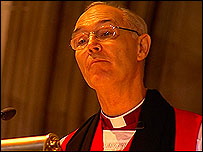 A Church of Ireland priest has described Archbishop Alan Harper (pictured), the leader of his church, as a 'false teacher', following a speech by the archbishop which raised the possibility that emerging scientific knowledge may lead the church to change its traditional teaching on homosexuality. The Reverend Canon Clive West, formerly rector of All Saints', Belfast, and a former chairman of the Evangelical Fellowship of Irish Clergy, said today on Sunday Sequence that Archbishop Harper 'is speaking for himself, not for the church'.
In a heated exchange with the Reverend Patrick Comerford, director of spiritual formation at the Church of Ireland Theological College in Dublin, Canon West challenged his church leader's authority to teach following his comments on homosexuality. Here's an excerpt from our live discussion (listen in full here).
Clive West: He's a bishop -- he's a guardian of the faith. But the question is, is he guarding the faith or is he a false teacher?
William Crawley: What do you think?
Clive West: I think he's a false teacher.
Patrick Comerford: Well I think that's a disgraceful comment from you Clive, I really do ...
Clive West: It's not a disgraceful comment ...
Patrick Comerford: ... coming from a priest in the Church of Ireland.
Clive West: We are asked to search the Scriptures and Paul praised people who searched the Scriptures. And if Archbishop Harper is at variance with Scripture, then I don't follow Archbishop Harper ... I'm not in communion with him.
Patrick Comerford: He's not at variance with Scripture. He's actually asking the questions that need to be asked and asking them in charity. [ . . . ] There's no point in being a member of an episcopal church when you don't appreciate the role of the bishops, including the archbishop, in guiding us through a debate like this and helping us -- and that sort of language is not helpful as we try to approach this with a reasonable and rational and charitable approach. To use that language about the archbishop when we're trying to have a reasonable and a rational approach only actually ups the temperature and ups the scale of debate in a way that is unfair on people who are actually trying to guide the church through this.
Clive West: Well I don't think he's guiding the church. You guide the church when you guide the church back to scripture.
William Crawley: Clive, do you believe there are many clergy who would agree with you that your archbishop, your primate, is a false teacher?
Clive West: I think quite a lot would. It gives me no joy to say that. But I do believe if we search the scripture -- John, for example, in Second and Third John, praises the people for not welcoming certain false teachers into their congregation, and Paul again praised the people at Berea because they searched the scriptures daily to see if his teaching was correct. So we are at liberty to search the scriptures and see if Archbishop Harper's teaching is correct.
William Crawley: What we have here, in this speech, Clive, is a very carefully thought-through argument, drawing on 16th century Anglican theology, and building a case for the use of science and reason in how we view the scriptures and how we interpret the Bible. You would grant that Archbishop Harper is engaging in that kind of mature discussion with sincerity, wouldn't you?
Clive West: I think he is using Hooker ... to support his interpretation of Romans 1. But Hooker was very strong on tradition as well -- the tradition of the church. And you will know that the Bishop of Rochester is not going to Lambeth because some of the teaching that's around today is not in accordance with the teaching that's been around for two thousand years.


Page 1 of 2
Comment number 1.
At 15:48 6th Jul 2008, jovialPTL wrote:This comment was removed because the moderators found it broke the house rules. Explain.
Complain about this comment (Comment number 1)
Comment number 2.
At 17:12 6th Jul 2008, brianmcclinton wrote:A 'false teacher' is someone who merely dictates to pupils/students what they should think and relies on 'authority' (a text, a leader) to bolster his/her viewpoint. A false teacher tries to stifle an enquiring mind. It maintains that 'the authority' is infallible and should not be questioned.
A good teacher is someone who promotes the active engagement of the learner and 'leads' out the mind, encouraging it to think for itself. A good teacher encourages the development of critical thinking, not slavish obedience to authority.
When we blindly accept a political system or a religion or whatever, we become automatons. We cease to grow.
The good teacher tries to dispel myths, plant ripples of doubt and even confusion. Yes, confusion, so that the learner gets frustrated and seeks to find out the truth for themselves. As Galileo put it, you cannot teach a man anything; you can only help him find it within himself.
By these criteria, Alan Harper seems to a good teacher.
Complain about this comment (Comment number 2)
Comment number 3.
At 19:50 6th Jul 2008, petermorrow wrote:Hi Brian
On another thread you objected to my use of the word literalist.
Could you then explain the words authority, dictates, slavish, automatons and myths.
I'm probably wrong here, but these appear to contain just the merest soupcon of bias, and we wouldn't want to do that to our minds.
Complain about this comment (Comment number 3)
Comment number 4.
At 19:57 6th Jul 2008, davidjagnew wrote:Brian
I see you have just confessed to being a false teacher as you have been dictating for quite a while now as to how it is irrational to believe that God is real. This truth that the good teacher wants his students to seek out, is it self-existing truth? And if found, would it be a truth or a myth, and should it too be questioned?
Complain about this comment (Comment number 4)
Comment number 5.
At 20:08 6th Jul 2008, davidjagnew wrote:Brian
I should also add that post 2 is a prime example of inaccurate, confused and contradictory statements.
Complain about this comment (Comment number 5)
Comment number 6.
At 20:10 6th Jul 2008, brianmcclinton wrote:David:
Nonsense. I encouraged pupils to question my views all the time. My view that the Christian god is irrational is not dictated to anybody. You can believe whatever myth you want. The choice is yours.
Complain about this comment (Comment number 6)
Comment number 7.
At 20:22 6th Jul 2008, brianmcclinton wrote:Peter, David:
What is the connection between literalism and bias, Peter?
Neither are you are models of objectivity in these matters.
Let me say that Alan Harper is acting like a brave Christian who is daring to question antiquated dogma. What do you two think?
Complain about this comment (Comment number 7)
Comment number 8.
At 20:38 6th Jul 2008, MarcusAureliusII wrote:It seems to me it depends on what your definition of "teacher" is. Does it mean someone who teaches you what to think or someone who teaches you how to think. For many instructors, they are interested in indoctrination. That is what religious "teachers" do. They do not want you to question their intellectual authority. The problem for religion is that when real knowledge from science advances, facts come into evidence which cannot be explained by the inflexible dogma or creates contradictions within the dogma itself which cannot be resolved. When the theologist tries to adapt the rigid dogma, he finds that by its very nature if it is bent, it will break. It cannot adapt to new truths which is why the Catholic Church fought the advance of science. To this day religion fights a losing battle against evolution, where life begins and ends, where the human species begins and ends, what sexuality is and isn't, and myriads of questions that swirl around these and other new realities it has no longer has any ready answers for. The issue of homosexuality is small potatoes...compared to what religion will face when life is finally synthesized in a test tube from inert matter or trans species creations that are part human, part animal are actually brought to life. Yes it's a frightening prospect. We already routinely bring people back from the dead, people whose heart has stopped beating and are actually dead by prior standards. Religion ultimately can only appeal to emotion, not intellect becuase the truely questioning mind which thinks critically and independently will see through the contradictions and inadequacies of every one of them easily. That is why it is irrational to believe in something for which there is not one shred of evidence and whose best argument is by tyros in scientific knowledge whose flawed logic is that they can't find any other explanation for existance so god must be real by process of elimination.
Complain about this comment (Comment number 8)
Comment number 9.
At 20:44 6th Jul 2008, petermorrow wrote:Hi Brian
You objected to my word, I am objecting to yours. If you are as open as you say you are, you will critique your own thoughts, your own world view, your own doubt and your own bias. I have been open about my doubts and belief, and I have criticised christianity and the church, yet you object to my grammar. I have yet to hear a critique of atheism.
'Slavish' and 'automatons' are pretty absolute words, are they not? I would have thought your doubt would have steered you clear of them.
Complain about this comment (Comment number 9)
Comment number 10.
At 21:32 6th Jul 2008, brianmcclinton wrote:Hi Peter:
I have already said that atheism is not enough. Read my posts.
What about Alan Harper's stance?
Complain about this comment (Comment number 10)
Comment number 11.
At 22:03 6th Jul 2008, brianmcclinton wrote:Peter:
I said that when we blindly accept a political system or a religion or whatever, we become automatons.
What on earth is wrong with that?
'Slavish' is often used as an adjective describing unquestioning obedience, being servile or imitative. As such, it is perfectly acceptable. If you want to think that any criticism of your viewpoint is 'absolutist', that's your problem.
What about the subject of this thread??
Complain about this comment (Comment number 11)
Comment number 12.
At 22:08 6th Jul 2008, Gandalf_wise wrote:The Catholic church did not fight the advance of science, and the Protestant reformers positively stimulated it. Copernicus, Galileo, Descartes and Pascal were all Catholic theists. Kepler, Newton, Locke, Priestley, and Faraday (to name but a few) were all Protestant theists and their work in science was faith-driven rather than faith-hampered. How on earth did people get hold of the idea that the Christian faith somehow held back the advance of science. The opposite is in fact the case. Even Richard Dawkins admits that without the Christian faith, the belief in a Law-giver behind every scientific law, science in the West would never have got off the ground!
Complain about this comment (Comment number 12)
Comment number 13.
At 22:14 6th Jul 2008, Gandalf_wise wrote:ANd by the way Marcus Aurelius, the Faraday institute in Cambridge is actually made up of Christian theists who are also scientists in a variety of fields, the majority of whom, if not all, also accept, without blushing, evolution and natural selection as the dynamic whereby the created order, once initiated, developed into what we see around us today. They are also, as it happens, evangelical inerrantists. They don't believe that the Bible made mistakes in scientific description of phenomena when its purpose was not in fact to offer a scientific description of the said phenomena.
Complain about this comment (Comment number 13)
Comment number 14.
At 22:18 6th Jul 2008, davidjagnew wrote:Brian
So this truth that your pupils have discovered, are they to question that as well? To whom are you making your statements that belief in God is irrational if you are not dictating to anybody?
By the way, what did you teach?
I see you are looking for a response about Alan Harper from Peter. Well here is one from me. Alan Harper as Archbishop of the Church of Ireland is supposed to accept the canon of Scripture as outlined in the 39 articles as God’s infallible and inherent word. He is now telling us that Paul in this same word may have got things wrong. You may have noticed as an expert in making contradictions that this is a contradiction in terms.
Complain about this comment (Comment number 14)
Comment number 15.
At 22:23 6th Jul 2008, brianmcclinton wrote:Mark:
I agree with you that much religious 'teaching', especially in NI, is indoctrination, not education. Instead of widening and opening children's horizons it is intended to keep them firmly closed.
The RE core syllabus is the most exclusive of any in the UK and fails to take account of the increasing diversity in the wider community. Recently, two world religions other than Christianity were included at key stage 3, when world religions should be included at every stage, as should secular worldviews, which are on the syllabus in schools throughout GB.
Bu when you realise that the 4 main Christian churches in NI have the power to draw up the RE core syllabus themselves, you know why. This is the extent of their 'self-criticism'. The other two world religions have only been recently included because of complaints of discrimination and inequality of treatment.
Complain about this comment (Comment number 15)
Comment number 16.
At 22:44 6th Jul 2008, petermorrow wrote:Hi Brian
The subject of this thread is about the ability of the Archbishop to teach and to that debate you introduced the concept of what is and is not a good teacher.
I am not off topic.
I see you are being absolute in terms of your statements about your views on religion again. I thought the concept of absolute was something you objected to. Do you ever doubt your views on the bible? Do you doubt the views of the Archbishop as much as you doubt the views attributed to Paul? I guess not. Indeed you seem accept Mr. Harper's views without critiquing them. Is it just because they so closely resemble yours?
I say again, I have doubted my faith, yet I still hold to it. Why? Precisely because I have challenged the views of Archbishops, Reverend gentlemen, self appointed evangelical leaders and christian celebrities. I have not blindly accepted any political or religious view, I am not in slavish obedience to the teaching of anyone and christian faith is not opposed to science, nor is it irrational.
If you are going to doubt, doubt everything, starting with atheism. If it is not enough, what is wrong with it, what is missing and what will you add to it? Then, like me, try doubting yourself. Follow your own advice on what it means to be a good teacher and doubt yourself to the point of frustration and confusion. I've been there, there is nothing to fear. The critique will make interesting reading. So will the interpretation of Matthew 13: 31 and 32 on the other thread when you have it posted.
Specifically on the Archbishop and his views on Paul, anyone can take bits of the bible and make them say what they want to say. All this stems from what it means to understand the bible in the context of genre, history, and culture, none of this means Paul was wrong. If you want to discuss inerrant we can do that.
Complain about this comment (Comment number 16)
Comment number 17.
At 22:56 6th Jul 2008, brianmcclinton wrote:David (post 14):
You ask: "So this truth that your pupils have discovered, are they to question that as well?"
I would like to think that there isn't only one truth. There are lots of truths, and lots of things we don't know. So, yes, indeed, I hope that they would be sceptical, yet open-minded, and question everything. This is a neverending process, as new knowledge is discovered, whereas you seem to imply (somewhat dogmatically) that there is only ONE truth. I have already repeated ad nauseam that there are lots of things I don't know, that I am not sure of etc. The Christian god is not, however, included in my long list of doubts and uncertainties (I am 99% certain of his non-existence). Sorry, folks, but there it is.
The 39 Articles were drawn up in 1563. Yes, 445 years ago. Any chance of an update, you chaps?
As for Paul, he certainly did get some things wrong, and he certainly contradicted Jesus, the most obvious one being that the law of Moses is abrogated by Jesus's death (Galatians 2:15-16), whereas Jesus explicitly states that he came not to abolish the law or the prophets but to fulfil them".
(Matt. 5:17-20). Paul says that we are not justified by observing the law, whereas Jesus says that "whoever practises the law will be called great in the kingdom of heaven".
There are many other contradictions between Jesus and Paul, and I may return to some of them later.
Complain about this comment (Comment number 17)
Comment number 18.
At 22:57 6th Jul 2008, davidjagnew wrote:Post 14
Unlike God's word, I am not inerrant, I wrote inherent.
Complain about this comment (Comment number 18)
Comment number 19.
At 23:00 6th Jul 2008, petermorrow wrote:99% Brian?
Any movement is good. What about conversion 1 percentage point at a time?!
Complain about this comment (Comment number 19)
Comment number 20.
At 23:07 6th Jul 2008, portwyne wrote:David
The 39 Articles - which many Anglicans like myself find an anachronistic anti-Catholic embarrassment - do not describe the Bible as either infallible or (as I assume you meant to say) inerrant. I would regard them as an historical curiosity of little more significance than the lace jabot affected by Presbyterian moderators.
Archbishop Harper in keeping with the BEST traditions of Anglicanism is seeking to steer a middle way between opposing positions and has found a very interesting means of opening up the possibilities for full and long overdue acceptance of gay people in the church. He is offering the closest thing to prophetic leadership a true Anglican can manage. In his tenure of his office so far he has proved a faithful pastor and a wise and able teacher. Thank God for his ministry and his courage.
Complain about this comment (Comment number 20)
Comment number 21.
At 23:20 6th Jul 2008, brianmcclinton wrote:Peter:
You say that the subject of this thread is about the ability of the Archbishop to teach and to that debate I introduced the concept of what is and is not a good teacher. But instead of telling us what you thought a good teacher was, how it was similar to or different from mine, and whether Alan Harper fitted the category (the subject of the thread), you turned it all upon me and tried to expose what you consider to be my inconsistencies and hypocrisies. The thread is not about me but about whether Alan Harper is a false teacher. Can't you stick to that?
Or must you keep avoiding controversial Christian topics by having a go at atheism (I keep repeating, but you won’t listen, that I am not ONLY an atheist but also an agnostic, a sceptic and a humanist, but that's too pick'n'mix for you). You also make huge mental leaps in your posts by, for example, equating Christianity with religion. The latter is much bigger than Christianity, Peter.
I think Alan Harper is brave because he is trying to give a modern, humane lead to Christianity in relation to the question of homosexuality in the face of a very reactionary and traditional Christian ethos. He is being doubly brave in the context of the recent statements by leading local Protestant politicians such as Iris Robinson and Ian Paisley Jnr. By the look of it, he is getting more 'Christian' sympathy on this thread from non-believers than he is from some Christians. Or am I being too 'absolutist' here?
Complain about this comment (Comment number 21)
Comment number 22.
At 23:34 6th Jul 2008, davidjagnew wrote:Brian (post 17)
I think you may need to return to some of them now. You have chosen what you call the 'most obvious' contradiction between Paul and Jesus. Now are these really the questions you want me to answer? Please tell me that you have something more, Brian. You have put the bible on trial here. Please tell me that you have an ace up your sleeve, that your hopes for contradiction rely on something more than this.
At least now I think I have an answer about your knowledge of the original Biblical languages and their theological meaning.
Complain about this comment (Comment number 22)
Comment number 23.
At 23:35 6th Jul 2008, davidjagnew wrote:Portwyne
The 39 Articles accept the 66 books of the Old and New Testaments as the Canon of Scripture in accordance with the Council of Jamnia. I would much prefer to stick with this middle way than that offered by a false prophet, who is only interested in appeasing modern liberal interpretations.
Complain about this comment (Comment number 23)
Comment number 24.
At 23:40 6th Jul 2008, brianmcclinton wrote:David:
Why all these personal attacks and name-calling because someone says something different from some others? Clive West calls Alan Harper a 'false teacher' and now you call him a 'false prophet'.
Gosh. Is this bitchiness an example of Christianity in action???
Complain about this comment (Comment number 24)
Comment number 25.
At 23:56 6th Jul 2008, petermorrow wrote:Hi Brian
Would you prefer I didn't respond to what you had to say?
Please tell me too when I have avoided controversial Christian issues. I am the one remember who has dealt with every question you have asked, including the 'cruelty' of God, death, the Cross of Jesus, my own personal doubt and the shortcomings of the church.
On the question of equating Christianity with religion, obviously the latter is bigger, but everyone uses the terms interchangeably, do I have to qualify everything? Anyway the Archbishop is a christian is he not?
As for the Archbishop and this thread, I have stated my view clearly on Post 16, and this thread and the other one about his views relate directly to biblical interpretation and inerrancy. The discussion is actually about how the Archbishop understands the bible, not whether or not he can be kind to gays.
So maybe we could, after all, move to biblical interpretation without assuming it is inaccurate, man-made and full of contradiction.
Complain about this comment (Comment number 25)
Comment number 26.
At 00:11 7th Jul 2008, brianmcclinton wrote:Peter:
Peter, respond by all means, but do it relevantly.
You say that you have dealt with every question I have asked, including the 'cruelty' of God, death, your own personal doubt and the shortcomings of the church.
Really? Is God cruel, then? Do you doubt the Bible or Paul on homosexuality? Is 'the church' homophobic?
You say everyone uses the terms Christianity and religion interchangeably. That is very 'absolutist' if I may say so. And if they do, they shouldn't: Islam, Judaism, Hinduism, Buddhism, etc, are all considered religions. Moreover, religion could be defined as a committed faith', in which case Humanism is a religion of humanity. This is how Mill saw it. I don't happen to agree, but this is just one example of how we humanists are not absolutists.
We don't all agree. If some people want to call humanism a religion, it's fine by me.
Indeed, we are proud of our disagreements because we see them as examples of freethought in action. Some Christians, on the other hand, get very angry at one another if they disagree, as this thread indicates.
Lastly, you say that the discussion is actually about how the Archbishop understands the bible, not whether or not he can be kind to gays. Hopefully, and in a truly 'Christian manner, it would be about both. Is the Bible not 'kind' to gays, Peter?
Complain about this comment (Comment number 26)
Comment number 27.
At 00:22 7th Jul 2008, portwyne wrote:David
I'd be interested to know in what way exactly the position you mention is a 'middle way'? Mid-way between what and what?
There is the position that the Bible is a load of errant nonsense - dangerous when it isn't laughable.
There is my own position that the Biblical scriptures are interesting and informative accounts of man's search for meaning in existence: mystically resonant but of no particular authority.
I don't think your interpretation of the 39 Articles' stance falls midway between those two opinions so locate with reference to the poles it lies between for me please.
Complain about this comment (Comment number 27)
Comment number 28.
At 00:25 7th Jul 2008, MarcusAureliusII wrote:Gandalf_wise #12
So that whole thing about the Inquisition showing Galileo the instruments of torture and putting him under house arrest for advancing his scientific theories was all just made up, it never happened? #13 When they are being Christians, they cannot be scientists at the same time. And visa versa. Being a scientist means keeping an open mind and concluding the universe is what the experimental observations lead you to believe by rational deduction wherever that takes you. Being a Christian means that you accept and believe the Holy Bible is the word of God. If you are selective in what you believe from the Bible or if you try to twist its plain meanings to suit your own prejudice, or if you set it aside for a time when you have to work in a laboratory or on a scientific thesis, then you are not really a Christian. Being a Christian is not a part time occupation.
It is not illogical for the same person to be of two different minds at different times. When they are absorbed in a scientific problem, they focus on getting the right answers and set everything else aside. But when they are laying awake at night in the dark thinking that they will one day die and it frightens them, objectivity goes out the window and they are just like the primitives of tens of thousands of years ago sitting around a fire or at the mouth of a cave looking up at the night sky wondering what life is all about. That's when their fantasies and superstitions embodied in religion bring them the only comfort they can find. Some think this irrationality is genetic, others like Dawkins call it a mental disorder, or maybe it's both. Maybe one day we will know more about what causes it when we have a better understanding of how the human brain functions. Science isn't that advanced yet.
Complain about this comment (Comment number 28)
Comment number 29.
At 00:31 7th Jul 2008, petermorrow wrote:Hi Brian
You raise questions you have raised before, we have been over this ground before.
Anger is not always bad.
Neither do I think false teacher or false prophet are forms of names calling, they are just ways of stating that someone is not a prophet as opposed to being one. Portwyne said prophet, David said not prophet. They are points of view, disagreements.
You have deemed God cruel because of the Old Testament - I pointed you to the cross, it is the same God - justice and mercy - we have discussed this before too.
On the contradictions of Paul and Jesus. The big picture view of the bible understands that Jesus did fufill the law and prophets - there is no contradiction.
Everyone is welcome in the Kingdom of Heaven, no type of person need be excluded, that includes people like me; but we will differ on one point, I understand the Kingdom of Heaven in terms of being remade in God's image, personal morality included, and again, that includes me.
And now that we're on biblical interpretation again, Matthew 13:31 -32. When I see how you handle the words it might help us understand one another better.
Complain about this comment (Comment number 29)
Comment number 30.
At 01:46 7th Jul 2008, gveale wrote:Brian
Did I pick you up right? You're a teacher? Or were?
If so we've similar teaching philosophies - state your views but encourage your students to challenge them.
Graham Veale
Complain about this comment (Comment number 30)
Comment number 31.
At 11:01 7th Jul 2008, brianmcclinton wrote:Graham:
I am a retired teacher of Economics and Politics to senior pupils (also taught the odd History class to make up my timetable). My philosophy was exactly as you say. if they didn't challenge my views and other views, I would have thought I was doing my job properly.
If they asked me about God and religion, I never hesitated to respond because I know that when your mind is developing it asks basic questions about life, the universe and everything. I always let them know that I thought traditional religions provided the wrong answers to these basic questions, and if they wanted to understand the world they would have to look elsewhere. Some agreed and some didn't. We would argue about it, and still some agreed and some didn't. I always argued that they had to make up their own mind.
Alan Harper is to be commended, not insulted. Peter brushes aside remarks such as 'false teacher' and 'false prophet' but doesn't hesitate to have a go at a Humani statement that insults nobody!
Complain about this comment (Comment number 31)
Comment number 32.
At 11:04 7th Jul 2008, brianmcclinton wrote:Graham:
Second last line, para 1 should read:
"I would have thought I was NOT doing my job properly".
Complain about this comment (Comment number 32)
Comment number 33.
At 12:28 7th Jul 2008, petermorrow wrote:Hi Brian
First on the point of false prophet. To counter the label 'prophet' (which in this context I presume means 'visionary leader', rather than one who speaks God's word) with the label 'false' or 'not prophet' is not an insult, it is a statement meaning 'not visionary leader'. Of course, as I didn't use the word in the first place, maybe you should take it up with David.
On teaching. I'm all on for questioning, that should be obvious from some of what I have said, and yes, good teachers provoke, and yes, on many things we do have to make up our own minds, and we ought to encourage students and our own children to make up their own minds. However, good teachers also recognise knowledge for what it is. One and one for example is not something we really have to discover. Mathematical knowledge is knowledge, grammatical knowledge is knowledge, and there is other knowledge to know, so there must be a balance.
You also say I should respond to you relevantly. OK let's do a bit of explaining. When I read this blog, I read a lot about the need for open-mindedness - great! I also read a lot about religion. Religion, including Christianity, is, I am told, irrational, indoctrination, 'a dead weight' (yes the Humani statement) cruel, that the bible is made up, inaccurate, contradictory etc. Those views have again been aired on the two threads relating to the Archbishop and I have challenged them, where is the problem? Unfortunately it appears to be a default mode. Wherever I see these words used, I reserve the right to question them.
I have explained over and over that to dismiss religion as merely irrational and so on is a limited way to think about it, yet the caricature remains. I have also accepted that some of religion and Christianity is limited, yet no change. Furthermore I have attempted to answer question after question, yet, when, in the spirt of open-mindedness, I query atheism, when I challenge other worldviews as strongly as I have challenged my own, I am told I am having a go.
As I have suggested before, championing skepticism demands that we are consistent enough to challenge our own deeply held views. I have been both atheist and theist, sometimes all at the same time! I have deliberately gone out of my way to push my so-called faith and the christian leaders I have known to their limits - yet I still believe. It is perfectly relevant to counter statements like, "A good teacher encourages the development of critical thinking, not slavish obedience to authority", written in the context of the Christian religion with, 'does anyone doubt their atheism?'
And now back to biblical interpretation. The reason good teacher, false teacher (note good and false are not antonyms) has been raised, has to do with how Christians read the bible. The Archbishop in his speech referred directly to this. He was not justifying homosexuality per-se. Actually his conclusion on this is reserved, "Finally, let us be clear on this: it has not yet been conclusively shown that for some males and some females homosexuality and homosexual acts are natural rather than unnatural." Presumably if science deemed homosexuality 'unnatural' the Bishop would stick with Paul, at which point non-believers would disagree with him. This is all down to his and other Christian's interpretation. While homosexuality is the current crisis point, the real issue here is how the church handles the bible. What I find interesting then, is that those who have already dismissed the bible find way to commend the Bishop when what he did was to set his views completely within the context of biblical interpretation. I could be wrong, but I do not expect that your agreement with the Archbishop relates to his biblical exegesis, or the lack of it.
So, on biblical interpretation, what about Matthew 13:31-32, how do you read it?
Complain about this comment (Comment number 33)
Comment number 34.
At 12:52 7th Jul 2008, brianmcclinton wrote:Peter wishes to discuss the Bible. Ok. Alan Harper is right to question the ideas of Paul in the New Testament, because it is a message which gives Christianity a very bad name. Let us leave homosexuality for a moment and also assume that the same man wrote all 123 epistles attributed to him.
SLAVERY
The Roman slave laws were relatively liberal and humane. Not so Paul. He sent Onesimus, the runaway slave whom he had converted, back to his Christian master, Philemon. In 1 Corinthians 7:20-22) he says that everyone should remain in the state in which he was called. Indeed he tells slaves that they ought to be indifferent to their lack of freedom because they are really 'freemen of Christ', and thus by twisting language he draws a veil over the injustice of slavery. In 1 Timothy 6: 1 he tells slaves that they should submit themselves voluntarily to their masters in a spirit of humble obedience, "so that the name of God and his doctrine be not blasphemed". It is in fact a Christian duty. As he states in Ephesians 6:5, slaves should obey their masters 'with fear and trembling’...as unto Christ'.
WOMEN
Paul was very negative towards women. He actually says that "it is good for a man not to touch a woman" (1 Corinthians 7:1) and it would be best if all people remained unmarried (1 Corinthians 7: 26-27). He even says that those who have wives should live 'as though they had none' (1 Corinthians 7: 29). He condemns sexual relationships outside marriage, not because it is a betrayal of personal love, but because 'the immoral man sins against his own body' (1 Corinthians 6:18). In other words, the purpose of marriage is to satisfy legally the sexual urge that so many Christians unfortunately cannot deny.
This defamation of sex inevitably leads to the defamation of women. Paul points out that it was not the man, Adam, who was tempted but Eve, the woman (2 Corinthians 11:3), and that man was not created for the sake of woman, but woman for the sake of man (1 Corinthians 11:9). The hierarchy of creation, according to Paul, was: God, Christ, man, woman (1 Corinthians 11:3). Only man, not woman, is the image and glory of God - woman is the glory of man (1 Corinthians 11:7). in communal worship, woman's subordination was to be made clear by her wearing a veil (1 Corinthians 11:5ff) and by her keeping silent (1 Corinthians 14:34). If she wanted to know anything, she should wait until she got home and then ask her husband (1 Corinthians 14:35).
1 Timothy 2:11ff) is pretty clear. "Let the woman learn in silence with all subjection. But I suffer not a woman to teach, nor to usurp authority over the man, but to be in silence. for Adam was first formed, then Eve. And Adam was not deceived, but the woman being deceived was in the transgression. Notwithstanding, she shall be saved in childbearing, if they continue in faith and charity and holiness with sobriety".
Complain about this comment (Comment number 34)
Comment number 35.
At 12:53 7th Jul 2008, brianmcclinton wrote:Last line, para 1, should be 13.
Complain about this comment (Comment number 35)
Comment number 36.
At 13:18 7th Jul 2008, gveale wrote:Brian
I teach RE. Good on you for your teaching style, you're exactly right. My best students tend to be atheists or skeptics - the Born again Christians tend to think they already have all the answers. And yes, I try to help the atheists clarify and improve their arguments for atheism.
I could get in trouble for this, but I think the Churches have too much say in the RE syllabus. Were Humanists even consulted? Sometimes I think the Churches expect me to "Church the Unchurched". That's their problem.
And I'm with you on Comprehensive and non-denominational Education. Our current system betrays a lack of trust in Northern Irelands teachers to be impartial, and to teach all abilities. It's also elitist and irrational.
Graham Veale
Complain about this comment (Comment number 36)
Comment number 37.
At 13:19 7th Jul 2008, gveale wrote:There go my chances of promotion
Complain about this comment (Comment number 37)
Comment number 38.
At 13:19 7th Jul 2008, Heliopolitan wrote:Brian, in fairness Saul Paulus didn't write the epistles to Timothy - they are fakes. But then of course Saul Paulus was a fake apostle - a false prophet who used the personage of Jesus of Nazareth as a hook to hang his Graeco-Judean syncretistic fantasies upon. Or so goes one line of thought.
Hey, anyone hear PB on the radio this morning? (Good Morning Ulster).
Complain about this comment (Comment number 38)
Comment number 39.
At 13:21 7th Jul 2008, Heliopolitan wrote:Graham, well said.
-H
Complain about this comment (Comment number 39)
Comment number 40.
At 13:47 7th Jul 2008, petermorrow wrote:Hi Brian
You are certainly good at quoting the bible, it's a pity you weren't as good at interpretation.
Do you really expect me to answer yet more objections and trust your explanation of these references when you can't deal with simple things like Matthew 13:31-32
And please don't go assuming this is avoidance. I can give you book long answers if you want but I'm not sure it will make any difference, your mind appears fixed against biblical Christianity.
I presume too that my understanding of what the bishop said is pretty close to the mark and that you realize that the bishop was arguing for a very particular reading of Paul based on the writing of Hooker, the concept of "The Law of God, The Word of the Lord" being key. You will also note from the Archbishop's speech that he fully accepted Paul's understanding of God.
Have you any thoughts on that? Have you grasped the implications of the fact that Paul was writing to the church in all the passages you quote? Do you even have a view on what the church is? Or, as I suspect, do you agree with the bishop because he agrees with you?
Stop raising the same tired old objections to the bible and Paul and Christianity that I have heard for years and tell me, in your own words, how we should understand Matthew 13: 31-32. This is the fifth time you have been given the opportunity.
Is it literal or is it not? Or maybe it is both. Then we can move on.
Complain about this comment (Comment number 40)
Comment number 41.
At 13:59 7th Jul 2008, brianmcclinton wrote:Hi Graham:
Great! I should also say that some of my best pupils were Christians and remained so, despite being afflicted with me.
A member told me that last year his daughter, who is a 'firm' agnostic, achieved an A grade in RE A2s, backing up what you say.
I have to go out and walk the dog, maybe muse on mustard seeds. Peter is very impatient.
Complain about this comment (Comment number 41)
Comment number 42.
At 14:11 7th Jul 2008, davidjagnew wrote:Portwyne,
I should have used quotation marks for “middle way”. I was simply meaning that it is the only way. I was referring not to the 39 articles per say, but to the revelation of the Bible, which the Church of Ireland has historically been in agreement with.
The 39 articles are not anti catholic. They were written to oppose error and hence anti Roman Catholicism. I used to belong to the Church of Ireland and have never been embarrassed by the 39 Articles.Instead of traditions we need to start with Biblical Interpretation first.
The Bible is not about man's search for meaning and existence. The Bible is about God revealing himself to man. This sovereign act then defines man meaning and existence for all time. In the person of Jesus, God comes to seek and save his people form their many sins, homosexuality being only one sin.
Complain about this comment (Comment number 42)
Comment number 43.
At 15:42 7th Jul 2008, brianmcclinton wrote:Peter:
Parables as such aren't arguments but substitutes for arguments (or illustrations only).
I would turn it round and say that Jesus and Paul should have started loving women and gays, instead of denigrating them. They too might have found that their love grew and grew to gigantic proportions.
As for Jesus, I'm sorry but I cannot love a character from 2,000 years ago whose real life is shrouded in myth and contradiction. As far as he is portrayed in the Four Gospels, I don't like his teaching that, instead of thinking, we should accept and believe. This is indoctrination, not teaching. I do like his message of 'loving your enemies', though it wasn't original and we might add that we should strive not to have enemies in the first place.
On the other hand, I don't agree with a message which says that, if you are oppressed or wronged, you should accept it and do nothing about it. On the contrary, we should resist it and support those who are unfortunate, put upon and oppressed themselves. We would still be living in the Dark Ages if some people hadn’t resisted ignorance, prejudice, bigotry, intolerance, oppression (slavery, sexism, cultural and political imperialism, anti-semitism, homophobia). Indeed, on the issue of anti-semitism, most Jews know only too well that failure effectively to resist Nazism and to gain support from others in that resistance (a crucial aspect), led to the Holocaust.
Socrates, who said that "the unexamined life is not worth living" and taught that we should question things, and who also was prepared to be a martyr for his teaching, is more worthy of 'love' or at least admiration than Jesus. You should try your mustard seed test with him. It would be more fruitful and enlightening.
There is also a Buddhist parable about mustard seed which is wiser than the Christian one. A young girl has a son who dies. She goes to the Buddha with the dead child and asks him for medicine to cure her boy. The Buddha replies that she must prepare tea from five or six grains of mustard seed, but she must take it from a house where no one has lost a child, husband, parent or friend. The poor girl goes from house to house. Naturally, they pity her and offer her mustard seed, but when she asks if a son or a daughter, a father or mother died in the family, they answer her: "Alas the living are few, but the dead are many. Do not remind us of our deepest grief". And of course there was no house but some beloved one had died in it. She then sat down by the wayside and thought to herself: "How selfish am I in my grief! Death is common to all". Putting away the selfishness of her affection for her child, she buries the dead body in the forest. Returning to the Buddha, she takes refuge in him and finds comfort in the Dharma, which is a balm that will soothe all the pains of our troubled hearts.
This, Peter, is a better parable than that of Jesus, for it relates to the real world and the universal truth of death and, crucially, the man who taught it demands nothing of the learner for himself.
Leaving aside for a moment Heliopolitan's entirely reasonable point about the dubious authenticity of the Pauline epistles, I interpret 'Paul' to say that, just as gay sex is unnatural, so slavery is perfectly natural, while giving women equal rights with men is wrong because they are naturally inferior to men. Am I 'in error'? Is my interpretation not good?
Complain about this comment (Comment number 43)
Comment number 44.
At 16:59 7th Jul 2008, petermorrow wrote:Hi Brian
Hope you had a good walk. My mum has accused me of impatience too, so you could be right about that, the testimony of two witnesses being an indication that we should think again. Interestingly however I first posted my question at 20 to 8 last night, so I think I'm making progress on the patience front.
And so to your answer. You say parables as such aren't arguments but substitutes for arguments (a bit like the small print in advertisements - for illustrative purposes only). But that wasn't really an interpretation of the text. I already knew it was a parable, verse 31 told me that. That bit of the text can be interpreted literally. It says Jesus told them another parable and then he did. It then tells us what the parable was. It continues by presenting the Kingdom of Heaven and the mustard seed in terms of a simile. So obviously we can conclude that the Kingdom of Heaven, whatever it is, is not actually a mustard seed. So, what is it saying? You are pretty convinced that Jesus didn't love women, that the bible is full of error and contradiction, so I'm interested in how you handle the text.
The Buddha's parable is interesting indeed, but in the same way I have questioned and interpreted christianity, I shall seek to question and interpret the Buddha.
Seems to me that the Buddha was saying that the ultimate reality of the universe is that everybody dies. And yes, that is literally true, we all do, so in a sense the Buddha was right; we all have something in common in that we have to suffer death. In this we are not alone. And in life we also all have times of happiness and sadness and pain from which we cannot free ourselves; so we should not fight or struggle against this, rather we should guard ourselves against selfishness and bitterness whatever comes our way. In doing so the we shall find peace in our adversity.
Now I think this is a pretty reasonable interpretation of the Buddha's parable (especially for a Christian), but Jesus was speaking of the Kingdom of Heaven in his, so we'd need to understand what he meant by that.
And I'm still curious.
Complain about this comment (Comment number 44)
Comment number 45.
At 17:01 7th Jul 2008, davidjagnew wrote:Brian,
At least I now know why you thought that the “big bang “ was an explosion. That is exactly the way an economist or politician might read into a theory rather than understand it.
You are applying the same method to your interpretation of the Bible.
However Jesus is the one who in redemption conquers sin, the world and the devil.
The Buddha is acquiescing to circumstances. We are to rejoice in our defeat by circumstances according to old Buddha. The emphasis in his name is definitely in the ha,ha,ha.
I would listen to Newton under his tree rather than Buddha under his, if I was you, at least you might get your math and physics correct then.
Complain about this comment (Comment number 45)
Comment number 46.
At 17:25 7th Jul 2008, petermorrow wrote:Graham
Very interesting post about teaching RE. I wouldn't worry to much about missing out on promotion, promotion is overrated!
I agree fully with your thoughts on not using the classroom for evangelism, too many in the church have not grasped the problem and seem to see public institutions such as schools as captive audiences or a fast track to getting their message out.
Nondenominational and comprehensive makes complete sense.
Indeed I will go further. I am not even in favour of churches using 'children's meetings' as a way of communicating the christian faith to parents. If the churches haven't figured out how to explain who they are and what they believe to adults then they ought not to organise children's meetings as a very poor alternative.
Complain about this comment (Comment number 46)
Comment number 47.
At 17:45 7th Jul 2008, jovialPTL wrote:hey William I see The Times is running with your story of the 'false teacher' of Armagh. I don't expect Clive West expected to be making the headlines ...
Complain about this comment (Comment number 47)
Comment number 48.
At 18:28 7th Jul 2008, petermorrow wrote:Heliopolitan
I see you think Saint Saulus Paulus of Tarsus was a fakeus apostle. Fake in the false sense. I do hope that wasn't an insult! That would fake in ridiculous. Of course if he really was fake he wouldn't care, and anyway he's dead so he'll hardly sue-us.
Anyway, got me to thinking, if he was a fake, a phoney, a fraud and a cad, who were the real apostles?
Complain about this comment (Comment number 48)
Comment number 49.
At 18:31 7th Jul 2008, davidjagnew wrote:Graham,
I think the problem you refer to in post 36 arises from the visible church not knowing what God intended his people to be. The visible church seems obsessed with activity rather than the identity that God has decreed it to have. It should be an living example of what the Gospel is. The church seems to have given the impression that it is all about signing up to activity. This activity could be in the form of missionary activity or even signing up to confessions of faith. The Pharisee's are a prime example of this. The emphasis on activity makes the outward paramount whereas Jesus puts the emphasis on the heart of man. The heart of man can only change when man is brought back into correct relationship with God by God which inevitably leads to correct relationships with other men. The church seems to have lost this relational understanding evidenced the lack of community we see in the church today. A community that can engages with the world around us whenever, wherever we are.
Instead we have children's, young people's, woman's, men's meetings. We have Sunday school, seminars, workshops, para church organizations. All of it made up, not one part of it in the Bible.
David.
Complain about this comment (Comment number 49)
Comment number 50.
At 19:08 7th Jul 2008, brianmcclinton wrote:David, Post 45:
You made this snide and inane point months ago. I let it go then but not a second time. Only an 'amateur' scientist would dispute a suggestion that there was an 'explosion' in the way you are doing.
The inflation theory basically says that in the early moments following the explosion or Big Bang, there was an extremely rapid expansion of the nascent universe.
Just a few quotes:
University of Michigan:
"About 15 billion years ago a tremendous explosion started the expansion of the universe. This explosion is known as the Big Bang"
Cambridge University:
"About ten billion years ago, the Universe began in a gigantic explosion - the Hot Big Bang!"
NASA:
"At some point in the distant past all the matter and energy we see today must have been crammed together in a tiny region of unimaginably high density and temperature. Cosmologists call that moment the Big Bang".
The standard big bang theory says the universe began with a massive explosion, but a more recent theory suggests it is a cyclic event that consists of repeating big bangs. In the cyclic universe model, our universe would be part of a larger universe, one of two parallel, three-dimensional membranes separated by a tiny gap in the fourth dimension. A collision of the two membranes would release enough energy to cause the big bang - in fact, many big bangs, coming at regular intervals of perhaps several trillion years. Collisions suggest 'explosions', do they not?
Now, I am fully aware that some cosmologists prefer the word 'inflation' rather than explosion for the initial moment. But as an Economics teacher, I know that we can talk of 'the population explosion', meaning a rapid or sudden great increase, and we can talk of 'price inflation' as ... a rapid or sudden great increase. look the words up in a dictionary, David, if you have one.
DICTIONARY DEFINITIONS
Explosion: violent release release of energy, a sudden great increase.
Inflation: a rapid expansion.
Complain about this comment (Comment number 50)
Comment number 51.
At 20:00 7th Jul 2008, portwyne wrote:David
Middle = only.
Interesting use of language.
I am reminded of Humpty-Dumpty's rejoinder to Alice: "When I use a word it means just what I choose it to mean - neither more nor less." Substitute the definite for the indefinite article and you have what I have often considered the evangelical approach to Biblical interpretation.
If I were the kind of person who placed store on knowledge of the biblical languages (which I am not) I rather think I would be careful both to use my own accurately and to ensure that any Latin tags I threw in were spelt correctly.
Complain about this comment (Comment number 51)
Comment number 52.
At 20:19 7th Jul 2008, davidjagnew wrote:Brian,
Poor, very poor indeed. You were the one who brought up the “big bang”. I see that you did not even have the manners to read my reply to you over this issue.
You have been cutting and pasting like mad, yet again. Why when you do not like Christians using the Bible as their final authority are you so quick to quote from sources that are merely sound bites. What error analysis have you carried out on these sources. Those quotes were probably written by some secretary in a faculty office or in the case of NASA the PR department.
An explosion assumes pre-existent space and time. There is no pre-existent space and time in the “big bang”. In the theory it is the expansion which “creates” the space and the time.
Again exactly consistent with your ability to interpret the Bible. Vainly trying to point out errors in the Bible yet arrogantly not admitting to your own. Not at all surprising that you like the surrender policy of Buddha!
David
Complain about this comment (Comment number 52)
Comment number 53.
At 20:36 7th Jul 2008, davidjagnew wrote:Portwyne,
I am only too glad for you or any others to point out any errors that I make either in use of language , spelling or typing.
Also I have never said that I was an expert on any Biblical languages.
I have always been much more used to the reading or speaking. My lack of writing skills has always been very apparent to me. Perhaps a good word processor with spell checker would be a good investment for me, I believe others use that on these posts and I have only recently become aware of them.
David.
Complain about this comment (Comment number 53)
Comment number 54.
At 21:17 7th Jul 2008, Heliopolitan wrote:Hi Peter, there is no such thing as a "true" apostle - it's a meaningless term!
As you know, Saul was a Roman citizen by birth. He therefore had a "Roman name" at birth (not at all surprising, since he came from Tarsus in Anatolia) and from a prominent family at that. One of his illustrious relatives seems to have been Sergius Paulus, the governor of Cyprus, and indeed it is highly probable that it was this that led him there after his ideas regarding "Christ" began to take shape. Indeed, Sergius Paulus was a bit of a religious experimenter himself, so it's no big surprise that Saul's mind ran riot over there. Fertile ground for religion manufacturing. [In Acts, it's Barnabas that does the intro, but the overwhelming likelihood is that it was the other way round]
One of the most puzzling aspects of Saul's career is why/when he changed his name to Paul(us). In Acts, this happend *precisely* at the point he goes to Cyprus to visit uncle Sergius. This is Saul throwing off the Jew and donning the Roman. He had already tried Jewish fundamentalism previously, and when he found out that Gamaliel and the crowd weren't as well 'ard as he would have liked, he became disillusioned, and started dabbling. The rest is (nearly) history.
Complain about this comment (Comment number 54)
Comment number 55.
At 21:23 7th Jul 2008, portwyne wrote:Brian
I must take issue with you on your understanding of Jesus. I believe that the gospel portrait conflates a man and a mythos. It is not difficult though to arrive at some picture of the man: difficult, querulous, challenging, insightful, humane, loving, driven, passionate, reflective... All these qualities and more shine through the narrative and portray a man who lived his life in such a way that the glory of God shone perfectly through him.
I can find no trace of misogyny in Jesus - witness his close friendships with Mary and Martha, his acceptance of Mary Magdalene's ministrations, and his treatment of the woman taken in adultery. For a Jewish man of his time these were all quite radical positions.
The Bible is silent on Jesus' sex-life, if any, but we do know he enjoyed a close, intimate and loving relationship with John the Apostle. In the much quoted Matthew 19 passage on marriage, while advocating lifelong commitment or, failing that, celibacy as the gold-standard, he is quite clear that he does not think God has made all men capable of following that path. He lists categories of those to whom it might not apply including "eunuchs which were so born from their mother's womb" (in the context eunuch refers to men not having sex with women and here quite certainly means homosexuals). Christ then ends his comments on relationships with the words - "He that is able to receive it, let him receive it" - the original laissez-faire approach?
I can't see your anti-gay, anti-woman bigot in this man.
Then as to striving not to make enemies - I absolutely can't agree with you. I want, as did Jesus, to make enemies of those who would exploit the poor and the dispossessed, I want to challenge those would tread down the weak. If you are going to "put down the mighty from their seat and exalt the humble and meek" you are going to make enemies and it is a splendid thing that you do.
When I read the gospels I see in Jesus a man utterly committed to social justice, a man whose overwhelming passion for righteousness would prompt him to take direct action to overturn commercial exploitation in the Temple at Jerusalem, yet a man who understood that you cannot overcome evil with evil, you can only overcome evil with good.
Complain about this comment (Comment number 55)
Comment number 56.
At 21:24 7th Jul 2008, Heliopolitan wrote:Incidentally [Will, you should do something on this], there has been a spate of interest in a stone slab from the 1st century BCE which appears to refer to a messiah who will suffer and rise from the dead after three days. https://www.nytimes.com/2008/07/06/world/middleeast/06stone.html
Interesting - if they're right, it would explain that a lot of Jesus' sayings were in common currency well prior to his birth, and also why when the tomb was found empty after only a day-and-a-bit the early christians insisted on forcing it into the "third day" (rather messily and unconvincingly).
Complain about this comment (Comment number 56)
Comment number 57.
At 21:33 7th Jul 2008, brianmcclinton wrote:David (#52):
1. It doesn’t matter who raised the question of the Big Bang.
2. Don't be presumptuous. I did read your reply. It is cogged and out of date.
3. You want longer quotes from sources? Ok, next time you'll get them, mate, with knobs on.
4. "They were written by some secretary in a faculty office"? Wow! How cynical of you! And what a pathetically feeble dismissal! I would never suggest that Leviticus was dictated by a homophobic cowhand.
5. You say: "An explosion assumes a pre-existent space and time”. And an inflation doesn't? This is a puerile play on words. We might say that the big bang was very much a sudden, explosive origin of space, time, and matter. This is what Hartle and Hawking say. The big bang is a convenient event for us to use as our universal starting point, but we don't really know that time or space did not or could not exist before it. You have not addressed the theory that the Big Bang could have been triggered when our own universe collided with a 'parallel universe'.
6. You say: "Not at all surprising that you like the surrender policy of Buddha!" Very poor logic, David. One swallow doesn't make a summer. I quote one story from the parables attributed to the Buddha and I am said to be enslaved to his philosophy. In any case, I thought (reading Peter's posts) that it was Christianity that was about surrender. See post 95 on 'Evangelical bishop explains why he's going to Lambeth'. Of course, I accept that you and Peter don’t necessarily sing from the same hymn sheet.
Complain about this comment (Comment number 57)
Comment number 58.
At 21:52 7th Jul 2008, portwyne wrote:Peter
(Your post # 33)
I am not sure if I were the first to use the term 'prophetic' with regard to Alan Harper's leadership, I certainly did use the term and, to clarify, I meant by it someone who was pleading God's cause with God's people.
Complain about this comment (Comment number 58)
Comment number 59.
At 22:30 7th Jul 2008, petermorrow wrote:Portwyne
Thank you for that explanation.
Complain about this comment (Comment number 59)
Comment number 60.
At 22:49 7th Jul 2008, Heliopolitan wrote:Portwyne, I actually vaguely agree with you that Jesus does not (usually) come across as mysogynistic. However, it is wrong to suggest that rapprochement with the fairer sex was somehow shockingly scandalously radical - this would really only have been seen as such if Jesus had been a highly "orthodox" Jew. But Galileans had a far more laissez-faire attitude, and even in Jerusalem, this was no big deal.
Which indeed is one of the points raised by Geza Vermes in "Jesus the Jew" - much of what 19th century theologians want us to see as "revolutionary" and "unique" was very well attested in other Jewish preachers of the period, and fits very well into what we know of the very dynamic melting pot of ideas that was 1st Century CE Palestine.
Which also raises another issue - many of the supposed sayings and stories of Jesus are accretions from other people. The irony is not so much that there was any "Jesus" at all, but that the place was coming down with the buggers!
Complain about this comment (Comment number 60)
Comment number 61.
At 23:32 7th Jul 2008, petermorrow wrote:Hi Helio
Yep, it’s all in how we understand the story.
Obviously if Jesus is just a human, born because his mother Mary had an affair with a Roman solider or maybe Joseph, who enjoyed a good night out but wasn't going to own up, then became the leader of a radical rabble of outcasts, eloquent and not so eloquent speech maker, lover of Mary Magdalene (the Holy Grail) with whom he had a couple of kids; man with a god-wish/delusion, executed by the Romans as a favour to the local god-squad for his presumed blasphemy and died and stayed dead, but had his body snaffled by his friends, who, high on mushrooms, overpowered a Roman guard, or perhaps swooned and escaped, like Brian in the Python movie, and went on a hiking hoilday to India and the Himalayas, finally dying for real and being buried in a tomb in Kashmir where he now lies. Then, it's not so much Holy Grail as Holy crap batman. Indeed rumour has it that some of God's, I mean Jesus' relatives are still floating about in Scotland or France somewhere, and every year around July time they dress up as knights and roll up their trouser legs and have a big festival with a jousting tournament and all, and drink wine from wooden cups, the cup of a carpenter, and have a jolly old time working out anagrams and selling rip offs of the Mona Lisa (Amon L'lsa) making a load of money, which they use buy flowers for Mary's grave under Rosslyn Chapel and... oh I've lost the will to live...
It also makes complete sense that Paul would emphasize his Jewish roots in Jerusalem, and his Roman citizenship in the rest of Rome outside Israel. It would have given him privileges not otherwise available.
Anyway there's a a safe deposit box at the Paris branch of the Depository Bank of Zurich. Saunière's account number at the bank is a 10-digit number listing the digits of the first eight Fibonacci numbers: 1 1 2 3 5 8 13 21... if you don’t believe me....
Oh, and on the stone thing, sounds like a real clincher. Redeemer motif before Jesus? Perhaps we could call it the Old Testament.
Complain about this comment (Comment number 61)
Comment number 62.
At 23:38 7th Jul 2008, brianmcclinton wrote:Hi Portwyne (#55):
I agree that the Jesus of the Gospels is less homophobic and misogynistic than Paul. But he is rather down on sex. "For when they rise from the dead, they neither marry nor are given in marriage; but are as the angels which are in heaven" (Mark 12:25). In other words, sexuality belongs to a sinful world, whereas in the kingdom of god sexual pleasures have no place. Some believers even castrate themselves on earth for the sake of the kingdom of heaven (Matthew 19:12).
As for exploitation and injustice, I agree that we should firmly oppose them. But did Jesus? For a start, he encouraged the beating of slaves 'with many stripes' (Luke 12:47). He never denounced slavery and incorporated the master-slave relationship into many of his parables.
As for poverty, he certainly seemed to align himself with the poor and oppressed and condemned the rich, who would find more difficulty than a camel going through the eye of a needle in entering heaven. Luke 6:24 is quite explicit: "Woe unto you that are rich, for you have received your consolation". When the rich man asked him what he needed to do to 'inherit eternal life' (Mark 10:17), his reply was unequivocal: "Go thy way, sell whatsoever thou hast, and give to the poor" (Mark 10:21). But, although he condemned the rich and lived among and preached to the poor, he did nothing or said nothing that could be construed as a coherent policy to alleviate poverty. On the contrary, "Ye have the poor with you always".
The message instead seemed to be that the poor should be content with their state, for their reward would come in the next life: "Blessed are the poor in spirit, for theirs is the kingdom of heaven" (Matthew 5:3). The essence of the Sermon on the Mount is that the poor, the hungry and the wretched should accept the status quo because they will receive justice eventually in a spiritual dimension beyond this world.
As such, the political philosophy of Jesus is a profoundly reactionary message which fails to provide any practical scheme for the good of society. To tell people to 'trust in god', to disregard the world, to have no thought for tomorrow, to welcome poverty, to neglect their home and families, to let evil happen is really to compel them to opt out of the human struggle in favour of an escape into an unreal mental world. Jesus is saying that religion is a drug. In his teachings he seems to confirm the words of Karl Marx that religion is the opium of the people.
Complain about this comment (Comment number 62)
Comment number 63.
At 00:06 8th Jul 2008, petermorrow wrote:Hi Brian (post 62)
Is that more interpretation?
Complain about this comment (Comment number 63)
Comment number 64.
At 00:09 8th Jul 2008, davidjagnew wrote:Brian,
Amusing how do not like what you claim to be errors and contradictions in the Bible but are quite happy with the contradictory and confused statements that you yourself have quoted from universities then from cosmologists. If can say that the Bible is made up by man surely I can be allowed to say that the University and NASA statements are PR exercises.
The very fact that you now quote Hawking shows that you are just grasping the meaning of expansion now. He would not describe an explosion that way. If only you had started with that. You now bring up Membrane theory commonly just called M-theory authored by Edward Witten, maybe you have not got that far yet on wikipedia. Yet more quotes without knobs or whistles! Interesting how you are doing a patch up job on your statements. It would have been better for you if you had never raised them. By the way even Witten calls it murky theory.
You should not go hanging with Buddha and then ditch him when it does not suit. Again your lack of understanding of what the Bible says fits the general tone of your other quotes. The death of Jesus, by his own decision of laying down his life, and his being raised from the dead, is exactly how death is defeated. Buddha just dies defeated by death.
Finally Peter may well sing from a hymn sheet. I do not.
David.
Complain about this comment (Comment number 64)
Comment number 65.
At 00:47 8th Jul 2008, portwyne wrote:Heliopolitan
quite = shockingly scandalously ?
That's semantic laxity almost on a par with middle = only.
What about Jesus' acceptance of the touch of the woman haemorrhaging blood for twelve years? I suspect even Galilean Rabbis would have seen her as an outcast but he recognised only her faith.
I would certainly accept that we have barely any reliable biographical data on the person of Christ and that much of the teaching ascribed to him is a reflection of ideas current, not just in contemporary Judaism, but also in the Hebrew prophetic tradition and in other religions of the age and region. I just don't see how that is an issue.
The man the Bible portrays cannot fairly be seen as the anti-gay misogynist of Brian's post and what makes him unique and special for Christians is the subsequent identification of his life with the living God. The man (or men) is absorbed into a mythos where he becomes an icon of the divine - "the image of the invisible god". Jesus is important to Christians not just for what he taught or how he lived but for what the idea of the Christ represents as a mediation of God.
Complain about this comment (Comment number 65)
Comment number 66.
At 02:24 8th Jul 2008, portwyne wrote:Brian
'Tis late and tomorrow's a busy day so just a brief reply to your post.
I would suggest Jesus is merely saying sexuality belongs to the physical world. In general, though, sex does not appear to have been a major concern of his - but you would agree that that is an appropriate stance for a god? Matthew 19 uses the word eunuch to mean a man who abstains from sex - three types are identified, homosexuals, castrates and celibates - there is no implication in the third category that men actually castrated themselves, merely that they were abstinent.
Jesus does not encourage the beating of slaves - the reference you cite is to a parable.
Jesus statement that the poor would always be with us was a (prescient) statement of fact rather than a policy.
It is a common error to see the kingdom parables as referring to a future or afterlife - Jesus did not seek to claim political power for himself but he preached a message of transformation which would awaken the kingdom of God in men's hearts here and now not in some hazy future.
Your understanding of his message is a travesty. Jesus called on his followers to abandon all seeking after rank, position, material goods, power and self-aggrandisement - he called on them not to retreat from the world as you have suggested but to engage with it - just not on its terms - and to seek to transform it. Jesus cannot be blamed that we his followers have been less than faithful in following the plan.
Complain about this comment (Comment number 66)
Comment number 67.
At 08:39 8th Jul 2008, brianmcclinton wrote:David (#64):
1. "Amusing how do not like what you claim to be errors and contradictions in the Bible but are quite happy with the contradictory and confused statements that you yourself have quoted from universities then from cosmologists. If can say that the Bible is made up by man surely I can be allowed to say that the University and NASA statements are PR exercises".
This is crass. The Bible, being a collection of books written over a thousand years 2000-3000 years ago, is inevitably flawed scientifically. Indeed, it is largely a work of fiction. Scientists today have different views on the origin of the universe (though most agree that there was, in Hoyle's words, a 'Big Bang' of some sort. Whether you term it an explosion (and I cite HUNDREDS of scientists who do) or an inflation or a collision, there was an event which began our universe or our part of the multiverse.
You seem to misunderstand the nature of the inflation hypothesis. Some scientists called it an inflation, not to distinguish it from an explosion (which you seem to think implies an actual 'bang' like a bomb), but to suggest that the expansion happened even more rapidly than some scientists have thought earlier.
I don't rely on the internet. I have had in my possession for several years Hawking's Brief History of Time (he dispenses with the need of a god and suggests that the universe has no beginning or end of either time or space), Gribbin's 'In Search of the Big Bang' and Ferris's 'The Whole Shebang'. So I don't need to rely on Wikipedia (do you?).
You are welcome to the confusions and contradictions of the Bible. I will stick with the so-called confusions and contradictions of the scientists.
At least, they are striving to explain reality, not constructing a fairy tale.
2. "You should not go hanging with Buddha and then ditch him when it does not suit".
This is moronic. 'The Buddha' said many wise things, far more than Jesus, but I prefer to acquire wisdom wherever it manifests itself. I don't throw all my intellectual eggs into one basket.
If you want to rubbish the Buddha, that's your choice, but it is so silly and immature. He didn't get everything right, but Jesus certainly didn't either.
3. Jesus did not rise from the dead any more than did Osiris, Dionysus, Krishna, Mithra, Adonis, Atis or Quetzalcoatl, all gods said to be born of virgins and who supposedly rose from the dead. Did they rise from the dead as well as Jesus, David?
Complain about this comment (Comment number 67)
Comment number 68.
At 08:58 8th Jul 2008, Heliopolitan wrote:Hi Peter,
Yes, Jesus was "just a human" in the same way anyone is. There is absolutely no evidence for a virgin birth; Jesus never made this claim about himself, nor did anyone else during his lifetime, or who met him personally. It was just a codged on myth to bolster the particular prejudices/bloopers of the writers of Matthew and Luke.
As for all the holy grail crap, yes, I agree with you that that is crap, like the resurrection, miracles etc etc. At heart, the Jesus story is a very homely and all-too-human one, with not a hint of the "divine".
As for the redeemer motif, that even pre-dates the Old Testament - parallels of the Suffering Servant who emerges triumphant are very well attested in Egyptian texts, for example. But the interesting thing about the stone is that it seems to indicate that the very specific claim of the "three days" attributed to Jesus (even though it was only just over 36 hours) was current in the fervid messianic expectations of the period; it is therefore quite natural that the remaining disciples tried to co-opt it after Jesus' body was returned to Galilee for formal burial (as stated by the young man at the tomb, actually).
The problem for Christians here is that you don't actually *need* a silly da vinci code story to come up with a credible alternative to the wholly nutty claim of a resurrection. Like portwyne says, the mythos of the "Christ" got cobbled together (largely syncretistically) from many sources, Mithras, Horus, Serapis, Yahweh being just some of them. It got stuck onto this entirely ordinary Galilean preacher-wannabe-messiah called Jesus, and simply snowballed, with silly ideas like the virgin birth, the miracles, the "son of god", the trinity, etc getting cobbled on as people's imaginations continued to run riot over the subsequent decades to centuries.
It is not rocket science - it has happened many times before and since. Christianity simply caught a Zeitgeist.
Complain about this comment (Comment number 68)
Comment number 69.
At 09:06 8th Jul 2008, brianmcclinton wrote:Portwyne (#66):
It is an appropriate stance for a god not to have sex? Heaven knows, Portwyne! Most pagan gods had sex, I know that. Perhaps Christianity dispenses with the need for it. That’s its loss.
I don't think your defence of Jesus is at all convincing. His statements are perfectly in keeping with the hostility of ancient Judaism and Christianity to sex. As I say, Jesus even implies that it would be better not to have sex in the PHYSICAL world, as you call it (the real world, as I prefer). I could have quoted more. For example, he says that marriage should be given up for his sake (Matthew 19:29). Divorce, he says, is also wrong, and even a desirous glance at another makes a person fit for hell (Matthew 5:28).
Jesus, you say, did not encourage the beating of slaves and my reference is to a parable. This is quite wrong. In the parables generally slavery is glorified as a model of the relationship between god and man. Matthew 18: 23ff: "therefore the kingdom of god may be compared to a king who wished to settle accounts with his servants...". In the parable to which I referred in Luke, the message is that slaves SHOULD BE beaten for disobedience, but not more severely than they deserve. So, that's all right, then?
I think my understanding of the political message of Jesus is entirely correct. It is one of surrender to the power of the state: "render unto Caesar". In effect, it is telling the Jews under Roman occupation to accept their position, for 'my kingdom is not of this world'. It is a reactionary message of submission to injustice. indeed, some Christians on this blog intepret it in precisely this way.
Complain about this comment (Comment number 69)
Comment number 70.
At 11:39 8th Jul 2008, brianmcclinton wrote:I have to say, after a lot of this discussion, that some people like nothing better than to wander away from the topic in hand. To return to it, I think that on the issue of homosexuality and Christianity, Alan Harper is a 'good' teacher, not a 'false' teacher because he is asking Christians to think about their beliefs. Indeed as Crowmwell put it, he is beseeching them in the bowels of Christ, to think it possible they may be mistaken.
He is accepting, like Hooker, that not ever word of the Bible is the word of God. As well as direct oracles, there are 'by-speeches', as Hooker called them, which occur in a historical narration, and to distinguish the two we need to use knowledge and reason. This strikes me as an advance on a hardline and unquestioning position of rigid scripturalism. Christians should face facts: many things in the Bible are wrong. Trying to hold on to every word of Holy Writ only makes Christianity appear outdated, ridiculous and at times frankly 'unchristian'.
Paul's condemnation in Romans 1 of homosexual intercourse as 'unnatural' may therefore be mistaken. His assumptions about what is natural or unnatural were based on the knowledge and understanding of the time. We now know that homosexuality is 'natural' for a minority of the human race, and the animal world too (although Harper says we do not know this conclusively). So, on the basis of this additional knowledge and the application of reason, Paul's assumptions are now shown to be inadequate.
Would this acknowledgement of Paul's error diminish Christianity? I don’t think so. It would instead demonstrate that Christianity is a living philosophy which takes account of new knowledge, not a stubborn dinosaur stuck in a primitive and increasingly irrelevant rut.
Peter has said he suspects that I am not interested in defending Harper in order to defend Christianity. I have repeated on numerous occasions that the dogma is, in my view, mistaken and has no conceivable relevance to the real world. But some of the Christian ethic is worth preserving. Part of that ethic is supposedly tolerance. Yet some Christians seem unwilling to extend it to gays. That is sad.
Complain about this comment (Comment number 70)
Comment number 71.
At 12:05 8th Jul 2008, Heliopolitan wrote:Slight side issue (BBC- guilty here) - the concept that homosexuality is *natural* for some people (including Paul, perhaps) is NOT the same as saying that it is "genetic". Let's not go too far down the road of genetic determinism; there are many factors that impinge on biological outcomes.
That notwithstanding, I would of course suggest that the whole damn corpus is a "byspeech", and morality and ethical conduct come from much more reliable sources - our experience and application of our social relationships that do not require the alleged authority of a text or an imaginary supreme lawgiver.
Complain about this comment (Comment number 71)
Comment number 72.
At 13:51 8th Jul 2008, petermorrow wrote:Hi Brian
I had ignored the first reference to me and the idea of surrender but you have raised it again in post 69.
I see too that you refused my suggestion, again, to explain, line by line, the parable of the mustard seed even though I did my best with the Buddha. But if we can't figure out what is going on in this parable, how the words are used, who he is speaking to in different contexts and the cultural images being drawn upon on, it's going to be pretty difficult to come to agreement on the rest. Remember too that how we understand the bible, cultural context, illustrations and 'by speeches' and the like is directly related to this thread. So let's have a go at some interpretation.
You are concerned with Luke 12, and what you get out of it is approval for beating slaves. Interestingly it also includes references to our rights and expectations, so let's see. It all sort of begins with ch 12:1 with crowds gathering to listen to Jesus and his opening line is a reference to the Pharisees. Over and over Jesus contrasted the Kingdom of Heaven with the religious leaders (cultural context) and he says, really, they're only a bunch of hypocrites, they practice religion but they are hypocrites, and one day, how you have lived will be broadcast for all to see. (a sort of Jesus 'you tube') So, says Jesus, don't worry about what others think, worry about what God thinks, he is our ultimate judge (and here Jesus mentions hell, which I would have thought was a bigger problem than a kicking). Anyway, in the middle of all this, or possibly at some other time, cos the sequence may not be chronological, somebody shouts out, "Here Jesus bloke! My big brother won't split the will, tell him to cough up." And Jesus answers, "Am I your judge?" (that, it would seem, is a touch of irony given what he said in verses 8-12.) Then he says, "Do you want a story about money? I've got one for you", and he tells him a story (this bit didn't actually happen but is a cultural picture drawing on everyday life. If he told it today he would have probably said something about cashing in on the property boom, you know, the madness of million pound houses on the Lisburn Road) Anyway, to the person looking a share of the spoils, Jesus basically says, home improvements are OK but they are overrated, you have a life and your are not really in charge of it as much as you would like to think, and as for me acting as judge in the matter, well the real judge is God, so don't be selfish." Now I don't actually know how the man who asked the question felt, but if it had been me I have done one of two things. Either I have said, "Well fat lot of use you are Jesus, or I'd gone for a walk with the dog and thought about it.
Anyway, Jesus then follows up this home improvement malarky, and says, "Well, actually, never mind extensions and double garages and roof conversions and the like, lets turn to food and fashion, catwalks and cappuccinos. Is God not in charge of these too? Can you really prolong your life, can the low fat pro-biotic drinks really guarantee the extra hour you crave, do high heels really enable you to walk tall? You can chase them if you want, but really, there are more important things, like God and His Kingdom." (There's that mustard seed like Kingdom again) So listen says Jesus, you don't need to be afraid about all that living in this world can throw at you and you don't need to worry about Mr and Mrs Jones and their new car and conservatory, you can do without it; share what you have with the poor and tread lightly in this world. Because one day it will fail, one day your money will run out, only the Kingdom of God lasts forever. Take a risk and ask yourself who you really are and what you really treasure." (and at this point, if I'd been in the crowd, I'd probably have gone for an coffee or the equivalent, because who does this Jesus guy think he is to tell me what I should think, and I'd have said to my friends, have your heard the Galileean, bit of a nutter, don't you think?) But it is the constancy of Kingdom of Heaven which means that I can voluntarily relinquish my rights for the benefit of another. My rights to a nice house, make do with less, my rights to promotion, be content with what I have, my rights to recognition, so I can seek justice for others, I didn't say that we should concede defeat.
Anyway Jesus goes on, and having told us (or them) something about the Kingdom and lifestyle he goes on to say, "Now you make sure you are living this way." And he uses a cultural example of Jewish marriage and a universal example of a burglar. Then Peter pipes up, "Are you telling this to some of us or all of us?" And Jesus give another cultural example, this time masters and servants and people who can be trusted to do a good job something the people were all familiar with, and (in reply to Peter) says, "Look some people know what needs to be done and some don't. Now, Peter, its up to you to figure out whether you are one of the people who understand the Kingdom or not, if you do, don't go asking questions about other people who may or may not understand, take responsibility for yourself."
And just like the earlier question about wills and estates and inheritance Jesus puts tension in the mind of the questioner. This is all about the Kingdom and faithful citizens of the Kingdom, how it this boils down to the idea that slaves should be beaten I don’t know.
I, by the way, am not a faithful citizen
Complain about this comment (Comment number 72)
Comment number 73.
At 14:45 8th Jul 2008, gveale wrote:Brian
I am impressed with your knowledge of the King James Version of the Bible. A few comments.
1) I get the impression that you have read the Bible the same way that some evangelicals study the Koran. They assume that it preaches a message of violence, and that it is full of contradictions. Lo and behold the find the same when they read it. Therefore, when their objections are put to a knowledgeable Muslim like Reza Aslan, they sound foolish. They haven't understood the text, as they have not inetrpreted it in the same way that they would interpret any other historical work. They do not determine the literary or historical context. They do not distinguish between figures of speech, poetic language, or literal descriptions. They make no effort to discover the author's intentions. This is basic hermeneutics Brian. I cannot see you taking a similar approach to Plato's "Republic".
2) I mean no disrespect, but skeptical scholars, like Maurice Casey or JD Crossnan would find your interpretations of the parables laughable. There has been a significant amount of work on the Historical Jesus. A consensus has been reached among Jews, Liberal Christians, Conservative Christians and Agnostics that the Gospels are a good source of historical information. Controversy, not surprisingly, rages over (A) the miracles and (B) Jesus' self conception. In these areas we step away from history into philosophy and theology.
A good introduction to this field is Gerd Thiessen's "Shadow of the Galilean". It draws no theological conclusions about Jesus - it just puts Jesus into his historical context. (Reading this book wouldn't convert anyone to any position, so I'm not trying to evangalise you!I genuinely think you would enjoy it.)
3) Acknowledging Paul's error for these reasons would be devastating to traditional Christian morality. I had a naturally occurring predisposition to have more than one sexual partner in my lifetime. Marriage would become a contract, not the basis of the family and new life. In other words it would be redefined to mean whatever the partners in the contract want. And we would be in the awkward position of arguing that Paul founded his ethics on faulty premises. Which is rather different than saying he didn't do enough social reform, or could have arranged church government differently. I know evangelicals who believe the ordination of women to be a mistake, but I don't know any who would say it is immoral.
4) No doubt you would have no problem with redefining marriage, or being skeptical about Paul's ethics. Fair enough. But the Archbishop was trying to converse with conservatives like me. Do you really care what Richard Baxter said? I don't think he made a good argument, but it was a gentlemanly attempt to discuss the topic with conservatives on their own terms. Bad manners do not help the Conservative case (Puritan, take note!)
Graham Veale
Complain about this comment (Comment number 73)
Comment number 74.
At 14:48 8th Jul 2008, gveale wrote:I should add that no-one takes the view that Christians took their ideas from pagan mystery cults seriously any more. Recent research has shown continuities with Judaism.
John Dominic Crossnan or Marcus Borg would probably be more helpful reads.
GV
Complain about this comment (Comment number 74)
Comment number 75.
At 15:27 8th Jul 2008, Heliopolitan wrote:Graham, (#74) - you're quite wrong. The world of C1CE was a veritable melting pot of fruity ideas, and Christianity evolved out of that, accreting concepts as it went. I don't think anyone suggests that the disciples went into religious Tesco and filled their trolley with conscious choices of what horseshit they wanted their new religion to include. It evolved; ideas ("memes" even) jumped ship from Mithras or whatever and got stuck on to Jesus. The concept of the Trinity and the place of Mary derived from the Egyptian notions; indeed the cross evolved from the Egyptian ankh (Roman executional crosses of C1CE were "T" bars, apparently).
Of *course* there are continuities with Judaism (which itself evolved spectacularly during this period, and bears hardly any resemblance to earlier Israelite religion), but there are continuities with Mithraism, Egyptian religion, Serapism, various mystery cults, etc etc. The barriers between religions back then were very very minimal - it was one big promiscuous religious cess-pit. The notion of a pure uncontaminated Christianity sprouting from a pure Judaism is the one that no-one takes seriously any more.
Complain about this comment (Comment number 75)
Comment number 76.
At 17:16 8th Jul 2008, gveale wrote:Heliopoiltan
Wow! I quote scholars, some of whom are quite hostile to conservative Christianity, and you prove me wrong by just saying so under a pseudonym!
That's really impressive. If I pursue a PhD, can I quote you?
Since the work of scholars like EP Sanders, these ideas have been confined to books like the Da Vinci code. And AN Wilson. The History of Religions school is dead and gone.
To be quite frank, what you have said shows a bewildering ignorance. Mithraic rites POST-DATE Christianity. The Eucharist finds it's origins in Jewish rites like the Passover.
There are skeptical scholars, of course. Crossnan is one of the best. He certainly believes that Jesus taught in the style of a cynic philosopher (but archaeology falsifies the idea that the Galilean cities near Jesus were the Graeco-Roman melting pots required to sustain his hypothesis). But his description of early Christianity sounds nothing like yours.
The work of NT Wright and Richard Bauckham has forced scholars to consider that the Trinity may also have Jewish roots.
Furthermore scholars are tempted to talk about Judaisms, rather than Judaism. There obviously was interaction with Helenism, but Jews made every effort to keep themselves pure - to the extent that some even avoided contact with suspect Jewish groups.
I assume that you've read Elaine Pagels, or some other media don. I'd love to know what scholars you are relying on. They don't publish books with Penguin press by any chance?
Do you honestly take the idea of "memes" seriously? You need to be very careful, you never know what idea might jump into your head reading this blog!
Graham Veale
Complain about this comment (Comment number 76)
Comment number 77.
At 19:23 8th Jul 2008, portwyne wrote:Brian
# 69
I am sorry, I thought we were in agreement from earlier postings that it was odd that a god should be much concerned about human sexual activity. That is the impression I have of Jesus - he was a man on a mission, ANYTHING that distracted him or his followers from total commitment was preferably to be avoided.
My reading of his take on human relationships would paraphrase Matthew 19 much as follows:
"If you're going to commit to a bitch at least have the decency to stick with her, but, look, that's not for everybody so, hey, like, whatevva".
I hope you will forgive the vernacular and I admit not all Christians on the blog will go wholly along with the interpretation but I think it shows a man saying - be honest in your relationships but don't obsess there are much more important things than sex and relationships going on here.
In Jesus' mind the important thing going on was the establishment of the kingdom. The 'kingdom' he talks about was not an earthly kingdom - he was not a revolutionary - but equally it is not an escatological opiate desensitising those who seek it from the injustices and oppression around them.
Jesus correctly understood the folly of attempting to build a Utopian society on earth - the competitive advantage selfishness gives us makes all such attempts futile. Instead Jesus set out to recruit a band of utterly committed followers who would 'salt' (as he put it) the world in which they lived.
The kingdom is a mindset which inverts the established order, which exhorts its adherents to question received wisdom, which propels Christians to challenge the very basis and fabric of society. Jesus was not a revolutionary - he was something much more dangerous he was a subversive.
He did not directly challenge the Romans but for most people the Romans were not the problem - their real oppressors were the Romans' Jewish collaborators and the priestly caste who administered Caesar's rule, enriching themselves while serving their colonial masters. Jesus' teachings are full of scorn for these people and they saw him as a sufficient threat to the established order that it was necessary to kill him. Anything further from capitulation to systemic injustice than self-sacrificial commitment is hard to imagine.
Peter has often referred to the parable of the mustard seed - we have not been collaborating but it is a perfect illustration of the kingdom in this context. The kingdom is something that starts very small - it operates on the microcosm of your own heart. It germinates there, you tend it, nourish it, and it grows - if you are faithful it grows to such proportions that it has an influence beyond the soil in which it was planted and offers shelter and succour for all around it.
In a modern context a revolutionary might say - destroy capitalism; the subversive wisdom of Jesus would say - start small, conquer greed, and capitalism will wither.
Complain about this comment (Comment number 77)
Comment number 78.
At 19:39 8th Jul 2008, portwyne wrote:I should have added, because his subversion was purposeful, 'Start small, conquer greed, SO capitalism will wither...'
Complain about this comment (Comment number 78)
Comment number 79.
At 20:38 8th Jul 2008, petermorrow wrote:Hi Helio
I'm not going to spend much time, any time really, highlighting all the christ types in the old testament, you probably already know them, unless your Christian background was fundamentalist or even NI evangelical, but what I will say is this; the reason I mentioned the da vinci code and Indiana Jones was that the content of these stories draws upon much of the same myth making you accuse the early christians and Jesus himself of. They have the perfect blend of pagan worship, Jewish symbol, Egyptian god and goddesses, Christianity and imagination.
I haven't read to the same extent that Graham obviously has, but I've read some. I've read enough biblical criticism, enough of the ancient myths and enough theology to know that your 'problems' don't really amount to very much. Indeed I would be surprised if the Hebrews, people in and out of slavery, in and out of exile and under the influence and oppression of any number of surrounding nations, hadn't been influenced by other cultures. In fact the Old Testament is chock full of criticisms of the examples of syncretism in their culture. I would be surprised too if there hadn't been a Messiah wish given the history of the OT prophets. Is it any wonder then that claims and counter claims arose in the melting pot of the Middle East? Is it any wonder either that they understood it in terms of nation emancipation? Indeed even after the cross and the ...ehmm... resurrection the writer of Acts record the disciples asking the question, "Lord, are you at this time going to restore the Kingdom to Israel?" But of course according to your view Jesus was dead, so you're going to have to explain why a bunch of radicalised failures, people who couldn't cut it in the own nation, decided to go global with their myth. There are simply too many people, and too many events recorded in the gospels to turn them into a mere idea.
And what was it they caught anyway, a Zeitgeist or a meme?
As for your other comments, "not a hint of the divine." Not one? What were you singing about in that christian band of yours?
And the stone thing. Testimony anyone?
Complain about this comment (Comment number 79)
Comment number 80.
At 20:40 8th Jul 2008, brianmcclinton wrote:Peter (#72):
I liked your story.
1. You ask: is hell a bigger problem than a kicking? A kicking or whipping is real and in the case of slavery represents power and domination over other human beings. Most slaves in those times were already in hell on earth. For them, as Sartre whom you have quoted said, hell was other people, i.e. their masters. As for the biblical hell, it wasn't real but represented a threat for failure to obey. I thought that most Christians had quietly dropped a real hell from their 'hermeneutics', or at least parked it.
2. Your story doesn't 'boil down' to the treatment of slaves, but you cannot ignore what Jesus actually said when it is inconvenient while being a stickler for what Paul says about gay sex. I'm afraid that hermeneutics doesn't allow for that degree of liberality of interpretation. As I said, many of the parables presuppose that slavery was 'natural' (to use Paul's word). Far from criticising it, as I said to Portwyne above, they glorify it as a model of the relationship between god and man: master and servant. See not only Matthew 18:23ff but also Mark 13:34; Luke 12:42ff; Luke 17:7ff.
Peter and Graham:
3. I find it odd that you want to ignore what Jesus says about slaves, sex and women but are hooked on what Paul says about homosexuality. I have quoted the words of Jesus extensively, but apparently to do this is to misunderstand what is being said. Apparently, he didn’t really mean that slaves should be beaten at all when he said they should be beaten as they deserve.
Let’s have some serious general 'hermeneutics', as Graham suggests. Did Jesus support slavery, or didn't he? Did Jesus deplore sex, or didn't he? Did Jesus tell the poor to accept their lot in this life because they would be rewarded in heaven, or didn't he? And Peter, if you insist, did Jesus believe in hell, or didn't he?
4. How about some general 'hermeneutics' about Hooker's distinction between 'direct oracles' and by-speeches? Might not Paul's attack on gays be a 'by-speech' and mistaken? Or are you both inflexible about what the Bible says regarding sex? (I notice that, Graham, you have equated sexual matters with morality - can't we get away from this nonsense, please? It is such a demeaning and narrowing of morality) while wriggling your way out of the pro-slavery and sexist 'hermeneutics'? Perhaps if you adressed Hooker more fully, you might actually be indulging in some relevant 'hermeneutics' for a change by addressing the topic of the thread!
Complain about this comment (Comment number 80)
Comment number 81.
At 20:56 8th Jul 2008, petermorrow wrote:Brian
I see you have more new questions. Are you able to accept any that has been said to you?
I've tried, Graham has tried, and Portwyne has tried... I'm off to watch CSI.
Complain about this comment (Comment number 81)
Comment number 82.
At 21:05 8th Jul 2008, brianmcclinton wrote:Peter:
So only you can ask repeated questions? Anyone for mustard seeds?
You should be watching Bonekickers. The first episode is called 'army of God'. I wonder if it is as excitable as the embattled ranks of Christians on this blog.
Complain about this comment (Comment number 82)
Comment number 83.
At 21:13 8th Jul 2008, U11831742 wrote:At the risk of interruption, ca I bring the subject back to Alan Harper.
Archbishop Alan has done the church a great favour and he is teaching general society a thing or two about the difference between intelligent readings of the bible and biblical fundamentalism.
Fundamentalists take the view that every sentence of the Bible is inspired by God and is applicable to every situation at any time. They thus read the passages about homosexuality and simply conclude that God is opposed to gay sex.
Those passages in fact have nothing to do with homosexuality. they have to do with temple prostitution, gang rape, idolatry, cultural misunderstandings of human sexual orientation ... any a host of other things EXCEPT homosexuality.
Theologians have long argued that the bible should not be read as a contemporary science book. That's true of geology and it's true of psychology too.
The Bible writers were people of their time. We need to separate out their teaching into those sections which reflect their cultural understanding at the time (e.g., the world is flat, everyone is born heterosexual) and those teachings which apply to every age (e.g., love your neighbour as yourself, do not judge).
Archbishop Alan is simply pointing this out. I wish he would go further and spell out the obvious conclusion. Which is: the church has got it worng over centuries about homosexuality. Just as the church got it wrong about many other moral questions.
This is not a reason to throw the Bible away. The Bible is a rich collection of books which tell part of the story of humanity's relationship with God.
Let's read the Bible as ancient literature, not as contemporary science.
Complain about this comment (Comment number 83)
Comment number 84.
At 22:30 8th Jul 2008, petermorrow wrote:Hi Brian
CSI was a repeat. Switched to Bonekickers. Do you think Helio had a hand in the script? It was OK, but a bit predictable, really predictable actually.
Repeated questions? I think I said new questions. It's a moot point.
"Anyone for mustard seeds?"
Well Colmans, and the people of Dijon (or some of them anyway), the Buddha (apparently), but not Jesus, because he knew a good metaphor when he saw one.
Complain about this comment (Comment number 84)
Comment number 85.
At 22:54 8th Jul 2008, brianmcclinton wrote:Peter:
'Bonekickers' was a hilarious piece of piss-taking hokum. It had everything bar the kitchen sink: a right-wing Christian plot to take over the country; the Knights Templar; and a precious holy relic.
"Next week we'll find the Holy Grail and, the week after, Atlantis", says the team leader. It was self- mocking and had some great one-liners.
On 'Newsnight Review' the panel thought it didn't take itself seriously enough so that it was difficult to suspend disbelief. But it seemed to me that the aim was not really to suck you in but rather to give you a good laugh at its own silliness. And for me it succeeded.
Augustine:
Good for you. I agree with many of your points, but I think some of the other posts give you a measure of your task in trying to change opinion. They won't even address Hooker's 'hermeneutic' distinction between 'direct oracles' and 'by-speech', a key element of Harper's argument, as a result of which he has been labelled in public as a 'false teacher'.
Complain about this comment (Comment number 85)
Comment number 86.
At 23:28 8th Jul 2008, petermorrow wrote:Brian
How can we deal with Hooker and the law of God if we can't get past the concept of Jesus as a misogynist and someone who supported slavery?
That was why I gave you the opportunity to explain a parable, I wanted to see what you would do with it.
Funny thing is you seem to want to discuss Hooker now, but don't you believe the whole bible to be a 'by-speech'?
I'm pretty sure there’s a pun there somewhere!
Bonekickers - "a right-wing Christian plot to take over the country; the Knights Templar; and a precious holy relic" - I know, predictable, should have put it down the kitchen sink, nowhere close to Python.
Suspending disbelief..... mmmmmmm.....now there's a thought!
Complain about this comment (Comment number 86)
Comment number 87.
At 23:41 8th Jul 2008, brianmcclinton wrote:Peter:
The issue is not what I believe but what Christians believe. The thread is about Harper and Hooker. Look at the top of it.
To be honest, I don't think much of the mustard seed parable. This is really why I haven't discussed it with you (didn't want to 'offend' you too much).
Now, I'm off to watch the great film Cabaret again. 'Tomorrow belongs to me'.
Complain about this comment (Comment number 87)
Comment number 88.
At 23:42 8th Jul 2008, portwyne wrote:Brian
I have to respond to questions you have asked about Jesus on sex and slavery.
First on sex: aside from the points I have already made, still in Matthew 19 (v. 12), Jesus assets that some men are eunuchs "which were so born from their mother's womb". I have said that, as in the context eunuch is used figuratively to refer to a man who does not engage in sexual activity with a woman, Jesus is here almost certainly referring to homosexuals and, very germane to the current debate, Jesus is saying the condition is natural - the men were born that way, it could hardly be clearer.
On the topic of Jesus and slavery I have to say your interpretation of Luke 12 to suggest that Christ advocated the lashing of slaves is not even a literal reading of the text but a misreading so unwarranted that I have to hope it is merely perverse.
As I have already indicated, Christ, in his teachings about the kingdom, subverted traditional roles and understandings. Here, having exhorted his followers to divest themselves of worldly goods and give to the poor, he reminds them of their mission to be lights in world and the responsibilities they are charged with. When he first invokes the master/slave model he immediately inverts it - this is a master who will gird himself, and make the servants sit down to eat, and he will come to serve them. Jesus, however, has a serious mission and he needs to impress on his followers the need for total commitment and faithful stewardship of his legacy. He extends the same metaphor of master/slave (but only in response to questioning by Peter) to warn them that if they abuse their position or turn to self-gratification they can expect and would deserve the kind of punishment a master would mete out to an overseer who mistreated the under-servants entrusted to his care.
That he is talking to and about his own followers is unmistakeable and so too is the weight of the charge he lays on them to be faithful to their calling.
Complain about this comment (Comment number 88)
Comment number 89.
At 10:45 9th Jul 2008, Heliopolitan wrote:Damn! Where did my devastating response post go to?!?!
Quick reprise: the fact that Christianity emerged from a melting pot of ideas, and co-opted notions that were in common circulation at the time is neither new nor seriously contested. I think it's a bit rich to be asked for references when none are forthcoming, other than name-dropping. I think it's safe to say that we should care less about who holds a particular view than what their arguments are.
The fact that Christianity arose primarily out of Judaism is also uncontroversial, as is the fact that in C1CE we know of several sects within Judaism, with a huge range of doctrinal views, which themselves were bolt-ons from other religions - the notion of a "true" Judaism is absurd. Religions are leaky ships - all sorts of things flow in, and the occupants of said ships will nail on any old bit of flotsam in order to keep the rickety ship afloat. Christianity is no different from any other religion in this respect. Just with more encrustations than most.
As for conspiracy theories and what Brian correctly calls "hokum", I would merely add in that Christianity itself is the hokum here - there aren't any holy relics; Jesus was not anyone special (even if he conceivably *might* have been a remarkable person, but that's by no means clear). Where Dan Brown or the bonekickers have got it wrong is in thinking that something amazing needed to happen to start or nurture the myth, or that startling revelations etc are being suppressed. Nothing of the sort - it's just the way humans make up stories.
Now it would seem that Harper (after Hooker) is waking up to this - at least in relation to the unethical opprobium attached by traditional "christianity" towards homosexuality. Regardless of whether it's "natural" or "genetic" or whatever, what is done between two consenting adults that harms no-one is no business of gods or clerics or anyone else. Is the Anglican church waking up to this? If so, great.
Complain about this comment (Comment number 89)
Comment number 90.
At 11:11 9th Jul 2008, petermorrow wrote:Hi Helio
"Religions are leaky ships - all sorts of things flow in, and the occupants of said ships will nail on any old bit of flotsam in order to keep the rickety ship afloat."
If Jesus was dead, the ship had already sunk.
Complain about this comment (Comment number 90)
Comment number 91.
At 11:24 9th Jul 2008, Peter wrote:In my opinion, Christian leaders who preach that there is irrefutable evidence the Earth/Universe are a mere few thousand years old and that dinosaurs lived with people in the Garden of Eden are not only false teachers but liars as well. I don't think archbishop Harper falls into this catagory.
Complain about this comment (Comment number 91)
Comment number 92.
At 11:33 9th Jul 2008, Heliopolitan wrote:Hi Peter,
Not in the least. When Jesus was alive, he was very much within the normal range of variation that localised to "Judaism". There was no reason for the ship to sink - lots of false religions survive the death of their leader. L Ron Hubbard's dead; Mohammed is dead. The mechanism that the followers of Jesus ended up using (resurrection) is not even particularly novel - it's a common motif. The subsequent "deification" of Jesus is likewise not novel. These are things people do. So far, so mundane, in fact.
-H
Complain about this comment (Comment number 92)
Comment number 93.
At 13:20 9th Jul 2008, brianmcclinton wrote:Portwyne (#88):
It seems to me that Christians will stop at nothing to maintain the pretence that Jesus was perfect and therefore could not have said anything wrong, bigoted, cruel, inaccurate, stupid, racist, homophobic or silly. They will even twist the meaning of words in order to avoid the truth (hermeneutics betrayed, Graham?) that he was very much a flawed human being. They oppose homosexuality on the grounds that the Bible throughout makes it clear that sex is for procreation in marriage, and yet say that Jesus is not negative about sex!
Of course, if homosexual rights had been achieved at the same time as the abolition of slavery, they would now be flurrying around trying to show that there is nothing in the bible which denigrates gays. That is the real truth of the matter.
I'm sorry, Portwyne, but your hermeneutics is wrong. Let's take these two cases.
"IT IS WELL FOR A MAN NOT TO TOUCH A WOMAN" (1 Corinthians 7:1)
First of all, the references I gave (PLURAL, please note) to sexuality. Now, either words mean what they say or they don't. The first reference in Mark 12: 25 states clearly that there will be NO marriage in heaven. And why not? Because marriage and sex belong to a sinful world which is passing away. It is something that is overcome and left behind. In the kingdom of God, where human life is ultimately fulfilled, sexual pleasures have no place, with the result that there are some believers who will castrate themselves here on earth for the sake of the kingdom of heaven (Matthew 19:12) This has nothing to do with homosexuality. Indeed, existing marriages (by heterosexuals!) should either be given up for the sake of Christ (Matthew 19: 29) or, according to the evangelical prohibition against divorce (Mark 12: 11ff), they must be endured like lifelong imprisonment, with the result that even a desirous glance makes a person fit for hell (Matthew 5: 28ff).
Now, Portwyne, Paul CONFIRMS this message. His statement "flesh and blood cannot enter the kingdom of heaven" (1Corinthians 15:50) is one of the most misanthropic statements in the entire NT. Our 'lowly' bodies (Philemon 3:21) will perish and God will destroy our stomachs (1 Corinthians 6:13). In eternity, "there is neither male nor female" (Galatians 3:28). At the resurrection, Christians will be clothed with an asexual body made of ethereal, heavenly substance (1 Corinthians 15:42ff; 2 Corinthians 6:1ff).
A man who despised and ridiculed everything to do with the body as much as Paul does was bound to say that "it is well for a man not to touch a woman" (1 Corinthians 7:1) and that it is best if ALL people remain unmarried (1 Corinthians 7:7, 26). But, and I repeat this point, marriage is allowed, not because of love, because it legalises the sexual urge that so many Christians unfortunately cannot deny (1 Corinthians 6: 18; 1 Corinthians 7:3). He also demands that those who have wives should live "as though they had nothing" (1 Corinthians 7:29).
Now, I agree that Paul is more deprecating of women than Jesus. Both Helio and I have already pointed this out, but it is a matter of degree, not absolute difference. It is certainly Paul who, as I quoted above, insists that women are inferior to men (see the quotes in post 34 above). But, here's a question: who is right about women: Jesus or Paul? And if Jesus is right that women should be treated with the respect that he apparently accorded them, as some of you Christians suggest, then would you concede that Paul was making 'by-speeches', in Hooker's terminology? Was Paul mistaken in the comments I quoted in post 34 above? And might he have been similarly wrong about homosexuality? Come on, address this question.
PUNISH THEM LIGHTLY
Once again, words don't mean what they say, apparently. Let us take another translation of the parable in Luke 12: 47-48:
"The servant will be severely punished, for though he knew his duty, he refused to do it. But people who are not aware that they are doing wrong will be punished only lightly. Much is required from those to whom much is given, and much more is required from those to whom much more is given". (NLT)
Now, Jesus clearly approves of beating slaves even if they didn't know they were doing anything wrong. There is NO other possible sane reading of this text. Paul confirms it:
"Slaves, obey your earthly masters with deep respect and fear. Serve them sincerely as you would serve Christ". (Ephesians 6:5 NLT)
Or is there a difference? And if so, is Paul wrong? By-speeches, not direct oracles, not anyone?
For a thousand years after the Bible was written, Christians approved of slavery and many of them kept slaves. Are you Christians out there saying that their ‘hermeneutics’ were mistaken? Don’t you think, then, that the message might have been made a bit clearer to Christians? After all, for many of us who aren't Christians, it is certainly clear enough.
Complain about this comment (Comment number 93)
Comment number 94.
At 13:41 9th Jul 2008, petermorrow wrote:Hi Brian
Post 87 : "The issue is not what I believe but what Christians believe."
cross reference Post 93
That's an awful lot of belief.
Whatever.
How was Cabaret?
Complain about this comment (Comment number 94)
Comment number 95.
At 13:43 9th Jul 2008, petermorrow wrote:Hi Brian
Just read your post, I posted a reply, then it vanished. It's like the twilight zone round here.
And you were concerned about me being offended!!
Complain about this comment (Comment number 95)
Comment number 96.
At 13:59 9th Jul 2008, petermorrow wrote:Hi Helio
Couple of things
"there aren't any holy relics"
Quite correct. No shrouds, no splinters from the cross, no threads from the robe, no buckles from sandals, straw from the manger, Passover cup, no donkey's saddle, wet suits for walking on water, (although I suppose you wouldn't need a wet suit if you could walk on water) wizard's wands, magic mirrors, poisonous rose bushes, beanstalks, Tir-nan-og, monsters from the deep - it all centers on a person, and as I said earlier, a bundle of historical events. Miracles yes, magic no, and a bunch of very ordinary, even mundane stuff.
Interestingly too Jesus did not teach a way or a religion, he claimed to be the way, he did not claim simply to be the prophet of God, *he* said he was God.
And as for messiahs and rival messiahs, well if you messiah dies you either give up or appoint a new one, lots of people did, but some people kept on insisting that the dead guy was still in charge. Hubbard and Mohammed didn't claim to be the messiah, and this idea you have about the defeated followers of Jesus constructing (subsequently) his deity and resurrection is not particularly convincing, unless of course you are trying to convince yourself.
Complain about this comment (Comment number 96)
Comment number 97.
At 15:51 9th Jul 2008, Heliopolitan wrote:Hi Peter,
By "there aren't any holy relics" I didn't mean that people didn't manufacture a lot of tat to substitute for them - they obviously did. What I mean is that my boring mundane model (Jesus died; the resurrection story is a myth) adequately explains the data without resorting to the nonsense of Dan Brownoids. There's no conspiracy - people make stupid stuff up, and then (like John Lennox in a recent podcast I caught) invent all sorts of silly nonsense to try to justify it.
One problem with your analysis is that Jesus did NOT say that he "was god", or at least not unambiguously. All we have are the gospels, which are contaminated with at the very least decades of "theological development" (or "after-the-fact embellishment" if you prefer), and we have very little idea of how Jesus saw himself in relation to the Jewish concept of god. Indeed, there is plenty of evidence in the gospels to suggest that Jesus did NOT see himself as co-equal with GTF, and certainly no evidence whatsoever that he envisioned a tripartite godhead - that is all just wishful thinking from later generations (with the odd little interpolation thrown in for good measure).
Sure, we have the rather weird stuff at the start of "John", but we have no way of retrocontextualising that back to Jesus himself. Don't believe me? Just read the gospels again.
As for his death and supposed resurrection, I do find it interesting, and it's a phenomenon that deserves a close look. If you *do* look closely you'll find that all the alleged post-resurrection appearances of Jesus are at odds with each other; they are all rather spooky (he disappears and appears and stuff), and they lack all credibility as accurate accounts. They are embellishments. They didn't actually happen.
Did the body disappear from the tomb? Personally I think it probably did. And I think it was simply removed for definitive burial in Galilee, as the young man at the tomb who met the ladies actually said (but they misunderstood him). There was no Roman guard - that is an embellishment. There was no earthquake. The dead did not rise from their graves and walk around Jerusalem. The resurrection was a myth that gathered pace over the course of a number of years. Even as late as Paul's time there were still considerable numbers of Christians who did NOT see Jesus as divine, and did NOT believe that he had risen from the dead. But they were Christians.
Indeed, you might argue that a lot of people who would call themselves Christians are in the same position today. I sometimes even call myself a Christian atheist, so even belief in god is unnecessary.
Cheers,
-H
Complain about this comment (Comment number 97)
Comment number 98.
At 17:52 9th Jul 2008, petermorrow wrote:Hi Helio
"One problem with your analysis is that Jesus did NOT say that he 'was god', or at least not unambiguously."
And if he'd said, "Yes folks, me heap big Sky Spirit," we'd obviously have believed him.
Complain about this comment (Comment number 98)
Comment number 99.
At 17:57 9th Jul 2008, davidjagnew wrote:Portwyne
You have said before that the Bible for you has no particular authority. By what authority do you have knowledge of God?
Complain about this comment (Comment number 99)
Comment number 100.
At 18:25 9th Jul 2008, brianmcclinton wrote:Portwyne:
You cannot seriously maintain the notion that Jesus was perfect and therefore could not have said anything wrong, bigoted, cruel, inaccurate, stupid, racist, homophobic or silly. You are twisting the meaning of words in order to avoid the truth (hermeneutics betrayed, Graham) that he was very much a flawed human being.
I'm sorry, but your hermeneutics is wrong. Let's take these two cases.
"IT IS WELL FOR A MAN NOT TO TOUCH A WOMAN" (1 Corinthians 7:1)
First of all, the references I gave (PLURAL, please note) to sexuality. Now, either words mean what they say or they don’t. The first reference in Mark 12: 25 states clearly that there will be NO marriage in heaven. And why not? Because marriage and sex belong to a sinful world. It is something that is overcome by death and left behind. In the kingdom of God, where human life is ultimately fulfilled, sexual pleasures have no place, with the result that there are some believers who will castrate themselves here on earth for the sake of the kingdom of heaven (Matthew 19:12) This has nothing to do with homosexuality. Indeed, existing marriages (by heterosexuals!) should either be given up for the sake of Christ (Matthew 19: 29) or, according to the evangelical prohibition against divorce (Mark 12: 11ff), they must be endured as lifelong imprisonment and even a desirous glance makes a person fit for hell (Matthew 5: 28ff).
Now, Portwyne, Paul CONFIRMS this message. His statement "flesh and blood cannot enter the kingdom of heaven" (1 Corinthians 15:50) is pretty direct. Our 'lowly’ bodies' (Philemon 3:21) will perish and God will destroy our stomachs (1 Corinthians 6:13). In eternity, "there is neither male nor female" (Galatians 3:28). At the resurrection, Christians will be clothed with an asexual body made of ethereal, heavenly substance (1 Corinthians 15:42ff; 2 Corinthians 6:1ff). A man who despised and ridiculed everything to do with the body as much as Paul does was bound to say that "it is well for a man not to touch a woman" (1 Corinthians 7:1) and that it is best if ALL people remain unmarried (1 Corinthians 7:7, 26). But, as and I repeat this point, marriage is allowed, not because of love, because it legalises the sexual urge that so many Christians unfortunately cannot deny (1 Corinthians 6: 18; 1 Corinthians 7:3). He also demands that those who have wives should live "as though they had nothing" (1 Corinthians 7:29).
Now, I agree that Paul is more deprecating of women than Jesus. Both Helio and I have already pointed this out, but it is a matter of degree, not absolute difference. It is certainly Paul who, as I quoted above, insists that women are inferior to men (see the quotes in post 34 above). But, here's a question: who is right about women: Jesus or Paul? And if Jesus is right that women should be treated with the respect that he apparently accorded them, as some of you Christians suggest, then would you concede that Paul was making 'by-speeches', in Hooker's terminology? Was Paul mistaken in the comments I quoted in post 34 above. And might he have been similarly wrong about homosexuality? Come on, address this question.
Of course, if homosexual rights had been achieved at the same time as the abolition of slavery, I suspect that many Christians would now be flurrying around trying to show that there is nothing in the Bible which denigrates gays. That is the real truth of the matter.
PUNISH THEM LIGHTLY
Once again, words don't mean what they say, apparently. Let us take another translation of the parable in Luke 12: 47-48:"The servant will be severely punished, for though he knew his duty, he refused to do it. But people who are not aware that they are doing wrong will be punished only lightly" (NLT). Now, Jesus clearly approves of beating slaves even if they didn't know they were doing anything wrong. There is NO other possible reasonable reading of this text. Paul confirms it: "Slaves, obey your earthly masters with deep respect and fear. Serve them sincerely as you would serve Christ" (Ephesians 6:5, NLT).
Or is actually there a difference? And if so, is Paul wrong? By-speeches, not direct oracles, anyone?
For a thousand years after the Bible was written, most Christians approved of slavery and many of them kept slaves. Are you saying that their 'hermeneutics' were mistaken? Don't you think, then, that the message might have been made a bit clearer to some Christians? After all, for many of us who aren't of that persuasion, it is clear enough.
Complain about this comment (Comment number 100)
Page 1 of 2