Starling Survey

Guest blogger
Dr Anne Goodenough is an ornitholoigist working for the University of Gloucesterhsire
Imagine thousands of birds flying in the sky making shifting, swirling, mesmerizing, 3D patterns; each bird turning in perfect timing with its neighbours in front and behind, left and right, above and below. This incredible phenomenon is a starling murmuration, something that can be seen at dusk during autumn and winter at many sites in the UK.
Witnessing a starling murmuration is a sight that can never be forgotten, but, somewhat surprisingly for such a dramatic spectacle, this biological phenomenon is very poorly understood. We know that murmurations typically occur before the birds go down to roost for the night, but many aspects of this behaviour remain something of a mystery.
We know most about how the birds murmurate. In essence, the whole fantastically-orchestrated display comes down to one simple rule: each bird always keeping the same distance apart from its neighbours in the flock so whatever one does, the movement is replicated throughout the flock. We know a lot less about why the birds murmurate.
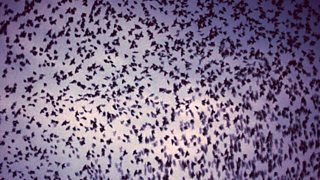
In early 2014, I saw an amazing murmuration at WWT Slimbridge, the sister site of WWT Caerlaverock that is hosting BBC Autumnwatch this year. The sight of 40,000 birds forming huge moving patterns across the sky was amazing. My first thought was to reach for my camera. My second was to wonder if we could use citizen science and harness the power of wildlife enthusiasts to unravel some of the mysteries of murmurations.
Throughout the 2014/15 murmuration season, the University of Gloucestershire and the Royal Society of Biology teamed up to try to answer some of the many questions surrounding the mystery of starling murmurations. Over 1,600 sightings revealed some interesting results about location and duration of murmurations. We had records from all over the UK from the northern tip of Scotland to the southern tip of Cornwall. Many off-shore islands were presented too, including Orkney, Anglesey and the Isle of Wight. We also learnt that some murmuration events last well over an hour, which was much longer than we had anticipated.
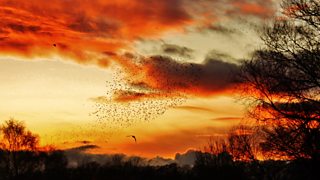
This autumn we are calling on the public to send in more specific information in order to discover more. We are again asking people to record where and when they see starling murmurations occurring as well as the number of birds involved and the duration of the display. This year, though, there is a particular focus on predation, with people being asked to record whether or not there was a predator such as a bird of prey in the area and, if so, what it was doing.
People can record their starling murmurations now via the Royal Society of Biology website:
The survey takes less than a minute to complete and we are especially keen to have multiple records from the same sites, as well as one-off sightings.
People can also share photographs and information using the hashtag #StarlingSurvey and dedicated Twitter account @Starling_Survey.
