Re-discovering the great fox-spider

Wildlife Trusts
Partner organisation of the Watches
By Mike Waite, Surrey Wildlife Trust
“It could still be out there…”
Little did I know in 2018 how one casually tossed gauntlet in reference to the great fox-spider would later lead to a welcome glimmer of light in the darkness come autumn 2020.
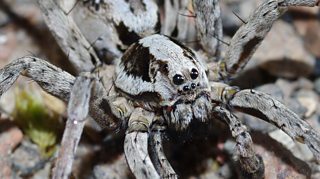
Great fox spider (male) by Mike Waite
The inspirational Jonty Denton, who has amassed the longest list of ‘ticked’ UK wildlife species, had just captured my interest in a spider not seen in Britain for more than 25 years. Back then, I’d just gleefully reported, to him as our vice-county spider recorder, seeing my first lynx spider on Blackheath in Surrey; a species which also belongs in a special, but unfortunate, cabal of rare invertebrates that are so reduced nationally that Surrey’s are now their only population remaining in the UK. The challenge to re-find probably the least-known of the lot, and with only the flimsiest hint of any likelihood of success, proved too much to resist.
However, after a long two years and many hours spent pacing carefully across the last and only Surrey site where the great fox had ever been recorded, now picture me pausing, alone except for my head-torch, backlit by dim moonlight and heathland shadows, very much at the point of giving up.
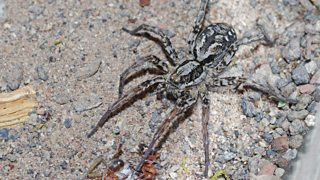
Great fox spider (female) by Mike Waite
The elusive arachnid
A largely nocturnal predator, the great fox-spider (or Alopecosa fabrilis to its arachnophile aficionados) is one of the largest of the Lycosids, or ‘wolf-spiders’. Surrey and just one other former site in Dorset represented the total ever-recorded UK range of the species. So yes, very rare indeed, not seen for more than a quarter of a century, critically endangered and assumed extinct, by most.
Wolf-spiders are some of the most charismatic arachnids, not sedentary web-spinners in the conventional sense, but nimble, active, chasers-down of their prey, which is bitten and paralysed with fast-acting venom prior to consumption. The name ‘fox-spider’ refers to four British species of the same genus and is a straight translation of their classical Greek tag Alopecos, meaning ‘of a fox’.
Chasing down this spider, I initially had to focus my search by using aerial photographs and using what I knew of its ecology and preferred habitat, which is sloping bare sand and stony ground, juxtaposed with scattered clumps of heather. The Surrey site is a Ministry of Defence training area, consisting for the most part of dry, lowland heath and is, moreover, very extensive. Interestingly, the landscape in the location of the previous recorded sighting had subtly changed, becoming much overgrown with mature heather, with far less bare ground. So, now I had to look elsewhere on this vast site – a needle in the proverbial haystack, or what?
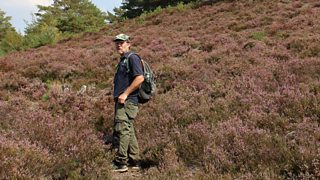
Mike Waite from Surrey Wildlife Trust out on the heath by Richard Bullock
A golden moment
Hunting for one species invariably means paying close attention to many others. I certainly familiarised myself with myriad invertebrates this fantastic piece of heathland supports and finally collected a small wolf-spider that was way too small for the great fox, yet it bore enough features to suggest it could actually be an immature specimen. It promptly escaped during my excited mishandling, but here, in this fleeting encounter, was the strongest clue to date.
The next night was ‘the big one’. I returned, my heart in my mouth, to the same spot and there, fully adult great fox-spiders at last! When my head-torch spot-lit that first stunning 55mm female, her eyes glimmering, and sitting, resplendent, beside a large, pale stone, I was absolutely elated!
Several mature males followed, then a few more still sub-adult immatures, that assured me my initial hunch had been correct. From this, plus several following nights’ incredible tally, can I dare to hope that we have quite a strong population on this site? Any more accurate estimation will rely upon more applied methodology, which I hope to employ next year through further fieldwork and research.
The site is safe, being actively managed for its rare wildlife by the Amphibian & Reptile Conservation Trust, where we know that many species benefit indirectly from a symbiotic relationship with its military use, where heavy vehicular movements help to maintain the bare openness and sandy landscape within the site.
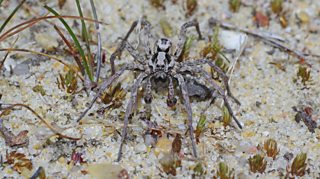
Great fox-spider (male) by Mike Waite
A legacy for Lycosids?
On that memorable night, I immediately texted friends who have shared a running interest in my endeavours to say “WE HAVE IT – THE GF-S STILL EXISTS..!!” I knew there and then that the rediscovery of such an impressive and photogenic creature and a national ‘priority species’ for conservation, would be a welcome story; running contrary to the extinction crisis we are sadly far more accustomed to.
In what is my 60th year, it is reassuring to reflect that this small story of hope for our wildlife might just inspire a child to take an interest in arachnids, or prompt someone to join their local Wildlife Trust and get involved with an ecology group. That thought makes those many hours of searching all the more worthwhile and so I am doubly glad that, on that one evening, captured briefly by a moment of doubt, I chose not to give up on the search for spiders.

Mike Waite, re-discoverer of the great fox-spider in 2020
