A Wonderful Set of Primaries

Guest blogger
Your response to the BBC Springwatch ring-necked parakeet feature.
WOAH! I have never received so much post! I think secretly, quite a few people in my department are a little bit jealous too. Prior to my appearance on BBC Springwatch this year, I’d worked hard to promote my studies. When I began my PhD researching evolution and genetics in ring-necked parakeets, I was faced with the problem of collecting enough samples. How on earth was I going to obtain lots of samples from ring-necked parakeets around the UK?
In steps my helpful boyfriend…’have you tried reaching out to people through twitter?’
‘Don’t be daft’ … I say dismissively, ‘twitter is pointless’!
Oh how wrong I was. Despite my protests, Ben (the helpful boyfriend) persisted in showing me how twitter works, and how I might be able to contact people around the country. I somewhat reluctantly set up a twitter account and began sending out tweets asking for help gathering shed feathers from gardens and parks. Surprise! I had a great response, and received lots of lovely green ring-necked parakeet feathers from around the UK. Oh the irony of twitter being such an important networking tool to collect bird samples.
Now, fast forward to my BBC Springwatch appearance and the wonderful footage shown on ring-necked parakeets (we all remember the hilarious head-banging footage). These short films led to a huge interest from YOU! Emails and tweets galore came flooding in. Since then I have received over 200 letters containing feathers from all around the UK. This is an example of my desk on just two mornings…

Parakeet Post 1

Parakeet Post 2
Not only are these feather samples vitally important to my studies, but also the information I’ve received from you over the past few months is proving extremely helpful in constructing a clearer picture of how these birds became established in the UK. I have received some wonderful accounts of observations, escapees and even releases into the wild over the past 40-50 years. One such account explains how a garden designer released two ring-necked parakeets into his garden to improve the aesthetics of the trees. Another told of how a wild parakeet persisted in pealing away wires of an outdoor aviary until one morning all the captive parakeets had escaped. In addition to such interesting information, I’ve been sent some fantastic photos of ring-necked parakeets visiting bird feeders, or in gardens and parks.
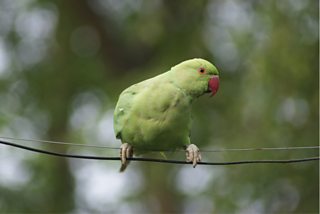
Parakeet by Dave French in Warfield
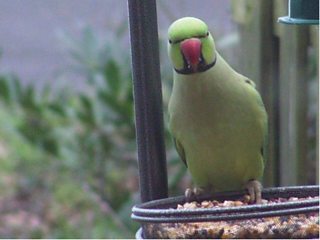
Parakeet by Lynda Stewart in Windsor
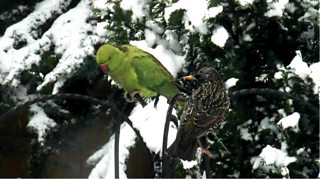
Parakeet by Lianne Sleeman
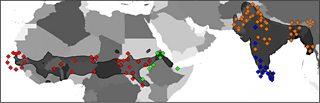
Using the feathers you’ve sent in, I’ve so far been able to ascertain the ancestral origins of ring-necked parakeets across the UK. This is an important first step in understanding evolutionary and environmental factors that are responsible for the successful establishment of ring-necked parakeets outside of their native ranges. These parakeets have a huge native range spanning Sub-Saharan Africa and Southern Asia, and comprise four subspecies.
Parakeet map
Dark shaded area is the large native range for ring-necked parakeets. The different colour points represent samples of each of the four subspecies I included in my study from the Natural History Museum at Tring.
To ascertain the ancestral origins of our ring-necked parakeets I also extracted DNA from 98 museum specimens from the Natural History Museum in Tring, which represented their whole native range, and each of the four subspecies. I then extracted DNA from the feathers you sent me, largely from a blood spot found in the base of the feather.
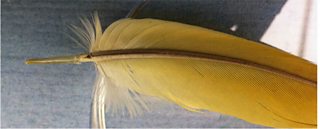
Parakeet Feather Blood Spot
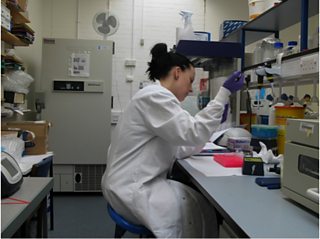
Hazel Jackson working in the lab
Whilst I expected to find representatives from all four subspecies, across all the native ranges within our UK population, it appears our current population largely originates from northern areas of India, predominately comprising a single subspecies, Psittacula krameri borealis. Whilst this was perhaps surprising, records of wild bird trade and climatic conditions in the native range support my findings. Before the wild bird trade was banned in 2007, huge numbers of ring-necked parakeets were imported from India and Africa, however, the majority of these imports were received from India (75%). Additionally parakeets from northern Indian native ranges have a much higher tolerance for a colder climate such as in the UK.
Whilst my PhD is nearly over (I’m in the last final months of writing), my research continues and I have many plans. One of the best pieces of advice I was given with regards to my PhD was, ‘you never finish your PhD, you just stop doing it’. This is absolutely true. I will stop doing my PhD but I will continue to study these fascinating, charismatic birds. There is so much to learn about their genetics and ecology. Why are they so successful at inhabiting new environments all around the world? What lessons can we learn from these birds to apply to conservation of other endangered species of parrot?
It seems clear that from the huge response I’ve had from the BBC Springwatch feature that you are all interested in learning about these exotic and charming birds too. If you enjoy this blog, I’ll indeed do more. I’ll soon have lots more exciting results to share with you all!
Thanks for your help so far, and please get in touch. I love to hear from you.
Hazel Jackson

Hazel Jackson
That parakeet lady off Springwatch
email: hj61@kent.ac.uk
twitter: @WildParakeetsUK
website: www.wildparakeetsuk.co.uk
