Wildflowers: important to pollinators, important to people

British Ecological Society
By Professor Jane Memmott, President of the British Ecological Society. University of Bristol.
Most of us know wildflowers are important to pollinators as they provide pollen and nectar. But what’s perhaps overlooked is their importance to us and our wellbeing. Prevalent in many aspects of our lives, they’re written about by poets, drawn by artists and the basis of businesses ranging from sustainable harvesting of Protea flowers in South Africa to nurseries selling native plants to ecologically-minded gardeners in the UK.
Why flowers are important to people
When people think back to the 2012 Olympics, they often think of the jaw-droppingly beautiful flower meadows that were grown across the site. Flowers make people happy, particularly the brightly coloured large-scale floral displays such as the Olympic ones, or the one at the University of Bristol shown below.
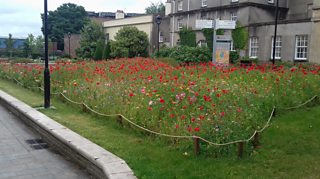
A joint University of Bristol/Avon Wildlife Trust flower meadow – this one is a mixture of native and garden flowers and photographed just as the native poppies came into flower (photo by Jane Memmott).
Personally, I love plants, my garden is the place where I am at my happiest and when stuck in traffic jams I automatically start identifying roadside flowers. I’ve also recently learnt that plants can help in some of the challenging situations that life throws at you.
Last week one of my daughters injured herself and it was a long wait at A&E. As she is 18, we weren’t allowed to wait with her, and all the usual coffee shops were shut too – both a consequence of Covid-19. So, we waited outside the Bristol Royal Infirmary on a shady scrap of green grass between the hospital and a main road and kept in touch by text. After 3 hours of waiting and many texts, all forms of distraction were exhausted, so I decided to identify the plant species growing in the 10m x 4m patch of grassy vegetation.
An hour later and I’d identified 37 species and just as the text came through saying she was free to go a field pansy was spotted which was a bit of a surprise. This tiny yellow native pansy seemed like a small omen of joy at the end of what had been a very trying day.
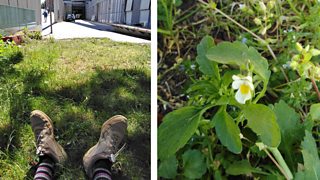
The weedy wonderland outside the Bristol BRI (10m x 4m in size) where we sat for three hours, the field pansy spotted amongst the 37 plants growing in this site (photos by Jane Memmott)
Growing wildflowers
If you have a garden, make space for native wildflowers. Many are easy to grow, and some can compete as equals with much more exotic plants. Right now, vipers bugloss, cornflower, bloody cranesbill, chicory and foxglove are looking spectacular in my garden.
Wildflowers will grow in some really unpromising places too. We have a patch of verge 10m by 2m right next to a busy road which gets very dry very quickly. Rather than mow it to keep it tidy, we have planted native columbines, cowslips, vipers bugloss and birds foot trefoil. Ox eye daisies arrived under their own steam and there are plenty of dandelions, hawkbits, daisies and other natives too. It’s now a mecca for bumblebees and food for the soul when walking along the adjacent pavement.
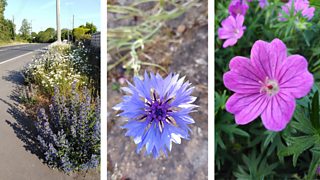
Vipers bugloss and Ox Eye daisy in flower on our roadside wildflower meadow, cornflower which self-sows between the bricks outside our back door and bloody cranesbill which is happy in a dry border (photos by Jane Memmott).
If you don’t have an outdoor space, volunteer with a local wildlife group. Just outside of Bristol, The St George’s Flower Bank Volunteers have adopted a roadside verge and for the last 20 years have managed it for wildflowers. Thousands of cars drive past every day and the drivers are treated to a floral extravaganza that starts in early spring with carpets of primroses and orchids and lasts until the autumn with a sward of nectar-rich scabious.
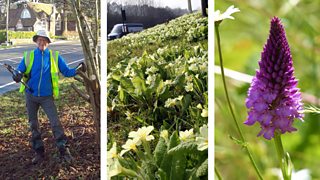
St George’s Flower Banks just outside Bristol as you approach JN 19 on the M5 on the A369. Bob Buck who leads the Flower Bank volunteers, primroses and a pyramidal orchid from the site (photos by Colin Jackson, Liz Milner and Giles Morris respectively).
So find a chair and make a cup of tea - or a G&T, glass of wine, cold beer, depending on the mood - and sit yourself next to some wildflowers. Watch them waving gently in the breeze, listen to the sound of bees buzzing and just enjoy their presence. They are not cancelled, shut due to covid-19 or closed until further notice – they are most definitely still there and right now they are the best show in town.
For more information on what the British Ecological Society can offer you, please visit our membership page.
Check out the Spring issue of our membership magazine, The Niche which is currently free to read!
