The blonde hedgehogs of Alderney
Claire Thorpe
People and Wildlife Officer, Alderney Wildlife Trust
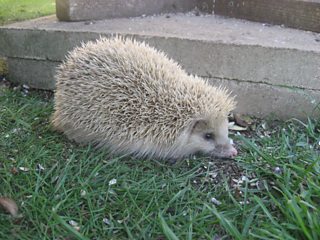
The hedgehogs found in Alderney (the third smallest and most northerly of the Channel Islands) are thought to originate from only a handful of pairs, not being native to the island originally. The hedgehogs were brought to the island as pets in the 60s which subsequently either escaped or were released into the wild. Because the population comes from just these few individuals they have become quite inbred and their genetic diversity is very low, leading to an unusual feature – blonde spines!
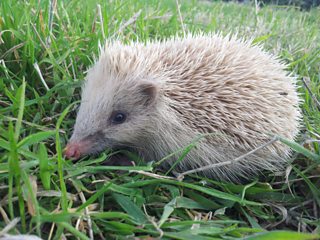
Of the original hedgehogs at least two must have carried the genetic variation for blonde spines, as this recessive characteristic only shows if both parents are carriers. Typically it is a very rare trait but here on Alderney we estimate that 60% of our 400-600 hedgehogs are blonde. The blonde (or leucistic) hedgehogs are not albinos, hence the dark eyes, with the different colour being more similar to the variety of hair colours seen in people so meaning all the hedgehogs on Alderney continue to interbreed. You may also notice the blondes have a pink nose where you would usually see a black one.
We are also lucky here on Alderney as hedgehogs remain a common sight in gardens, verges and even wandering town. The UK has seen hedgehogs decline by over a third in the past ten years but we believe here on Alderney the population is stable. As the reasons behind hedgehog decline in the UK are still unclear it is hard to explain this difference but the small size of the island reduces the number of potential threats and many residents leave food and water out all year, presumably lowering mortality during hibernation.
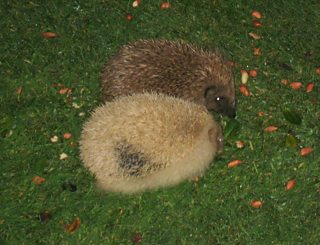
Being slightly further south than the UK we have seen our hedgehogs active throughout the winter if it is mild, with a much reduced hibernation period. Hedgehogs begin breeding in early April here, with litters of up to seven hoglets being born from May onwards. Once weened, at around a month old, the hoglets will become independent and we sometimes see mothers successfully raising a second litter in the same year.
The Alderney Wildlife Trust runs weekly bat and hedgehog walks and they have proven popular with both locals and tourists wanting to know more about our creatures of the night and the rare situation of being able to almost guarantee a sighting. If you would like to help hedgehogs in your garden we would suggest putting out non-fish flavoured cat or dog food and making sure your garden is planted in an insect friendly way, without the use of chemical insecticides or slug pellets. Making sure you avoid using strimmers, or checking where you will use one first can also help conserve hedgehogs as they sleep in the space under hedges and shrubs. You can find out more about the wildlife of Alderney and our hedgehogs by visiting the Trust’s website.
The BBC is not responsible for the content of external websites.