It’s not the size that matters

David Sexton
Dave Sexton is the Mull officer for RSPB Scotland
RSPB Scotland Mull Officer, David Sexton talks about how his focus has shifted from the UK's largest bird of prey to the UK's second smallest garden bird during lockdown.
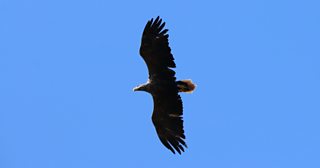
Photo: Cian Burke-Brown/ RSPB
Lockdown has forced us to do some unlikely things this spring. For me, the biggest wrench (apart from not seeing family of course) has been not being out and about around Mull monitoring our breeding white-tailed eagles. The RSPB, along with other wildlife NGO’s and the UK’s Government nature conservation bodies, suspended all fieldwork as a result of the coronavirus crisis in March. My daily spring routine, basically my reason for getting up in the morning, shuddered to an abrupt halt like a train hitting the buffers. It was unnerving and disconcerting. Suddenly, along with everyone else, I was in completely unfamiliar territory.
Occasionally, a high-flying sea eagle would drift over my garden and away into the hills, as if to tease me. They were getting on perfectly fine without me but was I getting on okay without them?
From one extreme to another
One fine spring day in April I was in the garden scanning the distant ridges for that unmistakably massive silhouette of a sea eagle. They soar on broad, flat, plank-like wings with barely a flap. Today, there was no sign. I felt a bit deflated to be honest. Just one of those unfathomable days when you know how lucky you really are to be isolating on this magical island and yet find it hard to feel remotely positive. As I lowered the binoculars, I became aware of a wren flitting about the stump of an old holly tree which had long since gone. The fresh, green prickly holly leaves had massively re-sprouted at the base and had formed a modest yet impenetrable fortress. The wren liked what he saw and for the rest of the day he went back and forth gathering lichen from the rowan tree and vanishing into the dark, spiky world. I sat, transfixed; sea eagles long gone from my mind.
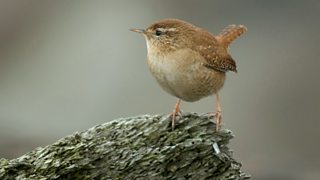
Photo: John Bridge/ RSPB
The new bird in town
I’d gone from studying one of the biggest birds in the world with a wingspan of 2.5 metres to one of the smallest with a wingspan of 13 centimetres! The next day and for several more after that, the male wren worked tirelessly to impress his ‘take it or leave it’ female. She might make him build several before deciding to pick one she liked and only then helping him to line it. As the holly was so dense, I could never really see what was going on in there but clearly something was. I had to guess at the timing of when the 5-8 glossy, white eggs might be laid. From my daily observations, I could tell that the comings and goings were now few and far between and that the 16 days of incubation was underway.
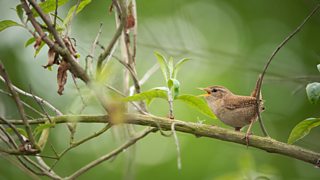
Photo: Ben Andrew/ RSPB
Short and sweet
Every now and then, we would be treated to an explosive outburst of song from Britain’s second smallest bird. They may not be the smallest (the goldcrest holds that title in the UK) but they are apparently the ‘shortest bird in the Western Palearctic’! The male would sit boldly on a fence post and let rip. From being shy and skulking one moment to bold as brass the next was an unusual tactic and I feared for the safety of the nest in case he gave the game away. After all, it was only half a metre off the ground and well within reach of a cat. But the holly leaves were to be their saviour.
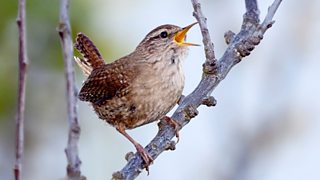
Photo: Paul Chesterfield/ RSPB
A brave new world
As I write, the comings and goings are at fever pitch again with food going in and faecal sacs coming out. We have a hatch! I’d love to know how many chicks are squished into that mossy, hairy dome-shaped nest but I’ll have to wait for that. Fledging should be just days away. But with lockdown gently easing in Scotland, I’ve been told my sea eagle fieldwork can resume. I just can’t bear to tear myself away. For now, the eagles can wait their turn. The wrens have given me stability, a focus and a distraction when all around seemed chaotic. For that I’m grateful and will never forget my brave little family of holly bush wrens in the spring of 2020.
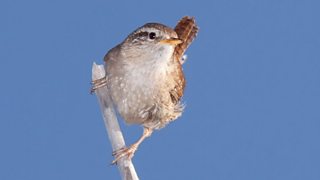
Photo: Paul Chesterfield/ RSPB
