Giving godwits a headstart…
Black-tailed godwit eggs were collected from the Nene Washes back in April and May, under a special license granted by Natural England. We now have 28 black-tailed godwit chicks at the rearing facility at WWT Welney. This is a fantastic result for the aviculture team, who have been busy working around the clock to care for the chicks. The first few weeks of life can be tough for a young wader, so we’re giving the birds a helping hand during this crucial period. We hope that headstarting will allow us to boost the number of juveniles that fledge and therefore fast-track population growth at the Ouse Washes, where flood-free, wet grassland habitat has been created with godwits in mind.

These very special chicks have spent the first week of their lives inside their early-stage rearing facility. They were then given a taste of life outside when they were moved to their mid-stage rearing enclosure at around nine days old. This aviary has been constructed within the wet grassland habitat at the release site, giving the chicks access to the sights and sounds of the fens as they grow. The chicks are already well able to feed themselves and have been observed feeding on wild invertebrates (worms are a particular favourite) just as they would do in the wild.
Meanwhile, back at the Nene Washes, many of the black-tailed godwit pairs from which eggs were collected have laid replacement nests, giving the birds the chance to raise their own broods in the wild. It’s been a difficult year for the breeding population at the Nene Washes, but we remain hopeful that some black-tailed godwit chicks will successfully fledge there.
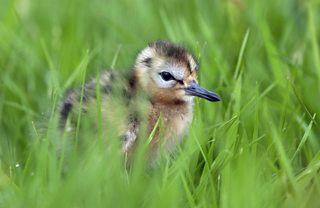
The headstarted godwit chicks are growing up fast. Last week the chicks were all given a health check, prior to being moved to the pre-release aviary. This aviary will be their final training ground, where they have space to start flexing those all important flight muscles. All being well, they will be released when they are able to fly, at around 30 days old. The hope is that the birds will then join post-breeding flocks of wild of black-tailed godwits, before starting their southerly migration towards the wintering grounds in Spain, Portugal and West Africa. In two years time, the hope is that the released birds will return to the Ouse Washes to breed, boosting this fragile population, where we have been working to create safe, flood free habitat for them.
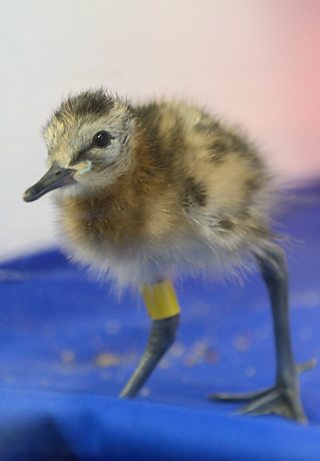
The chicks have their own colour rings so that they can be followed after release
Project Godwit staff have fitted the headstarted chicks with their own colour rings so that they can be followed after their release. Each bird has received a unique colour ring combination. This year’s headstarted chicks have received a green colour ring above the knee on the right leg, situated above another lime colour ring with the black letter “E” stamped on the ring. Two additional colour rings on the left leg, above the knee, complete the combination. If you see a colour ringed black-tailed godwit, you can report it to us on our sightings page here projectgodwit.org.uk/get-involved/report-a-sighting/
Project Godwit is a partnership between RSPB and WWT with major funding from the EU LIFE Nature Programme, The HSBC 150th Anniversary Fund, Natural England and the Heritage Lottery Fund. You can follow the godwits' progress at projectgodwit.org.uk, @projectgodwit and facebook.com/projectgodwit
The BBC is not responsible for the content of external sites.
