Bird ringing with the BTO

Guest blogger
Lee Barber works for the British Trust for Ornithology, which collects citizen science data on bird populations in the UK.
Barnacle goose
The barnacle goose was once thought to start life as goose barnacles growing on driftwood at sea, perhaps because no one had ever seen its nest (unsurprisingly, since they mostly breed in the Arctic).
As well as the 91,000 barnacle geese regularly wintering in the UK, escapees from wildfowl collections have since led to a feral breeding population of around 3,000 birds.
Around 100-200 barnacle geese are ringed in the UK and Ireland annually with a unique metal ring. These rings help us track how long they live, which breeding population they are from (Greenland, Svalbard or UK) and where they go. Due to the thickness of their legs, there are only a few species in the UK that use same ring size as barnacle geese, these are bittern, capercallie (female only), Egyptian goose and grey heron.
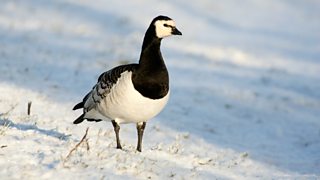
Photo by Edmund Fellowes, British Trust for Ornithology
Whooper swan
Every winter, whooper and bewick’s Swans arrive in the UK in their thousands. But while the number of bewick’s swans has decreased dramatically since the 1990’s, whooper swans have been very successful with numbers increasing since the 1980’s.
The oldest known whooper swan was originally ringed as an adult at Caerlaverock in 1968 and was then seen alive in Iceland 20 years, 3 months and 7 days later. As they breed in Iceland and are quite faithful to their wintering sites, this bird must have travelled at least 24,800km in those 20 years, which is half way around the world on its migration! During migration whooper swans have been recorded at altitudes of up to 8,200 m where the ambient temperature is -40°C. Not only that, these birds probably take the longest sea crossing of any species of swan, from Iceland to the UK.
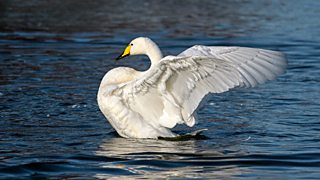
Photo by Jill Pakenham, British Trust for Ornithology
