A journey towards viable and trusted public interest media in Sierra Leone
Sierra Leone has unveiled a National Action Plan to create more viable public interest media – our country director examines their journey so far, and what must happen to succeed.

Sierra Leone’s media landscape has grown significantly since the end of the civil war in 2002. By 2021, there were over 500 registered media outlets, including newspapers and magazines, radio, television and direct to home services, according to the country’s media regulator, the Independent Media Commission (IMC).
This growth has been seen as a positive step toward media pluralism. But that is without taking into account the economic viability, independence, and subsequent ability to produce trusted public interest content. In fact, over half of Sierra Leone’s registered media outlets are either not operational at all, or are frequently off-air or out of circulation.
In such an environment, they cannot fulfil the critical role of media in the public interest – sharing trusted information, providing space for dialogue and debate, and holding leaders to account.
Economic implications for media
These deep-seated challenges of the media reflect the economy of Sierra Leone more broadly. Sierra Leone has low gross domestic product (GDP), a growing, but largely unproductive public sector dominated by patron-client politics, and is driven largely by subsistence informal economy. These socio-economic and political features also have implications for media’s operations.
However, even with these challenges, Sierra Leone’s media sector has seen tremendous legal reforms, following decades of advocacy by civil society, media organisations and donors. Particularly problematic was a draconian, colonial-era seditious libel law that criminalised the media profession. In 2020 and 2021, Sierra Leone’s Parliament repealed the criminal libel laws contained in Part 5 of the Public Order Act of 1965, and enacted a new IMC Act and Cyber Security and Crimes Act.
Support for reform
BBC Media Action has supported reforms to media laws and policies through its Protecting Independent Media for Effective Development (PRIMED) media support consortium. With PRIMED support, the IMC has revised the code of practice for journalists and complaint mechanisms; the central government also provides annual subsidies to the Sierra Leone Association of Journalists, in the amount of 500 million Leone (about £32,000). All these initiatives were critical to unshackle the media, provide an environment for investment, and create a basis for the production and dissemination of freely available public interest content.
Media that work in the public interest are essential to advancing democracy, prosperity, and stability. But these legislative and policy reforms alone are not enough to guarantee and sustain press freedom, and independent, pluralistic and trusted public interest content. A viable media must be able to balance income and expenditure to sustain free and fair journalism. As long as advertising markets dwindle, and without policies to guide government adverting, media houses were undoubtedly going to fall on the trappings of corruption, nepotism, and state capture.
Wooing investors
In recognition of these challenges – and undoubtedly also for political considerations - the President of Sierra Leone, on the occasion of the signing of a revised public order act, committed to organising a national media investment conference to woo investors into the media. To deliver on this political commitment, the Minister of Information and Communication gathered a committee of stakeholders from the media, government, private sector, and civil society to organise a national media investment conference. But one full year after the formation of this committee, no significant progress had been made - until BBC Media Action was invited to contribute technical and logistical support.
The idea of the media investment conference sat well with PRIMED’s objective to promote a viable media ecosystem, supporting the free flow of trusted public interest content. But we also sensed over-optimism on the part of the government, that merely bringing together private sector actors would result in large investment in the media sector. We knew this was impossible, given the economy of Sierra Leone and the changing nature of media globally.
A wider conversation
But we were motivated by the conviction provided by the concept of a media investment conference, and the entry point it would provide for a wider conversation on media viability and investment. We recruited two consultants – one international and one Sierra Leonean – to design a national consultation that would lead to a binding constraints analysis, and a business case for media investment in Sierra Leone. We also commissioned six papers [LINK] to inform the process - including a political economy analysis of the media in Sierra Leone, the potential for investment, and examinations of advertising policies, models of public subsidies and global funding mechanisms for public interest media.
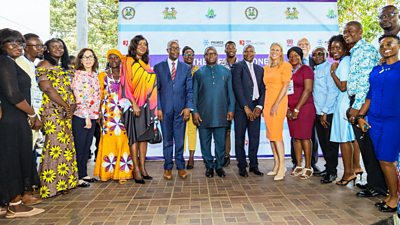
Formally opened by the president of Sierra Leone, HE Brigadier-General Julius Maada Bio, the National Media Viability and Investment Conference brought together 300 media industry stakeholders, the private sector, government and civil society leaders in a two-day gathering – both in-person and online, to discuss challenges limiting investment in the media, pathways for sustainable media funding, and options for improved financial viability that were both appropriate and context specific. The session culminated in a set of broad principles as recommendations for a National Action Plan for media viability in Sierra Leone, anchored around seven thematic areas:
- The Government of Sierra Leone should continue to show the political will necessary to drive media market reforms
- A review of the existing media legal and regulatory framework
- The media should commit to re-engineering the industry in order to boost the potential for attracting private-sector investment and public subsidies
- The Government should take affirmative action to promote community media and the public service broadcaster, the Sierra Leona Broadcasting Corporation (SLBC)
- The introduction of a national policy on advertising
- Government and development partners should commit to a national fund for public interest media
- Stakeholders should seek to address the existing gender imbalance in the media industry
Broad national acceptance
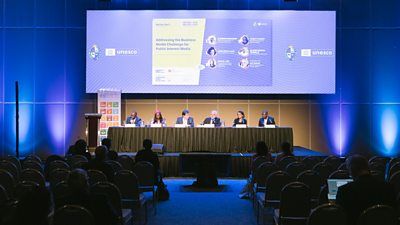
The National Action Plan, still to be further developed with detailed activities and timelines, has broad national appeal and acceptance, and was unveiled by Mohamed Rahman Swaray, the minister of information and communications, at the UNESCO World Press Freedom Day Global Conference in Puta Del Este, Uruguay.
The next step is to present the plan to Sierra Leone’s Cabinet for review and approval – and it is after this stage that the real work of translating the plan into action will commence.
On the global stage in Uruguay, Sierra Leone’s progress was presented as a gold standard in the implementation of the Windhoek+30 commitment. This progress is also evident in Sierra Leone’s ranking in the 2022 World Press Freedom Index report published by Reporters Without Borders: now 46th out of 180 countries, jumping 29 places up from 75th position in 2021.
Time to consolidate gains
But it is critical now that the gains made in Sierra Leone are consolidated and strengthened. Evidence tells us that press freedom without an economically secure public interest media is not enough: media will remain subject to corruption, or find themselves incapable of holding the powerful to account. The economic crisis for public interest journalism has been made even starker by dwindling advertising income for traditional media and the financial impact of COVID-19.
Sierra Leone’s national media viability action plan, when supported and fully implemented, will strengthen the gains made in media’s legal landscape, and re-engineer the industry to boost its potential to attract private sector investment. It will support the establishment of advertising policies that are fair for all, and establish and roll out a national fund for public interest media with government and donor funding.
The plan will also provide a platform for collaboration among stakeholders - including government, media practitioners, the private sector, civil society and donors – to work together to support and guarantee the independence and viability of the media, so that they can provide freely available and trusted public interest content that is critical to democratic and national development.
The plan is a road map – but it requires piloting and support, especially at in this inception stage.

Protecting Independent Media for Effective Development is a media support consortium led by BBC Media Action working in Sierra Leone, Ethiopia and Bangladesh.
More information on the Sierra Leone National Media Viability and Investment Conference, and the research studies commissioned as part of the National Action Plan, can be found on our website.
PRIMED is funded by the UK Foreign, Commonwealth and Development Office.
Latest Sierra Leone stories
More stories from Sierra LeoneSearch by Tag:
- Tagged with InsightInsight
- Tagged with Sierra LeoneSierra Leone
- Tagged with World Press Freedom DayWorld Press Freedom Day
- Tagged with Media developmentMedia development
- Tagged with Independent mediaIndependent media
