A Technology Capability Framework for broadcasters

Andy Leigh, Nick Hopewell
Andy Leigh, Head of Architecture for Broadcasting and Nick Hopewell, Lead Architect for Broadcasting Architecture, are part of BBC Design + Engineering’s Technology Strategy and Architecture team.
The UK’s public service broadcasters are facing greater challenges than at any time since the 1970s from US tech companies dominating global media. As BBC Director General Tony Hall recently stated, we are at a time of “breath-taking, seismic change”. Due to big market interventions from conglomerates such as Disney and Comcast, the media world is consolidating at a speed not seen before, and the BBC needs to change radically to meet this challenge.
In order to help the BBC keep pace with the new global players, we set about creating a Technology Capability Framework to support a common vocabulary between the BBC’s Design and Engineering division and the rest of the BBC, providing a mechanism to assess the current, required, strength and performance of capabilities as a part of our strategic planning.
Defining the BBC’s business imperatives and capabilities
This piece of work came about as a result of the Technology Strategy and Architecture team conducting a strategic analysis. Many organisations have now developed generic capability models that describe the capabilities that a business uses to fulfil its objectives and reach their maturity. We wanted to use a capability model that was relevant to the BBC and, so we started to think about the BBC’s capabilities. We interviewed over 60 stakeholders around the BBC, from COOs to Directors of Technology and Finance, about what the BBC does and what technologies were currently being used to support those business areas.
Out of this work, we developed the BBC’s technology capability framework. The framework diagram below identifies the top level of the technology architecture, capturing the core building blocks that can be used to describe the enterprise’s technology capability domains. In fact, to go one stage further, if you were building the BBC from scratch, or indeed any other broadcast media organisation, we believe this model would not change significantly.
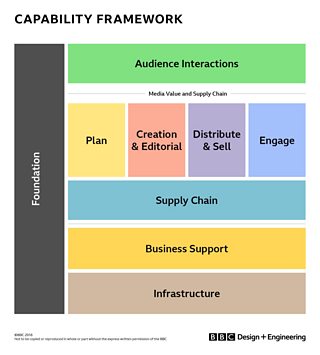
The four middle blocks represent what the BBC does day in, day out – it plans content, it creates or buys that content, it distributes or sells it (in the case of commercial subsidiaries) and finally, audiences engage with our content and we measure their engagement to find out what people like; this information then feeds back in to the planning and so the process begins again.
The content that we make or buy is part of an increasingly important supply chain – this is what allows us to deliver the content our audiences want to consume in this increasingly on-demand world. To run the BBC we need support from areas such as Finance, HR, Technology and Facilities. We need to have the right infrastructure in place, from all the physical hardware and those that we consume as services. As part of the strategic analysis we identified a set of foundations which we believe will need to become embedded in everything new that we build as part of envisaging a new BBC.
This capability framework will provide a tool for assisting the organisation to make a wide range of technology investment decisions and change initiatives to achieve its future goals.
Connecting the technology capabilities to the business priorities
The idea of a technology capability framework is not new. In fact, increasingly it is becoming an accepted way of providing a common language between business operations and technology that ensures that business priorities trigger key technology decisions. For instance, offering a more personalised audience experience across all our products and services is a core strategic priority for the BBC. By using the capability framework, we can more easily identify where we need to invest in new technology capabilities to provide a content centric view to support this business imperative.
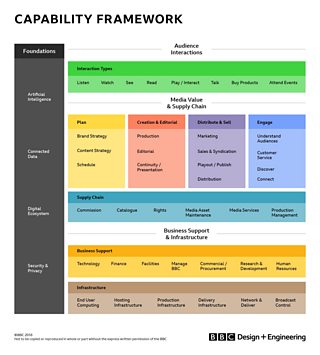
We can also use it to identify opportunities for transformation, discover areas where there is duplication and determine where organisational change needs to happen. For instance, as the BBC seeks to reinvent itself for an online-first audience, we are using this framework to establish where technology capabilities need to be transformed to deliver new, flexible solutions to support our strategic goals.
So we have shown how capability modelling can provide a simple, stable view of the business, while creating a common language among decision makers; and, by and large, the business capabilities won’t change significantly over the next two to three years. It is how things get done which really changes.
When we started the strategic analysis 16 months ago, we identified a set of foundations which we believe will need to become imbedded in everything new that we build as part of envisaging a new BBC. We didn’t have in our original model the capabilities for Connected Data and Artificial Intelligence and digital ecosystem, as we had not yet identified the importance of these specific capabilities to the organisation’s future. By adding these two capabilities as part of the bedrock of what the BBC does, we have been able to identify the need to invest in these technology capabilities. We have already started to establish these new capabilities; for example, in the area of connected data and the establishment of data science and machine learning with the creation of new roles for a head of data architecture within the technology strategy and architecture teams.
Of course, other new things will turn up from time to time. 15 years ago, the personalisation capability would have been very different to what BBC Sign In has delivered today. Now, in an internet focused world, it’s the biggest thing that’s changed. The ability to personalise content to engage audiences is now one of the most strategically important goals of media organisations. To enable the BBC to offer people the opportunity to discover its products and services in new ways, the organisation needs to develop entirely new ways of working, transforming existing capabilities and establishing the maturity of newly introduced capabilities.
A media framework fit for digital transformation
We hope this framework will be useful for other similar organisations and our partners. We are already using it within Design + Engineering to help assess the current state of our technology capabilities, and define what we need to build and improve to fulfil our objective to drive the digital transformation of the BBC.
It is important to remember that capability modelling is a technique for representing an organisation's set of activities, independent of its organisational structure. You’re not going to find the individual BBC Divisions listed in this model, which is how it should be.
However, this framework is an endless work in progress. Is there a better way of describing what we do? We would like to open up the debate and get people talking about what are the significant capabilities that a modern media organisation needs to be successful. By sharing this capability model more widely, we hope to get your feedback and suggestions for improvements.
