Mobile: Apps & Beyond – a conference without limits?

Shahnaz Hameed
Junior Software Engineer, Media Services
Tagged with:
On 5th February 2020, the BBC’s mobile community came together for the first time to discuss the opportunities and challenges they face, share experiences and learn from others working in the mobile space.
Breaking down silos and building a wider mobile community - that was the key message of the introductory address made by Will Wychgram, Senior Architect for Technology Strategy & Architecture (TS&A) who worked tirelessly - alongside TS&A’s Alison Kelly and Diane Richard - to put together the first mobile community conference, with Google’s London Academy as our hosts for the day.
As members of the tech sector - software engineers, developers in test, business analysts, project managers and product owners - we all feel that none of us really have the opportunity to talk to anyone in the other teams with whose products we integrate; or that we can reach out to another team to find out how they might approach a problem that’s causing us some grief. That’s what the inaugural Mobile: Apps & Beyond conference was all about.
The day was full of talks, presentations and opportunities for networking – you can’t beat passing time chatting out in the cold, during a fire drill!
The first of our talks was a fireside chat with Matthew Postgate, BBC Chief Technology & Product Officer - hosted by BBC R&D’s Bill Thompson - who mused that ‘...mobile is still the most tangible expression of the information age…’, aligning with thoughts expressed in a lecture Postgate had heard at the Royal Academy of Engineering regarding information as a utility, in that it would be constantly available and accessible.
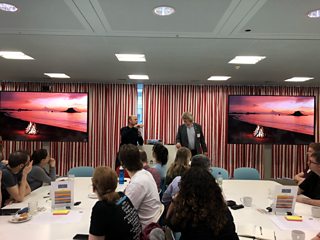
Matthew Postgate and Bill Thompson engage in a fireside chat
Thoughts then turned to 5G and Ambient Computing; Postgate cautioned that whilst 5G will lead to more device connectivity, there’s no telling how users will make use of that bandwidth and that the technology is still quite young. Ambient Computing opens up a number of possibilities and scenarios - it’s something the BBC is exploring with Voice and AI - where we’ll be relying on, perhaps something being said out loud, or triggered by a watch, with the response being displayed; or even an activity started on one device and continued on another.
After being evacuated for a fire drill – surely a coincidence that this followed Matthew’s fireside chat - Victor Riparbelli of Synthesia took to the stage. He has worked with the Blue Room to put together a concept of a personalised weather report utilising a computer generated weather reporter. Riparbelli touched upon other ways Synthesia uses AI to create content, such as generating streets and traffic, and having someone speak a number of languages, as showcased in David Beckham’s Malaria Must Die campaign.
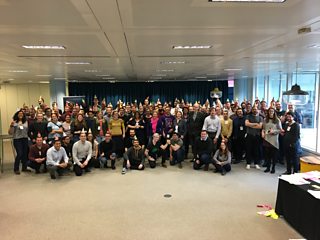
The mobile community in networking mode - including party hats
We then had a panel discussion with Neil Hall (Head of Sport Digital), Alex Watson (Head of Product, News), Matt Clark (Head of Architecture, Digital Products), Christine Bellamy (Head of Product, Home) and David Andrade (Head of Software Engineering, iPlayer & Sounds), chaired by Ahmed Razek (Blue Room). Topics of discussion covered:
- The 2020 Vision - The panel turned its thoughts towards ways to generate engagement with BBC content during this year’s Sporting events, and BBC Sounds. By creating a personalised recommended experience for users, with a larger focus on acquiring and retaining under 35s with Project Chrysalis.
- Retaining Under 35s - As this is a large age range to cover, there are different strategies being utilised, such as enhancing children’s experience of iPlayer, encouraging Sign In and celebrating the release of Nightfall; so far, experience shows that teens are harder to engage, but this challenge also presents many opportunities. Across the board though, the panel felt we need to be more granular, to aggregate content and have a better symbiosis and partnership with Editorial, so that we can get relevant content in front of our audiences.
- Staying Competitive - With the launch of Disney Plus and Amazon’s airing of sport, the panel reminded us to have confidence in our position - the BBC has a strong relationship with sports fans and we should be playing to our strengths. However, we shouldn’t rest on our laurels, as it’s good to be worried with the market getting so competitive - it keeps us on our toes and drives us to get more creative. Despite being our competitors, we should still look for opportunities to collaborate with these platforms professionally and create an “Education Space” for us to learn from each other, whilst maintaining our brand identity.
- The Level of Focus on Web vs Mobile - Whilst we get a lot of users interacting with the BBC via mobile, this is not solely through our apps, but also our web presence. We do need to encourage more development in the “App Space” because apps can interact with users in a way that the web doesn’t, such as through push notifications. The panel recognised that there is frustration with the slow pace of change, but assured us this is due to deep structural reasons.
Demos, Networking & Lightning Talks
During lunch, we were given a tour of the BBC Blue Room’s Digital Human demos and BBC R&D helped us discover the potential uses of 5G in content production, consumption and distribution.
After lunch we all participated in a fun networking activity which involved party hats, emoji stickers and some surprising revelations! To round off the day, there were a series of interesting lightning talks - one from Google showcasing some highlights with what to expect from Android Studio 4.0; and the rest from various BBC Mobile teams including News, Sport, iPlayer & Sounds, and Children’s.
Overall the day provided us with a great opportunity to meet, share ideas, collaborate and build new working relationships with other members of the mobile community – it was certainly long overdue and I hope it is just the start of many more such opportunities to come together as one community.
