AI for the good of society

Ali Shah
Emerging Technology and Strategic Direction

Ali Shah, Head of Emerging Technology and Strategic Direction, looks at how AI might be used to create more social mobility.
I come from an immigrant family – my parents migrated to the UK from Pakistan in the 1960’s. My father started working in an engineering factory in Sheffield, and my mother worked as a housewife. Over the years they found work came and went as the economic conditions in the UK changed, and as more automation was introduced into the workplace. This meant work wasn’t always as stable as they would have liked, however they were able to take advantage of the education and healthcare provided by the public service institutions in the UK, to allow my siblings and me to study to university level. They instilled a work ethic, and sense of social responsibility in their children that has helped all of us to achieve a modicum of success in our respective fields. If my parents became labelled working class when they moved to the UK, then I think it’s fair to say that their children have moved to a more middle-class position in life. This is down to all the hard work, and sacrifices my parents had to endure, and not without a great deal of luck.
Many readers will recognise that the social group you start of in life with, and the amount of luck you have, seems to determine many of your outcomes in life. The socio-economic reasons behind this are complex – a BBC survey of the United Kingdom conducted in 2011 (and related academic analysis by Savage et al. (2013) found that there are seven different distinct social groupings in the UK – spanning familiar ones such as working class and middle class, through to elites. The difference between groups came down to the levels of economic, social and cultural capital each group possessed – with the elites having high levels of each type of capital.
The analysis showed that of those belonging to the elite category, 52% came from a family where the parents were already in a professional job. That is, it is much more difficult for you to move to the elite category if your parents are not already there or nearly there themselves. It was startling to see that only 4% of ethnic minorities in the UK belong to the elite group. Other research in 2016 by the Social Mobility Commission in the UK showed that children from working class backgrounds are less likely to achieve well paid jobs because they don’t have access to the networks of influence needed to navigate modern society. To break through, and realise their potential they need luck, and lots of it!
Therefore, it seems the equation for modern life is
luck * (where you start + who you know)
Can that be considered fair in modern society? And what impact will AI have on this?
The Nobel prize winning philosopher and economist Amartya Sen wrote “the success of a society is to be evaluated primarily by the freedoms that members of that society enjoy”
A healthy society recognises the balance and interplay between economic, social and other forms of capital – such as cultural. The grand challenge is to rebalance society so that the interplay of these different forms of capital is prioritised equally, and to ensure that luck is not a factor - if we are to agree with Sen then it is also the freedom that each citizen has to choose how to balance the economic, social and cultural capital available to them to realise their own goals, that will define if we have developed society for good.
So how can the recent phenomenal developments in AI help towards realising this grand ambition?
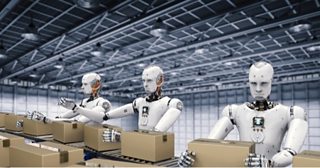
It won’t come to the surprise of the reader that so much of the recent news about AI has related to the projections about how many jobs will become automated. Estimates for the next 5-10 years range from 20-30% of jobs being taken by AI (often with a caveat that just as many new types of jobs will be created). This is the most common AI trope.
If the news isn’t about AI automating your job, then it’s usually about how AI has surpassed some human capacity at a task, and how it can be used to support you in your job or task. AI as helper is the second trope! Both of these tropes are welcome – the more jobs that can be automated, actually become automated, the better. And the more that each of us can benefit from an AI helper in our remaining jobs, the better. But we need to recognise that both of these tropes stem from one form of capital - namely economic capital.
The demands to become more productive, more efficient, to increase revenue, grow GDP, grow economic capital – for the state, corporation or citizen – are currently the catalyst for the developments in AI we are seeing. But as I said earlier, a healthy society isn’t one that only focuses on economic capital. It is the mix of different forms of capital, and the agency a citizen has to access them to achieve their goals, that defines a healthy society. And this is where the greatest power that AI has can be applied, but it’s one that we are not tapping into effectively.

The capacity of AI to act as a mirror to society, and to amplify our efforts and endeavours is AI’s greatest superpower. This power to reflect back and amplify can be used for benefit or harm, and perhaps even worse, squandered. The survey the BBC conducted in 2011 was the largest survey ever conducted of UK society – 161,400 people responded, and this allowed the researchers to not only build detailed profiles of each individual, but to then analyse and assess what unites us, and what divides us. Fast forward to today, and it is child’s play for retailers, banks, ISPs, media, and social media companies to develop profiles of citizens at the level of the BBC survey – in fact today it’s easier to go much further, and to develop an almost complete picture of society and citizens with the power of AI. And what is that data and power of AI used for? Well for the most part to show citizens ads, or suggest something else to watch, or something else to buy! Again, because the incentives are built around economic capital, it is quite understandable that the benefits derived from AI are aligned to economic gains.
What if this power of AI was used to reflect and amplify a more balanced society Would this allow us to build a new equation for life that focuses on how we might flourish as humanity?

If we can achieve this then the payoff is a society where arguments related to scarcity of resources, or to luck of the draw can be eliminated. But how might we enable this to happen?
It is at this point in the article that I am going to confess that there is no clear-cut roadmap or blueprint that we can follow to addressing these social issues with AI. But I will offer three short suggestions that all stem from my work in the BBC as a public service organisation, and what it means to be in the service of the public, and to think about the welfare of the citizen and society.
1. AI as helper – the focus has been on developing services by corporations that augment the worker. And in the consumer world, AI services that represent the company and extend its ability to help the consumer in some way. For example, smart, personal assistants are in my view extensions of the companies they emerged from, which while potentially very helpful, are none the less not very personal to me. As they are not completely loyal to me, it is not 100% certain that they will always have my interests at heart. What is needed is a shift to AI companion services that are loyal to the citizen, and can help the citizen gain more social, cultural and economic capital.
2. AI to amplify public service. Public service institutions have acted as the cornerstones of society – often providing essential services, or filling the gap that commercial enterprise doesn’t want to fill. These institutions are under pressure, with a lack of resources, increases in demand, and a multitude of other factors constraining their effectiveness and ability to support citizens. What is necessary is for public service institutions to amplify their efforts, and AI offers an avenue to achieve this. A public service knowledge graph, that connects public service institutions data, while allowing them to operate independently, and that draws the power of algorithms to identify opportunities that just wouldn’t be spotted by each individual institution on its own, has the capacity to offer citizens more joined up services. This approach of joining up doesn’t have to be limited to established institutions, and would in fact benefit greatly from any actor who supports the goal of increasing citizens’ access to the different forms of capital.
3. New forms of incentivising AI developments – As I mentioned, the recent phenomenal developments in AI have emerged from a demand to increase economic capital. The key performance indicators for industry are all linked to this. For the next epoch of AI development in service of society, it is essential that new key performance indicators are developed that treat social and cultural capital as equals to economic capital. What is essential to ensure these new KPIs are effective is to make them just as specific and measureable as economic ones. Specificity is the essential ingredient for the development of objective functions in AI.
Finally, not a suggestion per-se, but a reminder of what Amartya Sen considered the definition of a healthy society:
“the success of a society is to be evaluated…primarily by the…freedoms that…members of that society enjoy.”
We are often concerned in AI development circles of the risk of humanity losing agency to AI. It is worth remembering that without AI we have still managed to marginalise many in society and take away their agency – their capability and freedom to define their lives for themselves. As AI practitioners, perhaps first we should be concerned with how we might apply AI to society to increase the agency the most marginalised have – in other words, how can AI be used to increase the access to capitals needed for citizens to choose their own path. This it seems to me would be a simple definition of AI for good, and each empowered citizen can help develop society for the better.
