Inside the BBC's new Technology, Strategy & Architecture group

Charlie Halford
Lead Architect - Content
Tagged with:
One of Design & Engineering’s Lead Architects, Charlie Halford, talks about the recent TS&A Community launch event, which saw over 80 people come together from across the division at BBC New Broadcasting House in London.
TS&A (Technology, Strategy & Architecture) recently hosted its first group-wide get-together in London. TS&A is a relatively new part of the BBC - emerging from a re-organisation of more distributed technology groups, now positioned together as Design & Engineering. The event was a diverse mix of people and opinions, bringing together an entire community of technical strategists and architectural practitioners - many of whom were meeting for the first time.
A community approach to drive innovation
Matthew Postgate, our Chief Technology and Product Officer, kicked the day off by giving us some insight into the process of forming the Design & Engineering division. He talked about the need for a community approach as being vital in driving innovation and lowering costs. He could, he explained, have formed the division into completely separate silos around News, TV, Radio, Sport etc. This could potentially have given the most freedom to those groups to develop great audience services, but crucially, would have meant increased duplication and significantly less underlying capability to rely on. By continuing to foster and support groups like Platform and ISOC (Infrastructure Services, Operations and Commercial), and by creating the TS&A group, we can provide our editorial users and audience-facing services with far more value. Innovation from TS&A, Platform and other groups has a ripple out effect almost everywhere else.
Bridge builders
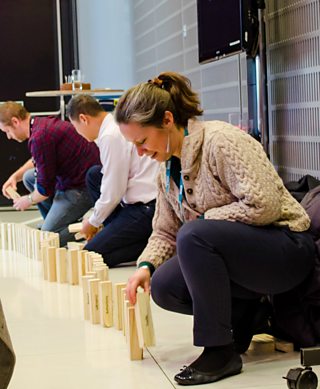
Jess Pryce-Jones (Founder and Chair, iOpener Institute) gave a fascinating talk on the psychology of collaboration and communication and left us with an understanding of the value of the people that build bridges within organisations, linking the groups that probably should be collaborating, but aren't. In an organisation the size of the BBC, this could be a problem. She also explained that these people facilitate the flow of new ideas into teams and social groups, and so are essential for innovation. As a group, TS&A needs to foster the behaviours common to these individuals, and be cognisant of places where a lack of communication is having a negative impact.
Where to focus our effort
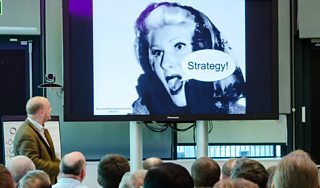
The morning was wrapped up by Simon Wardley (Researcher, Leading Edge Forum), whose inspiring talk focussed on increasing our situational awareness, which is absolutely essential in making decisions. He's done previous talks on the same subject - you really should watch him in action to do the talk justice. Simon uses maps to show where on the product evolution curve a given part of a business or system is, and in doing so, allows us to begin to make decisions about where to focus effort. Crucially, this can act as a tool to show where outsourcing a project is sensible (spoiler: it's when a product is approaching or has become a commodity), and where it is much more appropriate to develop in-house (when a product or idea is nascent, or there are unknowns that require more than "off the shelf" solutions). It can also be used to identify duplication, investment opportunities, innovation drivers and more.
With the morning’s speakers done, we moved into a much more free-form afternoon. It was great to get a chance to catch up with developers, product managers and architects from across the BBC, but I have to admit, I was much worse at "networking" with people I didn't already know. An improvement for future events might be to spend some more time introducing us to our groups to really get to know each other. Sessions from the Blue Room, R&D and News Labs were great in exploring the art of the possible. One of my highlights was a discussion about the positioning of BBC content on the ever increasing range of platforms now available in the marketplace.
Problem solving
We ended the day with a problem-solving activity that saw groups of attendees working together to think about solutions to problems posed earlier. How do we flexibly organise groups of users? Is there a way to enable collaborative whiteboarding sessions across remote sites? How do we engage with multiple stakeholders effectively? The problems were all interesting to think about and the interactions underscored my earlier point about the diversity of opinion. Everyone had their own approach to solving them, some more creatively than others!
Overall, the day was really enjoyable. I think we can continue to build on:
- How we work effectively with the rest of D&E and the BBC (particularly when not running a "transformation project").
- How we work and collaborate together as a community.
I'd also like to say a big thank you to the organisers: Chief Architect Jatin Aythora, HR Lead Liv Wild, Business Co-ordinator Nzinga Gardner, Team Assistant Diane Richard and the rest of the team.
Come and join us!
TS&A is just at the start of an exciting journey - helping to define how the BBC can continue to innovate and provide audiences with the very best content, reaching and positively impacting as many people as we can.
If you're an architect or technologist, we have a number of opportunities open now.
