Privacy by design

Adam Bailin
Head of Audiences Products, BBC Marketing & Audiences
This little button means a lot to us.

When it’s switched on it allows you to view personalised content recommendations based on your historic BBC activity data.
I work for the BBC Analytics Services team in Cardiff and we’ve been working on what happens when you switch it off.
The BBC decided that when you switch off personalisation, it shouldn’t link any activity data to your account. In fact, we think that it shouldn’t ever be possible to tie activity data back to you. This page about using the BBC expresses it well:
“Data about how you use the BBC will be anonymous. For instance, we’d be able to see that someone looked at a particular story on BBC News, but we wouldn’t be able to tell if it was you.”
That’s actually quite a difficult software engineering problem to solve. The way most analytics tracking systems work is by using cookies or some other persistent identifier precisely to be able to tie together a user’s activity across multiple sessions. To get around that, we reset a user’s analytics identifier whenever they switch personalisation off.
How it's normally done
Normally, when you sign in or out of a service your analytics identifier will persist. This means that organisations can attribute data to you as an individual even when you’re signed out or have chosen not to receive a personalised experience.
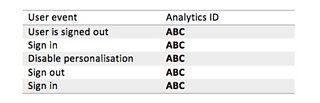
How we've designed it
We’ve designed our analytics ID differently, with privacy in mind. We’ve designed it so that when you sign in to your BBC account and disable personalisation, we can’t attribute activity back to you as an individual.
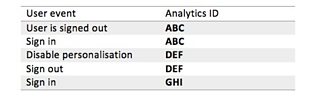
We’ve designed privacy into our analytics.
Putting users in control of their data
The General Data Protection Regulation, or GDPR for short, is one of the biggest changes to data privacy law in recent years. It is designed to put you in control of how your information is collected and used by organisations.
This change to our analytics services is a small example of how we are designing privacy as a feature to put users in control of their data. It is part of a wider opportunity to enable much greater control over how your data is collected, what you share and with whom. And in turn to drive a more relevant and nuanced personalisation of the BBC’s services.
We see privacy not just as an exercise in legal compliance but as an opportunity to deliver greater value for users.
