Production Trainee: Alia Cassam on why she applied for the Production Trainee Scheme.
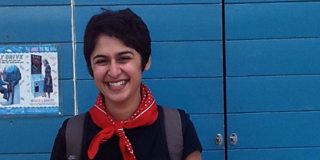
Alia Cassam
Production Trainee
I remember sitting in my PTS (production trainee scheme) interview, and being asked to talk about the last few years of my experience since graduating from university. I blinked, took a deep breath, and said: “I took the scenic route.”
My path to the PTS was certainly unusual, and not one I could have ever have imagined. But a love of language, people, and the human voice, has led me into a new world of possibilities in radio production at the BBC.
I had grown up listening to BBC radio and it has always been a part of my life. During my Theatre Studies MA at Leeds University, I produced a radio play based on a George Orwell novel, and I loved making it. For some reason it never occurred to me to work in radio. Perhaps I thought it would be too tough to break into. Ironically, it was catastrophe rather than success that opened new doors for me.
Just a year after graduating, I developed a condition called M.E. (Myalgic Encephalomyelitis). This came as a complete shock – my hopes of a career dwindled, and while I’d made some improvements in my health, I remained significantly affected by the condition. Then in 2013, I experienced a massive relapse. It was one of the most difficult years yet, and I struggled to know how to make sense of things.
Later that year, I went to the Forward Poetry Prize readings at London’s Southbank Centre. I’d always been a poetry lover, and sitting in the auditorium, my head in a dizzying fog, I heard some words that seemed to make sense. Jeannette Winterson, the chair of the prize, spoke with passion about Seamus Heaney and his belief that “poetry should be strong enough to help”. In a time of desolation, these words felt truthful. And I wasn’t going to argue with Seamus Heaney.
A few months later, I received an email from the arts organisation Poet in the City. They were looking for new volunteers, and I decided to join. At the first meeting, I discovered they had a vibrant audio team and I mentioned that I’d once made a radio play, and that I’d love to develop my skills. I soon began interviewing guest speakers and editing recordings with poets, and I initiated and produced the organisation’s podcast. Inspired by the BBC broadcasts I’d listen to at home, I wanted to see if I could make my own programmes too.
With the support and encouragement of colleagues, it was suggested that I approach the BBC. Initially I was sceptical, but sure enough I saw that the Corporation had a disability hub and a scheme called Extend. I watched the online Extend video and read blogs by disabled staff. Feeling heartened, I made my application.
The PTS application process was rigorous, but I felt continually challenged and invigorated: I was being asked to think in new ways, develop myself, and really consider who I was and what I was about. At the hotel room in Birmingham for my final interview, I remember staring at a printout of an article I’d found on the BBC Get Creative website, which I'd kept near my suitcase. It said: “Can poetry really change your life?” I really hoped, and believed, that it could. And it has.
Now three months into the PTS scheme, and I’m working at the BBC’s Radio Documentaries Unit, the largest in the world. It's a privilege to be here, learning from the very best in the field, and gaining skills in research and journalism, recording, and how to construct complex documentary stories. I’m part of a team making work that is truthful and intelligent, surprising and joyful. Broadcasts, which in our confused and troubled times, are strong enough to help.
