Pages from history - Radio Times in the 1930s

Andrew Martin
BBC Genome
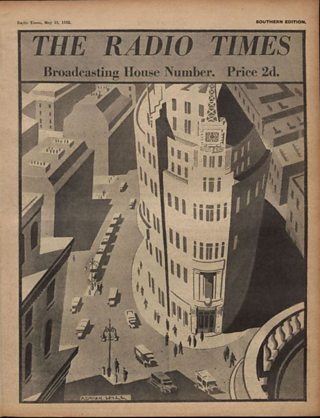
Radio Times publicised the opening of broadcasting House in May 1932 with this cover by Adrian Hill (the presenter of BBC TV's Sketch Club in the 1950s)
The BBC Genome Project is releasing the next batch of pages from Radio Times, this time covering the 1930s.
Genome users will now be able to access the articles, editorial material, letters pages, illustrations and photographs from the 1930s. We hope this will help users correct some of the errors in the Genome data - as well as gain insights into broadcasting during this fascinating period.
The 1930s was a turbulent decade. The country had to cope with the worldwide depression and mass unemployment that followed the Wall Street Crash of 1929. In 1936, King George V died, but his successor Edward VIII abdicated at the end of the year, to be replaced by George VI, his younger brother. Internationally, the decade was marked by the rise of the Nazis in Germany, and the sequence of events which culminated in the outbreak of war in September 1939.
It was a period of change in broadcasting too. At the start of the 1930s the BBC was still overseen by Sir John Reith, its first Director General. In 1932, the BBC moved from its cramped headquarters at Savoy Hill to the purpose-built Broadcasting House.
The old individual stations identified by their call signs – such as 2LO, 5IT and 6LV – changed to the more centralised networks of the National and Regional Programmes. Another innovation was the Empire Service, forerunner of the World Service, which began in December 1932. As its transmissions were not aimed at domestic listeners, the listings were not carried by Radio Times; but one programme that is in Radio Times and was broadcast by the new Empire Service, was the first Royal Christmas broadcast, in which King George V’s voice was relayed live around the world on Christmas Day.
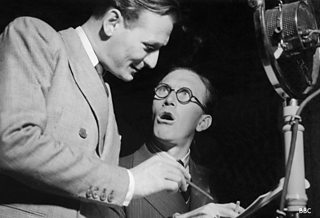
Richard 'Stinker' Murdoch and Arthur 'Big-Hearted' Askey, stars of innovative BBC variety show of the 1930s, Band Waggon
One of the BBC’s most popular types of programme was variety, and a new generation of performers attuned to broadcasting made their mark in the 30s. Towards the end of the decade came the first variety shows specially designed for radio, including the ground-breaking Band Waggon (starring Arthur Askey and Richard Murdoch) and It’s That Man Again (with Tommy Handley). Regular series like these were still relatively unusual at the time, and Radio Times made much of this in an article introducing the programme: "Tommy Handley is the man. You'll hear him again (and again)". However, it took the spirit of wartime to make ITMA – as it became known – into a "national treasure" of the 1940s.
Drama too was developing fast in the 30s, under the leadership of Val Gielgud (brother of John). Technical advances such as the "Dramatic Control Panel" allowed far greater flexibility in play production, and the arts of writing, producing and performing drama were growing in maturity. Early experiments in recording were also being undertaken. Radio Times was full of articles about the growth of broadcasting techniques.
From the beginning of the BBC music had been provided by "Wireless Orchestras" and bands named after their respective stations. In 1930, serious music was put on a more professional footing with the founding of the BBC Symphony Orchestra, which gave its first concert in October, as featured in Radio Times. The BBC Dance Orchestra continued to provide light music, with Jack Payne’s tenure as its conductor passing to Henry Hall. Other orchestras were founded for specific purposes, such as the Theatre and Television Orchestras.
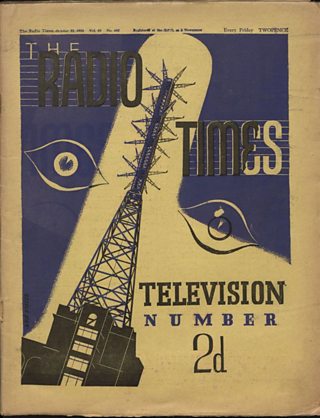
This striking artwork cover heralded the start of the high definition BBC television in 1936 - there were feature articles but no listings, as programmes did not actually start until the following week
The Television Service was another emerging aspect of BBC output in this decade. In 1930, the BBC had only recently allowed John Logie Baird to use its transmitters for experimental television, and with only one transmitter then available, the first television broadcasts had to alternate sound and vision. The launch of the Regional Programme early in 1930 allowed both to be broadcast simultaneously using the different transmitters, but the low-definition (30 lines) service was still very basic, even after the BBC assumed responsibility for making the programmes. "Television makes its bow from Broadcasting House," announced Radio Times in August 1932.
High definition television began in 1936, from Alexandra Palace. At that time, "high definition" was a fraction of what it means today - two systems were used for the first few months, the Baird system on 240 lines and Marconi-EMI on 405 lines - but the former was dropped in February 1937. In May, the first "remote" outside broadcast occurred, when scenes of the coronation procession of King George VI were televised. Gradually more sophisticated and ambitious programmes were produced, and though the service still only transmitted a few hours each day, it was gaining viewers, and plans were afoot to expand to the Midlands and the rest of the country.
All that came to an end on 1 September 1939, when the Nazis invaded Poland. Although it was two more days until Britain declared war, the BBC put its emergency plans into operation: television closed down, and domestic radio services were conflated into a single Home Service. Programmes were disrupted as BBC departments were scattered to various sites around the country: the issue of Radio Times for 3-9 September 1939 was printed, but it was now entirely redundant and an emergency edition was published in its place on 4 September 1939.
After a month or so things began to settle down, aided by the fact that the expected mass bombing of the UK did not immediately materialise. That would come in 1940: but that is another story...
