Behind the camera: John Hunter Blair

Andrew Martin
BBC Genome
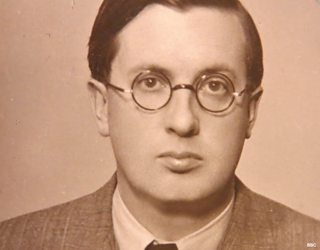
John Hunter Blair arrived late at the BBC after a life of travel and teaching
Blue Peter is the BBC’s flagship children’s programme which has formed an important part of its output since its launch in 1958.
As a favourite with succeeding generations, it has received a great deal of attention. Perhaps the greatest amount has been reserved for the ‘dream team’ era from the late 1960s to early 70s, when Valerie Singleton, John Noakes and Peter Purves were at the helm. Successive replacements have in many ways tried to emulate that formula, although in the changed environment of the 21stcentury the programme is a very different animal from 45 years ago.
The prominent figure behind the scenes from 1962 to 1988 was formidable editor Biddy Baxter, and her long service and strong personality have shaped the programme in no uncertain terms.
Yet one figure who preceded her is the programme’s founder and first producer, John Hunter Blair, about whom little is known.
John Wauchope Hunter Blair was a slightly eccentric and obscure figure. Born in 1903 to Major-General W. Hunter Blair and his wife Ethel, he went to school at the Royal Naval College in Osbourne and Dartmouth. After studying at Edinburgh University, he did an MA in Modern History at Oriel College, Oxford, before becoming a schoolmaster.
In 1933 he took the unusual step of going to work in Latvia, at the University of Riga. He stayed there until 1940, when the independent republic was swallowed up by the Soviet Union. In the course of his time there he became fluent in Latvian, began working in radio for the Latvian State Broadcasting Service, and married a local woman.
Even less is known about Hunter Blair’s wife than about him: she was called Helene Ezergailis, but by the time he was established in the UK as a television producer they had separated. He obviously didn’t talk about her as it was only vaguely apparent to BBC officials and colleagues that he had been married. He lived alone, and some even referred to him as a bachelor.
When he left Latvia he moved to Australia, where he worked for the Australian Broadcasting Corporation, initially as an announcer based in Brisbane. In 1943 he became a script writer for ABC, and then in 1944 a Presentation Officer, which also involved writing. He continued in this job until 1947, when for some reason he decided to return to Britain.
He got leave of absence from ABC, and applied to join the BBC. One of the great loves of his life was music, and he at first tried to enter the music department. But he was turned down, and gained a sick relief post in Far Eastern department of the Empire Service. Following this he moved to Schools Broadcasting, where he obviously made a good enough impression. He is credited as script writer for the series Senior English in 1949, and for the Geography series, contributing a talk about Latvia, as a ‘former British resident'. In 1951 he was able to gain promotion to Producer in Children’s Television.
It’s not clear why Hunter Blair made the move to television, but by 1951 it was starting to expand around the country, with the opening of the BBC’s third transmitter, Holme Moss, bringing the medium to the North of England. It had also been decided to start a regular children’s television service in 1950, to replace the patchy, occasional programmes shown before. Although characters like Muffin the Mule were already popular, the BBC decided to dedicate a slot to children’s programming, which came from the new Lime Grove studios.
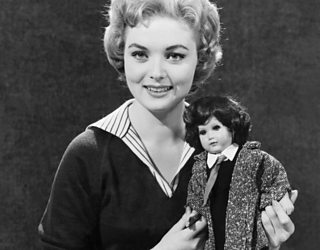
Leila Williams was Blue Peter's first female presenter under Hunter Blair
The expansion of television meant new people were taken on, though Hunter Blair seems to have replaced a producer called Alan Bromly whose contract had ended. Bromly nonetheless went on to have a successful TV career, producing thriller serials including those of Frances Durbridge.
At this point Hunter Blair did not even have a television set, unable to obtain one of the few domestic sets owned by the BBC for staff use, although he was able to hire one from Radio Rentals and claim back the cost.
Hunter Blair began work at Lime Grove on 1 November 1951. Although working as a producer his name did not necessarily appear in Radio Times, and when it did it was sometimes in another capacity. He is credited for musical direction on children’s drama series The Silver Swan.
After a year or two his credits start to appear as a producer, for Jack-in-the-Box, The Runaway Band and The House that Jack Built. In 1954 he continued with Jack-in-the-Box but was also producer, writer and music composer for a play with music called The Smith Family which received several showings, latterly billed as a children’s opera. It’s not always clear from listings what children’s output Hunter Blair was producing, but among the material shown were items on model railways, and appearances by young artist Tony Hart, both of which would figure in Hunter Blair’s later career.
By 1955 he was dividing his time between drama serial Bobby in France, which combined elements of language teaching with storytelling, and allowed Hunter Blair to exercise his good command of French and passion for travel. His flair for music was reflected in Television Puppet Theatre and two programmes with Eric Robinson and his Orchestra. He was also still in charge of Jack-in-the-Box, which featured Nat Temple and his Orchestra.
Birth of Blue Peter
His credits mounted up in 1956, producing drama including more Bobby in France, Lucky Silver and The Adventures of Pierre. His musical output also increased, with Anniversary marking 200 years since Mozart’s birth and The Fisk Jubilee Singers, a programme of Negro spirituals.
By 1957 Hunter Blair was a safe pair of hands, and was commended – and given a bonus – for his innovative work in music for children’s TV. Annual reports paint a picture of a man who was very happy in his work, though he could be uncommunicative in formal situations. His appearance, as described by acquaintances and confirmed by the few photographs of him, was reminiscent of Billy Bunter, with his round face and spectacles. There seems to have been something of the schoolboy about him too in his enthusiasm for model railways. He was said to possess a first class mind, though happy in his lot as a children’s TV producer.
His 1957 productions seem to have been mostly musical, until he was appointed editor and producer of the series Studio E. Starting in January, Hunter Blair took over with what was described as a ‘scratch team of assistants’. This magazine programme included comedy with the likes of Clive Dunn as well as a range of factual and music items. George Cansdale talked about animals, Percy Thrower about gardening, Shirley Abicair told stories and played her zither, Johnny Morris appeared as the Hot Chestnut Man. It was presented by the redoubtable Vera McKechnie, later Elizabeth Lanchbury.
Hunter Blair left “Studio E” in 1958 to be replaced by Ursula Eason, but continued to produce Jack-in-the-Box, until it finished in September. He also co-wrote another musical drama, Castle Dangerous, for which he also composed and conducted the music. He had the odd other credit, but something new was in the air.
Owen Reed, head of Children’s Television, saw there was a gap in the provision for children too old for Watch with Mother but too young for the sophistications of Studio E. Sensing that Hunter Blair knew what appealed to children - despite having none of his own - Reed gave him the task of producing a weekly 15-minute magazine programme for primary-age children.
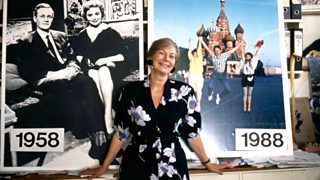
Biddy Baxter took charge of Blue Peter for more than 20 years
Hunter Blair found a solid male presenter in actor Christopher Trace, and to partner him the 1957 winner of Miss Great Britain, Leila Williams. Needing a title for the show, Hunter Blair chose the name of the flag flown by ships preparing to set sail: Blue Peter.
The first episode went out live on October 16 1958. Originally the series’ title sequence used film of a sailing ship at sea, and colleagues recalled Hunter Blair’s gleeful instruction in the gallery to add the sound of sea wash to the footage. The show quickly caught the imagination of children with its fresh and enthusiastic presentation.
Christopher Trace was an avuncular figure, a former army officer with an undistinguished acting career, but he took to presenting at once. He is cited as coming up with two of the best-known phrases associated with Blue Peter – “And now for something completely different” and “Here’s one I made earlier”. Arriving for interview with Hunter Blair, staff remembered that he immediately bonded with the producer over a shared love of model trains, which soon became a regular feature of the series, even featuring in a regular story series. Storytelling was also a feature, predating Jackanory.
Although Blue Peter aired every week, Hunter Blair continued to contribute to other shows, including Young Musicians (a one-off that included Jacqueline du Pré) and a series with Shirley Abicair. But Blue Peter was his main job, and one which he was commended on numerous times. He even went as far as taking trips abroad to try to source idea for items and unusual toys to feature in the series.
Ill health
However, all was not well. It’s unlikely that Hunter Blair took much exercise, and the stresses of live television production were starting to tell. He began to suffer from heart problems, and was admitted to hospital in December 1960. He returned to work the following January but had a heart attack in June.
His last day on duty with the BBC was the 12 June 1961 – a Blue Peter transmission day. Hunter Blair apparently collapsed in the production gallery, although not during transmission as far as records show.
He was signed off from work, and various others took charge temporarily, with greater or lesser degrees of success. At first, this was thought to be until Hunter Blair would recover sufficiently to return to work, but eventually it was realised he would never be fit enough again. He had angina, and struggled to climb stairs at times and was also suffering from Parkinson’s disease. He had spells in hospital and nursing homes, and gave up his flat in Maida Vale to go and live in his sister’s house in Norfolk. At last, the BBC agreed that he would have to retire prematurely on health grounds.
A late starter with the Corporation, he was 43 when he joined and 57 when he made his last programme. It was agreed his last day on the staff roll would be his 59th birthday, October 4 1962. Hunter Blair’s health never improved, and he died just over two years later, on December 31 1964.
By that time, Blue Peter had celebrated over six years on air, and was now running twice a week, presented by Trace and Valerie Singleton. Although the Children’s Television department no longer really existed, with most output farmed to other areas, Blue Peter survived, and under its eventual permanent replacement producer/editor Biddy Baxter, it would go on to fulfil and exceed all of John Hunter Blair’s hopes in the succeeding decades.
