What's in the Studios?
Andrew Martin
BBC Genome
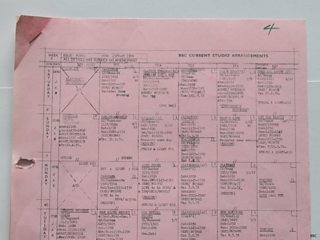
A detail from the BBC Current Studio Arrangements form for Week 4, 1976
The above piece of paperwork is one of the unsung documents of the BBC's administration, the form on which are logged the programmes which were scheduled to be produced in the BBC's electronic television studios in one week of January 1976. In this blog we take a look at what was being made that week, where it was being made - and see how the broadcasting landscape differed 45 years ago.
On the face of it, this is a fairly typical production week. There are a mixture of live shows and pre-recorded programmes, which might be going out later the same day, or days, weeks or months in the future. The studios listed are mostly at Television Centre, the main location for making BBC programmes at the time, located in west London. In this era when there was very little independent production, and most programmes which were not made in the BBC's electronic studios were films from a variety of sources, including those made by the BBC itself, and those bought in from abroad. This form does not include those, or purely outside broadcast programmes; also not listed are news bulletins, which had their own dedicated facilities.
The form is laid out as a grid, taking each studio along one axis and the days of the week on the other. As well as TV Centre productions, there are columns for Lime Grove studios and the BBC Television Theatre, and for brief details of networked shows made in other parts of the country.
In the studios
The various studios listed begin with TC1, as Studio 1 at Television Centre was known for short. Studio TC2 is missing from the list – this studio, which in its 60s heyday hosted shows including That Was the Week That Was and Juke Box Jury, was no longer in service by the 1970s. Together with studios TC5 and TC7, it was a smaller space, which while it could accommodate a modest studio audience, had not been converted to colour production along with the other TVC facilities (TC5 was the last of the working studios converted at that time, the previous year, before which it had mainly been used for those Schools Programmes still made in black and white).
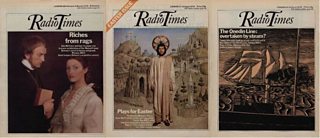
Three productions recording in one week in 1976 made the cover of Radio Times - Our Mutual Friend (photo Dmitri Kasterine), The Chester Mystery Plays (photo Tony Evans, painting Tom Taylor) and The Onedin Line (artwork Nigel Holmes)
Many of the programmes listed on the form were regular series which went out all year round or for long runs, often in the documentary, arts or current affairs genres. These included Panorama, broadcast live although usually based around one or more pre-filmed reports, The Money Programme, and the arts strand Omnibus. There was also the science magazine Tomorrow’s World, the consumer slot That’s Life, and regular pop music programme Top of the Pops, presented this week by Tony Blackburn.
Dramas produced in the BBC’s London studios during the week were The Onedin Line, set in the world of sailing ships during the 19th century, an dramatisation of Dickens’ Our Mutual Friend, and an episode of the final series of the police drama Dixon of Dock Green.
It's a Mystery...
The main production in TC1 was The Chester Mystery Plays, a technically complex adaptation of the medieval folk dramas starring Tom Courtenay as Jesus. It made heavy use of blue screen electronic effects (then called CSO or Colour Separation Overlay by the BBC, and Chromakey elsewhere) which allowed backgrounds and other special effects to be created cheaply – although it required careful alignment of picture elements and lighting to be effective. Often, non-naturalistic dramas like this one were better suited to the technique than conventional plays.
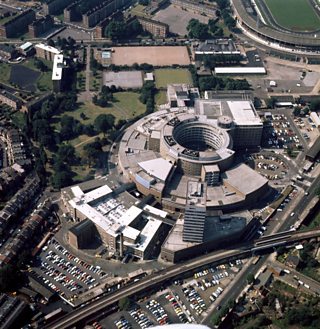
An aerial view of Television Centre in the mid-1970s, when lots more people drove to work and there was still a stadium at White City
Daily current affairs took the form of two strands, Nationwide in the early evening and Tonight, which was often the last programme before closedown on BBC One. Nationwide’s unique selling point was linking up the nations and regions of the BBC, both through the daily local programmes which formed the first part of each edition, and by including local stories of national interest, or a local perspectives on a national issue, in the networked part of the show - it also often included humorous items from around the country. In this particular week, Nationwide featured a special series of reports from Belfast.
Lime Grove and the Television Theatre
Grandstand, Match of the Day and Nationwide were all broadcast live this week from Studio E at Lime Grove, which was the only studio in that building in operation at the time. Normally the workload would be shared with Studio D, amongst whose many claims to fame was as the original studio used for Doctor Who, but it was out of action between the beginning of the year and the late spring. Lime Grove had been a film studio originally, acquired by the BBC at the end of the 1940s to help with production space as television began to expand. It was located on the street of the same name not far from Television Centre.
Also nearby was the BBC Television Theatre, formerly the Shepherd’s Bush Empire, a variety theatre built in 1903. It was bought by the BBC 50 years later and saw service for them until the start of the 1990s. With built-in audience seating it was ideal for light entertainment series, game shows, chat shows and music concerts. Four shows were hosted there in this week: Nana Mouskouri, Crackerjack, It's Cliff - & Friends, and Ancestral Voices – the last of these being an educational series about musical instruments.
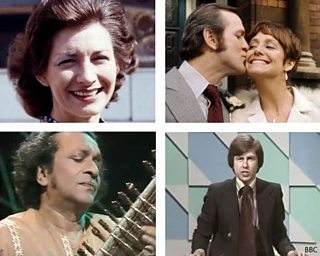
English regions output - Birmingham's Pebble Mill at One with Marian Foster (top left), The Brothers (top right) and Nai Zindagi Naya Jeevan (bottom left); and Manchester's Screen Test
The penultimate two columns on the form are for the Presentation Studios A and B, which were originally designed for continuity announcements by BBC One and BBC Two respectively, when these were done in-vision. As a very small studio, "Pres A" was used this week for Weather Forecasts and Promotions (i.e. trailers) while "Pres B" was employed for the BBC Two current affairs series Newsday, and various other small productions including Film Night – one of the two surviving spin-offs from Late Night Line-up, the BBC Two review series that ran from 1964 to 1972. The other was The Old Grey Whistle Test, not listed on the form as this week’s edition was a pre-filmed concert by Supertramp from Hammersmith Odeon.
Nations and Regions
Finally, there is the column showing productions in other studios – Birmingham, Manchester and Bristol, with Broadcasting House also squeezed in here – the small TV studio maintained there listed this week for Drama Auditions. Each of the regions had their own specialities, as did the Nations – Scotland, Wales and Northern Ireland. Natural History shows typically came from Bristol, for example, while Birmingham was the home of English Regions Drama – its current big hit being the family saga The Brothers - and they all produced a range of material for their local audience in addition to their network commitments.
So, that was the week that was Week 4, 1976: a typical week in the history of BBC TV production, and a cross section of BBC TV output the best part of half a century ago. BBC Television had come a long way since the days of two small studios at Alexandra Palace in the 1930s; it had a long way to go still…
