Colour Television: 50 Years On
Andrew Martin
BBC Genome
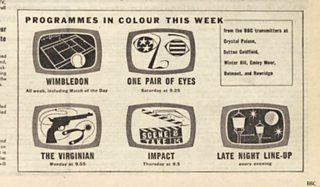
Everyone's seen the cover, so here's the entire list of colour programmes for the week, from Radio Times published 29 June 1967
On 1 July 1967, BBC Two officially became the first channel in Europe to transmit in colour. The debut colour programme was an outside broadcast of Wimbledon, featuring the Men’s Singles match between Cliff Drysdale and Roger Taylor.
However (and isn’t this always the case…) this was not the first colour transmission on the BBC, or even on BBC Two. BBC colour test transmissions actually date back to 1955, with BBC Two beginning colour broadcasts, for the handful of people who had a colour set, in April 1967.
Colour television was an obvious thing to aspire to after the basic achievement of television itself came about in the mid-1920s. Although basic monochrome television was still far from being perfected, the television pioneer John Logie Baird demonstrated a primitive form of colour in 1928. Despite many setbacks with his mechanical television system, he continued to work on colour television until his death in 1946.
In the United States, with greater resources at their disposal, workable colour television was developed during the 1940s, with the first regular programmes starting in the early 50s. The system used there was known as NTSC, after the National Television System Committee. Even in the US however, colour television took time to get off the ground. The technical quality was variable, and the system was jocularly dubbed Never Twice the Same Colour. It took until the mid-1960s for the US networks to go over fully to colour production.
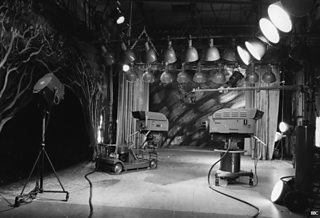
Studio A at Alexandra Palace during the live colour television tests in the late 50s. Presumably during the tea break...
In the UK, colour television experiments started around 1947 in the BBC Research Department laboratories at Nightingale Square, London, and later moved to Kingswood Warren. These used a variation of the NTSC system adapted to the British 405 line standard. In 1953, the BBC submitted its 10-year plan to the government, which included two alternative television services, with a proportion of the programmes in colour. Television Centre, on which work was underway by the mid-50s, was planned with this in mind.
Experimental colour transmissions started on 10 October 1955 from Studio A at Alexandra Palace, after the end of normal television programmes. There was a mixture of live and filmed programmes, the latter including the 1957 series Men, Women and Clothes. Selected observers were given colour sets to check quality of the picture and the compatibility of the images when viewed in monochrome. The results were positive, and the BBC expected, or hoped, that the go-ahead would be given to start a service soon.
Although test transmissions were later curtailed at the BBC, it was inevitable that colour would come at some point. There were decisions to be made about the line standard and system that would be used. After much debate involving the EBU in attempts to agree Europe-wide standards, in early 1966 the Postmaster General (the government minister in charge of broadcasting in the UK) announced the go-ahead for colour television to start on BBC Two, using the PAL system developed in Germany a few years before.
The BBC planned to start transmissions towards the end of 1967, giving the TV receiver industry time to perfect colour sets, and also enable the BBC to train staff in the new techniques. However, it was already able to provide facilities for colour coverage of the 1966 election results programme to be transmitted via the Early Bird satellite to America, even though the domestic coverage was still in black and white.
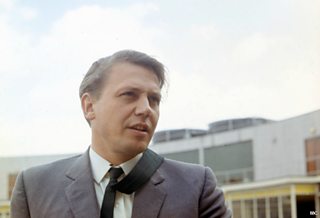
David Attenborough as controller of BBC Two. He pioneered colour film-making in the 1950s with Zoo Quest
In an article in the 1967 BBC Handbook, David Attenborough, then Controller of BBC Two, pointed out that BBC already showed programmes made in colour, but transmitted in black and white – for example The Virginian and the Danny Kaye Show. But the BBC now needed to make its own colour programmes. There was plenty of experience around in colour film-making, but electronic colour programmes were a different matter.
One pitfall to avoid was thinking just in terms of the most spectacular colour and putting the programme content second, since for the present most people were still viewing in black and white. Drama presented the most complex design challenges for colour working – factual genres had to avoid too much colour, while light entertainment could go to town. But in drama, colour was part of what made a programme look right – it did not necessarily need to be strictly realistic, but had to convey the mood without distracting from the story being told.
It was planned to transmit in colour across the country straight away – two thirds of the UK population would be able to receive BBC Two by the end of 1967, with 10 more BBC Two transmitters coming into use during 1968. Two studios at TV Centre (TC6 and TC8) were being equipped with colour cameras, while a smaller studio (Pres B, the BBC Two Presentation Studio) already had colour cameras. Two large colour outside broadcast units had been ordered.
On the 20 April 1967 Michael Dean introduced that day’s edition of Late Night Line-Up by mentioning that the programme was being shown entirely in colour (some colour sequences had been shown previously). It was no coincidence that this was BBC Two’s third birthday, and David Attenborough had announced the channel’s colour plans that day.
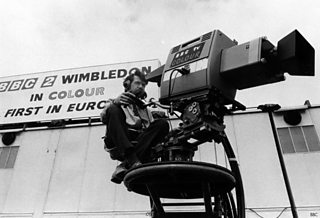
A BBC cameraman tries out his colour TV camera at Wimbledon 1967 (ironically in black and white)
Finally, on 1 July, the full trial period for colour began, and with it the BBC’s “official” date for the start of colour transmission. It would be another five months until the full colour schedule began, but until then an increasing amount of colour material would be shown. The BBC had achieved a regular colour television service before anyone else in Europe.
Early colour programmes were confined to presentation material including Late Night Line-Up, outside broadcasts, and any programmes that could be obtained in colour – including US material, whether on film or videotape. The documentary series One Pair of Eyes was already being made in colour, and other colour film projects were in the pipeline but would take time to come to fruition – most famously Kenneth Clark’s series Civilisation, which was not transmitted until 1969. Colour material amounted to about five hours a week for the first few months.
Programmes in colour were originally listed in a box-out at the front of Radio Times, rather than on the listings pages. From 30 September 1967, the word "colour" appeared at the bottom of each billing, coinciding with the colour service stepping up a notch, with twice the amount of programmes. From 2 December, "colour" was prominently marked at the top of the billing (a custom that went on until July 1975).
Colour on BBC Two continued apace, and colour broadcasting finally came to BBC1 and ITV on 15 November 1969. By 1972 there were 1.5 million colour sets in use, by 1974 that had risen to 5.5 million. In 1978, there were a total of 11 million colour licences - fifty years after John Logie Baird's first colour television demonstration.
