The Sunday Post: Continuity
Andrew Martin
BBC Genome
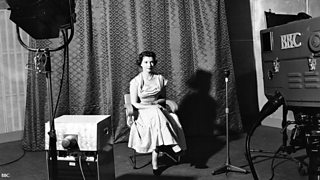
Continuity announcer Sylvia Peters in the Lime Grove studios in 1953
The bits in between the programmes, the glue that holds television together, continuity announcements, junctions, links… There are many ways to describe the material that joins together (or separates, if you like) the distinct programme material on radio and television. That could bring us back to the vexed question of what constitutes a programme - it’s a problem that we have yet to face on the Genome Project, insofar as at the moment we only log actual billed programmes. That said, there are some indications of the existence of continuity in the pages of Radio Times, from billed intervals and closedowns to children’s strands like “But First This!”
From the earliest days of broadcasting, when everything apart from gramophone records was live, it was never a question of just having distinct programmes with nothing between them. Every artist or item needed to be introduced. The earliest broadcasts were in essence someone talking, and it was soon found necessary to plan what they were going to talk about, and to vary the offerings with stories, humour, and music. In a way, continuity is the essence of broadcasting. If you look at stations such as Radios 1 and 2, much of their programming is continuity, since it consists of an announcer/presenter/DJ talking, and introducing records.
Because their voices were the most often heard on the air, BBC announcers were among the earliest recognisable personalities, although the cautious and sober early BBC was reluctant to create any kind of personality cult for them, so they were usually unnamed. Other than the pseudonyms such as “Uncle Mac” (Derek McCulloch) used in “Children’s Hour”, it was not until the Second World War and the need to verify the identities of announcers, to avoid the danger of people confusing Nazi propaganda broadcasts with BBC transmissions, that their names were given on air (as the announcers also read the news). There had however been articles in Radio Times earlier profiling announcers, and their names can be seen in early billings as part of the closedown - but public curiosity (and that of the press) meant that some names were well known anyway.
The first television announcers however were deliberately publicised. Early low definition television had been linked by radio announcers, but it was decided to make a feature of the television announcers, as for one thing they would be on screen so frequently that it would be impractical and bizarre not to name them. When the original announcers, Leslie Mitchell, Jasmine Bligh and Elizabeth Cowell were chosen, they were the subject of press coverage, and featured in BBC radio programmes prior to their on-screen appearance.
Because the television broadcasts that began in August 1936 all came from a single studio (at first there were two alternate systems, the Baird and the Marconi-EMI system, each with its own studio at Alexandra Palace), everything other than any pre-filmed material appeared as a continuous flow of output. Except for drama, which needed to be kept within its own created ‘world’, programmes would be introduced by the announcers, from whom the cameras would travel over to, or cut to, the act or speaker just announced. The television technology available in the 30s and as late as the mid-50s was not good at the instant cut, and it could be a few seconds before the picture from one camera was replaced by another, so the style of presentation was necessarily more fluid and languid than the rapid style possible now. The television announcers were also in some cases the presenters of programmes, interacting with the artists. Even after he left the announcer’s job in February 1938, Leslie Mitchell continued as the interviewer for the long-running magazine, “Picture Page”.
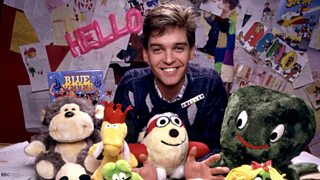
In-vision continuity made a popular comeback with Phillip Schofield in the Broom Cupboard
Post-war, there came to be what seems now a strange obsession with the role of the announcer, and they became the first real television personalities. The pre-war announcers were replaced by new names such as Mary Malcolm, Macdonald Hobley and Sylvia Peters among others, with thousands of hopefuls putting their names forward whenever a vacancy came up. By the end of the 1950s though things were changing, and it was decided to reduce the prominence of in-vision continuity announcers. Male announcers were reserved for out-of-vision factual information, while the female announcers would give details of programmes, programme changes etc. Famous announcer names in the early 60s included Valerie Singleton, Judith Chalmers and Sarah Ward, the latter of whom also hosted the viewer feedback series “Junior Points of View” which along with its parent programme “Points of View” was one of an increasing number of programmes made by the Presentation Department.
When BBC2 began in April 1964, it too at first had in-vision announcements, though with a male and female team including Denis Tuohy, who presented the first edition of the series “Line-Up” (famously a day later than scheduled due to a blackout at Battersea Power Station). “Line-up” was intended to preview the evening’s programmes, and the presentation team would appear during the evening before rounding things off with the closedown. After a few months, this arrangement evolved into giving a brief programme summary at the start of transmissions, and the closedown routine became a review of some of the evening’s programmes – and later this expanded into a more wide ranging review and comment strand, “Late Night Line-Up”, which launched the career of Joan Bakewell* among others, and gave rise to spin-off series such as “Film Night” and “Colour Me Pop” (which begat “Disco 2”, which begat “The Old Grey Whistle Test”…)
(*Always a difficult cliche to justify, but although she had appeared in various programmes including “Woman’s Hour”, “Meeting Point” and “What Next in Labour-Saving Gardens”, “LNLU” was what made Lady Joan famous…)
In 1965 however it was decided to drop in-vision announcements from both channels, and television announcers receded into anonymity. At least, that is, until Children’s BBC decided to revive the tradition in the mid-80s. On 9th September 1985 at 3.55pm, Phillip Schofield made his first in-vision announcement from a tiny presentation studio, which soon became known as the Broom Cupboard. In line with the general approach to presentation and continuity, this was not reflected in the listings or anywhere else in the magazine…
Every Sunday, Andrew Martin will be guiding you through the history of broadcasting by digging out archive gems and information from the BBC Genome listings.
