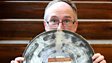
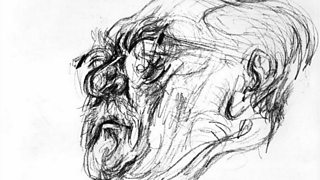
Gilbert Harding, notorious as “the rudest man in Britain”, was one of the most colourful of television personalities in the second age of television, when it started to become the favourite medium of most Britons.
In his 1950s heyday he was a regular panellist on What’s My Line?, but made many appearances on many other programmes as host, presenter and contributor, starting as a radio commentator in the early 1940s.
Harding was born in 1907 in Hereford. After school in Wolverhampton he studied French and German at Queen’s College, Cambridge, before beginning studies to become an Anglican priest, converting to Catholicism soon afterwards. He spent most of the late 20s and 30s as a schoolteacher, although he also served as a policeman in Bradford, and latterly began to study for a career in law.
Having briefly been the Times corresponden in Cyprus, he had failed to break into journalism in England, until the outbreak of the Second World War, when he was offered a job in the Monitoring Department of the BBC Overseas Service. He was promoted to Information Bureau Supervisor, collating salient points from foreign radio bulletins at Broadcasting House.
Rudeness and intolerance
He later worked at the Monitoring station at Wood Norton as one of a team compiling weekly summaries for the Cabinet. His reports were complimented by Churchill for the “succinct mind” behind them. His first broadcast was during this time, for an Overseas Service series called Voice of the Nazi, standing in for the usual speaker. On the back of this, he was offered a job by Michael Standing of Outside Broadcasts in 1942.
Harding worked as an interviewer on programmes for overseas consumption such as Meet John Londoner and the Home Service’s The Microphone Wants to Know. His first domestic credit was for A London School in the Country, showing how an evacuated school coped with its new location. After a stint in Canada, Harding found difficulty in obtaining a role, although still on the BBC staff, but decided to go freelance when offered a presenting job on a new show. Round Britain Quiz succeeded Transatlantic Quiz, which had had to be abandoned due to government restrictions on spending British dollar reserves. Harding became a roving quizmaster on the series, travelling around the country while Lionel Hale presented from London. Known for its fiendish difficult cryptic questions, the programme continues to this day.
His profile greatly increased, Harding was now approached to be the chairman of The Brains Trust in 1948 and later became a panellist on We Beg to Differ, in which a team of two men faced four women in a light-hearted discussion of various topics.
It was on this programme that Harding first acquired his reputation for irascibility and ‘calling a spade a spade’ – which many interpreted as rudeness and intolerance. He was also accused of hating women, which impression the format of the show may have encouraged. In 1950 he added the chairmanship of another radio quiz, Twenty Questions, to his C.V., but on one occasion various technical difficulties resulted in him losing his temper live on-air and was suspended from the programme for some months. However, on the BBC’s other medium, television, he was about to enter his period of greatest fame.
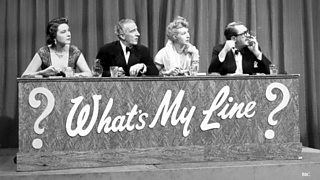
Harding had made occasional television appearances since his debut in Crossword in September 1948, but had never made any great impact – even in a short-lived television version of We Beg to Differ. In May 1951 he was invited to Lime Grove studios to view a recording of a US programme, a parlour game in which four celebrities had to try to guess the job of a challenger – What’s My Line?.
Though not overly impressed, Harding saw potential if it was adapted to British sensibilities. But he wrongly assumed he was being sounded out as chairman rather than as a panellist. A colleague attending the screening with him, along with other potential panellists, was a young Irish journalist called Eamonn Andrews – and he was the intended chair. However the producer agreed to give Harding a shot at chairing the game, and he was assigned to the second programme.
Again technical problems – a mix-up between the details of two guests – got in the way of Harding’s success, although he kept his temper sufficiently to come back as a panellist after a few weeks, and Andrews became the regular host of the show.
After its shaky start What’s My Line? soon became a phenomenon of early 50s television, and Harding’s regular appearances and brusque manner, was an almost essential part of the mix. Other regulars in the first few years included the comic actor Jerry Desmonde, Barbara Kelly, Elizabeth Allen, Ghislaine Alexander, Lady (Isobel) Barnett, magician David Nixon and Marghanita Laski.
Kelly and Lady Barnett were perhaps the best remembered, but they were outshone by Harding, who made more appearances than either. The show’s success made it one of the highlights of the era, and made household names of its stars. The members of the public who came on gave a mime of their job, and then could only answer ‘yes’ or ‘no’ to questions about it by the panel. If they succeeded in getting 10 ‘nos’ before the panel worked out what they did, they had won – and got a scroll commemorating the fact (no cash prizes on the BBC in those days).
Man of the people
There was also a guest celebrity round, for which the panel were blindfolded – the celebrity put on a funny voice (on one occasion the impressionist Peter Cavanagh mimicked Harding himself), and the panel had to guess who they were rather than what they did. Harding’s interaction with the challengers was the main cause of his temper fraying if he felt he was being misled in any way. Another well-remembered aspect of the show was occasional oddly-named or obscure jobs. The most celebrated of these was a job associated with pottery-making, a ‘sagger-maker’s bottom-knocker’.
The show’s success resulted in Harding making guest appearances in other programmes, and even in feature films. He was a frequent host of radio series such as Gilbert Harding’s Book Club and The Harding Interview, which solicited the audience’s opinion on who should next be interviewed. The 50s were a great time for the panel game, and Harding was a panellist on Who Said That? a member of the TV Brains Trust, chairman for the pilot of Ask Your Dad (but replaced for the series by Humphrey Lestocq, then Peter West), and ‘judge’ in a short-lived series called False Evidence on the Light Programme.
He was a guest on a Frankie Howerd vehicle Nuts in May and fronted his own show about his personal tastes, A Little of What You Fancy. His own view that women should be banned from universities was challenged in an edition of Leisure and Pleasure in the For Women strand. In 1955 he presented his own television show, Harding Finds Out in which he answered viewers’ questions, and in 1956 in a show just called Gilbert Harding where he was able to give his thoughts on any subject he chose, in the role of a ‘television columnist’.
Harding’s unlikely reputation as a ‘man of the people’ was exploited by radio series On the Spot, in which Harding acted as studio anchor interrogating BBC reporters who brought back stories from around the country. In the same week Harding was still appearing on Twenty Questions and Round Britain Quiz, as usual. The former also acquired a television version, and again Harding was the compere. He could also be avuncular, and was picked to preview the BBC’s Christmas offerings for 1958 in Gilbert Harding says ‘I Hope You’ll Like…’
As the 50s continued, Harding’s popularity did too, and his regular appearances both on What’s My Line? and numerous other programmes went on unabated – he was ubiquitous, the very epitome of the television (and radio) personality, and the workload must have been intense. Harding was not a well man – he was an asthmatic, and kept a supply of oxygen with him in case of emergencies. He drank, took little exercise, and was, not unusually for the time, a heavy smoker. His stress levels, given his occasional apoplectic eruptions, cannot have been good.
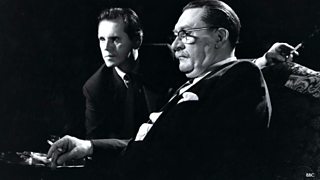
Harding was moved to tears on probing interview show Face to Face
As the sixties dawned, Harding even appeared twice on the new record review programme Juke Box Jury, and his reaction to the popular music of the era can be imagined. On 18th September 1960 , he was the latest of John Freeman’s interviewees in the series Face to Face. This series saw each subject constantly on camera, with Freeman barely seen, and they were questioned in depth about their beliefs and influences, and how they saw themselves and their place in the world.
While potentially insightful and revealing, this could on occasion prove uncomfortable for the ‘victim’, and such was the case with Harding. He was asked whether he had ever been with someone who was dying, in Harding’s case this was his mother, who had passed away not long before (his father died when he was a child). Pressed on the matter, Harding could not hide his tears.
Prhaps this programme unlocked many self-doubts in Harding’s mind. He had written books including 1953 autobiography Along My Line (serialised on the Light Programme in 1956), in which he already showed how uncomfortable he felt being a celebrity, how worthless he thought his career was, and which ends with the chilling line “But I do wish the future were over”.
The part of Harding’s life that he could not admit to, as its practice was illegal, and which some felt that Freeman was getting at with the probing about his mother, was that Harding was gay, and society’s attitude at that time cannot have helped his evident feelings of self-hatred. One of the quotes from his Face to Face was “I should be very glad to be dead, but I don’t look forward to the actual process of dying.”
On 16th November 1960, Harding collapsed and died while getting into a taxi outside BBC Broadcasting House in London, after recording two editions of Round Britain Quiz. To the panellists on the shows (which were never broadcast) he appeared ill, his breathing laboured and alleviated by oxygen and whisky, but he seemed his old self during the actual recordings. The following Sunday, BBC television showed a tribute called Profile: Gilbert Harding, in place of the usual edition of What’s My Line?.
Harding, though seemingly a symbol of a bygone age, has never quite been forgotten, and his name occasionally surfaces when broadcasting in the 50s is discussed. His life was considered in Late Night Line-Up’s Plunder feature in 1966, and he was profiled in In Search of Gilbert Harding in 1973 and Radio Lives in 1990, and was also the subject of a 2005 radio play Dr Brighton and Mr. Harding.
For an age written off as deferential, he is a reminder, as more of an Angry Old Man than an ‘Angry Young Man’, that not everything is as they seem. In spite of his public image, those who knew him well remembered him as a loyal and steadfast friend.
