Missing Believed Wiped
Andrew Martin
BBC Genome
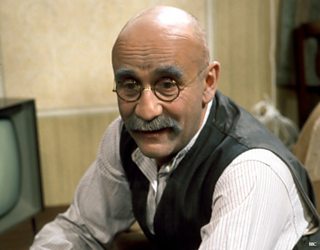
The late Warren Mitchell as Alf Garnett in a 1972 episode of Till Death Us Do Part. Mitchell was cast only after several other actors, including Peter Sellers, had turned the role down
Last week I attended the annual Missing Believed Wiped event at the National Film Theatre on London’s South Bank. This event, which has been going for over twenty years, always feels a bit like the AGM of British archive television fans, with many familiar faces from the community of those who appreciate archive television. The event was established over twenty years ago to show and celebrate programmes which were missing from television companies' archives, but have now been recovered.
This year’s event was dominated by a selection of programmes recovered in the last few months. ITV was represented by an episode from the first series of The Avengers, the top and tail of an edition of entertainment show Stars and Garters, and an excerpt from Gone Fishing, a series presented by Jack Hargreaves, better known for Out of Town and How.
The BBC material consisted of one of three recently recovered editions of Whack-o!, starring Jimmy Edwards; a complete Till Death Us Do Part (only part of which had previously existed in the archives); and Family Feud, an episode of Z Cars from 1962 – which, since a hoard of episodes was found in Cyprus in the early 1990s, had been the oldest missing edition of the series.
This last was part of a haul of material recently acquired by the archive television organisation Kaleidoscope, which included another first series episode of Z Cars, Affray, the pilot episode of Z Cars' spin-off Softly Softly, an edition of Dr Finlay’s Casebook, and one of Terry Scott sitcom Hugh and I.
It had been planned to show a recovered edition of The World of Wooster, but it turned out at the last moment that this already existed in the archive... But that’s life I suppose.
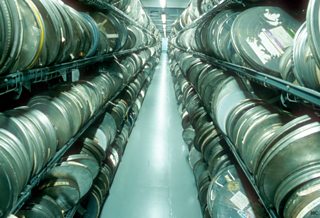
The film vaults at the BBC's former Windmill Road archive, now demolished (but don't worry, the films were removed first)
As we’ve discussed before in this blog, at the beginning of broadcasting there was no way to record programmes, although sound recording - the gramophone etc - precedes broadcasting by some decades. An economic way to record programmes took some time to achieve. With television the problem was different, with first film, and then electronic tape being used to record programmes.
Even once videotape was widely used, there was a long period when film was still used to make copies of programmes for foreign sale (and sometimes, usually with live programmes, for domestic repeat, or for reference purposes), partly because of different line standards used in foreign television services, and also the expense of videotape.
When television programmes from the 50s to the early 70s are recovered, it is as often as not in this format, as unlike videotape, film cannot be reused (other than by recycling it to extract the silver content), and film copies were often passed round to various countries in turn (known as bicycling). At the end of their contractual life they were supposed to be destroyed or returned to the distributor, but this did not always happen. In some cases the final official recipient has still had the material, in others the copies have come into private hands.
Copies could then be passed on from one collector to another – and sometimes they come into the possession of collectors who are willing to return them to the producers, or bodies like the BFI. At this point, it can become possible for programmes to be seen again...
Public access to old programmes is now far easier than it was a few decades ago. Firstly, the agreements with talent unions have loosened up considerably since the 1970s, and many more programmes can be repeated on television and radio than used to be possible. There is also now a market for release of programmes, on CD and DVD, or by download. Some programmes (and you can see links to these on Genome) are also available free online.
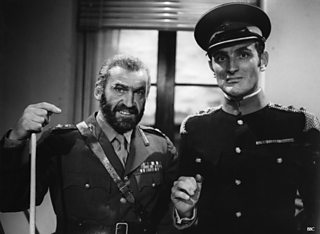
Guest Patrick Troughton and star Gerald Harper in the Adam Adamant Lives! episode, D for Destruction. Rediscovered in 2003 in the BBC Archives, it was shown at Missing Believed Wiped
However, there is a still a lot of material that is not available, and it may be a long time before it is. With popular forms like drama and comedy, a lot of people are willing to pay to see them again, though the numbers can vary widely depending on the particular show. With these genres, actors, writers and others need to be paid for the exploitation of their work beyond what was originally contracted.
At Missing Believed Wiped only a certain proportion of all the programmes that have been returned can be shown, and of course this is to a tiny number of people, although occasionally some have gone on to be released or broadcast. The amazing thing though is that every time a programme is returned, people say to themselves that it could be the last time anything turns up – except that year after year more material is unearthed. How much more missing content is out there?
The host for Missing Believed Wiped was Dick Fiddy, television consultant at the BFI. In his introduction he pointed out that if the programmes that day had linking any theme it would be that they could be regarded as politically incorrect. The way in which, and the extent to which that was true varied from programme to programme.
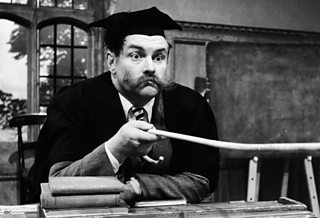
'Professor' Jimmy Edwards in Whack-o!, his sitcom which ran from 1956 to 1960, with a revival in colour in 1971/2
Till Death Us Do Part is an interesting, but controversial programme. It was criticised by the likes of Mary Whitehouse when it was originally transmitted for the swearing (comparatively mild by today’s standards, even creative in its way!) but what really jars to modern ears are the racial epithets. It can be quite an uncomfortable experience to hear frequent use of racist language – even though it never uses the ‘N word’.
The great irony of the series of course is that it was intended to satirise racism and intolerance – Intolerance was even the title of this recovered episode – but in doing so it broke the boundaries of acceptable language, and arguably made racist terms less taboo. Speight and star Warren Mitchell were constantly surprised when people told them that they sided with Alf Garnett, not realising they were supposed to pity him – but perhaps they did pity him, in a different way, since Alf always seemed to lose the argument. Alf’s few triumphs were when he got the better of authority figures.
Of the other programmes shown, Whack-o! depicts a world in which corporal punishment was a normal event, which might surprise some young people, although the stage headmaster with mortarboard and ever-ready cane was a caricature even in the 50s. The episode had some imaginative sequences involving special video effects, and a typically sharp script by Frank Muir and Denis Norden.
The Avengers showed how much the early 1960s owed to the 1950s, with the thriller clichés of the past rubbing shoulders with the stirrings of the new decade, in an episode made in 1961. The Avengers would transform itself over time into the epitome of a swinging 60s surreal spy drama, and Patrick Macnee’s effortlessly humorous performance was the catalyst for its evolution.
The other ITV contributions were the pleasingly rural charms of Gone Fishing and the bizarre pleasures of Stars and Garters. The latter was a variety show set in a pub, but recorded at Fountain Studios, which have recently closed. The copy was incomplete, but excited much comment in the interval between the two screening sessions.
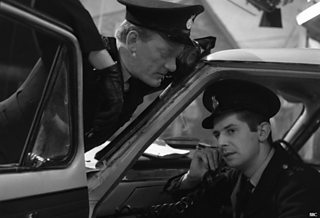
PCs Bob Steele (Jeremy Kemp) and Bert Lynch (James Ellis) who appeared in the returned Z Cars episode Family Feud, are seen here in the cut-down Ford Zephyr used for studio scenes
The last programme of the evening session was the 1962 Z Cars episode Family Feud. Written by the series’ founding father Troy Kennedy Martin, this episode perhaps had more in common with his original concepts, rather than the slickly popular, but more conformist series Z Cars soon became (by which time, Kennedy Martin had moved on). The episode is also an interesting contrast with the melodramatic world of The Avengers: the drama in Z Cars is more prosaic, but ironically more action-packed, with a greater amount of location film and stunt sequences.
Family Feud is a Romeo and Juliet story where a boy and girl from of different branches of the same Irish family, the Madigans, who fell out forty years before, find their love affair threatens to cause an outbreak of violence which the policemen of Newtown station have to defuse. The episode features the crew of crime car Z Victor 2, PCs Lynch and Steele. The latter is also dealing with his own domestic crisis, when his wife, Janey, walks out on him.
I always enjoy watching these archive treasures, whether they are newly recovered or items that have been preserved in the vaults of television companies all along. We can learn about the society they depict, we can learn about the ways of producing drama, we can compare them with life and society nowadays and how they are depicted in modern programmes.
The forms of drama have changed, as have the production processes. Will what we are making now seems as exotic in another fifty years, or as entertaining – at least to those of us who can get past black and white pictures, mono sound and a 4:3 aspect ratio (if – dare I say it – those things really matter at all) – and enjoy them for themselves? We – or our descendants – shall see.
Share your thoughts about the evolution of television, below… What shows would you like to see repeated that are never seen now? Or what missing episode would you like most to see recovered?
