Sunday Post: Not Only… But Also - The Missing Minutes
Andrew Martin
BBC Genome
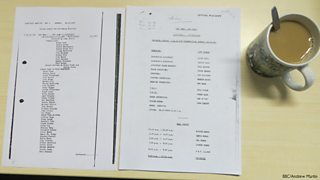
The essential tools of research into a Not Only...But Also conundrum.
Last week our guest blogger talked about some lesser-known comedies, this week it’s the turn of one of the better-known ones – but a sketch show with a difference, rather than a sitcom.
It was brought to my attention recently that one episode of Not Only…But Also, the classic BBC2 sketch series starring Peter Cook and Dudley Moore, was allegedly shorter by about five minutes in the BBC Archive than as originally transmitted.
While this is not that unusual – once a programme is exported, it is possible for edits to be made for censorship or timing reasons, and if the exported version is all that survives, as in this case, that is what we end up with – I decided to do some research and discover whether this was the case here, and what was actually missing. Armed with a copy of the recording and the script, it soon became apparent that it was true…
Cook and Moore had first come to prominence in the stage revue Beyond the Fringe, which was credited with launching the 1960s satire boom. When that finally ended in 1964 after a Broadway run (with a BBC showing of a special farewell performance in London), they were both looking for new projects.
Dudley Moore’s first BBC credit had been as a musician, and many of his early appearances including on Monitor and in a short television series, Meet Mr. Moore, were in that capacity, both as composer and performer. With his jazz trio, he also appeared in several radio series.
In 1964 Moore was approached to present a one-off programme for the new BBC2 channel, in which he would perform music, comedy and poems with guests including singer Diahann Carroll, Beatle John Lennon – and Peter Cook.
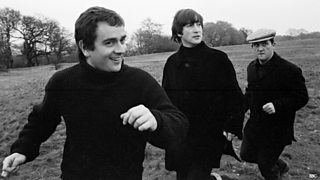
Filmed in November 1964, Dudley Moore and guests J.W. Lennon and Norman Rossington.
This pilot show was originally more than an hour long, and it is this version which survives in the BBC archives. By the time it was transmitted in January 1965, it had been decided to commission a series starring Moore and Cook. The first episode was cut down to 45 minutes with the spare material transferred to episode two.
The pilot had been entitled Not Only… Dudley Moore But Also - followed by the list of guest artists. The series proper became known as Not Only… But Also, with Moore taking first billing in series one, but the order alternated in the second series, and by series three it was alphabetical, favouring Cook.
The timing discrepancy in question was in the episode transmitted on 26 December 1966, a stand-alone edition shown well after the second series in January and February that year.
Looking in detail at the ‘Christmas’ episode (not that there is anything very seasonal about it) showed not only what had been cut – a section of one studio sketch and a whole filmed sketch – but also (see what I did there?) it was noticeable how much what was said on screen departed from the script. Cook and Moore’s comedy was heavily improvised, and even though a script was needed for production reasons, it was obviously an acknowledged part of their creative process that they would not necessarily stick to it.
Many traditional actors might have found this too challenging – but Cook and Moore clearly enjoy the mental sparring involved. Cook probably has the greater tendency to wander from the text, given his anarchic temperament and low boredom threshold, as well as his mischievous delight in trying to throw Moore off kilter. But Moore, who perhaps better remembers where they are supposed to be going and to try to get there, also has a jazzman’s love of improvisation, reacting in the moment to play around with the script.
The amount of material missing from the print of the December 1966 episode amounts to approximately four minutes. The show, recorded on 9 December, begins with a filmed sketch where Dudley is a new member of a fox hunt, who is given a fox costume and chased by the hounds . At the end of the item he goes down a burrow and emerges in the studio. This was followed by a song by guest Marion Montgomery, backed by the Dudley Moore Trio (on recording, there was a break to allow Moore to change costume).
After another break, the next sketch has Cook as a ‘fairy cobbler’ and Moore as his wife, a frustrated fairy called Melanie. The sketch demonstrates how the written dialogue differs from what was actually said on the night, but it also has a large section of dialogue missing on the recording compared to the script. It seems likely that this was recorded and cut later, as there is an obvious edit in the programme. It’s not clear why it was cut, and when, unless it was the censor’s objection to the word ‘titter’. (It’s lucky Frankie Howerd wasn’t a guest star or there would hardly be anything left…)
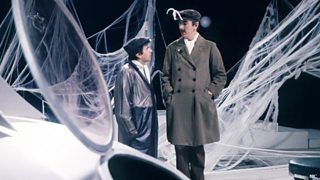
No, not Out of the Unknown, it's Pete and Dud...
The next item is a film sketch entitled ‘Golf quickie’, which is also missing from the BBC’s copy of the show – as with all the film items, no details are listed on the recording script.
In the case of drama or situation comedy scripts, film sequences tend to have their dialogue and stage directions included, as they contribute to the sense of the whole plot, but in a sketch show the film is not always relevant to the surrounding material, so the director might choose to omit it for brevity’s sake. The film itself would be played to the studio audience, to add their laughter to the soundtrack of the finished programme.
Next is another musical item by the Dudley Moore Trio, then the obligatory ‘Pete and Dud’ sketch, with Cook and Moore in their trademark flat caps and plastic macs, ruminating on the universe and Dud’s Aunt Dolly. As with the ‘fairy cobbler’ sketch, the spoken word diverges from the written, but it was the usual practice of the two to improvise sketches onto a tape recorder, then have this written down as a guide script. However on the day they would just use this as a basis for what they would actually say.
Towards the end of the sketch there is a filmed insert – the sketch is about Dud having an alien encounter on Willesden Common, and in the film sequence he is taken to another planet – with the payoff to the item back in the studio.
Another Marion Montgomery number is followed by a final sketch, ‘Swinging London’, starting on film with Cook as an American television reporter, and featuring another cameo appearance by John Lennon. The sketch moves to the studio, where Dudley is the proprietor of an exclusive public toilet, the ‘Ad Lav Club’, a satire on trendy London nightclubs (and perhaps a dig at critics of ‘lavatorial’ humour). Finally Dudley and Peter drive off on a piano from the club, which, back on film, travels across country and onto a railway track, as the closing theme ‘Goodbye’ is played – for once by an orchestra, rather than sung by the comedians (whose version was a hit single in 1965).
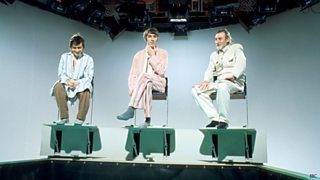
Guest Spike Milligan in the 1970 series item 'Poets Cornered' - prepare to be dunked in gunge!
As mentioned earlier, this was the last BBC show for several years by Cook and Moore, and their 1970 series, although followed by two episodes made in Australia, would be their last major television work together.
Cook and Moore’s comedy is definitely classic stuff, and it is regrettable that more of it has not survived - there are only eight complete episodes of the 22 made. At least more of it is retained than of Beyond the Fringe colleague Alan Bennett’s On the Margin, of which little more than off-air soundtracks and a couple of filmed sequences are left of its six episodes.
The missing material from the December 1966 episode, although probably only surviving in sound, may not plug a huge gap in the Not Only… archive, but we at the Genome Project like to think that every little helps…
Let us know any other TV or radio mysteries you'd like us to investigate - and any other subjects you want the Genome blog to cover...
