Marconi - the Sound of Silence
Andrew Martin
BBC Genome
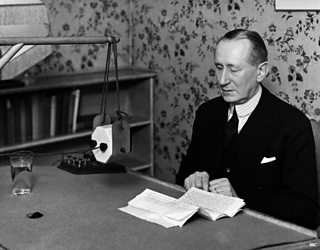
Giulielmo Marconi (1874-1937), pioneer of radio, giving a broadcast from a BBC studio in the 1920s (in those days they believed in making you feel at home)
It is 80 years since the death of Guglielmo Marconi, the pioneer of wireless telegraphy – in other words, radio.
Born in Bologna, Italy, in 1874, Marconi had a comparatively privileged upbringing, with expectations that he would go into the family business or another respectable profession. He did neither, but made the family name world famous.
Marconi was not conventionally academic, and never completed a formal programme of study, but he showed an early aptitude for science, especially physics. One new aspect of the science that was attracting attention in the late 19th Century was the phenomenon of Hertzian waves: what we now know as radio waves. This electromagnetic radiation had yet to be harnessed into any practical application, but it became Marconi's obsession to achieve this.
He was something of a prodigy, developing a basic system of wireless transmission while still in his early 20s. Thereafter he worked continually on it until he was able to convince institutions, such as the British Post Office, of its efficacy. With his lack of scientific education his work was practical rather than theoretical, but this was the key to his success. Conventional scientific wisdom, as espoused by the likes of Sir Oliver Lodge and other leading scientists of the time, had concluded that wireless communication was impossible.
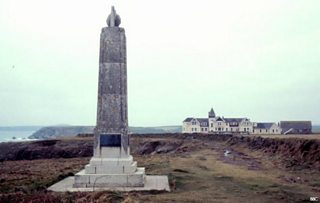
The memorial at Poldhu, Cornwall, to commemorate Marconi's sending of the first radio signal across the Atlantic on 12 December 1901. It was the letter 'S' - three dots in Morse code
It was not until the 1920s that it was established that radio waves were able to bounce off different layers of the atmosphere, making communication across the oceans possible – but this was many years after Marconi had achieved the feat, without actually understanding how it worked, only that it did. It was previously thought that radio signals needed line-of-sight between the transmitter and receiver, but it was then also thought that there was a substance called “the ether” through which electromagnetic waves had to travel, as it was thought that nothing could travel through a true vacuum.
As with many inventions, it was the interest of the armed forces, and in particular the use the technology was put to during the World War One, which gave the impetus to the full development of what we now think of as radio. Although the military authorities in many countries worried that private use of radio would interfere with their communications, it was soon inevitable that the demand for other uses, such as broadcasting, would have to be acknowledged.
Marconi, like that other maverick pioneer, John Logie Baird, took others’ inventions and made something new out of them, but did not devise every component himself. Marconi is generally known as the inventor of radio, and shared the 1909 Nobel Prize for Physics for his work (with Karl Ferdinand Braun, whose inventions included the cathode-ray tube, a tuning circuit for radio transmitters and the use of crystals for receiving sets), but many others, from James Clark Maxwell to Heinrich Hertz, Nikola Tesla and Reginald Fessenden, played a part in the development of broadcast radio.
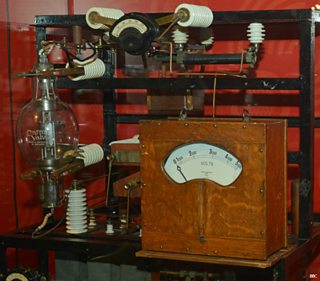
The original BBC transmitter, call sign 2LO, from 1922. The first BBC broadcasts were from Marconi House in the Strand, home of the Marconi Company who built the transmitter
Marconi however discovered a means of realising the new technology of radio and got it to work. He also publicised it and made it into a commercial concern, paving the way for the radio industry. But curiously he was not particularly interested in broadcasting, and left it to others to develop means of transmitting sound, which led to modern radio. All his work was on technology to transmit messages using Morse code, and it was with this technique that his fame rested during his active research period. Wireless telegraphy became the wonder of the early 20th Century, with crucial roles in events like the capture of the murderer Dr Crippen, the sinking of the Titanic – but also with the Marconi shares scandal of 1911.
As with Baird, the company that bore Marconi’s name continued long after he was no longer its chief asset and driving force, and indeed after his death. In 1920, the Marconi Company broadcast the first UK radio programme, with the famous singer Dame Nellie Melba, from its Chelmsford premises. Within two years, Marconi and the other major firms, with representatives of smaller companies, came together in a consortium to provide content for a national radio broadcasting service. The British Broadcasting Company was born.
The Marconi Company was responsible for some of the most important technology used by the BBC and other broadcasters, from the original 2LO transmitter to the Marconi-Stille sound tape recorder of the 1930s; Marconi joined forces with EMI in the early 1930s to develop a system of electronic television, and it was their 405-line system which became the main television format in the UK from 1937 until the late 1960s.
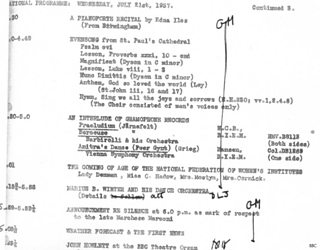
The BBC paperwork showing the 2 minutes' silence in tribute to Marconi, on 21 July 1937, the day after he died. Marconi was ennobled as a Marchese (Marquis) by the King of Italy in 1929
Marconi himself was not a frequent presence on the BBC, but nonetheless, like many prominent figures of the time, he was persuaded to broadcast on occasion. On the BBC’s first anniversary in November 1923 he gave a talk in a sequence of programmes called The BBC Birthday, and in 1931 he spoke on The Beginnings of Wireless. Marconi was a fluent English speaker through his mother’s influence (she was born Anne Jameson, of the Irish whiskey dynasty), and reportedly spoke it without a strong accent, doubtless confounding some people’s expectations based on his nationality.
The last 15 years of Marconi’s life saw the rise of Fascism in his home country. He had been appointed a Senator in the Italian parliament in 1914, and he became a friend of the Italian dictator Benito Mussolini, who appointed him to his ruling council, and accorded him a state funeral when he died.
The day after Marconi’s death, 21 July 1937, broadcasters everywhere joined in turning off all radio transmissions for two minutes (his homeland, Italy, observed five minutes’ silence). In Great Britain this radio silence was at 6pm, and included all BBC stations then broadcasting – except television, as it was not transmitting at that time of day anyway. It was still a fitting tribute to the man who first achieved this new method of communication, and changed the world.
