Shabnam's story - by Rakhee Thakrar

EastEnders Backstage Team
Nominated for best Serial Drama Performance at the 2016 National Television Awards for her powerful and touching portrayal of Shabnam Masood, actress Rakhee Thakrar reflects on Shabnam's moving and unforgettable storyline in this exclusive blog post.
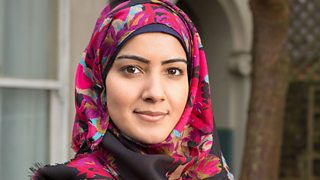
Stillbirth is when your baby is born without a heartbeat. I knew this. I knew it was sad. I knew it wasn't an easy thing for someone to go through. But you know what, I didn't know anything. Sad doesn't even begin to describe the trauma and heartbreak that is involved. Let's make it clear, stillbirth is when your baby dies inside you and you must give birth to them, usually naturally, as it's the safest option for the mother.
When I left the room after being told this was the story wer are telling for Shabnam, I felt a weight. I think it was the pressure to do it justice but also, it was a world I had never ventured into. How do you even begin to make your way into the world of such complicated grief? I soon realised my responsibility within it and so the research began.
I started, in the early stages with our best friend...the Internet! I found lots of stories on YouTube, mainly American ones, where women talked in great detail about what happened to them. I read books and blogs. Poems. Made a music play list. I work very much from the inside, I look for details that make me feel something and hope that stores in me somehow.
My first real turning point was when I went to visit Erica Stewart, bereavement support officer at Sands (stillbirth and neonatal death charity). I went in with an open heart, and I was a little nervous if I'm honest. I wanted to reassure them that I would serve their cause and that I was the right person for this. Thinking back, that was silly. As soon as Erica began to tell me, in great detail, the kind of grief that comes with the death of a baby, I soon forgot about my own worries. All I could think was - "I can't believe this happens". I felt like she let me into this secret world, a world where no one lives by choice and yet it is filled with more people than you would think. I spent 4 ½ hours there on my first visit.
The thing is, each story is unique. Everyone deals with this in their own individual way. However, there were some common markers. Things that came up again and again with different experiences. There is the numbness that many experience in the beginning, the guilt of knowing this happened in your body and trying to figure what you did wrong (even though you are not to blame), the anger at how unfair this is, the loneliness- because grief is so unique, often two people won’t handle it in the same way at the same time. The robbing of your innocence as you now know what can go wrong in the world. This all struck a chord with me. If I could serve some of these markers in the way I tell Shabnam's story, then maybe her experience could be the truth of some of the mothers who may watch? I didn't plot or plan where these markers would be, I just let them ruminate in me and surface when it felt right.
For example, the dinner table scene (the day after Zaair is born), where Shabnam has an outburst at Carmel and talks openly about him; I didn’t plan the scream. But this was one of the markers. Mothers told me about the feeling of coming out of hospital with a memory box in your arms instead of a baby, whilst the world is carrying on. No one seems to notice and you just want to scream at them “STOP WHAT YOU’RE DOING, MY BABY HAS JUST DIED!” That was one of the first scenes we filmed and I remember walking into the Masood kitchen after and thinking “I can’t believe this is what women are going through right now, it’s so unfair”.
I met with three mothers in the beginning and each of them were invaluable. These women, and this is not an understatement, are AMAZING. They spoke to me with their hearts open and let me into the life of a bereaved parent. They formed the core of Shabnam’s story for me. I didn’t realise at the time, but I ended up doing it for them. This was so much bigger than this show and I wanted to honour that as much as possible.
As this was quite an intense story, I constantly sought out inspiration and information to make sure I could keep my input into the scenes alive and truthful. I found a great online magazine called “Still Standing” which is a collection of articles and poems by bereaved parents. This was incredibly helpful to me, as they’d give me different points of view on the same story. A nuance I hadn’t thought of, an experience that maybe I could weave into our story. Not to mention how moving they all were.
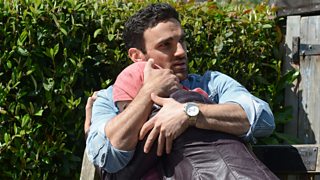
One of the details we were keen to plant in our story was a movement pattern for Zaair. I spoke to Kris Green (script editor) and together we implemented seeds here and there about the baby being more active in the morning. As well as being in denial, she thought there was this last hope to see if he would become active again at his usual timings. I also thought that she shouldn’t be too distraught too early, I always thought if she gave into panic too early, surely she would go into hospital immediately? From the research I did, parents told me that there is often a slow growing awareness of the fact that there is something wrong. You really don’t want to entertain the thought that your baby has died. It’s too unthinkable and so you find ways to deny it.
Something I learned about this kind of grief is that there is a major taboo around baby death, and in particular Stillbirth. So, no one talks about it and the consequence of this is that these beautiful babies are not acknowledged in the way they should be. Every parent I have met along the way has lit up the moment their baby’s name is mentioned. It’s about acknowledging this little person, who was very real, very wanted and is very much missed.
The sharing of memories is very limited, no one (technically) got to meet the baby so they may treat it as someone that wasn’t real, which is incredibly painful for parents. For the mother this is intensified as she had a special relationship with her child, she knew how the baby rolled, wriggled and kicked, if she is made to feel that this wasn’t a real person it can make the grief even more complicated. It deeply internalises the trauma which would then manifest itself in different ways. Also, because no one talks about stillbirth, there is much that the non-bereaved community aren’t aware of. I had many messages from mothers, after the episodes aired, saying family members didn’t realise they had to give birth…! What a HUGE part of your life not to be able to talk about?
We wanted to handle this sensitively and truthfully but you never know how it will land. Thankfully, the response was incredibly moving. I couldn’t believe the messages we were getting. Women saying thank You, for showing the utter devastation and heartbreak of the situation. Parents and families sharing their stories. Non-bereaved people being absolutely floored at what many parents go through every day. I was very aware we had an opportunity here to help even more, which is why I started the #saytheirname campaign on Twitter and Facebook after the Tuesday night episode (with that dinner table scene, where Shabnam implores her family to acknowledge Zaair) Here’s a chance for parents and families to openly acknowledge their babies under a unified movement. And that’s exactly what happened, but it went further, they shared pictures, stories, feelings and more. We were helping to break down this taboo, this stupid unnecessary taboo. It took off in a way I hadn’t expected, it was very special.
So once all the research and prep is done, the schedules are released and the costume is hanging up in your room-how do you tell the truth of giving birth to your dead baby? For me it’s imagination. I did as much research as humanly possible, but when you get to set, you have to let it go (ironically) and completely believe this is happening-right now.
We were very lucky to have an incredibly sensitive crew working on the filming of these episodes and an amazing director, Richard Lynn and a very supportive 1st Assistant Director, Matt McHale. It helped we had excellent scripts from Pete Lawson and Lauren Klee too. (With Anya Reiss perfectly setting up the chaotic comedy before we were hit with those haunting words…”It’s the baby…I don’t think it’s moved”) Erica Stewart from Sands metaphorically held my hand throughout this, she was on the end of the phone any time I needed to run something by her. Nathalie Mitcheson was invaluable at helping me work out more about the way Shabnam was about to deal with this. What Jo Napthine shared with me formed the heart of Zaair’s delivery. Nitin and Davood were perfect. I know you may not know many of these names, but I feel it’s important to mention some of the people who were instrumental in this. It was a collaboration in its truest form, and for me, an incredibly profound experience.
