Stacey's Story: Home at last

EastEnders News Team
Clare Dolman, Vice Chair of the Maternal Mental Health Alliance and trustee of Action on Postpartum Psychosis and Bipolar UK, explains how the EastEnders storyline has had a huge impact on awareness and understanding of the condition.
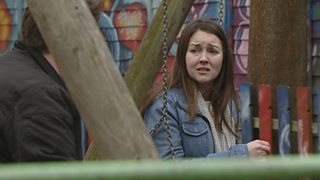
Tonight (Friday 8th April) Stacey Branning returns home with her baby, Arthur after weeks of treatment in a psychiatric hospital and then a Mother and Baby Unit for postpartum psychosis. Like the 1,400 women that postpartum psychosis affects every year, the transition to home life will probably be challenging and Stacey will need a lot of support from her family and understanding from her friends. When I suffered the same illness after the birth of my daughter, it took a long time to feel confident as a mum; I remember making up the same bottle of milk again and again because I wasn’t sure if I’d counted out the spoonfuls of formula correctly. Some though not all mums suffer symptoms of depression once the psychosis has ended. At APP – Action on Postpartum Psychosis, we’ve produced a free ‘Insider Guide’ to help women recover and get back to feeling themselves again.
In EastEnders, Stacey is lucky to have a lot of people around her who can help, so hopefully it won’t be too long before she regains her confidence as a mum.
The depiction of postpartum psychosis in EastEnders has massively raised the profile of this devastating condition among the general public. Lacey Turner’s brilliant portrayal of Stacey’s anguish as she suffers delusions and hallucinations soon after Arthur’s birth has deservedly received lots of praise in the press and on social media. Many people didn’t know this condition existed, while others who had suffered themselves had been reluctant to talk about it because of the stigma that exists against mental illness.
Just as Stacey had to suffer being separated from her baby in order to go into hospital and get the psychiatric care she desperately needed, so hundreds of new mums unlucky enough to be in a part of the country where there isn’t a specialist Mother and Baby Unit, have to spend weeks or months apart from their newborns. On EastEnders, Martin had to track down an available bed in a unit quite a drive away so that Stacey and little Arthur could be reunited. This reflected the real need for better care for women suffering in this way, and Stacey and Martin’s story has led to more people looking at the website of the Maternal Mental Health Alliance, to find out more about the issues. It’s possible to see what services are available in your own local area by looking at our map.
And it’s not just us who have been enthralled by the Stacey storyline: the Minister for Mental Health, Alistair Burt, also praised EastEnders in his speech to the House of Commons reporting on the government’s plans to improve perinatal mental healthcare:
“It’s great that EastEnders is raising awareness of this very important issue and it makes for some harrowing scenes to watch. Having a baby is a major life event and we want all new and expectant mums get the mental health support they need. That’s why we are spending an extra £350 million on perinatal mental health services over the next five years.”
Those of us who are aware of the need for massive improvement in the provision of specialist perinatal mental health services were thrilled to hear this commitment, but things need to change in all four nations of the United Kingdom – and as a society we need to tackle the stigma against people with mental illness. Here again, the EastEnders storyline has been a huge help. The interest it provoked led to perinatal mental health being featured in the BBC Mental Health season in February. As part of the ‘In The Mind’ season, BBC1 screened a brilliant documentary ‘My Baby, Psychosis and Me’ about the real-life experience of two mums in a Mother and Baby Unit, and encouraged Sport Relief night to include an appeal from Lacey Turner on the subject. Many mums and dads contacted @sportrelief #MumTalk to share their own stories of how perinatal mental illness had affected them personally, helping to dispel the stigma in the process.
In my first blog I wrote about how pleased Professor Ian Jones and I were that the EastEnders writers had done such a great job of portraying the reality of a young mum suffering from a postpartum psychotic episode and her struggle to get help. Both the charities which we are associated with - Bipolar UK and Action on Postpartum Psychosis - experienced a surge in emails, calls and hits on their websites. In fact, in the three months since the episodes aired, Bipolar UK has received nearly ten times as many downloads of their booklet on Bipolar and Pregnancy as in the three months before, and visits to APP’s website have doubled.
So as someone who suffered a postpartum psychosis myself and who has been trying to raise awareness about these issues for many years, I am extremely grateful to East Enders for deciding to feature this condition on the programme and for doing such a great job in portraying its frightening reality, but I also want to say thank you for helping to raise awareness of the need for better perinatal mental health services for everyone, no matter where they live in the UK.
