BBC BLOGS - West Country Cash

Archives for July 2009

Wiring the Great Western : are electric trains worth the money?

Dave Harvey|17:50 UK time, Thursday, 23 July 2009

They say time is money, so how much is a minute worth to you?

In order to see this content you need to have both Javascript enabled and Flash installed. Visit BBC Webwise for full instructions. If you're reading via RSS, you'll need to visit the blog to access this content.


If you had a vital meeting in London, or were heading up to see a show, what would you pay to get there a minute earlier?

I ask because Transport Ministers reckon a minute of our precious time is worth £83m. You read that right. Today's plan to electrify the Great Western Railway costs £1bn. It will shave 12 minutes off the Paddington to Temple Meads journey. Value for money?

"Unalloyed pleasure" was John Savage's reaction. The chief exec of Business West has been banging on about a fast train to London for decades. "Getting to and from the capital fast is one of the main reasons people move here, and move their companies here," he told me.

On the platforms, they're a little underwhelmed. "12 minutes?" say Max and Hannah, students travelling to London. "Not sure it makes a big difference really."

They, like many others, are more impressed by what electric trains will save the planet. Department for Transport figures suggest carbon emissions on electric trains are between 20 and 35% less than diesel locos. But there's a problem with these stats.

The electric line will come to Bristol, then on to Swansea. But for Weston-super-Mare, Taunton, and all points west the locos will be diesel. Which means the trains that run from London to Bristol and then on will be "hybrids". Electric power units AND a diesel engine will pull the same train.

"So," I ask the man from the ministry, "does this mean the electric engine will have to pull the diesel loco and all its heavy fuel?" Yes it will, I hear.

"So all the way along the super fast super clean super green electric route it will be lugging a great diesel loco and be much slower and heavier than it need be?"
That, I'm told, is an unduly cynical view. But yes, the facts are true.

How full is your glass? For optimists, today sees a revolution bringing faster, greener trains and boosting business. For cynics, a vast amount of money we can ill afford buys you another 12 minutes to wait for a tube.

What's it worth to you?
Bank's number two tells BBC Bristol: "I don't know"

Dave Harvey|17:23 UK time, Monday, 20 July 2009

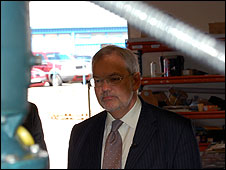
Charlie Bean, the Deputy Governor of the Bank of England, has just told BBC Radio Bristol's Ben Prater: "I don't know where rates are going next - and anyone who tells you they do is talking out of somewhere I shouldn't mention on the air."

In order to see this content you need to have both Javascript enabled and Flash installed. Visit BBC Webwise for full instructions. If you're reading via RSS, you'll need to visit the blog to access this content.

It's a fairly frank admission, when you think about it. Of course the DG doesn't exactly know what will happen next time the Monetary Policy Committee (MPC) of the BoE meets to fix interest rates. But he meant more than that.

Is the worst of the recession over? We don't know.

Are companies starting to trade better? Some are, some aren't.

Will inflation start pushing up in the winter and so rates will have to go up with it? No idea.

_46056603_bean003_bbc.jpg

Everything we asked him for a view on, he kept coming back to uncertainty. We just don't know.

People like me probably over-use the phrase "uncharted waters" to describe this current mess. But listening to Charlie Bean, I felt easier, quantitatively easier in fact, about not knowing.

They do know a fair bit, of course. The bank has an agent here, with 3,000 business contacts, who tell him how life is. "Most tell us the economy has bottomed out, the worst may be over," Mr Bean recounts. "But they're unsure where you go from here."

So, if ever there was justification for throwing the floor open to all, here it is.

Do you run a business? Tell us what it's like out there.

Do you have a job? How secure do you and your mates feel.

Do you spend money? Are you feeling confident? Ready to spend again?

The men who run the country's bank happily admit they don't know what's happening. So it's over to you.

How many more jobs will go at Lloyds in Bristol?

Dave Harvey|13:16 UK time, Thursday, 16 July 2009

Another 110 jobs have gone today at the Lloyds megaBank HQ in Bristol.

How many more? If you believe the man who blew the whistle on HBOS, there will be 20,000 jobs cut before this ends. Paul Moores, the controversial figure who claimed HBoS was run like a dodgy car boot sale, hails from Bristol and told me on the Politics Show West the cuts would be deep and savage.

5,000 people work for the superbank in Bristol. Waiting to meet one of them recently I had a nose through their staff newsletter. "We have lots of great operations", soothed the new man in charge of Group Operations, "but we often have two and only need one."

They've even got two buildings. Here they are - right next to each other on the harbourside.

Clerical Medical, once a proud Bristol-based insurer, has already had its chips. The brand will go, the Clevedon call centre will go. Today, 110 people who work on its marketing and finance desks in the HBOS tower in Bristol were told their jobs will go.

"Groundhog Day," the unions call it. But what can the managers do? Once the merger was sealed, the die was cast. Two IT systems? I think not. Two marketing teams for two insurance brands? No way.

And what of the customers? I was at a get-together of small businesses near Weston last night and several said we need more competition, not less. If you're looking for lenders all the foreigners have gone already, so rolling Lloyds, TSB, and Bank of Scotland all into one does no-one a service.

Can anyone see a way out? Or must we just grit our teeth and wait for another 12,000 jobs to go, perhaps 2,000 more in Bristol, before this merger is behind us.

The banker's problem: who will take my cash?

Dave Harvey|11:00 UK time, Tuesday, 14 July 2009

shoots_150709_banks.jpgIf there's one thing my eight year old can tell you about the Credit Crunch (other than her favourite pick'n'mix has vanished) it's the simple fact that bankers stopped lending.

Well I've just met one who swears he hasn't.

Can't tell you who he is yet, it's all very hush hush. But I can quote anonymously: "My problem is finding businesses to take the cash."

Form an orderly queue now, let me introduce you.

This guy works for one of our big banks, and lends to biggish firms in the West Country. He says colleagues working with one man bands have the same problem.

I remind him that in the popular version of the Credit Crunch, the bankers are the bad guys. The ones refusing to lend to healthy firms, or hiking their rates up for no reason.

"Not us", he insists. "We may have put our margins up, but our overall rates have gone down."

On this point he's quite right. Every deal is different, but imagine a widget-maker in Warminster, turning over £30m a year and borrowing from the bank at 1% over base rate. Yes, 1% above the Bank of England's base rate. Fairly common over the past few years, when money was cheap and the competition for lending fierce.

"1% over base is history," my banker tells me. Those days probably always were madness, and now they've gone. There was a wall of cash which retracted, and left a void," he says. Banks now have to keep much more capital in their reserves, world money markets are much more expensive, and everything is riskier. Which means that deal is now costing our widget-maker 3% above base.

But people should stop looking at the margin, says my man, leaning forward insistently. The actual cost of the money is all that matters. And since the Base Rate has dropped from 5.5% to 0.5%, that new deal is 3.5% - compared with 6.5% two years ago. Yes, the margin has gone up; but the price has gone down.

So what of his claim that every day bankers like him go out hawking their cash to a nation of penny-pinchers who won't take a loan? Well, it's not what I hear from Business Link, from the Federation of Small Businesses, or from companies I talk to. They all say the biggest bugbear is still raising finance.

"There's a real disconnect there," agrees my new money mate. You can say that again. We come up with a few possible reasons, but I'm open to suggestions on this one from you. First, he says people are more nervous about borrowing. If orders are down, you think twice about that fancy piece of German kit the production manager is begging you to buy. So there really are fewer firms asking for money.

And second, it's true that the foreigners have fled. Not the Polish plumbers, but the Icelandic bankers, and the Qatari Investment Funds. In the boom years before 2008 lots of deals were financed by overseas cash. There are much finer analysts of their flight than me, but suffice to say the overseas lenders aren't here any more.

The Bank of England has produced reams of stats that show how our big UK banks have been left holding the financial baby. Lloyds, HSBC, RBS and NatWest, Barclays - the usual names - are now doing the vast bulk of UK commercial lending. So it could be true both that these guys are lending more, and that there's less cash about.

Well, what do you know? This recession gets more and more complex, the web more and more intricate. So if you're borrowing from the banks, tell me what they're like. Is my Big Friendly Banker the only one? Is he spinning me a line? Hit that comments button now....

Swindon Jobs : The revolving door

Dave Harvey|15:15 UK time, Thursday, 9 July 2009

No sooner had I written about the return of jobs (albeit temporary) to Swindon than another firm announces bad news.

Plus Semi, a semi-conductor manufacturer in Cheney Manor, are going to sack between 60 and 85 people out of a total staff of 115.

Why? Horribly simple I'm afraid. Round the world, people aren't buying chips (of the silicon variety) like they used to. On the phone, the current MD is friendly and philosophical. They just aren't getting the orders, he says, and so they may have to stop manufacturing altogether.

Meanwhile on BBC Wiltshire's Breakfast show, I hear about another man who may soon be cashing in his chips (of the potato variety). Damien Oakes took over the Manor Road Fish bar in Trowbridge 18 months ago. He was taking £18,000 a week and had no debts.

And today? Takings are down to £1,000 a week. Damien tells BBC Wiltshire that the whole parade by his chip shop is suffering. The hairdressers has closed, the newsagents is up for sale - what's going on?

All I can say is: get used to it. We're going to have good news and bad side by side on the money front for a year at least. Agencies will hire staff, companies will open and profit; meanwhile, other firms will undoubtedly fail and unemployment will continue to rise. Why? Because this is what one analyst recently called "the fat grinding middle" of the recession.

We're no longer at the beginning of the recession. We're surely nowhere near the end. And to risk quoting a great Briton, we might have only seen the end of the beginning.

Jobs return to Swindon - but mostly for temps

Dave Harvey|07:30 UK time, Thursday, 9 July 2009

Stella Weekes is not a lady to mess around. She started her recruitment agency in the 1991 recession, so she knows a bit about doom and gloom.

Last year she did so well she took all 38 of the Mainline staff to Vegas. To say "thanks"!

Stella Weekes

This year, she had to let half of them go. It hurt. But when Woolies closed their distribution depot, big electronics companies laid people off, and Honda shut down for four months, the fizz had gone out of recruitment.

Behind the official unemployment stats, and the formal redundancies that people like me tell you about on the news, are the temps.

Agency staff are the first to go. Sometimes it hardly merits a phone call, the phone simply stops ringing. They can be sacked overnight if need be. Great for companies trying to cut costs in a hurry, awful for guys with kids to feed.

Tony was a temp at BMW, pressing the panels for the fancy Mini they make in Oxford. The company sacked all the agency staff on Christmas Eve.

So Tony went to see Stella, and her Mainline crew. For months, they had nothing. Then last week - tada! A job. Another forklift job, at another car supplier. This lot, Howard Tenans, run the warehousing for Honda. A million exhausts come in from Oxford, then go out one at a time exactly when the guys on the Honda line want them.

Howard Tenans laid off half their staff when Honda shut down. No surprise perhaps, but no nicer for that. Now they're hiring again, but here's the thing. They aren't confident enough to put everyone on the books - 11 permanent, 11 temps. "We're still bubbling along the bottom", their sales director, Ben Morris, told me.

So yes, jobs are creeping back to Swindon. But they're awfully vulnerable. If this is a green shoot, it's a tiny delicate slip of a thing. And you hope for Tony's sake there are no sharp economic frosts ahead.

Because we all know why people hire temps. Easy come and, sadly, easy go.

Green shoots, white flowers and long pipes

Dave Harvey|15:24 UK time, Tuesday, 7 July 2009

OK, enough "green shoots". After yesterday's avalanche of words and reports on possible recovery, a long cool drink is needed.

And in the Cotswolds, the thing to drink is elderflower cordial. Metaphor lovers can have a field day. First off, the elder seems to thrive in muddy ditches surrounded by nettles. Second, you can make a gert strong champagne out of its dainty flowers.

Memo to Mervyn: look in muddy ditches for the tonic you need.

ElderflowerAnyway, round Nympsfield way they've been harvesting, squashing and cordialising (is that a word?) for centuries. Then 20 years ago, a couple of locals started bottling the stuff. Today, Bottle Green is a multi-million pound firm, selling to supermarkets and cafes. Their ready-to-drink fizz graces hampers at Westonbirt jazz nights or polo at the Beaufort Club.

Last year was a shocker for them. Like so many firms, they had their own very private storm. Glass bottles, as I'm sure you all noticed, went up 30%. As did sugar which (of course) is traded in Euros, so the fall in sterling was bad news. Interesting, how many different reasons there are for a bad year.

"We're glad it's behind us," Nigel Osborne tells me. He's one of the directors, and his spreadsheets look a bit better now. They've changed bottle suppliers and lorry firms. They had to lose three of the 35 staff. And, best of all, the sun has come out.

"Our cordials are a kind of affordable treat," Nigel explains. "10p or 15p a glass isn't much, but with more people entertaining at home, it's selling well."

Enough of flowers. Pipes are the new metaphor for me.

"The news going into the pipe is good now, but the pipe is nine months long."

shoots_150709_gregory.jpg

This gem is from a senior deal-maker at Deloitte's, Martyn Gregory. Not a man to hog the limelight, Mr Gregory brokers deals when firms need to raise large amounts of cash. And yes, last year was a shocker for him too.

Now they're coming back for business, he says. Deloitte just surveyed 250 medium-sized firms in the West Country, and found 51% expect to cut more deals in the next six months.

In October, that figure was just 7%.

"The trouble is," Martyn Gregory explains, "these deals take six to nine months to complete. So the news coming out of the pipe now all started back in September, when everything was frozen. In six months' time, we'll start to see the fruits of today's labours."

So: take 20 elderflower heads, crush them with some Eurozone sugar, put them in a deal-maker's pipe and smoke 'em. By Christmas, we should be in clover.

Is that clear?

Green shoots in the garden ... or just weeds?

Dave Harvey|15:52 UK time, Monday, 6 July 2009

It's like an allotment in April. Eager grow-your-owners rush down after school to see if the sweetcorn is up yet. "Look look, here's a shoot! Or is it a weed?".

Next day the first tiny shoots have been caught by frost or squashed by a nosy badger.

Brendan Barber

The latest badger in the business news is Brendan Barber. The TUC's General Secretary says the recession will be long, deep and cold. Colder even than the 1980s. "Beware talk of green shoots", Mr Barber warned.

But then two respected bodies have both said "the worst is over". CBI boss Richard Lambert used those exact words in a report last week. And the
National Institute for Economic and Social Research (NIESR) came to the same conclusion a few weeks before that.

Everyone has their own dipsticks for spotting the recovery. City pundits fancy the Baltic Dry Index; others count the queues at the JobCentre. What's your favourite?

Mine is inexplicable optimism on the High Street.

In order to see this content you need to have both Javascript enabled and Flash installed. Visit BBC Webwise for full instructions. If you're reading via RSS, you'll need to visit the blog to access this content.


And on my walk to work at the BBC in Bristol there are two new delicate shoots poking through the hard soil of the retail allotment. Whiteladies Road is pockmarked with boarded up shops, restaurants, estate agents and mortgage brokers. But two down from Woolies, a new restaurant opens.

No surprise there, maybe, even in recessions new businesses open up. But Rockfish is almost a clone of the failed upmarket fish shop it has replaced. Classy, locally sourced fish dinners. A wet fish counter alongside the restaurant. Even the name on the menu is the same. Mitchell Tonks set up Fishworks in Bath in the 1990s and grew through the foodie revolution to ten outlets. He sold his own share a couple of years ago and then just before Christmas, Fishworks sank.

So what's different now? Is the recovery so strong that Bristol is once again full of posh diners seeking fancy Sea Bass and Samphire?

My resident doom-monger is Mark Dampier, of Bristol money-men Hargreaves Lansdown. He called the credit crunch a year out and refuses to be anything but gloomy still. So could the new "open for business" signs persuade him?

The second new shoot is even more surprising. At first sight, it looks like a mortgage brokers. In fact, Cartel doesn't do mortgages, at least not in the normal way. They "review your financial commitments" which is polite code for a booming industry. if you are having trouble with your mortgage, Cartel's advisers will comb the small print for a legal loophole. They do credit cards and loan agreements too. Their clients have escaped thousands of pounds of debt.

"Yes, a green shoot," says miserable Mark Dampier. "But one that grows on the dung heap of the recession, don't you think? The mountains of debt are so huge companies like this are going to do well."

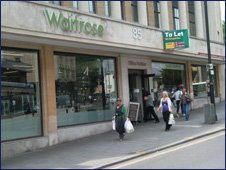
Waitrose

Down on The Triangle I come upon a sturdy new sapling and another withered little plant.

The sapling? Waitrose. A fancy new city centre offering from the upmarket supermarket, which has been transplanted right onto the site of a posh organic shop that died in the first economic frost of 2008. And they're doing very well.

But right next to it - a shutdown furniture store. Furniture - especially top end stuff - has been walloped by the recession round here. And this is the second firm to try selling bespoke beds from the same spot.

I guess Martin Weale, of the NIESR, would shop in Waitrose and hold his Cheddar Strawberries aloft crying "Here - the good times are coming back!"

Brendan Barber will stand grimly by the "To Let" sign on the old furniture store, muttering about early frosts and green shoots.

So what do you see? Shoot or weeds? Hit the comments now ...

Update 08:21
Seems we're not alone in shoot-spotting. The British Chambers of Commerce (BCC) which covers the whole country but has more members in the North, is also identifying "welcome progress" in the magic C Factor....

BBC © 2014The BBC is not responsible for the content of external sites. Read more.

This page is best viewed in an up-to-date web browser with style sheets (CSS) enabled. While you will be able to view the content of this page in your current browser, you will not be able to get the full visual experience. Please consider upgrading your browser software or enabling style sheets (CSS) if you are able to do so.