My Story: 5 special episodes

Mollie
CBeebies Grown-ups
A special series of My Story episodes is on CBeebies from 12th January. We spoke to Executive Producer, Morven to find out how this series is different and what we can expect….
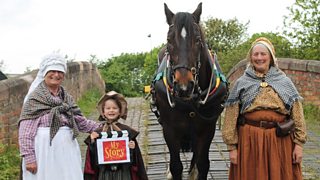
What are you doing differently in these special episodes compared to the My Story series that people will have already seen?
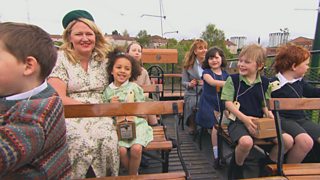
These special episodes are a bit different from series 1 & 2 of My Story where our families discovered their personal history. These 5 specials take our families further back in history to discover what childhood was like a long, long time ago. We explore what life was like for a child in the UK during Roman times, Viking times, Elizabethan times, the Industrial Revolution and World War II. Our families find out about real children who lived during these times and what life would have been like for them – where they lived, what they ate, the games they played, whether they went to school and how they learned.
Why do you think it’s important to have real children and their adult relations leading the programme?
As the programme says “it’s a journey of discovery”, not only for the child but for their adult relation too. The families taking part have a shared experience where they both learn and try out new activities together, and hopefully this demonstrates to all child carers the fun and discovery that they can have with their little ones.
We know the CBeebies audience have an appetite for history, so when we were looking for families to take part in these specials we put out a request through the CBeebies Grown-ups Facebook and Twitter pages asking for history enthusiasts to contact us if they were interested in being part of the programme – and we were absolutely inundated with applicants!
What do you hope that children will get out of the special episodes?
My Story aims to inspire children to explore how people lived in the past through imaginative play. We actually follow the curriculum for pre-school children, by looking at how people’s lives in the past were different from their own. We hope that children will be able to make a personal link to the past by discovering and exploring items and images connected with important individuals or events from the past. Each programme helps to introduce young children to the concept of history and time, and spark an interest and curiosity in them to want to discover more with their adult, and opening up the whole world of history to their family.
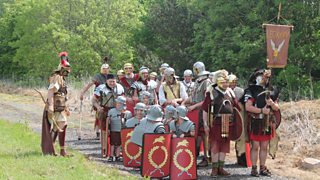
How did you select the locations and the historical topics?
In the second series of My Story the team made one programme which looked at the idea of childhood a hundred years ago – to tie in with the anniversary of World War I. That programme still had a family connection, but it did illustrate how the series could go further back in time.
When we came to develop these five Specials, we explored a number of ways of going further back –Including focusing on specific events in time – but ultimately felt this took away from the child element of My Story as most historical events are driven by the contribution made by adults. The Controller of CBeebies had requested that each story should ideally have a real, identifiable, child at its core, so that’s why we steered away from specific historical events and decided to focus on what childhood was like during broader time periods, discovering interesting characters and stories from those eras.
We worked with educational specialists to look at eras that most children would either already have had some exposure to or would have encountered in their early years education and we came up with our 5 stories; The Romans, Vikings, Elizabethans, Industrial Revolution and World War II. 2014 was the 450th anniversary of William Shakespeare’s birth so, for example, we also knew that we wanted to tie that into the Elizabethan episode.
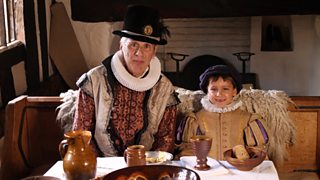
Finding the locations was a huge challenge, we needed locations that felt authentic, and would enable our families in the programme, and our viewers, to immerse themselves into that specific time in history.
There are many wonderful living museums throughout Britain but we often found that they didn’t have all the elements we required to tell our story effectively. Our Producer visited a large number of locations, then we had to narrow down our selection depending on the resources each place offered, their geographical location (to make sure they were spread across the whole of the UK), whether they were actually available for filming (many are booked up well in advance with school groups) and, of course, how much they would cost!
What’s the biggest challenge in explaining hundreds of years of history to a small child?
The biggest challenge was constantly checking whether our explanations were at a level which children could understand, without over simplifying, or making things factually inaccurate. We never want to patronise our audience but we do want to make sure that they understand what we are telling them – trying to define the industrial revolution in approximately one and half minutes was certainly one of the trickier things to do, but I believe the explanation in the show has succeeded.
How did the adults involved cope with using their imagination to ‘go back in time’? Did you find that the children took to that more easily?
Our adults were great and totally got what we were trying to achieve from the start. Dressing up in the costumes of the time really helped them to establish the mindset we needed, and they all embraced the journey of discovery. Some even wanted to keep the costumes on at the end of filming!
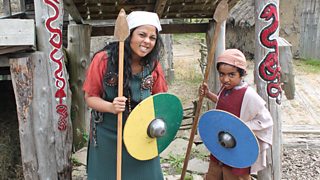
How could people take the ideas from the programme to explore their own local history?
There are lots of fantastic living museums throughout the UK, so you could find one near you to visit. Some even have costumes so that you too can dress up, just like the families in My Story, and others will have artefacts that you can get your hands on, or the opportunity to make things “the old-fashioned way”.
Most living museums run child-specific events so do keep your eye out for those as well. Even in our everyday lives, we’re often surrounded by items from history that you can use to transport a child back in time by telling stories of why an item was invented.
Finding out about a famous person from your local area can also open up a great journey of discovery with your child – can you find where they were born? Where they went to school? Does your local library have any information about them that can add to the adventure? Do a bit of research to find out what that person might have eaten and try making an authentic meal, the fun is endless! Local buildings and places often have their own fascinating history to explore, and of course going back to the earlier series of My Story, talking to older relatives, and looking at pictures and objects are great ways to explore family history too.
Visit the My Story web page
Have you been exploring history with your little one? Share your ideas on the CBeebies Grown-ups Facebook and Twitter pages.
