20 Years of Nevermind: Why Nirvana's Classic Still Appeals
Blog comments are currently unavailable. Find out more.
Post categories: 6 Music, Radio 1, album reviews
 |16:03 UK time, Friday, 30 September 2011
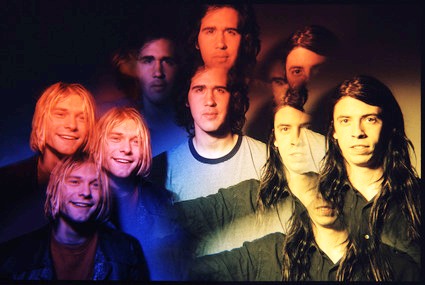
BBC Album Reviews editor Mike Diver looks at the lasting appeal of Nirvana's 20-year-old second LP
This weekend, Nirvana's Nevermind, originally released in September 1991, will re-enter the UK albums chart - and highly, too, with a midweek position in the top five. So-called classic albums are re-issued with additional material all of the time, but rarely do they sell in such numbers that the upper end of the chart is a realistic target. So why Nevermind? What makes this 20-year-old record so special that it not only appeals today, but to numbers enough that it can out-sell the likes of Girl's Aloud's Nicola Roberts and even Pink Floyd, whose own catalogue has been launched anew this week?
It's the middle of September, and I'm at the opening night of an exhibition of Nirvana photography and memorabilia at the Loading Bay Gallery, east London, attended by television presenters and Premier League footballers - plus a lot of us journalist types. Mingling, I speak to a handful of people about their own Nirvana memories and experiences, and it immediately becomes clear that the band effortlessly breezes between generations, even some 17 years since lead singer Kurt Cobain's suicide. A 40-something musician recounts times when, as a teenager, he and friends would hide themselves away from the outside world with some Nirvana records and some questionable mood enhancers - here, the music came alive, and it remains as vivid today as it ever was. Another musician, only 20, tells me she learned to play drums to Nevermind - an album released in the year of her birth.
Great records remain great records - but few teenagers today can be seen with the face of Syd Barrett beaming from their chests. More likely, one will see some kind of Nirvana/Cobain branding adorning the fashion choices of the nation's youth - "ten million miserable black-clad kids," as The Daily Mail's Paul Connolly so unwisely wrote online, leading to somewhat inevitable criticism from music press peers and the public alike. The music is easily understandable - pop-rock with bite, grunge through critical categorisation but with enough melodic nous to stand tall above so many of the plaid-shirted also-rans. It speaks, even today, to the temporarily disaffected teen; but in a way that's inclusive, too, of anyone who just wishes to enjoy a great chorus, a cracking hook, and a mighty riff. Put simply, Nevermind nailed a formula that several bands before Nirvana had been slowly brewing, thusly sending the Seattle-based trio into the stratosphere, from where they subsequently promoted the acts who'd been cornerstone influences. Would the Pixies be as big as they became without Nirvana's patronage? Would Sonic Youth? Would Mudhoney? Arguably, no. And this is just scratching the surface when it comes to acts that Cobain and company went out of their way to endorse, encouraging fans to check out a wealth of new-to-them music.
The story of Cobain is essential in Nirvana's legacy, too. His tale is one yet to be fully told, though Gus Van Sant's 2005 film Last Days paints a not-so-vague picture of the man's final hours, through the character of Blake. Looking over the romance and tragedy, the rise from nowhere to a position of substantial power, Cobain's life from 1991 to 1994 had an almost Shakespearian feel to it. And, of course, there's the unanswerable question of 'what if'. Had Cobain lived, where would Nirvana be today? Would they have crafted an album that surpassed not only the hits-filled (Smells Like Teen Spirit, Come As You Are, In Bloom, Lithium) Nevermind but also its darker successor, 1993's In Utero? Cobain had founded a friendship with R.E.M.'s Michael Stipe - Let Me In, on the recently disbanded Athens act's Monster album of 1994, was written as a tribute to Cobain. Would the fourth Nirvana collection have been a softer affair, with Cobain - having overcome the urges which led to him taking his own life - a happily married father of one (or more)? Such speculation, and so much more, is agonising as never will any hypothesis be realised.
Then there's the Foo Fighters. With ex-Nirvana drummer Dave Grohl's solo project turned stadium-filling concern still going great guns in 2011 - the band's seventh LP, Wasting Light, was released in April this year - many a relative newcomer to rock music is discovering Nirvana through the work of the Foos, working their way backwards to songs released long before their birth. And, of course, there are countless bands, bands with massive audiences, whose material owes a debt to Nirvana: 30 Seconds to Mars, Biffy Clyro, and even Nickelback. The latter outfit might be much-maligned in the music press, but their sales figures speak for themselves, and if just a handful of their followers check out Nirvana as a result... Well, that's a lot of new ears on Nevermind, for starters.
All of which goes some way to explaining this amazing album's enduring appeal. But, really, we can all surmise and suggest until every argument has been had - only for another to rise up. The only thing that really matters is that this music, just as it was in 1991, bursts with irrepressible energy, explodes with love for the art of making a room of people move and sweat in unison, and features lyrics that burn their way into the grey matter as if they're written on a branding iron.
Great music doesn't need qualifying through needs and musts. And Nevermind is, 20 years on, one of the greatest rock records ever written.
Read the BBC Music review of the expanded 20thh anniversary edition of Nevermind
BBC News on Nevermind's 20th anniversary
Listen to Zane Lowe's special Nevermind - 20 Years On show for Radio 1
Listen to a 6 Music special, Here We Are Now, Entertain Us: 20 years of Nevermind