"Who booked our transport to Glastonbury during the England game?" lamented 6 Music Editor Paul Rodgers. "Who cares?" came the reply.
So the 6 Music Glastonbury team were clearly in two camps - those desperate to follow a crucial game and those who say, "Well, it's not like, you know, Radiohead in '97. It's not like it's important."
Being an ex-pat Canadian I lay somewhere in between. I wanted to see the game, but wasn't that bothered. I just enjoy the spectacle. Which is what is fun about Glastonbury - the spectacle.
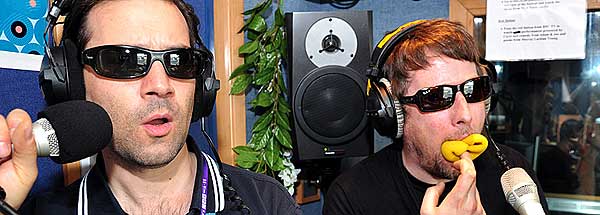
Not that we see much of it. As 5 live's AM frequency pumped through the bus tannoy, Paul and I shared the headphones of my DAB radio and got, if not crystal clear sound, then certainly something we could hear, I wondered if I would better my total of ONE song I saw at last year's event (Born To Run, since you ask, as soon as we went off air at midnight because Springsten ran over), then resigned myself that with an increase of broadcasting hours this year, that was unlikely, and the only real spectacle I would witness, would be the hard work going on in the BBC Compound.
This is a big operation, involving the skills of an essential team of broadcasting experts - from riggers, engineers, to producers, presenters, and editors, to interactive webheads, camera people, and those who support us through the 16 hour days of seemingly endless programming. And as someone who has worked in radio for a long time on both sides of the Atlantic and in commercial radio, I can say that no one covers and conveys a spectacle quite like the BBC.
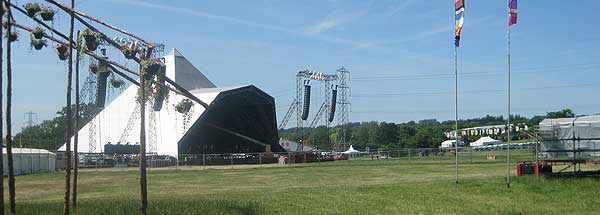
Glastonbury, as a physical space is enormous. And I mean enormous. It's something like 16 trillion square acres. It's essentially a town the size of Oxford that springs up suddenly, and instead of studious academics strolling around, you have 150,000 odd space cadets, in fancy dress, body paint, and a little 'ahem' chemically enhanced. Trying to cover all that (or indeed even navigate your way through it) is a Herculean task. But simply covering the Pyramid stage is not enough. So someone has to go to the other side of the site (a good hour's walk in decent weather) and have the technology to report back. So Tom Ravenscroft, who has a long history of seeking out the weird and the wonderful, is scouring the fringes of the festival site catching up with small and vibrant bands who play the smaller stages and tent and talking to the people who don't realise that there's actually music going on.
Julie Cullen and her team of journalists are covering the Other, Park, Peel, and West Holt stages with wrieless radio mics to let you know via us at 6 Music base who provided this year's "Glastonbury Moment".
So rest assured as you sit at home listening to our rolling coverage during the day with Lamacq, Lauren, Cerys, and Gideon, to the evening offerings of Tom Robinson, Craig Charles, Jarvis Cocker, Adam & Joe, and the exciting 'seat-of-the-pants what's happening next' showcase that will be the Headliner shows (2200 Fri - Sun), that we are toiling tirelessly, beavering away not only making sure that the generator doesn't give out and knock us off air, but that what you hear is the best radio anywhere in the world.
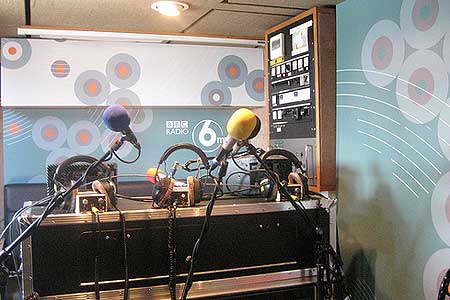
If it sounds effortless, then we're doing our jobs properly. If it doesn't, then, well, blame the "Magic of Glastonbury". Enjoy the spectacle coming out of your speakers, If only you could see the spectacle going on in the 6 Music broadcasting truck.
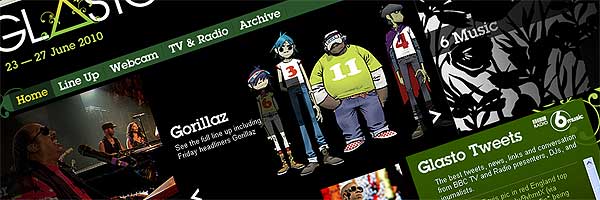
Keep up with all of the BBC's coverage, including live video streams of the 6 Music studio, on the Glastonbury home page.
Follow @BBCGlasto on Twitter for news, retweets and links from the festival.
We'll be scanning Twitter for use of the #BBCGlasto hashtag and publishing some of the tweets we find so use the hashtag when you're tweeting about the BBC's Glastonbury coverage.
I first went to Glastonbury in 1992. Why it took me nigh on 25 years to get there I don't know. It was hot, the Orb stole the show and Flowered Up did a version of Weekender that seemed to last an entire afternoon. But in a good way.
I forget how many times I've been to Pilton since those heady days of Fraggle but this will be my second year working here for 6Music. It makes for a different Glastonbury and not just because it is for me, quite rightly, a sober one.
I see it as part of my job to experience as much of the festival as possible. So, when I'm not presenting a show I'll be yomping across fields in a pair of shocking shades (hopefully) and a hastily bought hat (definitely). I'll be looking to see as many bands as possible but I'll also regularly visit the Green Fields, the Fields of Avalon, Shangri La, The Cabaret Field, Circus Field and wherever else I can get to.
With a notebook in my army trousers and probably having borrowed a pen I'll jot down as much as I can for use on air at a later point of the weekend. It could be anything from a band I've never heard of playing in a tent with no name to performers celebrating National No Smile Day to a chance encounter with a man with a ferret.
Admittedly this method of field reporting relies on my powers of description and increasingly poor handwriting but radio allows you to do this. Glastonbury is huge. Capturing it all on TV would require several thousand co-ordinated camcorders. With radio you can see something somewhere tucked away and then be talking about it on air minutes later. Provided you can find your way back to the studio
It's a tight space the Glastonbury 6Music studio and it takes a knack to open the door - much like an old shed - but it's slap bang in the middle of things and it works a treat. There's something special about being out of the comfort zone, not quite knowing what is going to happen next or indeed what button to press. I tell myself it's special anyway in an effort to keep calm.
And, over the weekend the studio plays host to a huge variety of musical guests. Some of them will also be part of the wider BBC coverage but many, many more will only feature on 6music. In that sense it's a constantly revolving door. Albeit one that needs a bit of a shove.
Gideon Coe presents live from Glastonbury thoughout the weekend. Follow his adventures on Twitter @gidcoe.
Keep up with all of the BBC's coverage, including live video streams of the 6 Music studio, on the Glastonbury home page.
Follow @BBCGlasto on Twitter for news, retweets and links from the festival.
We'll be scanning Twitter for use of the #BBCGlasto hashtag and publishing some of the tweets we find so use the hashtag when you're tweeting about the BBC's Glastonbury coverage.
It always feels really special returning to Glastonbury as it's where it all began for BBC Introducing in 2007.
BBC Introducing was set up to support unsigned, undiscovered and under the radar artists across the BBC and one way we wanted to do that was by giving new musicians big live performance opportunities. Our first thought, obviously, was Glastonbury!
In 2007 it was a new stage in a new area of the festival, The Park, and we were bringing 24 brand-new musicians to the festival to play the gig of their lives.
Back then we asked the newly set up network of BBC Introducing radio shows across local radio and all of the national networks, Radio 1, 6Music, 1Xtra and Asian Network to recommend artists from their area they felt needed to be seen by a wider audience. They each sent us three artists and we then pulled together a panel of music experts from across the BBC and beyond to listen. The likes of Steve Lamacq, Huw Stephens, Ras Kwame, Zane Lowe, Bobby Friction and Emily Eavis all listened and based on their selections we booked who'd perform on our stage.
Four years later and the principle is still the same. We are back in a new part of the festival, the Dance Village, but we are still bringing an eclectic mix of some of the hottest new acts from across the UK to festival-goers and those watching and listening to the BBC coverage at home.
We still programme the stage in the same way but now many of the artists that local radio shows suggest have come via the BBC Introducing uploader. Any new musician can go to the website and upload music they are making. Based on the postcode they enter it gets sent direct to their local BBC Introducing show - if they like it they will broadcast it, forward it onto Radio 1 or 6Music and maybe suggest them for a festival slot, which could lead to Glastonbury! So far more than 23,000 musicians have uploaded their music...
We always knew Glastonbury was a festival we had to have a stage at. It's legendary and continues to push boundaries with its line ups. That totally fits with the ethos of the BBC Introducing stage. You can go from a folk artist to a punk act, to an MC within a few hours and playing at Glastonbury all means something very special to the range of artists.
I have been lucky enough to call some of the musicians to let them know we'd like them to play the stage. Quite often there is screaming, disbelief and sometimes just a whispered 'thank you', as they explain that they are sat in the office, at their day job, surrounded by their work colleagues! Some then go on to tell you that they have been going to Glastonbury since they were kids and have always dreamed of playing. Others have never been, and aren't too sure about the sheer scale of the place - I remember one artist asking me if their friend would be able to sit outside in the car whilst they performed so they could get a lift home and I have seen quite shocked faces as they trade in their box fresh white trainers for wellies on arrival!
For the bands that play the BBC Introducing stage it isn't just about reaching an audience at the festival - we record and film the sets and each year we have seen the BBC's coverage of the stage grow. This year you will be able to hear tracks from the stage during 6Music's rolling coverage all weekend, plus on Radio 1 there will be highlights in their Monday night special from 7pm and Huw Stephens' Wednesday night show from 9pm. 1Xtra will be reflecting the stage on Sunday night in 100% Homegrown. Plus live tracks will go out in Bobby Friction's Wednesday night show on Asian Network and on the 37 local Introducing shows in the following weeks.
We also film the sets which will be streamed online at bbc.co.uk/glastonbury and tracks each day will go out on the red button and TV coverage - giving audiences the chance to see the big hitters next to some newer names who may become the big hitters of the future.
We are increasing our TV coverage this year with a documentary about the stage and three artists playing it (DME, Celt Islam and Lettie) which will air later this year on BBC Four. It will follow the acts from the rehearsal room to Glastonbury itself and all the nerves, tension and excitement that come in between.
So, back to 2007, the stand-out band of the year were the Ting Tings, who played to a very muddy but appreciative 40 people. Fast forward 12 months for them and they were playing in front of thousands who were packed into see them on the John Peel Stage. They have since returned to the Introducing stage to perform a special acoustic set to say thank you for the early support BBC Introducing gave them.
Florence & the Machine on the Introducing Stage at SxSW in 2008
So who will be the breakthrough artists this year? Well that's for you to decide. If you're heading down on site see you at the stage in our new home The Dance Village. And if you're watching at home do go online each day at bbc.co.uk/glastonbury and check out all the bands playing the BBC Introducing stage - I think you'll like what you see.
Follow @BBCGlasto on Twitter for news, retweets and links from the festival.
We'll be scanning Twitter for use of the #BBCGlasto hashtag and publishing some of the tweets we find so use the hashtag when you're tweeting about the BBC's Glastonbury coverage.
Clare Hudson|16:40 UK time, Thursday, 24 June 2010
I have always loved my annual Glastonbury-at-home experience and control it thoughtfully, from the Saturday night party guestlist to the ventilation (windows and backdoor open, even if it rains). So I was delighted when it was announced last year that the BBC was extending live rolling coverage from Glastonbury via 6 Music. Now, not only would I get a much more immersive experience of my favourite live music extravaganza but I'd also be able to help shape some of the interactive content we could provide from Pilton.
As my colleague Paul Rodgers outlines in his blog post the radio production team took on the challenge to provide the listening audience with the full Glastonbury experience and produced a staggering 39 hours of programming covering all aspects of the festival. The challenge for 6 Music's smaller but no-less perfectly formed interactive team was to find ways to reflect this sense of continuous output online. We opted to do two simple things - provide an accessible window on the station by broadcasting a live video stream from the 6 Music studio and aggregate the Twitter updates from our roving reporters and DJs on site.
At first, I think it's fair to say that most of our presenters were ambivalent about the cameras in the studio. But fabulous creatives that they are, by the second day into the long weekend, they'd found ways to use the camera to their advantage, mostly by improvising with what they found lying about in the van. So the studio white board became a canvas for Gid and Lammo to doodle on, and Adam and Joe turned some scrap cardboard into think bubbles to hold over their heads. You could see guests and contributors as they came in and out of the studio - I remember watching, captivated, as Emmy the Great and her guitar squeezed into the radio van to perform on Adam and Joe's Saturday show. We wondered if people watching were interested in seeing what else was going on so we set a small camera on the studio faders so people could watch the mechanics of radio in action.
This year we're taking what we learned and missed (including our very own 6 dressing up box) to bring 6 Music's experience of broadcasting live from Glastonbury direct to your laptop. The cameras will be back in the studio capturing and broadcasting our presenters and guests on air and hopefully coming up with some innovative ways to entertain our viewing listeners. We'll also send a camera out with our roving presenters so we can show you what they find, and for the first time, you'll be able to see many of the thousands of comments we receive via text, Twitter, Facebook and email alongside the pictures.
All our shows will be available to listen to again, including the rich array of archive programmes that are being broadcast overnight and we'll be providing shortcuts to all the best bits from the daily shows in handy clip form soon after broadcast.
I'm at home again this year, listening to non-stop Glasto from 6 Music and watching from my James Bond style set up of digital devices and consoles and would love to hear how everyone else plans to spend their Glasto-at-home.
Clare Hudson is the Interactive Editor of 6 Music and Radio 2
Follow @BBCGlasto on Twitter for news, retweets and links from the festival.
We'll be scanning Twitter for use of the #BBCGlasto hashtag and publishing some of the tweets we find so use the hashtag when you're tweeting about the BBC's Glastonbury coverage.
This year's Glastonbury coverage on the BBC will be the most interactive yet. Interactive is a word that's bandied around a lot but usually just means broadcasting online. Although this provides great access to 60-odd hours of performances and interviews, it feels restricted and beyond an avid Glastonbury fan's control.
So this year there are three main innovations added to the model of offering a tonne of rapidly available on-demand content on the BBC's Glastonbury website.
The first part is around liveness. We know that fans of festival coverage want to feel like they're at a festival, albeit without the mud. A wide choice of places to visit on the farm is vital and people at home also want to share moments with revellers at the festival.
TV and Radio will have some special live moments this year for sure, but why does the coverage have to be restricted by scheduling around Wimbledon and the World Cup? So from midday Friday, we'll be live streaming video backstage in the 6 Music studio, showing Julie Cullen's team of 6 Music News journalists in the field breaking stories and airing cutting edge bands playing the stages live.
These will all be presented in our new 'multiscreen' on bbc.co.uk/glastonbury. By the evening, the multiscreen will add the stunning BBC Two, Three, Four and Red Button programming as it happens, in one place, online.
The second innovation is access. Festival fans told us they wanted to see more of the atmosphere and get backstage. Although you may imagine Glastonbury's backstage to be a Studio 54 style cider disco or a supergroup campfire jam, the truth is there are many backstages spread across Worthy Farm which aren't particularly glam. However, we're lucky because the 6 Music studio is one of the few focal points where great bands, personalities and stories converge. So we've decided to live stream the activities of the studio throughout each day of the festival. It will be a weird and wonderful party hosted by the likes of Lauren Laverne, Adam & Joe and Steve Lamacq, bringing to life the atmosphere at the festival and its bold characters.
Thirdly, there are conversations with the entire audience. This is really what should be called interactive. Both radio and Mark Cooper's TV programmes will be embracing the opinions of audiences about the Glastonbury festival and the BBC's coverage of it. Be it Twitter updates including the #bbcglasto hash tag, text messages to 6 Music or emails, presenters will bring conversations and reactions into coverage; sharing interesting views and measuring the consensus.
If you're looking for something more immediate, they'll be a dedicated host (in rotation Jane Long, Peta Haigh and Kate Lawrence) live chatting during the event, giving the audience the inside scoop from the compound, responding to comments and pushing comments to 6 Music presenters.
As you've read, interactive works best when we join up with colleagues in television and radio. Rather than acting separately, we extend and expand the coverage, in turn trying to involve audiences more deeply. Please let us know what you think if this year's Glastonbury website.
Tim Clarke is Senior Content Producer at BBC Audio & Music Interactive
Follow @BBCGlasto on Twitter for news, retweets and links from the festival.
We'll be scanning Twitter for use of the #BBCGlasto hashtag and publishing some of the tweets we find so use the hashtag when you're tweeting about the BBC's Glastonbury coverage.
Terry O'Leary|16:09 UK time, Wednesday, 23 June 2010
During the festival the Glastonbury website will have live video streams, webcams, 6 Music's radio coverage, live chat and hundreds of photos on it. Delivering all this content from the middle of a field is a technical challenge to say the least. This is just some of the work we've been doing before both the crowds and our BBC colleagues arrive.
Day 1 - Monday
On Monday morning the crew at Henry Wood House in London pack a van full of tech kit and send it on its merry way to Somerset. The advance party of interactive senior producer Tim Clarke, AV producer Toby Bradley, connectivity manager Alan Ogilvie and myself follow by car.
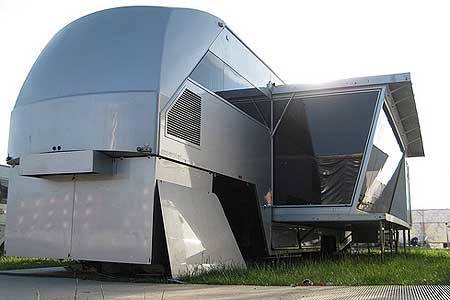
Once we get to Glastonbury around 4pm we have to jump through some red tape hoops to get our vehicle pass, our site pass and our BBC compound pass, but thankfully when we get to the compound all the kit has been unloaded into our truck... the Titan!
Our office for the week... the Titan
This is my favourite part of an event, arriving at what is basically a field, placing a truck in it, and then bringing it to life and giving it a brain. The brain's life blood is electrical power, data, audio and video.
My stop-frame video of us setting up inside the Titan
Our main task in the truck is split into three areas.
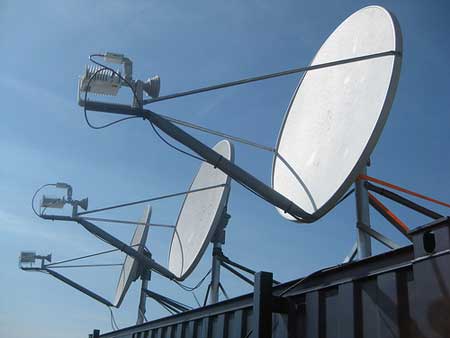
Generate four live streams via satellite, made up of 6 Music studio, stage feeds and two panoramic webcams
Manage and upload all the video content for on-demand use.
Set up a large number of computers on a network where assets such as photos text and code can be accessed, shared and uploaded to update and maintain a dynamic website.
Well we have put all the various flight cases, racks and cables where they need to go, tomorrow the serious task of getting all our feeds from many of the other trucks onsite delivering broadcast quality audio and video.
Day 2 - Tuesday
So, day two and we are busy running feeds to and from the 6 Music studio. To give some details, we will have five camera feeds, three permanently in the studio giving us a view of the presenters and their guests, a roving camera to bring us compelling interviews from site, and there is a fifth camera that will be in the studio or lurking outside. And, of course, audio because that's what radio stations do.
Inside 6 Music's temporary studio at Glastonbury
So here we are with reels of cables working out how to get them the 100 metres or so from the studio to our truck ...Titan. It's not that long a run, but there is a ditch/stream in between which only adds to the fun.
The satellite engineers have been onsite and have put up our three satellites. They are not connected yet, but the work is going to plan. In the meantime we have got the DSL lines running, which we aim to use for low level traffic, like email, Twitter and web chat (and that's what I am using to get this blog out to you all).
Day 3 - Wednesday
Our link to the outside world
Right today is the day we start to get some flesh on the bones. We have started networking the computers together and all the content that is produced on these goes to a Network Attached Storage (NAS) area. I let Toby and Alan get on with that while I concentrate on the streaming area, which we have set up in the Titan cockpit.
A couple of hours later we have most of the above in place and Alan is now busy configuring the routers for the satellites. Toby is now giving me a hand with the streaming kit: eight encoders for the four streams and four thumbnails, eight DV clamshells to bridge the analogue audio and video for the digital firewire inputs on the encoders, and a balance box to convert the balanced audio to unbalanced.
We also have to get some quad splits to screens to monitor the streams, and send a feed of the quad vision mix back to the 6 Music studio, so the presenters can see what is happening and talk about it on air.
I have mentioned three of the live streams. Well, the fourth will be a stream of live coverage from any one of four Glastonbury stages. That's the next task...
Terry O'Leary is a Senior AV Producer at BBC Audio & Music Interactive and took all of the photos in this post.
Follow @BBCGlasto on Twitter for news, retweets and links from the festival.
We'll be scanning Twitter for use of the #BBCGlasto hashtag and publishing some of the tweets we find so use the hashtag when you're tweeting about the BBC's Glastonbury coverage.
Paul Rodgers|12:15 UK time, Wednesday, 23 June 2010
I saw a survey commissioned by the Performing Rights Society recently that said that a weekend at the Glastonbury Festival was one of the top five special ways people liked to spend a big weekend. (Glastonbury was second in the survey, less popular than a weekend on a tropical beach but ahead of a London shopping spree, a gourmet meal, or a trip to Wembley for the FA Cup Final.)
This expression of public fondness for the Festival doesn't surprise me - Glastonbury is the perfect way to lose yourself in the best music from the UK and around the world. The Festival is 40 years old this year, and has hosted hundreds of thousands of Glasto-goers in the fields around Worthy Farm in Somerset.
The BBC has certainly helped bring Glastonbury to a wider public since the relationship with the Festival beginning in the muddy year of 1997 (see Mark Cooper's blog post about our TV coverage).
BBC Radio has also done its bit to bring the Festival experience from the fields of Worthy into the country's kitchens. Each year new innovations in radio coverage are sought.
This year we're coming back bigger and better (42 hours of live radio, overall 83 hours of Glasto coverage over the weekend if you include the excellent overnight programmes). Have a look here for the full schedule.
The 18 dedicated and very hard-working production staff will deliver a plethora of entertainment to delight your discerning radio ears. Highlights include live sets from the headliners, Cerys Matthews and the London Gospel Choir, Steve Lamacq's big interviews (fingers crossed) with the likes of Gorillaz, Muse, The Flaming Lips, La Roux and Florence, Tom Ravenscroft's excavations into the Glastonbury underground, and Lauren Laverne's shows which will boast a Festival Diary from Foals, an appearance by Slash, as well as hours of other good stuff.
Last year was the first in which the BBC extended live rolling coverage from the site. For 39 hours, 6 Music's team of Glastonbury veterans (some more or less grizzled than others) such as Steve Lamacq, Adam & Joe, Lauren Laverne,Gideon Coe and Cerys Matthews explored all the facets of the Festival. Interviews with star turns like Spinal Tap, Tom Jones, the boys from Blur were juxtaposed with exclusive sessions from the likes of Florence & the Machine and most important of all the airwaves were full of live music highlights harvested from across the festival's main stages.
6 Music, with its mission to explore and bring context to popular music is well suited to covering an event as broad and as deep as Glastonbury. But even with the station's wealth of trusted guide presenters and Glastonbury experience things can go a bit awry.
I'm really proud of what we achieved last year. Sustaining that level of live radio takes a lot of energy and hard work. I've never been on an outside broadcast like it and believe me, it was stressful and tiring but the response from the listeners was amazing and kept us going. As you can imagine, producing live radio can be fraught with problems. Guests going missing, CD players not working, and when your exclusive interview with one of the Festival headliners falls off air, not once but TWICE, the nerves are on a knife edge...
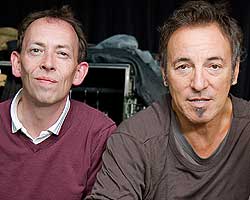
Last year Steve Lamacq landed an exclusive interview with Bruce Springsteen. It was the only broadcast interview Bruce did before the Festival. To set the scene for his monumental live set the next day we attempted to play out the recording. However, just as we pushed the button we lost all our power. The generator had packed up temporarily! Understandably, Steve wasn't best pleased but we restored the power quickly and promised to play the interview in full the next day, mixed with highlights from Bruce's set.
Unfortunately, the power failed again the next day. Two outs over the entire long weekend, and both of them during Springsteen interview leaving us Dancing In The Dark. Again quite a stressful situation but Lamacq's line after the second failure was a gem that brought a wry smile to everyone's face. After apologising for the technical difficulty he tried to explain the problem by saying that Tom Jones had vacated the Pyramid Stage after playing a stunning set, much of it televised.
The power failure, Lamacq surmised, was down to "a surge caused by two million electric kettles being switched on at the same time." Hopefully, we can keep the power going this year, if not I'll be on a bicycle round the back of the studio trying to generate it myself...
And what am I looking forward to? The return of Adam & Joe will be a tonic for the troops. I think they're bringing their own inflatable Big British Castle with them.
Also, the inimitable Jarvis Cocker. I'm so pleased we managed to coax him down to Glastonbury to do a live show from site (Sunday 6.00-8.00pm). Surely the 40th Glasto wouldn't be the same without him. I wonder if we can get him sing Common People for us?!
With all that plus a sprinkling of Funk & Soul from Craig Charles, new band delights from Tom Robinson's Introducing Show and Gideon Coe's expert opinion on proceedings I think music lovers and festival aficionados will be regally and digitally entertained this Glastonbury on BBC 6 Music.
Follow @BBCGlasto on Twitter for news, retweets and links from the festival.
We'll be scanning Twitter for use of the #BBCGlasto hashtag and publishing some of the tweets we find so use the hashtag when you're tweeting about the BBC's Glastonbury coverage.
It's about this time of year that anyone who works for the BBC starts getting a little obsessed with the weather. Or tries to feign indifference and adopt a 'Que sera sera' fatalism that's frankly hard to sustain.
The first year I went with the BBC to Glastonbury in 1997, it rained and rained and rained. There weren't many of us then, producing just seven or eight hours on BBC Two, and the site was awash with water and rumours and then mud. The Other Stage nearly sank.
We managed to go to Radiohead live who went straight into Paranoid Android at 11.30 on the Saturday night. Such triumphant memories are balanced by the recurring nightmare of walking mile upon mile through mud that became ever gloopier. It pulled like quicksand upon my wellies as I trudged endlessly around the BBC production area.
In 1998 it rained again. Possibly harder. Since then we have, of course, enjoyed some sunshine but also a major flash flood in 2005, 60 mph winds and last year, lightning. My production philosophy of Glastonbury is to make sure that every position from which we broadcast is 'defendable' against the elements so that it cannot be flooded or borne away. Of course this is only what the festival goers are going through but we are working and we have to stay on air. That's why we're there.
In the meantime our TV coverage of Glastonbury has grown with the BBC into a glorious multi-platform thing, filming across four or five stages with small teams roaming the farm to report on all manner of cultural activity as we supply a variety of acts and programming to BBC Two, Three and Four plus the video for red button and online. There's something like 32 hours of TV across the weekend and well over 100 hours on red button.
We bring artists to perform acoustically in our presentation garden behind the Pyramid to try and cover some of the acts who are on stages we aren't filming. And then of course there will be some late-night cabaret, usually of a grotesque variety to keep our presenters awake and on their toes. Last year the world's strongest woman lifted Zane Lowe and Mark Radcliffe aloft on a pole...
And yet there is so much we cannot show. Stages we cannot get to and to which our budget doesn't stretch. The 'on demand' generation now expect to be able to see everything all the time whereas some of the artists and bands, particularly the old-school American big names, are wary of live TV and of giving too much away.
We love the sense of live event that comes from broadcasting Gorillaz or Muse live to air but we can't always broadcast whole sets live and are often restricted in how much we can show for contractual reasons. Yet there is no doubt in my mind that the BBC at Glastonbury brings the licence payer the most extensive live coverage of any live music event anywhere in the world... this year, last year or ever!
The range and diversity and richness of the Glastonbury festival is extraordinary and that's just the punters, let alone the music. We can't wait to get back to Worthy Farm and whether it's wellies or sandals in this 40th year, we will be proud to be there again. Here's to the next 40!
Mark Cooper is executive producer of the BBC's Glastonbury TV coverage
Follow @BBCGlasto on Twitter for news, retweets and links from the festival.
We'll be scanning Twitter for use of the #BBCGlasto hashtag and publishing some of the tweets we find so use the hashtag when you're tweeting about the BBC's Glastonbury coverage.
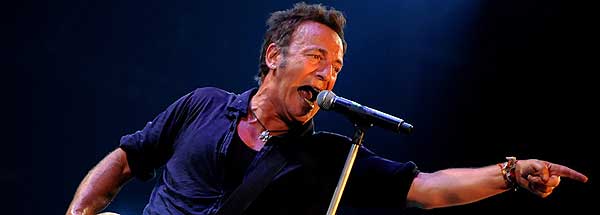
The picture of Bruce at last year's festival was taken by Steve Barney, one of our regular festival photographers.
Sun is shining, the weather is sweet, yeah, makes you wanna move... Not necessarily to late-90s Brit-winner Finley Quaye, but certainly along with some splendid records released last month. Here's a dozen fine picks from May's new albums crop.
"A statement of consolidation, a neatly segued set that finds Deftones playing to their well-established strengths. It won't blow experienced minds, yet still knocks every pretender to the band's throne into the middle of next week."
"Constantly mutating just when you begin to pin it down, drawing everything around in before rearranging atoms before your very eyes, Cosmogramma proves itself time and time again as mind-meltingly boundless as a black hole."
"For all their occasionally high-falutin' talk of Arthur Russell and Fela Kuti and the Wu-Tang Clan as influences, Foals' victory here is to loosen up and enjoy the moment. After all, the future can be a self-defeating business."
"Live with High Violet, The National's fifth album, for a while and it rewards patience with songs that colour one's waking existence, becoming vivid night-time narratives when curtains are drawn. After a gradual rise to recognition, the Brooklyn-based band has now delivered a potential album of the year."
Gayngs - Relayted
(Jagjaguwar, released 17 May)
Recommended by Rob da Bank
"If you like textured, atmospheric and extremely druggy songs, where discordant saxophones glide soporifically through a pink-purple glow of narcotic keyboards, vocals flapping lazily overhead like stoned alien birds... then you are in for a treat."
"This is surprisingly taut - nine tracks, most around four minutes long - incredibly disciplined for an RnB artist, unheard of for a dance act. And it only improves with further listens, the rich layering revealing itself and the hooks bedding in. It's a sensual and exhilarating album."
Nas and Damian Marley - Distant Relatives
(Universal, released 17 May)
Recommended by MistaJam, Tim Westwood
"The fierce integrity exhibited by both could have led to a clashing of egos - but Distant Relatives is the result of a harmonious union, as if these performers had been recording together for several albums. It succeeds where previous "Artist A feat. Artist B" efforts have not."
"A gauzy tendency dominates this second album, and by going light on oppressive darkness, Crystal Castles have allowed their obvious skill for writing dramatic pop with weird inflections twinkle through, helped along by more than just blazing anger."
"There's a bewitching, precocious charm about Conor O'Brien's debut album as Villagers. Having served his indie rock apprenticeship with The Immediate, the Dubliner's solo offering is a different beast altogether and exudes an aura of maturity that belies his tender age."
Rolo Tomassi - Cosmology
(Hassle, released 24 May)
Recommended by Huw Stephens
"By the time Cosmology comes to a close it's like the Sheffield quintet has morphed into a completely different band. Compare its closer to the brutal, eardrum-battering attack music that makes up the rest of the record and you wouldn't believe it could be done."
"Opener Sometimes I Don't Need to Believe in Anything is fabulous, the guitar thrum and crisp beat creating a sort of organic motorik pulse, before the heavens open and the chorus breaks through like sunshine after the rain. It is as great a track as any TFC have ever recorded."
"Rousing, noisy rambunctious funk, and its passion is matched by the skill and subtlety of the arrangement - KFG understand perfectly that the best funk sounds so spontaneous because it's been meticulously put together."
It must have been back in mid December 2009 that I started prepping up the first week of music for our new breakfast show, which launched on Monday January 11 2010.
Way before that Chris Evans and Helen Thomas, his producer, had been clear that every Monday they would be kicking the week off with two iconic Beatles tracks and they'd bring along the Gobsmackers daily from drive. Apart from that though, and with a few musical features in development, it was a blank canvas.
I had developed a strong plot for Terry Wogan's breakfast show and had worked with his producer Alan Boyd on a timeless and melodic mix of music that was still relevant for a multi-generational, yet modern Radio 2 audience, featuring classic artists such as Nat King Cole and Elvis Presley to newer voices such as Pixie Lott and Paloma Faith. I sensed, with a slight modification to allow for Chris' style, that this approach would also work for the new show.
Chris wanted big strong familiar songs, the musical hallmark of a great breakfast show and since Radio 2 is free to choose from over 60 years of popular music with the broadest range of styles and genres, that proved no problem.
Radio 2 listeners like their music to be relevant so you'll hear some of the best musical hits of the day too and quite a few records that you won't hear anywhere else; we really try to dig a bit deeper into an artist's repertoire. For instance you won't just hear I Only Want To Be With You by Dusty Springfield or Viva La Vida by Coldplay, you are equally likely to hear In The Middle of Nowhere or Don't Panic.
Chris, like Terry, loves brilliant music from all genres. For instance, after he attended the Radio 2 Folk Awards, he was so genuinely enthused by what he saw, he replayed two live tracks from the event into the next morning's show and pointed the audience towards the Mike Harding show later that evening. Chris now also plays a weekly record choice by David Jacobs, ensuring his millions of listeners are introduced to the magical gems played every week on David's Sunday night show.
From Helen's point of view, she tells me that she thinks it's been a really positive experience to work so closely together with the Head of Music and our talented music manager Michael Banbrook. An advantage of that relationship is the understanding of any network-wide concerns that the Breakfast show may help to address such as first plays of records or throwing support behind a new artist that Radio 2 is backing. For instance Chris and Helen both love new independently signed UK artist Rox who the station has supported since she first appeared in Radio 2 Recommends at the end of last year.
Of course the music plot has evolved as the show has bedded in, but Helen and I still meet regularly to review how things are going and that we're not straying too far from our original vision! One fantastic addition has been 'Moira's Golden Oldie', which she introduces just after the 730 news. The audience flood the show every day with suggestions from Bobby Vee to Vera Lynn, and it's good to know that we are introducing new 'old' tracks to some listeners, and entertaining other listeners with music that they have loved for many years.
We all feel very fortunate to be soundtracking so many people's morning routines and the team love nothing more than getting texts telling Chris about "jiving around so much to Glenn Miller in the shower' or 'The kids refusing to leave the house until you'd played The Candy Man this morning'.
So, we've kept it going the way it started, strong Radio 2 signature songs in key points in the show, plenty of pace and familiarity and enough surprises and distinctiveness to separate us musically from anything else on the radio at that time. After the recent phenomenal RAJAR figures, we're all pleased that people seem to like it!
Jeff Smith is the Head of Music for Radio 2 and 6 Music
Welcome to a new feature on the BBC Music Blog: short Q&A interviews with artists who've entertained the BBC Album Reviews team with truly special releases over the past few weeks.
We begin what will become a series by focusing on two bands that have decorated May's schedules with long-players of very different, but very brilliant design: Gayngs and Rolo Tomassi. The former love 10cc, the latter shriek kids into a merry sweat. Both are ace, so read on and be sure to listen later.
Inspired by a variety of soft-rock staples, most notably 10cc's über-anthem I'm Not In Love, Gayngs aren't the most likely of buzz acts on paper. But the US collective, led by Ryan Olson and featuring the likes of Bon Iver's Justin Vernon and members of Solid Gold and Megafaun, have delivered one of the most critically celebrated albums of 2010 to date, Relayted. Olson answers our Album Reviews Q&A.
Given the inspiration for the Gayngs project - perhaps the greatest soft-rock ballad of a generation - how does it feel now you're the other side of the process, with the album out, basking in the glow of a slew of superb reviews? Unexpected?
This whole thing is quite insane. Yeah, the fact that anybody besides me and my friends get to hear this band is crazy to me. It turns out I love England and it's nice to see that people are still taking time to hear an entire album. The most far-fetched thought about Gayngs for me, initially, was the idea of playing the songs live, and that's happened. It turns out that getting to play a bunch of songs with my friends, songs that are a bit sideways for us, is endlessly entertaining.
How easily did the 25-person-plus 'cast', if you will, for the album come together? The core was the three, right - Zack Coulter and Adam Hurlburt from Solid Gold, and you? Was it a word of mouth thing, where you'd receive a call or email out of the blue?
The initial crew came together right away: Zack and I got together one night and laid down The Gaudy Side of Town. The next day I called [Megafaun's] Phil Cook and started to plan a session at [Justin] Vernon's place. Adam, Zack and I worked on tracks once a week or so for a few months, I had [jazz saxophonist] Michael Lewis come over, then we met up with Megafaun at [Wisconsin studio] April Base. [The Rosebuds'] Ivan Howard killed it. Justin wanted to mix it. Editing and tracking folks in Minneapolis, wait for Vernon, mixing in Fall Creek. That's how that went down.
As Gayngs seems to have been conceived largely as a studio affair, just what should fans expect from the live experience? I see US dates are booked in for the autumn - can we expect to see you in the UK soon?
It'll be a 10-piece band, and songs will be reworked. We have a pretty solid set up; it's going to be fun as hell. I think England should happen, but I'm not sure how these things are going down.
Have you received any 'seals of approval' from artist who may have been influential in the concept of Relayted? Obviously Kevin Godley appears in the Cry video - what was it like to have him involved?
That was so cool of him. He has no idea how much that Cry video blew my third-grade mind, it was so sweet to have him be down. Also Prince showing up to our show at First Avenue in Minnesota - the dude was being entertained, for real. That is too big of a seal to deal with.
The video to Cry is a tribute to the Godley & Creme original - can we expect any more videos in this nodding-to-the-past vein?
I'd like to do No Sweat with the original actors from Oran "Juice" Jones' The Rain.
Lastly, do you have any favourite albums of 2010 so far? Caribou's Swim; NR:4;3.1-3 by Moonstone Continuum; Sade's Soldier of Love; and the self-titled record by Slapping Purses.
Sheffield-born synth-punks Rolo Tomassi released their praised debut album, the aptly titled Hysterics, back in 2008, while some members were still in their teenage years. But the Diplo-produced Cosmology sees the five-piece taking their sci-fi screamo into new territories via excursions into immersive prog and explorative passages that suggest they're closer aligned to the likes of The Mars Volta than any straight-up metal act. Keyboard player and co-vocalist James Spence, brother of lead singer Eva, answers our Album Reviews Q&A.
Cosmology was recorded in the States, with a big name producer on board and a bigger budget behind it, compared to your debut. Was this step up ever daunting, before the process started? Did you have that realisation of: "Wow, we're a 'proper' band"?
I think that once we were in a plane heading towards Los Angeles the realisation of what was actually going on set it. Prior to that we'd been so focused on just getting the writing for the record finished that we hadn't actually had the chance to take a step back and see just how crazy the whole situation was. I think we all found it more exciting than daunting once we'd had time to think about it.
The album sees you exploring more adventurous arrangements than ever before - have you found that you've developed significantly as musicians within this band, given how young you were when it started? I take it the 'prog' tag doesn't scare you at all?
Absolutely. I've been playing the piano since I was nine but the last five years of playing keyboards in this band have definitely challenged me and made me a better musician for it. After touring Hysterics for almost two years, as a unit we were a lot tighter and more in tune than ever when it came to playing together and writing the new record, which made us more confident when it came to exploring new arrangements. The 'prog' tag is something we openly put on ourselves, so we're not scared of it at all!
Do you think that being in this band since a young age has made you grow up faster, or has it sheltered you somewhat from the realities of the everyday?
I think it's a bit of both. Speaking for myself, especially in the earlier days of our band I dealt with the majority of the organisation for tours - we have a tour manager now who does a fantastic job in taking care of everything. When I was running things, it meant being in regular contact with older and vastly more experienced people and learning a lot from them, subsequently having to be a lot more mature than I probably was at the time. With regards to being sheltered from realities of everyday, I work a full-time job when we're not touring so I can afford to live away from my parents, pay bills etc. I'm very fortunate to have incredibly sympathetic employers who have been happy to let me go on tour and this is certainly a unique situation and still pretty far removed from reality!
Would it be fair to say that your own music tastes have probably developed considerably while in the band, which has had an effect on the band's sound?
Being on tour, with other people from different bands who have varying tastes in music, has opened me up to so much new music, especially considering the variety of different bands we've toured with. Obviously the first common ground that any two bands have is a love of music, so it's probably the one thing that is brought up most in day-to-day conversations of tours and can really enrich tastes. Aside from that, more and more people that like our band will have their own points of reference as to what and who they think we sound like, which often makes for interesting listening. It all has some impact on what our new material eventually sounds like.
To these ears, the Rolo experience live is a little different to that on record - not that the latter lacks the energy of the former, more that it's directed a little differently. Are you a band that sets out to explore all the possibilities of the studio? Do you ever write without really considering how the resultant song can be performed live?
In the past, we were keen to make sure we could replicate everything we did in the studio when we played lived, but with Cosmology I think there's more room for improvisation and expansion between what we recorded and what we play live. It came up whilst we were recording and Diplo's opinion of it was that we should do everything we could to make the recording sound big and interesting. Even if we couldn't do it live, because of the physical live energy of our band it wasn't an issue that something like a layer of pad synths couldn't be played live. We all still have an eye on playing the song live when it comes to writing, though.
The BBC review of Cosmology mentioned that the current rock scene is in pretty rude health - you've recently toured with Throats and Trash Talk. Are there any bands around right now who you think might soon experience the kind of rise you've enjoyed over the past few years? How crazy has it been to meet bands that inspired you?
I think the rock/hardcore scene is enjoying a really productive period right now, and the amount of great bands is ridiculous in the best way possible. I'd say that Trash Talk are going to do nothing but rise, considering the response they got on our tour together and the press response to their band. They're honest and true to the majority of things that get written about them and, most importantly, an unreal live band. I don't think we've ever toured with a band as consistently good as they are night after night. It's been surreal getting to meet bands that we've been inspired by. With Trash Talk again as an example, I was told to check them out before last year's South by Southwest. I was blown away, we then see them live, get to hang out with them and then go on tour with them. It's the kind of situation I've always dreamed of in terms of being able to make things like that happen so easily.
Lastly, do you have any favourite albums of 2010 so far?
My favourite album of the year is Heartland by Owen Pallett. I've also really enjoyed the new Daughters, Jaga Jazzist, Trash Talk and Fang Island albums. It's exciting that we're only halfway through the year and, for me, this year has already surpassed 2009 in terms of releases that I've enjoyed.

 |06:47 UK time, Saturday, 26 June 2010