John Leonard|16:39 UK time, Friday, 26 February 2010
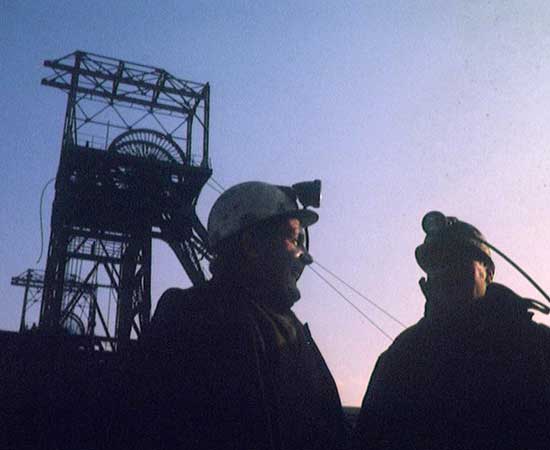
I grew up in South Yorkshire with the pithead of Cadeby Colliery, one of the biggest pits in Britain framed in our kitchen window. So when we were commissioned by Radio 2 to make a Radio Ballad on the Miner's Strike of 1984-85 I was a bit daunted. Most of the people in our street worked at the pit, apart from my father, he worked in a foundry making castings and machine parts to be used at the pit. So in a way my early years were financed by pit money.
In 2006 we made six Ballads for Radio 2 based on the ground-breaking work of Charles Parker, Ewan McCall and Peggy Seeger, during the 1950s. Our efforts had been well received in the main, we won two Sony awards and were relatively pleased with our work and felt we'd stayed reasonably true to the original concept of a Radio Ballad. But when it came to the Ballad of The Miner's Strike I found it incredibly difficult to start the programme.
Vince Hunt had come back with some fantastic interviews, full of passion, poetry, honesty and anger. But I found it impossible to select material in a way that I felt did justice to people I'd grown up with, lived amongst and then watched on the sidelines as their way of life was totally destroyed during the 80s. I needed other thoughts and ideas.
I sent some of the interviews to songwriters Julie Matthews and Jez Lowe and within a week they had come back with three wonderful songs, Jez had Judas Bus and Arthur My Dear and Julie had written Beyond The Picket Line, a moving song about the role of women during the strike. These three songs pointed the way for me and we had our first chapters.
I then went to spend a day with John Tams and after about eight hours we had pretty much decided on a shape, the chapters and the fact that we needed at least six more songs. I left John to come up with them and with help from Ray Hearne and a moving piece of work from Kay Sutcliffe, Coal Not Dole, the songs began to arrive.
The Radio Ballads are a true teamwork. Many people have their hands on the tiller and help to determine the direction the programme will take. I thank all the musicians and songwriters, Andy Seward the music producer, Annie Grundy our editor, Vince Hunt our reporter and most importantly, musical director John Tams.
John Leonard is Exec Producer of Smooth Operations who produced the Ballad of the Miners' Strike for BBC Radio 2.
To hear all the stories and views, listen to the programme on Tuesday 2 March 2010 at 8.30pm on BBC Radio 2.
Everything starts with the "life-tellers" - without them there is nothing, whatever the subject - they are the vital source, the inspiration - the true heroes and heroines of the work. Their stories are then cradled in song by a team of songmakers each given specific "chapters" to support, advance and generally deal with.
The privilege the "life-tellers" grant the songmakers is onerous. They must tread very lightly on the lives they are given such unique access to, attempting all the time to thread a fabric in melody and lyric that gives their "chapter" honour, dignity and the truth of their source material.
The Ballad of the Miners Strike
For me and indeed all my colleagues, without exception, this was a serious challenge that threatened all we thought we'd learned by doing the 2006 Radio Ballads series. Although we'd won a brace of Sony Academy Awards this was quite another issue and we needed to re-invent our own rulebook. Of all the programmes we've made together and it was good to see the team reunited, we were now dealing with issues so monumental that the changes they wrought affected the whole of the political and social landscape of the country.
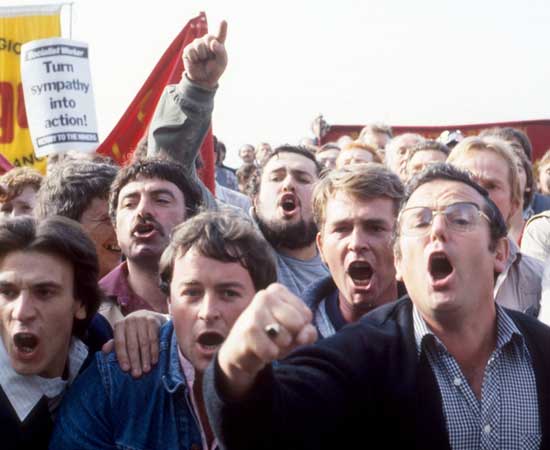
Striking miners, 1984
I'm a former journalist and the one thing that disturbed me most then was to make an obituary for a friend. Now as a songmaker I have to write an obituary for an industry that had been a friend - part of the family - a way of life. I witnessed the strike and continue to witness its fall-out - the disintegration of community and all that means, asking all the while if disintegration was in fact a concerted effort to dismantle. The dissolution of coal remains an open wound in former pit villages.
There are those who don't want to talk about it, let it lie, almost like a war - some say it was the last civil war - and there are those who live the strike everyday of their lives.
Well over 40 hours of "life-tellings" needed to be reviewed and distilled to approximately 40 minutes giving space for the songs to bring in the programme at 59 minutes. Hunter gatherer Vince Hunt took responsibility for many of the interviews, folded into "chapters" by Annie Grundy, both under the direction of Executive Producer John Leonard who edited, shaped, integrated the music and song and after many weeks in watchmaker's detail fashioned the final cut. The team of songmakers working alongside Music Producer Andy Seward were Julie Matthews, Jez Lowe, Ray Hearne and myself, with Kay Sutcliffe's magnificent "Coal Not Dole" written at the time of the strike bringing the ballad to a close.
Nigel Smith|12:10 UK time, Monday, 22 February 2010
A bottle drifts across dark, smoky water towards you. Inside are neon-lit letters spelling 'Arena'. Over the top plays Brian Eno's evocative piece of music Another Green World.
That Arena has recently profiled the composer of its famous signature tune seemed like the perfect excuse to make this short film about the much-loved opening sequence that's remained unchanged for more than 30 years.
A Short Film About Bottles
Anthony Wall, series editor of Arena since 1985, was the obvious first person to talk to. For starters, the original Arena bottle is perched high on a bookshelf in his office. It reappeared a few years ago after someone found it in a clear-out of old BBC prop cupboards.
The Arena team are habitual archivists. As well as the bottle they showed us a bulging file full of decades-old letters that viewers had written enquiring about the memorable theme tune. We were also able to use a selection of the alternative title sequences Arena has made over the years which placed the bottle in surprising situations (a supermarket, on the moon) or reversioned Eno's music in a completely different style.
My colleague Pete Marsh has done a lovely job editing the piece and used these gems from the archive to great effect. Sadly we couldn't squeeze them all in. The most bizarre was the title sequence for Arena's Animal Night from 1989 which saw puppets by Spitting Image creators Luck & Flaw on board a very suspicious-looking Ark.
For a perspective on how credit sequences have changed over decades and what makes Arena's so enduring we met Richard Norley, the Creative Director of Jump Design and Direction. His company have made opening titles for such hits as the X Factor and Hell's Kitchen.
You only have to read the comments on YouTube to see how much people love Arena's bottle and Eno's wonderful tune. Let us know what you think about our little tribute.
Mike Diver|10:45 UK time, Thursday, 4 February 2010
This time last year, many a critic's year-end number one LP was in stores. Animal Collective's Merriweather Post Pavilion overturned the odds stacked against it by being a January release that actually mattered several months later. That it was Really Very Good helped, obviously, but it's rare indeed when a release from the first month of the year maintains its support for the duration. Attentions simply weren't going anywhere else.
But could lightning strike twice, and for the same label? With a plethora of phenomenal reviews, These New Puritans' Hidden is already being pencilled into the best-of-2010 equation. An arresting amalgam of direct rock, art pop and classical influences, it's a mesmerising affair that's rightly receiving the acclaim it deserves. Domino certainly knows how to pick them - they're handling Hidden worldwide, with Angular doing the business domestically.
January saw several more brilliant releases. There's not room for all of them here, but hopefully the below serves as a cross-section that ably represents just how much talent is out there, ready for your investment of both time and pennies (artists need to pay bills, too). From Laura Veirs' lauded folk-rock, to Four Tet's delicious dancefloor artistry, via Beach House's sublime shoegazing and the sunny Afro-beat of Fool's Gold, it's been a great month.
- - -
These New Puritans - Hidden
(Angular/Domino, released 18 January)
Recommended by Marc Riley
"Their second album arrives, and impressively it turns out that vocalist Jack Barnett's blue-sky dreaming is actually a pretty accurate description of Hidden - heavily beat-driven, almost entirely absent of guitars, and laced with large amounts of elaborately arranged woodwind and brass. The mood is pagan, hallucinogenic, severe."
"Teen Dream almost entirely eschews the junkshop drum machine-meets-indie chanteuse fragility of the duo's eponymous 2006 debut and its even drowsier follow-up in favour of vigorous, hymnal pop essays that gleam like polished chrome. The most unmistakeable sound here is that of a band truly finding its own voice. In so doing, they may just have minted the new decade's first essential album."
Fool's Gold - Fool's Gold
(I Am Sound, released 25 January)
Recommended by Radcliffe & Maconie
"Fool's Gold stretch Western pop templates out into African shapes, and this debut album belies their name by being a genuine gem. From the sunny six-string licks that open Surprise Hotel through Nadine's joyous horns and Momentary Shelter's percussive swansong, they feel like a welcome breath of fresh air - even gusting from your car stereo in a suburban traffic jam."
Four Tet - There Is Love In You
(Domino, released 25 January)
Recommended by Gilles Peterson
"Hebden's tracks are aural mosaics, painstakingly compiled to work on several levels. The skipping two-step of Love Cry, for example, may appear relatively traditional; but take a closer listen and there are intricacies aplenty, including an underlying synth whirr that sounds oddly reminiscent of the noise Fred Flintstone's legs used to make when he carried the car to work."
"Named after a variety of peach, Veirs' seventh album is aptly named, its mood erring toward the ripe and summery, the stripped-back arrangements leaving plenty of spaces for her crystalline-as-mountain-air vocals to swoop and glide. It sounds like both an affirmation and a mission statement and encourages the happy thought that her best may still be to come."
"This fourth album sounds big - polished, even - and helpfully, that's a quality that suits them rather well. The Betrayed is not an underachieving record. It sweats hunger and ambition, and while it's not flawless, it's a success on their own, aggressively populist terms: 11 songs of big riffs and earworm choruses that reach over the moshpit to the stands beyond."
"Although it's played by machines, this music sounds strikingly human. There are heartbeats in the percussion, voices humming in the strings, and wordless songs from blown bottles. It's Metheny to the core. After all, he's composed, played and improvised every sound that you hear, and he's come close to his aim of making this album more than a curiosity."
"Prior to release, frontman Ezra Koenig told the press that Contra is about "retro gaming and Nicaraguan politics," and it may well be - his poetic lyrics can be hard to decipher. What we do know, however, is that this latest offering ushers in an entirely new age for Vampire Weekend: one of wisdom, grace, subtlety and for the first time a really strong sense of identity."
"There was some pressure on Delphic to deliver, and they have. From a palette of familiar reference points, they've created a fresh, vital sound that could prove to be the basis of an impressive career. Barney and Hooky will exchange knowing glances when they hear it, but Acolyte might just be the first great album of 2010."
"The end results here are as unsettling as they are uplifting. Although her last album sold half a million worldwide, Charlotte Gainsbourg remains very much a delicacy in the UK. The deeply moving and organic IRM deserves a wider audience, as it is one of 2010's first great examples of accomplished, adult pop."
Jeremy Marre|11:12 UK time, Tuesday, 2 February 2010
Latin Music USA is a coproduction with WGBH (the Boston PBS station) and although I was series producer for the BBC, the choice of which programme I directed was not solely down to me. So when I was asked to direct Salsa, it seemed at first like a case of déjà vu, since I'd once made a film on Salsa Music in New York. But the two experiences turned out to be very different. In 1979, I'd started a 14 part series called Beats Of The Heart and I arrived in New York at a time when many of the greats, like Tito Puente, Celia Cruz, Ray Barretto and Ruben Blades were still performing there and were happy to participate in a film that examined the social and political dynamics of Salsa music at that time.
Now, 30 years later, I was back. I met up with some old Salsa friends like Joe Conzo (a former pal of Tito Puente) and Felippe Luciano, formerly head of the Young Lords gang which had fought for young and 'disenfranchised' Latinos. But this new programme for Latin Music USA, needed a different theme, with more historic resonance, so we decided to trace the rise and fall of Fania Records, the company that created, promoted and - in the end - helped destroy Salsa. When I say 'Salsa', I'm not talking the retro stuff (some of it very good) we hear today, nor the slushy Salsa Romantica of the '80s, but Salsa 'Dura', Salsa with a statement to make about the lives of Latinos in New York and across Latin America.
It wasn't easy locating the Fania stars of the '70s. We started by finding the irrepressible Izzy Sanabria in suburban Florida. He was the man who helped give Salsa an image to match its sound: on record covers, street posters and magazines. We met up with bandleader Willie Colon in the Bronx and the two of them told the hilarious story of how they copied an FBI Wanted poster for an early Fania LP cover (La Gran Fuga) and how their neighbours thought the poster was for real and immediately claimed the reward from the FBI.
We met with legendary pianist Eddie Palmieri at his home in Queens and Eddie told of the days when his dynamic band 'La Perfecta' took young Latinos by storm. Though there wasn't time for his magnificent piano playing in this Salsa programme, our website does feature it, along with many other memorable excerpts of interviews and performances shot for this programme and the whole series; it's a website that really does complement the programmes.
It was a pleasure to drink Negra Modelo again with Felippe Luciano and to meet with dozens of other great musicians from the time. Then we travelled to the island of Puerto Rico and filmed with the gracious singer Cheo Feliciano, another essential ingredient of the Fania Records sound and - most memorably - to Cuba where, aided and abetted by the wonderful William Rakip (a nuclear physicist whose dad helped Al Capone smuggle rum into the States to beat prohibition) we filmed the story of pianist Larry Harlow, 'El Judio Maravilloso'. Larry toured Cuba as a student, exploring the roots of Salsa and the legacy of Arsenio Rodriguez, the blind musician who, in many ways, 'invented' Salsa music. (Incidentally, it was exciting to see Larry back in top form at the Barbican show that BBC4 televised last Friday, still playing Arsenio's music).
There were so many elements that went into making the original Fania sound', such a mix of musical styles and personalities, so many ups and downs, triumphs and tragedies, but ultimately it's the story of an extraordinary and inventive family of musicians. Near the end of our New York trip we met up with one of the founders of Fania, Johnny Pacheco, now frail and in his 70s, who completed the story of how he and Italian American Jerry Masucci created the label that was Salsa. But perhaps the most curious moment of the trip followed our filmed re-creation of Pacheco's trips around New York in his old Mercedes. It was snowing heavily, we were cold and exhausted, when, late in the day, I met up with Joe Conzo (Tito's man, whose wedding I had once filmed). We sat on the same seats in the same bar in Spanish Harlem and Joe began: "I'm so glad you came back, Jeremy. I never finished what I was saying last time .." and he picked up exactly where he's left off 30 years earlier, talking about joys of dancing to Salsa music.
Episode 2 Trailer
Jeremy Marre is the series producer of Latin Music USA for the BBC and also directed Episode 2 of the programme, Salsa, which screens Friday 5 February at 9pm on BBC Four.