
BBC Music Blog
  1. BBC Music
  2. Blog Home

Archives for May 2009

Performing To The Red Light

Blog comments are currently unavailable. Find out more.

Post categories:

Emma KingsleyEmma Kingsley|11:27 UK time, Friday, 29 May 2009

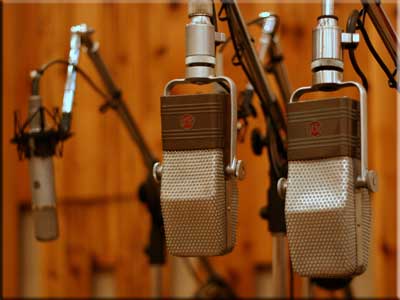
The antics of pop musicians in the recording studio are the stuff of legend. There are articles and books based around studio experiences - who stormed out, who came to blows or how long it took to put down one bar of a song. Maybe we hear so much about pop musicians because the studio is often a place where they come to compose and experiment.
mics.jpg

But classical solo artists don't usually use the studio for this. For them, recording is a process of reproducing music which is already composed and, in many cases, has been recorded hundreds of times before. This puts huge pressures on them - and very few people who listen to the end result on CD will have had a clue about what it took to make it.

I'd not really been aware of the demands that recording makes on classical musicians until Terence Curran got in touch with me last year. He's studied how they cope in a studio situation and his initial findings were fascinating. People he'd spoken to talked of the need for stamina because they might have to do 10 takes of the same difficult octave passage. Some felt a loss of control because they had to take instructions from a producer and some couldn't get used to being without a live audience.

Both Terence and I felt that the subject would be a fascinating one to explore in more depth and we were thrilled when Radio 4 commissioned two documentaries. We drew on Terence's original research and widened it, talking to a range of performers and producers.

It was also crucial for us to get to an actual session, to see at first hand how performers cope in a studio environment. We were allowed in to record the pianist Kathryn Stott and cellist Christian Poltera, who were working on sonatas by Saint-Saëns. We were also able to tape the Takács Quartet as they recorded some Schumann. To watch players of this calibre doing retake after retake to get a phrase just right was an inspiring experience.

We also recorded a newcomer to the recording process - the soprano Ilona Domnich, who was making her first CD with a varied programme of songs and who learned quickly to get used to hearing herself back in the control room.

There were so many new questions that kept arising. How much of a performer's breath does the producer leave in? What happens when soloists play chamber music and each prefers a different take? What happens when it's the last hour of a session and a performer is having an off-moment. And do musicians listen to their own recordings?

If you want to find out the answers, then do tune into Performing to the Red Light on Radio 4 , on Tuesday 2 June and Tuesday 9 June 1.30pm.

If you've had experience in a recording studio yourself leave a comment and share your thoughts.

Note - Ilona Domnich's album Le Secret has now been released on the Quartz label. You can find out more at the Quartz Music website.

Spring Back A Generation

Blog comments are currently unavailable. Find out more.

Post categories:

Gideon CoeGideon Coe|14:15 UK time, Wednesday, 20 May 2009

Gideon Coe's Theme Time Radio Hours

As you may have noticed, the Spring brings with it a whole slew of bank holidays. By that I mean about three or four with some regional variations. That's a slew in anyone's book. Even though these are normal working days for me, they don't feel quite the same and for that reason we generally run themed specials on my 6 Music show.

bankholiday.jpg.

Of course the whole area of a themed music show is now largely the domain of the really-quite-talented Bob Dylan. His show is the best music show on radio anywhere at the moment so we endeavour to think of themes that he has yet to chance upon. Perhaps more accurately, we come up with ideas with a mere fraction of the wit and imagination that fire his shows.

So far we have themed shows to particular record labels (4AD and Rough Trade), we've presented three hours of music from Scottish artists and done the same for Ireland and Wales, taking care with the latter to pay due respects to a show which constantly champions Welsh music, namely Adam Walton on BBC Radio Wales.

To complete the tour of the British Isles we had an English night. It proved to be more of a challenge than the others as Englishness is arguably less defined and somewhat muddied. But a combination of The Specials, Roy Harper and Billy Bragg got the ball rolling. As with all our themes, ideas for who we think we should play are added to and punctuated by listener suggestions.

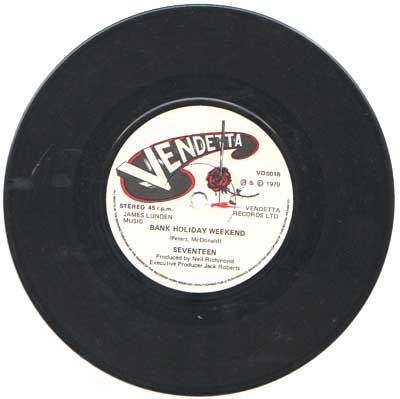
For the second Bank Holiday in May (you know the one, I forget what it's called, it's this weekend) we decided to focus on three years and dedicate an hour of concerts, sessions and records to each. The years are 1979, 1980 and 1981. These are pivotal years for me and each has an embarrassment of riches from which to choose.

As in all shows the idea is to get as much as a balance of styles and genres as possible, mixing those that were hits with those that got nowhere near Top of the Pops. So for 1979, do we go for M's Pop Musik, the Fall's Industrial Estate, Motorhead's Bomber or something from Boney M's Oceans of Fantasy? At the time of writing, it could be all of the above.

If you have suggestions of your own please leave a comment here or visit the message board for my programme.


Gideon Coe's show is on 6 Music Monday - Thursday from 9pm

Technorati Blog Claim

Blog comments are currently unavailable. Find out more.

Nigel SmithNigel Smith|10:29 UK time, Saturday, 16 May 2009

3xebsq4rwg

Technorati Blog Claim

Blog comments are currently unavailable. Find out more.

Nigel SmithNigel Smith|10:29 UK time, Saturday, 16 May 2009

3xebsq4rwg